TRITY ENVIRO
WATER WASTEWATER RECYCLING

STP and ETP Plant Manufacturer in Varanasi

Trity Environ Solutions manufactures STP and ETP plants for Varanasi's hotels, dharamshalas, and textile units. Engineered around the city's Namami Gange infrastructure and UPPCB norms. Get a free quote.

SPCB / CPCB Norm Compliant
Heavy Fabrication

STP and ETP Plant Manufacturer for Varanasi's Ghats and Growing City

Varanasi generates roughly 300 million litres of sewage a day, and under the Namami Gange programme, the city has built its treatment capacity up to around 420 MLD through plants at Dinapur (140 MLD, JICA-funded, biogas-powered), Goitha (120 MLD), Ramana (50 MLD, built under Hybrid Annuity Mode with performance-linked payments), Ramnagar (10 MLD), and Bhagwanpur (10 MLD). On paper, that's more capacity than the city needs. In practice, an NGT bench pulled up Varanasi's district magistrate in November 2024 over the state of the Assi and Varuna rivers and ordered public signboards warning that Ganga water isn't fit for bathing or drinking, and reporting from the ghats has documented sewage visibly flowing down the steps at Manikarnika, blocked sewers at Sheetla and Tripura Bhairavi, and STPs that reportedly stay shut during the four monsoon months when the river is in full spate, exactly when dilution matters most.

Trity Environ Solutions manufactures Sewage Treatment Plant (STP) and Effluent Treatment Plant (ETP) systems for Varanasi built around this gap between installed capacity and consistent performance. A hotel, dharamshala, or industrial unit here can't depend on municipal infrastructure alone, particularly during monsoon months, which is why we design every system to run reliably as a standalone plant year-round, not as a supplement to a network that scales back seasonally.

STP Plant Manufacturing for Varanasi's Hotels and Dharamshalas

Varanasi draws pilgrims and tourists to over 2,000 temples including Kashi Vishwanath, and the redeveloped Kashi Vishwanath corridor has pushed visitor numbers, and hotel and dharamshala construction, higher still. Our Sewage Treatment Plant systems are sized against actual peak pilgrimage-season occupancy, since major festivals and the Kartik Purnima period bring visitor surges that a plant sized for average daily footfall simply can't handle. A properly designed STP runs through three stages: preliminary treatment to remove physical solids, secondary treatment using biological processes such as MBBR to break down organic load, and tertiary treatment for disinfection before the water is reused or discharged.

For properties close to the ghats specifically, we design for zero-tolerance discharge quality, given how directly visible any failure becomes in a location under constant public and religious scrutiny.

ETP Plant Solutions for Varanasi's Textile and Industrial Sector

Varanasi's textile sector, centred on the city's famous Banarasi silk weaving and dyeing trade, generates wastewater carrying dyes, chemicals, and high organic load, alongside contributions from distilleries, leather processing, and food processing units across the wider district. Our Effluent Treatment Plant systems for textile and dyeing units are built around dedicated colour and COD removal stages, since standard biological treatment alone doesn't reliably strip synthetic dye compounds from wastewater.

Our ETPs run through physical treatment to remove suspended solids, chemical treatment using coagulation and flocculation for dye and dissolved contaminant removal, and biological treatment to reduce remaining organic load before discharge or reuse.

Turnkey Execution: Design to Commissioning

Our scope on Varanasi projects typically covers:

  • Site assessment and effluent or sewage characterisation
  • Process design suited to hospitality, textile, or general industrial load
  • Civil and structural coordination adapted to dense, older urban plots near the ghats
  • Equipment manufacturing at our own facility
  • Installation, piping, and electrical integration
  • Trial runs, commissioning, and UPPCB documentation support
  • Annual Maintenance Contracts (AMC) after commissioning

Given how compressed the space is around many ghat-adjacent properties, we plan equipment sizing and delivery access before finalising a design rather than assuming a standard footprint will fit.

Capacity Options We Manufacture

STP and ETP Plant Manufacturer for Varanasi's Ghats and Growing City

Varanasi generates roughly 300 million litres of sewage a day, and under the Namami Gange programme, the city has built its treatment capacity up to around 420 MLD through plants at Dinapur (140 MLD, JICA-funded, biogas-powered), Goitha (120 MLD), Ramana (50 MLD, built under Hybrid Annuity Mode with performance-linked payments), Ramnagar (10 MLD), and Bhagwanpur (10 MLD). On paper, that's more capacity than the city needs. In practice, an NGT bench pulled up Varanasi's district magistrate in November 2024 over the state of the Assi and Varuna rivers and ordered public signboards warning that Ganga water isn't fit for bathing or drinking, and reporting from the ghats has documented sewage visibly flowing down the steps at Manikarnika, blocked sewers at Sheetla and Tripura Bhairavi, and STPs that reportedly stay shut during the four monsoon months when the river is in full spate, exactly when dilution matters most.

Trity Environ Solutions manufactures Sewage Treatment Plant (STP) and Effluent Treatment Plant (ETP) systems for Varanasi built around this gap between installed capacity and consistent performance. A hotel, dharamshala, or industrial unit here can't depend on municipal infrastructure alone, particularly during monsoon months, which is why we design every system to run reliably as a standalone plant year-round, not as a supplement to a network that scales back seasonally.

STP Plant Manufacturing for Varanasi's Hotels and Dharamshalas

Varanasi draws pilgrims and tourists to over 2,000 temples including Kashi Vishwanath, and the redeveloped Kashi Vishwanath corridor has pushed visitor numbers, and hotel and dharamshala construction, higher still. As a leading STP Plant Manufacturer in Varanasi, our Sewage Treatment Plant (STP) systems are sized against actual peak pilgrimage-season occupancy, since major festivals and the Kartik Purnima period bring visitor surges that a plant sized for average daily footfall simply can't handle. A properly designed STP runs through three stages: preliminary treatment to remove physical solids, secondary treatment using biological processes such as MBBR to break down organic load, and tertiary treatment for disinfection before the water is reused or discharged.

For properties close to the ghats specifically, we design for zero-tolerance discharge quality, given how directly visible any failure becomes in a location under constant public and religious scrutiny.

ETP Plant Solutions for Varanasi's Textile and Industrial Sector

Varanasi's textile sector, centred on the city's famous Banarasi silk weaving and dyeing trade, generates wastewater carrying dyes, chemicals, and high organic load, alongside contributions from distilleries, leather processing, and food processing units across the wider district. As a trusted ETP Plant Manufacturer in Varanasi, our Effluent Treatment Plant (ETP) systems for textile and dyeing units are built around dedicated colour and COD removal stages, since standard biological treatment alone doesn't reliably strip synthetic dye compounds from wastewater.

Our ETPs run through physical treatment to remove suspended solids, chemical treatment using coagulation and flocculation for dye and dissolved contaminant removal, and biological treatment to reduce remaining organic load before discharge or reuse.

Turnkey Execution: Design to Commissioning

Our scope on Varanasi projects typically covers:

  • Site assessment and effluent or sewage characterisation
  • Process design suited to hospitality, textile, or general industrial load
  • Civil and structural coordination adapted to dense, older urban plots near the ghats
  • Equipment manufacturing at our own facility
  • Installation, piping, and electrical integration
  • Trial runs, commissioning, and UPPCB documentation support
  • Annual Maintenance Contracts (AMC) after commissioning

Given how compressed the space is around many ghat-adjacent properties, we plan equipment sizing and delivery access before finalising a design rather than assuming a standard footprint will fit.

Capacity Options We Manufacture

Plant Type Capacity Range Typical Application in Varanasi
STP 1 KLD to 300 KLD, modular for larger sites Hotels, dharamshalas, residential complexes, institutions
ETP 5 KLD to 1 MLD+ Textile and dyeing units, food processing, leather processing
Colour and COD removal ETP Custom-engineered Dyeing wastewater requiring dedicated decolourisation stages

Treatment Technologies We Deploy

UPPCB and CPCB recognise several treatment technologies, and we manufacture across the ones best suited to Varanasi's mix of hospitality and industrial demand:

  • MBBR (Moving Bed Biofilm Reactor): compact footprint, well suited to hotels and dharamshalas with limited plot space in the old city
  • SBR (Sequencing Batch Reactor): effective for larger institutional or residential sewage loads
  • Chemical coagulation and decolourisation: essential for textile and dyeing wastewater carrying synthetic dye compounds
  • Extended Aeration: cost-effective for smaller residential or institutional setups

Getting this right matters more in Varanasi than in a city without the same level of public and regulatory attention, since a plant that underperforms here doesn't just risk a fine, it risks becoming visible at a ghat that draws international visitors and press coverage.

Industries and Institutions We Serve in Varanasi

  • Hotels and dharamshalas: pilgrimage and festival-season demand concentrated around the ghats and Kashi Vishwanath corridor
  • Textile and dyeing units: Banarasi silk weaving and related processing, needing dedicated colour and COD treatment
  • Food processing units: high organic load effluent typical of the district's food processing base
  • Leather processing: effluent requiring careful chemical treatment given the toxicity of tanning byproducts
  • Educational institutions: centralised STP systems for campus and hostel sewage
  • Hospitals: dedicated disinfection stages for sewage carrying biomedical contamination risk

UPPCB Compliance and Discharge Norms

Every plant we design for Varanasi is built to clear these baseline requirements:

  • BOD: at or below 10 mg/L for reuse-grade discharge, tighter than the older 30 mg/L benchmark still cited in some general guidance
  • COD: typically capped around 50 mg/L, with textile units needing additional colour-removal performance beyond the base COD figure
  • TSS: 10 to 20 mg/L depending on intended reuse
  • Mandatory Consent to Establish (CTE) and Consent to Operate (CTO) from UPPCB before any discharge
  • Additional scrutiny given ongoing NGT oversight of Ganga, Assi, and Varuna water quality in the Varanasi stretch

Because Varanasi sits under some of the most visible environmental scrutiny of any city on the Ganga, we design with margin above the minimum requirement rather than to the exact limit.

Engineering Considerations Specific to Varanasi

A few conditions shape how we design differently for Varanasi compared to other Ganga-basin cities.

Municipal infrastructure isn't a year-round guarantee. With STPs reportedly scaling back or shutting during the four monsoon months when river levels peak, any property that depends entirely on municipal treatment risks a gap in coverage during exactly the period when untreated discharge does the most damage. We design private systems to operate independently of that seasonal cycle.

Ghat-adjacent sites carry extra visibility. A treatment failure at a hotel near Manikarnika or Dashashwamedh doesn't stay a private compliance issue. We build in redundancy and conservative safety margins for any site in close proximity to the ghats.

Old city plots are dense and irregular. Much like the ghats themselves, many surrounding properties were never built with modern infrastructure in mind. Compact, modular STP configurations tend to fit better than a design assuming open, regular ground.

Textile dyeing effluent needs treatment beyond standard biological stages. Synthetic dyes used in Banarasi silk production resist standard aerobic breakdown, which is why decolourisation and COD-specific treatment stages are a design requirement, not an optional upgrade, for units in this sector.

Areas We Cover Across Varanasi

We supply, install, and service STP and ETP systems across Varanasi, including areas around the ghats, the Kashi Vishwanath corridor, the wider textile and weaving districts, and surrounding industrial areas including Ramnagar and Bhagwanpur.

Why Varanasi Projects Choose Trity Environ Solutions

Search results for STP and ETP manufacturers in Varanasi are dominated by generic pages from Netsol Water and 3D Aqua that mention the Ganga in passing without engaging with what's actually documented here, an NGT order over Assi and Varuna pollution, STPs that scale back during monsoon, and a textile sector with treatment needs standard ETP templates don't fully address.

We design around those specifics rather than a generic Ganga-city template, sizing hospitality systems for real festival-season peaks and building decolourisation into every textile-sector ETP by default. For a city under this much regulatory and public attention, that specificity is the difference between a plant that passes inspection and one that becomes a visible problem.

Quality, Certification, and After-Sales Support

Trity Environ Solutions is ISO 9001:2015 certified, and every plant we manufacture goes through in-house quality inspection before dispatch. After installation, we provide AMC support, spare parts availability, and remote troubleshooting suited to the access constraints of Varanasi's older neighbourhoods. You can review our project history on our Achievement page, or read more about our full Services.

Frequently Asked Questions

1. What is the cost of an STP or ETP plant in Varanasi?

Cost depends on capacity, technology, and site conditions. A dharamshala STP and a textile unit's decolourisation-equipped ETP will differ significantly, since the treatment stages required are genuinely different. We provide a site-specific quote after reviewing your effluent profile.

2. Does Varanasi's Namami Gange infrastructure mean my hotel or business doesn't need its own STP?

No. Municipal capacity has expanded significantly, but individual properties are still required to have their own consent-compliant treatment system, and relying solely on municipal infrastructure carries real risk given reports of reduced STP operation during monsoon months.

3. Why does textile dyeing wastewater need special treatment beyond a standard ETP?

Synthetic dyes used in silk weaving and processing resist standard biological breakdown and can pass through a conventional aerobic system largely unchanged, which is why dedicated coagulation and decolourisation stages are necessary for compliant discharge.

4. How long does the UPPCB Consent to Establish and Consent to Operate process take in Varanasi?

Timelines vary by project scale, but generally run 60 to 90 days once your site plan and treatment design are submitted. We assist with documentation to avoid delays.

5. Can a compact STP be installed at a property near the ghats given how little space is available?

Yes. Compact, modular MBBR configurations are specifically suited to dense, irregular old-city plots where a conventional layout isn't practical.

6. What discharge standards apply for a hotel STP in Varanasi?

Reuse-grade discharge typically requires BOD at or below 10 mg/L, COD around 50 mg/L, and TSS between 10 and 20 mg/L. We design with margin above these limits rather than to the exact figure, given the level of scrutiny on water quality in this city.

7. Can an existing STP or ETP in Varanasi be upgraded to handle monsoon-season reliability better?

In many cases, yes. Adding backup capacity, upgrading aeration systems, or building in redundancy for periods when municipal infrastructure may be under strain can bring an existing plant closer to year-round reliability without a full rebuild. We assess this during site evaluation.


Ready to discuss your Varanasi project? Get a free quote or explore our full product range for STP, ETP, and related water treatment systems.


Treatment Technologies We Deploy

UPPCB and CPCB recognise several treatment technologies, and we manufacture across the ones best suited to Varanasi's mix of hospitality and industrial demand:

  • MBBR (Moving Bed Biofilm Reactor): compact footprint, well suited to hotels and dharamshalas with limited plot space in the old city
  • SBR (Sequencing Batch Reactor): effective for larger institutional or residential sewage loads
  • Chemical coagulation and decolourisation: essential for textile and dyeing wastewater carrying synthetic dye compounds
  • Extended Aeration: cost-effective for smaller residential or institutional setups

Getting this right matters more in Varanasi than in a city without the same level of public and regulatory attention, since a plant that underperforms here doesn't just risk a fine, it risks becoming visible at a ghat that draws international visitors and press coverage.

Industries and Institutions We Serve in Varanasi

  • Hotels and dharamshalas: pilgrimage and festival-season demand concentrated around the ghats and Kashi Vishwanath corridor
  • Textile and dyeing units: Banarasi silk weaving and related processing, needing dedicated colour and COD treatment
  • Food processing units: high organic load effluent typical of the district's food processing base
  • Leather processing: effluent requiring careful chemical treatment given the toxicity of tanning byproducts
  • Educational institutions: centralised STP systems for campus and hostel sewage
  • Hospitals: dedicated disinfection stages for sewage carrying biomedical contamination risk

UPPCB Compliance and Discharge Norms

Every plant we design for Varanasi is built to clear these baseline requirements:

  • BOD: at or below 10 mg/L for reuse-grade discharge, tighter than the older 30 mg/L benchmark still cited in some general guidance
  • COD: typically capped around 50 mg/L, with textile units needing additional colour-removal performance beyond the base COD figure
  • TSS: 10 to 20 mg/L depending on intended reuse
  • Mandatory Consent to Establish (CTE) and Consent to Operate (CTO) from UPPCB before any discharge
  • Additional scrutiny given ongoing NGT oversight of Ganga, Assi, and Varuna water quality in the Varanasi stretch

Because Varanasi sits under some of the most visible environmental scrutiny of any city on the Ganga, we design with margin above the minimum requirement rather than to the exact limit.

Engineering Considerations Specific to Varanasi

A few conditions shape how we design differently for Varanasi compared to other Ganga-basin cities.

Municipal infrastructure isn't a year-round guarantee. With STPs reportedly scaling back or shutting during the four monsoon months when river levels peak, any property that depends entirely on municipal treatment risks a gap in coverage during exactly the period when untreated discharge does the most damage. We design private systems to operate independently of that seasonal cycle.

Ghat-adjacent sites carry extra visibility. A treatment failure at a hotel near Manikarnika or Dashashwamedh doesn't stay a private compliance issue. We build in redundancy and conservative safety margins for any site in close proximity to the ghats.

Old city plots are dense and irregular. Much like the ghats themselves, many surrounding properties were never built with modern infrastructure in mind. Compact, modular STP configurations tend to fit better than a design assuming open, regular ground.

Textile dyeing effluent needs treatment beyond standard biological stages. Synthetic dyes used in Banarasi silk production resist standard aerobic breakdown, which is why decolourisation and COD-specific treatment stages are a design requirement, not an optional upgrade, for units in this sector.

Areas We Cover Across Varanasi

We supply, install, and service STP and ETP systems across Varanasi, including areas around the ghats, the Kashi Vishwanath corridor, the wider textile and weaving districts, and surrounding industrial areas including Ramnagar and Bhagwanpur.

Why Varanasi Projects Choose Trity Environ Solutions

Search results for STP and ETP manufacturers in Varanasi are dominated by generic pages from Netsol Water and 3D Aqua that mention the Ganga in passing without engaging with what's actually documented here, an NGT order over Assi and Varuna pollution, STPs that scale back during monsoon, and a textile sector with treatment needs standard ETP templates don't fully address.

We design around those specifics rather than a generic Ganga-city template, sizing hospitality systems for real festival-season peaks and building decolourisation into every textile-sector ETP by default. For a city under this much regulatory and public attention, that specificity is the difference between a plant that passes inspection and one that becomes a visible problem.

Quality, Certification, and After-Sales Support

Trity Environ Solutions is ISO 9001:2015 certified, and every plant we manufacture goes through in-house quality inspection before dispatch. After installation, we provide AMC support, spare parts availability, and remote troubleshooting suited to the access constraints of Varanasi's older neighbourhoods. You can review our project history on our Achievement page, or read more about our full Services.

Frequently Asked Questions

1. What is the cost of an STP or ETP plant in Varanasi?

Cost depends on capacity, technology, and site conditions. A dharamshala STP and a textile unit's decolourisation-equipped ETP will differ significantly, since the treatment stages required are genuinely different. We provide a site-specific quote after reviewing your effluent profile.

2. Does Varanasi's Namami Gange infrastructure mean my hotel or business doesn't need its own STP?

No. Municipal capacity has expanded significantly, but individual properties are still required to have their own consent-compliant treatment system, and relying solely on municipal infrastructure carries real risk given reports of reduced STP operation during monsoon months.

3. Why does textile dyeing wastewater need special treatment beyond a standard ETP?

Synthetic dyes used in silk weaving and processing resist standard biological breakdown and can pass through a conventional aerobic system largely unchanged, which is why dedicated coagulation and decolourisation stages are necessary for compliant discharge.

4. How long does the UPPCB Consent to Establish and Consent to Operate process take in Varanasi?

Timelines vary by project scale, but generally run 60 to 90 days once your site plan and treatment design are submitted. We assist with documentation to avoid delays.

5. Can a compact STP be installed at a property near the ghats given how little space is available?

Yes. Compact, modular MBBR configurations are specifically suited to dense, irregular old-city plots where a conventional layout isn't practical.

6. What discharge standards apply for a hotel STP in Varanasi?

Reuse-grade discharge typically requires BOD at or below 10 mg/L, COD around 50 mg/L, and TSS between 10 and 20 mg/L. We design with margin above these limits rather than to the exact figure, given the level of scrutiny on water quality in this city.

7. Can an existing STP or ETP in Varanasi be upgraded to handle monsoon-season reliability better?

In many cases, yes. Adding backup capacity, upgrading aeration systems, or building in redundancy for periods when municipal infrastructure may be under strain can bring an existing plant closer to year-round reliability without a full rebuild. We assess this during site evaluation.


Ready to discuss your Varanasi project? Get a free quote or explore our full product range for STP, ETP, and related water treatment systems.


WHY THIS SYSTEM?

Key Benefits of STP and ETP Plant Manufacturer in Varanasi

Engineered for high biological efficiency, full environmental compliance, and low lifecycle operational costs.

100% CPCB / SPCB Compliance

Strict adherence to national and state pollution control board parameters for BOD, COD, TSS, and heavy metals discharge.

Low Power & Operational Cost

Optimized hydraulic design and energy-efficient aeration reduce kilowatt consumption per cubic meter of treated water.

Compact & Modular Footprint

Skid-mounted and modular civil layouts save valuable industrial floor space and allow seamless capacity expansion.

Automated PLC / SCADA Control

Real-time water quality monitoring, automated dosing systems, and remote telemetry for hassle-free plant operation.

Zero Liquid Discharge (ZLD) Ready

Seamless integration with downstream RO and evaporator systems for maximum water recycling and recovery.

Robust Engineering & Longevity

Heavy-gauge anti-corrosive construction ensures 15+ years of reliable, uninterrupted service life.

SYSTEM CONFIGURATIONS

Types of STP and ETP Plant Manufacturer in Varanasi Configurations

Tailored industrial configurations matched to specific effluent composition, flow rates, and space constraints.
RO & Water Recycling Plant Manufacturer in India

RO & Water Recycling Plant Manufacturer in India

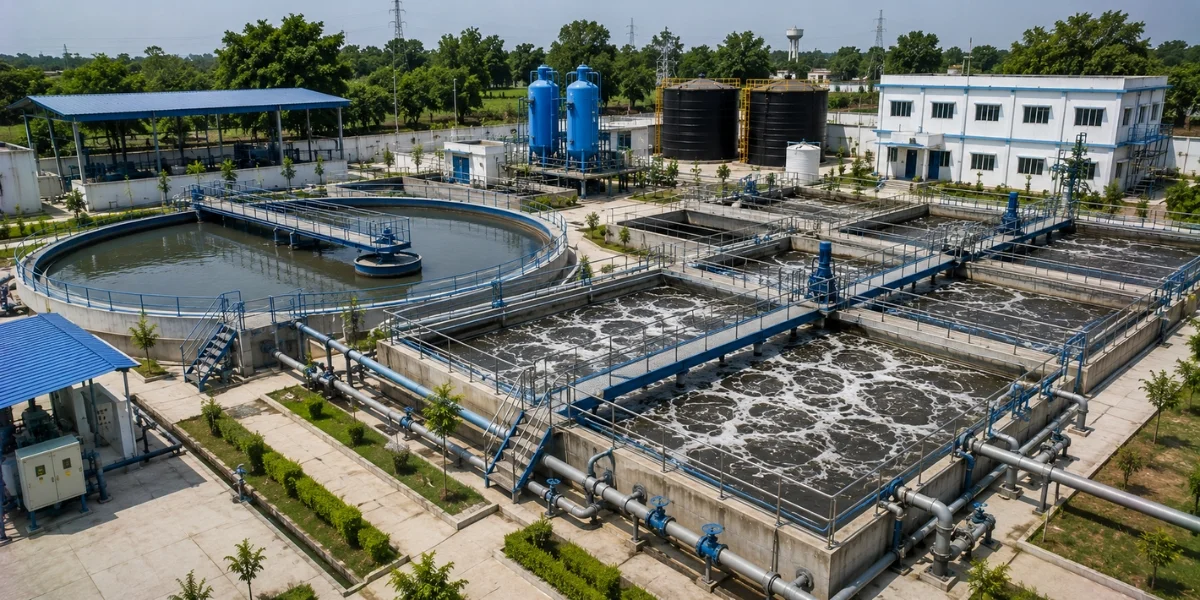
Trity Environ Solutions manufactures RO and water recycling systems for industries and commercial facilities, engineered for reliable purity and reuse.
Explore Configuration
Tertiary Treatment Plant Manufacturer in India

Tertiary Treatment Plant Manufacturer in India

Trity Environ Solutions manufactures tertiary treatment plants that polish treated water beyond secondary treatment, enabling genuine reuse and stricter discharge compliance.
Explore Configuration
Wastewater Recycling System Manufacturer in India

Wastewater Recycling System Manufacturer in India

Trity Environ Solutions manufactures wastewater recycling systems using UF and RO technology, turning treated wastewater into reuse-grade water for cooling, flushing, and gardening.
Explore Configuration
STEP-BY-STEP WORKFLOW

How the STP and ETP Plant Manufacturer in Varanasi Process Works

A sequential, multi-stage treatment methodology engineered for maximum contaminant removal and water recovery.
01

Primary Collection & Screening

Raw effluent equalization, coarse bar screening, and pH neutralization to stabilize influent parameters.

02

Physico-Chemical Coagulation

Flash mixing of coagulants and flocculants followed by primary clarifier separation for heavy suspended solids.

03

Advanced Biological Digestion

Aerobic/anaerobic microbial digestion (MBBR / SBR / ASP) for drastic reduction of dissolved BOD & COD.

04

Tertiary Polishing & Disinfection

Dual media sand and activated carbon filtration with UV/ozonation for clean, reusable output water.

PAN-INDIA CAPABILITIES

Regional Solutions & State Coverage

PROVEN EXCELLENCE

Featured Turnkey Installations

Need a Custom Water or Wastewater Treatment Solution?

Our engineering team can help design the right system for your capacity, industry, and compliance requirements.


QCI Approved
seller
whatsapp-image