ISO 9001:2015 & QCI Approved
Annual Maintenance Contract
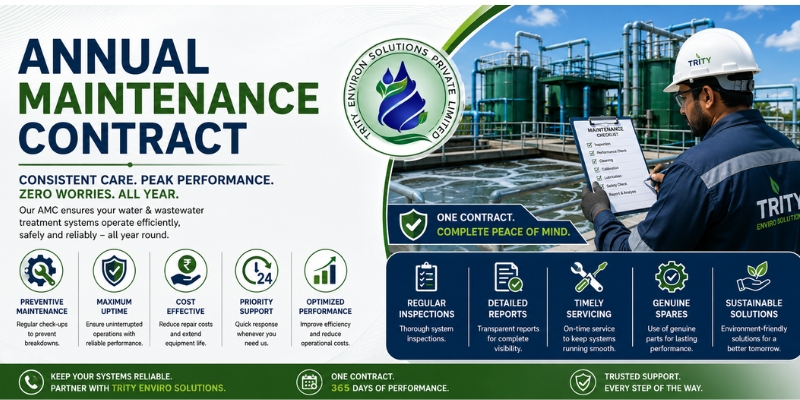
Trity Enviro offers structured Annual Maintenance Contracts covering preventive servicing, spare parts, chemical dosing, and compliance monitoring for STP, ETP, and RO plants.
Why a Well-Built Plant Still Needs a Maintenance Contract
A properly designed and installed STP or ETP doesn't stay well-performing on its own. Pumps and blowers wear, diffusers foul, sludge accumulates faster than expected during high-load periods, and dosing pumps drift out of calibration in ways that are invisible until effluent quality has already slipped. An Annual Maintenance Contract (AMC) is not mandatory under pollution control board regulations in most states, but its absence is one of the most common reasons plants that were fully compliant at commissioning end up receiving SPCB notices, penalties, or failed inspections a year or two later, not because the plant was designed badly, but because nobody was catching the small drifts before they became compliance failures.
What Our AMC Covers
- Preventive maintenance: routine servicing of pumps, blowers, diffusers, agitators, and valves on a defined schedule, catching wear before it causes a breakdown rather than responding after one happens
- Chemical dosing management: calibration and adjustment of dosing systems for coagulants, pH correction, and disinfection, since a dosing system that's drifted even slightly out of calibration can quietly undermine treatment efficiency for weeks before anyone notices in the output quality
- Water quality monitoring: regular sampling and testing against your consent parameters (BOD, COD, TSS, and others specific to your CTO conditions), so any deviation gets caught internally before it shows up in a regulatory inspection
- Sludge management: monitoring sludge levels and scheduling wasting or dewatering before accumulation starts affecting treatment performance
- Breakdown support: rapid response when something does fail unexpectedly, since even a well-maintained plant has occasional equipment failures, and how quickly that gets resolved determines whether it's a minor incident or a multi-day compliance gap
- Documentation and reporting: maintenance logs and performance records that double as audit-ready documentation if your SPCB inspection or CTO renewal asks for maintenance history
Comprehensive vs Non-Comprehensive AMC
AMC contracts in India typically come in two structures, and the difference matters for budgeting. A comprehensive AMC covers both labour and spare parts within the annual fee, giving you predictable costs even if a pump or blower needs replacing mid-year. A non-comprehensive AMC covers service visits and labour only, with spare parts billed separately as needed, which usually means a lower annual fee but less cost predictability if a major component fails. Which structure makes sense depends on the age of your equipment, since older plants with components approaching end-of-life are usually better served by comprehensive coverage, while a newly commissioned plant with equipment still under manufacturer warranty may not need it yet.
Why This Connects Directly to Your Consent to Operate
A Consent to Operate isn't a one-time approval, it's an ongoing commitment that your plant continues performing to the standards it was granted on. SPCB inspections increasingly look for maintenance records alongside effluent test results, since a plant with no documented maintenance history and declining performance is a red flag even if it happens to be passing on the day of inspection. A structured AMC gives you both the actual performance consistency and the paper trail to demonstrate it.
Why Trity Environ Solution for Your AMC
We manufacture the plants we maintain, which means our AMC technicians already understand your specific system's design, not a generic checklist applied to unfamiliar equipment. This matters most exactly when something goes wrong: a technician who knows why your plant was designed a certain way diagnoses a fault faster than one seeing the system for the first time. Our AMC packages tie directly into our project execution and operation and maintenance services, so a plant we build, install, and maintain stays under one team's institutional knowledge throughout its operating life.
Frequently Asked Questions
Is an AMC legally required for STP or ETP operation?
Not directly mandatory under most state pollution control board regulations, but poor maintenance without a structured AMC is a common cause of SPCB notices and penalties, since performance drift tends to go unnoticed until it shows up in a compliance failure.
What's the difference between comprehensive and non-comprehensive AMC?
Comprehensive AMC includes spare parts and labour in the annual fee, giving predictable costs. Non-comprehensive AMC covers service and labour only, with parts billed separately, usually at a lower base cost but less predictable if major components need replacement.
How often are maintenance visits scheduled under an AMC?
This depends on the plan and the plant's size and criticality, ranging from monthly to quarterly visits, with breakdown support available outside the scheduled visits.
Can you take over AMC for a plant that wasn't installed by Trity Environ Solution?
Yes, we service plants we didn't originally install, though the first visit typically includes a more thorough assessment to understand the existing system's design and current condition before setting up a maintenance schedule.
Does the AMC include operators, or just maintenance visits?
Our AMC packages can be structured to include trained operators for day-to-day plant operation alongside scheduled maintenance, or as maintenance-only support if you already have your own operations team in place.
Scope Highlights
Why Choose Trity Enviro Solutions?
Industry-certified environmental engineers delivering compliant, high-efficiency turnkey systems across India.
100% SPCB/CPCB Compliance
Complete regulatory clearance & legal liaison support.
Certified Engineers
Over a decade of industrial wastewater expertise.
Turnkey Execution
End-to-end design, fabrication, setup & commissioning.
Pan-India AMC & Service
24/7 technical hotline, scheduled visits & spare parts.
Frequently Asked Questions
Q1. What is a MBBR Media?
Moving bed biofilm reactor (MBBR) is a type of wastewater treatment process that was first invented by Prof. Hallvard Ødegaard at Norwegian University of Science and Technology in the late 1980s. For more detail call us on 8802624956
Q2. What is a digester tank?
The wet anaerobic digestion process is applied to liquid waste streams that are conveyable by liquid pumping. Sometimes wet systems are called Low Solids AD (LSAD). The Wet AD process can be done in reactors of two main configurations, continuously stirred tank reactors (CSTR) and plug flow reactors.
Q3. Which air pollutant is produced in anaerobic decomposition of organic matter?
Methane is the largest natural source of hydrocarbons. It's produced by the anaerobic decomposition of organic matter in bodies of water. -Trees and plants produce most of the remaining natural VOC's called terpenes. Volatile Organic Compounds - VOCs -Petroleum is the key source of man-made VOC pollution.
Q4. What is a sewage treatment plant?
The Sewage Treatment Plant process is similar to the way that a Septic Tank works but mechanical components provide a process to help break down solids to produce a cleaner, more environmentally friendly effluent.
Q5. What is the tertiary treatment of sewage?
Tertiary treatment is the final cleaning process that improves wastewater quality before it is reused, recycled or discharged to the environment. The treatment removes remaining inorganic compounds, and substances, such as the nitrogen and phosphorus.
Related Service Solutions
Rainwater Harvesting System
Technical Assistance on Web
Consent to Establishment
Related Industry Insights
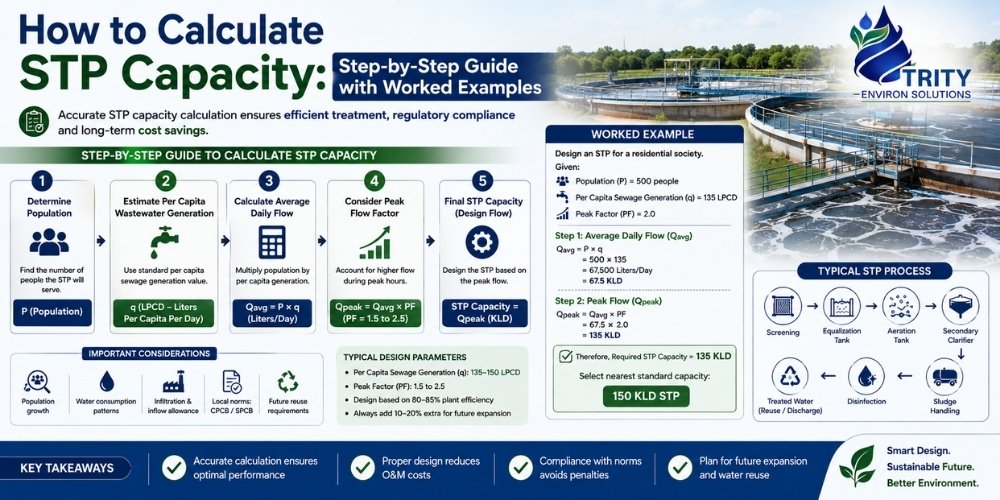
How to Calculate STP Capacity: Step-by-Step Guide with Worked Examples
Calculate STP capacity correctly with worked examples for residential, hotel, hospital, and industrial projects. CPHEEO-based formulas, peak factors, and tank sizing explained.
Read Article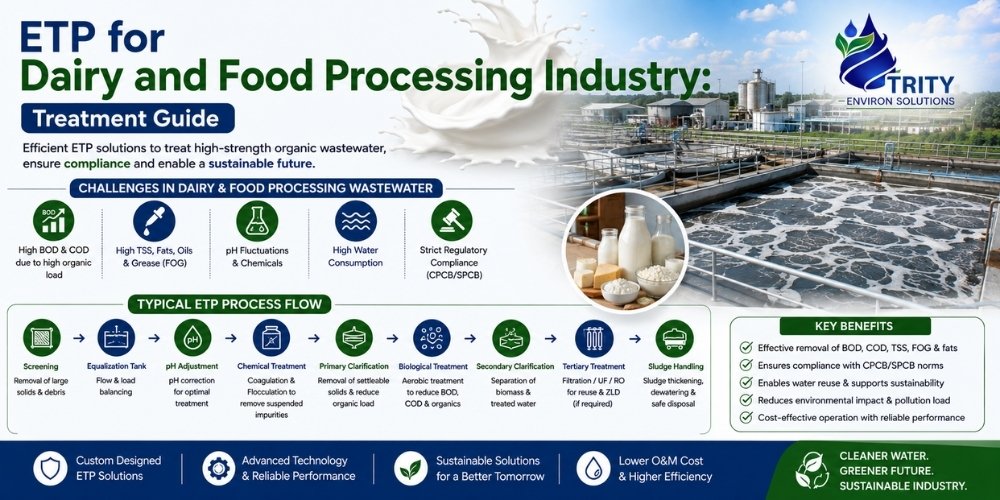
ETP for Dairy and Food Processing Industry: Treatment Guide
Dairy and food processing effluent carries high BOD, COD, and FOG that standard ETPs struggle with. See the treatment stages and technology choices that actually work.
Read Article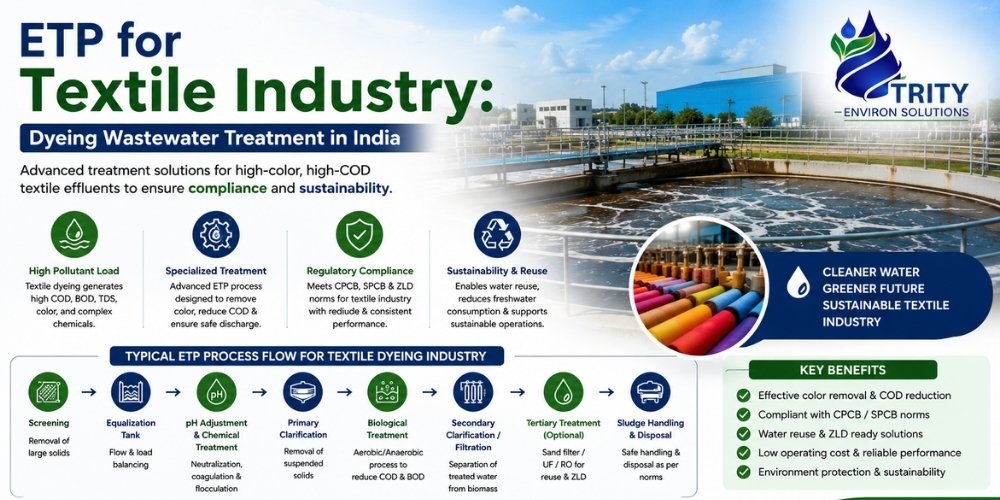
ETP for Textile Industry: Dyeing Wastewater Treatment in India
Textile effluent brings colour, high TDS, and variable pH that generic ETPs can't handle. See the treatment stages, technology choices, and compliance norms that actually work.
Read ArticleFeatured Turnkey Installations




Need Expert Support for Your Water Treatment Project?
From regulatory compliance to turnkey engineering and O&M, our certified environmental engineers are ready to assist.