Introduction
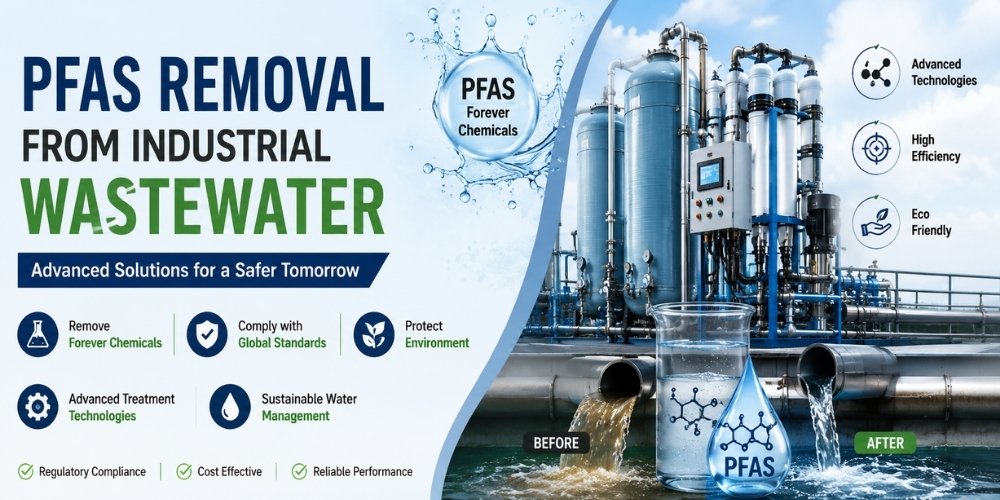
PFAS contamination has moved from a niche environmental concern to a board level compliance issue for Indian manufacturers exporting to Europe, the UK, and the US. Buyers now routinely test for per and polyfluoroalkyl substances in effluent, and a single failed report can delay a shipment.
This guide explains what PFAS are, why they persist in the environment, and which technologies actually remove them from industrial wastewater. It is written for engineers, EHS managers, factory owners, and procurement teams who need practical, technically sound answers.
What Are PFAS?
PFAS stands for per and polyfluoroalkyl substances, a family of more than 4,000 synthetic chemicals built around a carbon fluorine bond, one of the strongest bonds in chemistry. This is why PFAS resist heat, water, and oil so effectively. Industries use PFAS in non stick coatings, fire fighting foam (AFFF), textile waterproofing, electroplating mist suppressants, and semiconductor processing. PFOA and PFOS are the two most studied compounds.
Why Are PFAS Called Forever Chemicals?
The carbon fluorine bond does not break down through normal biological or chemical processes. Bacteria cannot digest it, sunlight barely affects it, and conventional wastewater treatment does not destroy it. This is why the industry calls PFAS "forever chemicals." Once released, these compounds persist in soil, groundwater, and living tissue for decades.
Sources of PFAS in Industrial Wastewater
PFAS enters industrial effluent through raw materials and process chemicals rather than as a deliberate discharge. Common entry points include fluorosurfactant mist suppressants in metal plating baths, water repellent coatings in textile finishing, AFFF foam used in fire training, and PFAS based etching chemicals in semiconductor fabrication.
Industries Generating PFAS
The sectors most exposed in India include chrome and metal electroplating, textile and apparel finishing, semiconductor and electronics fabrication, paper and packaging coating, and airports or defence sites that rely on AFFF for fire suppression.
Health Risks of PFAS Exposure
Long term PFAS exposure has been linked to thyroid disorders, elevated cholesterol, reduced immune response, liver damage, and certain cancers including kidney and testicular cancer. Pregnant women and children face higher risk, since PFAS can cross the placenta, accumulate in breast milk, and persist in the body for years. This is a sensitive health topic, and anyone with personal exposure concerns should consult a qualified medical professional.
Environmental Impact of PFAS
PFAS that escapes wastewater treatment travels easily through soil into groundwater, since the compounds are highly soluble and mobile. Once PFAS reaches groundwater, removal becomes far more difficult and expensive than treating it at the source. It also bioaccumulates in fish, livestock, and crops irrigated with contaminated water, creating a pathway back into the human food chain.
Government Regulations on PFAS
PFAS Standards in India
India does not yet have a dedicated, enforceable PFAS discharge standard under CPCB or SPCB norms, though this is changing. CPCB has begun monitoring PFAS in select industrial clusters, and export oriented manufacturers increasingly face buyer demands for PFAS control ahead of formal domestic regulation. NGT directions on industrial discharge already give SPCBs grounds to act on PFAS complaints even without a fixed numeric limit.
International PFAS Regulations
The US EPA has set enforceable limits for PFOA and PFOS in drinking water, and the EU's REACH framework is moving toward a broad restriction covering the entire PFAS class. Buyers in the EU, UK, and US now routinely demand PFAS testing during supplier audits, particularly for textile, packaging, and electroplating exports. Indian manufacturers who cannot demonstrate PFAS control risk losing contracts regardless of domestic compliance status.
Challenges in PFAS Removal
PFAS removal is considerably harder than removing BOD, COD, or heavy metals. The carbon fluorine bond resists biological treatment entirely, so a conventional effluent treatment plant biological stage passes PFAS through largely untouched. Short chain PFAS compounds are smaller and more soluble than long chain variants, making them harder to capture on carbon or membranes. Concentrations are often measured in parts per trillion, and treatment generates a concentrated waste stream that still needs safe disposal.
PFAS Detection Methods
Laboratories detect PFAS primarily through LC-MS/MS (liquid chromatography tandem mass spectrometry), which measures individual compounds down to parts per trillion. Total Organic Fluorine (TOF) testing offers a faster screening estimate when individual compound data is not immediately needed. A Total Oxidizable Precursor (TOP) assay can also estimate precursor compounds. Sampling at each stage confirms whether a system is removing PFAS rather than diluting it.
PFAS Treatment Technologies
No single technology destroys PFAS cheaply at scale today. Effective systems combine a capture step with a polishing or concentration step and treat destruction as a separate, downstream problem.
Activated Carbon
Granular activated carbon (GAC) is the most widely deployed PFAS removal method worldwide. Long chain PFAS such as PFOA and PFOS adsorb well onto carbon, though short chain compounds break through faster and need more frequent replacement. Activated carbon filters work best as a polishing stage after conventional ETP treatment.
Ion Exchange
Ion exchange resins, particularly anion exchange resins, capture PFAS through electrostatic attraction rather than simple adsorption. Resins generally remove short chain PFAS better than GAC and need less frequent replacement, though resin and regenerant waste cost more upfront. The same principle used in demineralised water plants applies here, with PFAS selective resin instead of standard beds.
Reverse Osmosis
RO membranes reject more than 99 percent of PFAS molecules, since membrane pores are smaller than the PFAS molecular structure. A properly designed commercial RO plant remains the most reliable single barrier for PFAS, but it concentrates PFAS into the reject stream instead of destroying it, so that reject needs further treatment.
Nanofiltration
Nanofiltration sits between ultrafiltration and RO in pore size and operates at lower pressure, reducing energy cost. NF rejects long chain PFAS effectively but performs less reliably against short chain compounds, making it a useful pre-treatment step. Many plants pair NF with an upstream ultrafiltration system to protect membranes before PFAS specific treatment.
Advanced Oxidation
Advanced Oxidation Processes (AOP) use ozone, UV light, or hydrogen peroxide to generate hydroxyl radicals that attack organic pollutants. AOP struggles to break the carbon fluorine bond and is generally ineffective alone against PFAS, though it remains useful as a supporting step alongside a dedicated PFAS capture technology.
Electrochemical Treatment
Electrochemical oxidation passes a direct electric current through specialised electrodes to break PFAS molecules apart, rather than merely capturing them. This is one of the few technologies capable of genuine PFAS destruction, but it stays energy intensive and is mostly used for concentrated reject streams rather than full plant flow.
Plasma Technology
Non thermal plasma treatment generates reactive species that can mineralise PFAS into fluoride ions and carbon dioxide. It ranks among the most promising destruction technologies under active research, particularly for treating concentrated PFAS waste from GAC regeneration or RO reject, though commercial scale cost remains high through 2026.
Comparison of PFAS Treatment Technologies
The table below summarises how each technology performs against PFAS in a typical industrial setting.
| Technology |
PFAS Removal |
Best Use |
Relative Cost |
Key Limitation |
| GAC |
High for long chain |
Polishing stage |
Low to medium |
Short chain breakthrough |
| Ion Exchange |
High, including short chain |
Polishing stage |
Medium to high |
Resin and regenerant cost |
| Reverse Osmosis |
Very high |
Final barrier |
High |
Generates a reject stream |
| Nanofiltration |
Medium to high |
Pre-treatment |
Medium |
Less reliable for short chain |
| Advanced Oxidation |
Low alone |
Co-contaminant support |
Medium |
Cannot break the C-F bond alone |
| Electrochemical |
High, destructive |
Concentrate treatment |
High |
Energy intensive |
| Plasma |
Very high, destructive |
Concentrate or residue treatment |
Very high |
Early stage, costly at scale |
Best PFAS Treatment Technology by Industry
Electroplating units generally do best with ion exchange ahead of RO, since their effluent already carries metals needing parallel treatment. Textile and leather finishing units typically pair GAC with RO, since their PFAS load tends toward long chain compounds. Semiconductor units, needing ultrapure water, usually pair RO or NF with GAC polishing. Airports and defence sites with legacy AFFF contamination need GAC, ion exchange, and a destruction step for concentrated residue.
PFAS Removal Process Flow
Equalisation and pH correction come first, followed by a conventional effluent treatment plant stage that removes BOD, COD, and suspended solids before they foul PFAS specific media. A pre-filtration step, often multigrade or ultrafiltration, protects membranes and resin beds next. This feeds the primary PFAS capture stage, GAC, ion exchange, or RO, chosen by the effluent profile. Concentrated reject or spent media is then segregated for disposal or destruction, and treated water is monitored before discharge.
Factors Affecting PFAS Removal Efficiency
Removal efficiency depends heavily on PFAS chain length, since short chain compounds resist capture more than long chain ones. Co-contaminants such as oil, grease, and high organic load compete for adsorption sites on carbon and resin, reducing PFAS capacity. Flow rate and contact time matter too, since faster flow through a GAC bed lowers removal. Water chemistry, particularly pH, hardness, and TDS, also affects membrane and resin performance.
Design, Cost, and Maintenance Considerations
Design Considerations
A PFAS treatment system should be designed only after a speciation analysis identifies which compounds and concentrations are present. Sizing GAC or resin vessels without this data risks premature breakthrough and unreliable compliance. Bypass valves and sampling ports at each stage let engineers verify performance quickly.
Operating Cost
GAC and resin replacement is usually the dominant recurring cost, and short chain heavy effluent raises it further since media exhausts faster. RO adds energy cost for pumping plus periodic membrane replacement. Destruction technologies like electrochemical and plasma treatment cost the most per litre, so most Indian facilities reserve them for concentrated residual streams.
Maintenance Requirements
GAC beds need backwashing and replacement based on breakthrough testing, not a fixed calendar. RO and NF membranes need regular clean in place cycles to prevent fouling. Ion exchange resins need monitored regeneration, similar to the resin management used in a water softener plant. Routine PFAS testing, not visual inspection, confirms real performance.
Advantages and Limitations
Advantages
A well designed PFAS treatment system protects export contracts, reduces long term liability from groundwater contamination, and positions a facility ahead of India's tightening regulatory direction. It also strengthens overall effluent quality, since GAC and RO stages remove other persistent organics too.
Limitations
The main limitations are cost, since most capture technologies are expensive at the parts per trillion level regulations demand, and the unresolved disposal problem, since capturing PFAS does not destroy it unless paired with a dedicated destruction step. Facilities must budget for ongoing media replacement, not just initial cost.
Case Study: A Representative PFAS Treatment Scenario
Consider a typical pattern in mid sized electroplating clusters across Delhi NCR supplying European automotive buyers. A facility using fluorosurfactant mist suppressants in its plating baths receives a PFAS related audit flag, even though its existing ETP already handles metals and BOD well. The practical fix is rarely a full plant rebuild. Adding an ion exchange polishing stage after the existing effluent treatment plant, followed by a GAC bed, typically brings PFOA and PFOS down from several hundred parts per trillion to well below buyer thresholds within months.
Future Trends in PFAS Treatment
Destruction technologies are moving from pilot scale toward early commercial deployment, with electrochemical oxidation and plasma systems growing more compact and energy efficient each year. Indian regulation is widely expected to introduce PFAS specific discharge limits in the coming years. AI driven monitoring is starting to predict GAC and resin breakthrough before it happens, reducing compliance risk between sampling events.
Frequently Asked Questions
What does PFAS stand for?
PFAS stands for per and polyfluoroalkyl substances, synthetic chemicals known for resisting heat, water, and oil because of a strong carbon fluorine bond.
Why can't a normal STP or ETP remove PFAS?
Conventional biological and chemical treatment cannot break the carbon fluorine bond, so PFAS passes through standard treatment largely untreated.
Which technology removes PFAS most effectively?
Reverse osmosis and ion exchange currently offer the most reliable removal, often combined with GAC for a layered approach.
Does activated carbon remove all types of PFAS?
No, GAC removes long chain PFAS like PFOA and PFOS well but performs poorly against smaller, more soluble short chain compounds.
Is PFAS regulated in India right now?
India has no dedicated CPCB or SPCB discharge standard for PFAS yet, though monitoring is increasing and export buyers often demand compliance regardless.
How is PFAS detected in wastewater?
PFAS is detected primarily through LC-MS/MS testing, which measures individual compounds down to parts per trillion in a water sample.
What happens to PFAS captured by GAC or resin?
Spent carbon or exhausted resin still contains the captured PFAS and must be disposed of safely or sent for destruction.
Can PFAS be destroyed completely?
Emerging technologies like electrochemical oxidation and plasma treatment can break PFAS into harmless fluoride and carbon dioxide, though both remain costly at scale.
Which industries in India face the highest PFAS risk?
Electroplating, textile finishing, semiconductor manufacturing, and AFFF using facilities carry the highest PFAS exposure risk in industrial wastewater.
How much does a PFAS treatment system cost?
Cost depends heavily on PFAS concentration, chain length, and flow rate, with GAC polishing generally costing less upfront than RO.
Can RO alone solve a PFAS problem?
RO removes PFAS very effectively from the water stream but concentrates it into the reject, which still needs a disposal plan.
How often does GAC need replacement for PFAS removal?
Replacement frequency depends on PFAS load and chain length, and breakthrough testing should determine timing rather than a fixed calendar.
Does PFAS in industrial discharge affect drinking water?
Yes, PFAS entering groundwater or surface water through industrial discharge can eventually reach drinking water sources downstream.
What is the difference between short chain and long chain PFAS?
Long chain PFAS like PFOA and PFOS adsorb more readily, while short chain variants are smaller, more soluble, and harder to capture.
Do export buyers actually test for PFAS in Indian supplier audits?
Yes, particularly across textile, electroplating, and electronics supply chains exporting to the EU, UK, and US.
Conclusion
PFAS removal is no longer optional for Indian manufacturers serving export markets or operating near sensitive groundwater zones. The right approach combines a properly functioning sewage and effluent treatment system with a targeted PFAS polishing stage, whether GAC, ion exchange, RO, or a combination matched to your effluent profile. Trity Environ Solutions designs and engineers wastewater treatment systems across India and can assess your effluent profile to recommend the right fit. Contact our engineering team for a site assessment.