Trusted Industrial Demineralized Water Plant Manufacturers in India for Power Plants, Pharma and Process Industries.
Get a Free QuoteEvery industrial process that depends on steam generation, chemical synthesis, pharmaceutical manufacturing, or precision cooling requires one thing that ordinary water cannot deliver: mineral-free, high-purity water. Dissolved salts, calcium, magnesium, silica, and other ionic impurities found in raw water cause scaling inside boilers, corrode heat exchangers, contaminate pharmaceutical batches, and degrade sensitive electronic components.
Industrial demineralized water plants solve this problem at the source. By removing virtually all dissolved ionic impurities through a controlled ion exchange process, a properly designed DM water plant delivers consistent water quality that protects equipment, extends operational life, and reduces unplanned shutdowns.
Trity Environ Solutions is a trusted name among demineralized water plant manufacturers in India, designing and supplying customized DM water systems for power plants, pharmaceutical facilities, chemical industries, boiler feed applications, food processing units, and textile plants across PAN India.
A demineralized water plant (also called a DM plant, deionization plant, or DI plant) is a water treatment system that removes dissolved mineral salts and ionic impurities from raw water using ion exchange resins.
When mineral salts dissolve in water, they split into positively charged ions (cations) such as calcium, magnesium, sodium, and iron, and negatively charged ions (anions) such as chloride, sulphate, bicarbonate, and nitrate. A demineralization system passes raw water through specialized resin beds that capture these ions and release hydrogen (H+) and hydroxyl (OH-) ions in their place. These combine to form pure water, leaving behind water that is free of dissolved minerals.
The output of a demineralization plant is water with very low TDS (typically below 10 ppm), extremely low conductivity (less than 10 microsiemens/cm from a two-bed system, less than 1 microsiemens/cm from a mixed bed polisher), and minimal silica content — meeting the quality requirements of the most demanding industrial applications.
A standard industrial DM water plant operates through a multi-stage ion exchange process. Each stage targets a specific category of dissolved impurities.
Raw water enters the cation exchange vessel first. This vessel is filled with strongly acidic cation exchange resin (in hydrogen form). As water passes through the resin bed, positively charged ions — calcium (Ca2+), magnesium (Mg2+), sodium (Na+), potassium (K+), and iron (Fe2+) — are captured by the resin and replaced with hydrogen ions (H+). The water leaving this vessel is acidic and still contains dissolved anions.
After the cation exchanger, water passes through a degasser tower. This unit strips out carbon dioxide (CO2) that was released during the cation exchange reaction. Removing CO2 at this stage reduces the load on the anion resin, extending resin life and lowering chemical consumption during regeneration. The degasser uses forced air flow or vacuum to remove dissolved gases efficiently.
The degassed, cation-free water then flows into the anion exchange vessel, filled with strongly basic anion exchange resin (in hydroxyl form). Negatively charged ions — chloride (Cl-), sulphate (SO4-), nitrate (NO3-), silica (SiO2), and carbonate (CO3-) — are removed here and replaced with hydroxyl ions (OH-). The hydrogen ions from the cation stage and hydroxyl ions from the anion stage combine to form water (H2O).
For applications requiring ultra-pure water — high-pressure boilers, pharmaceutical water for injection (WFI), electronics manufacturing — a mixed bed polisher is installed after the two-bed system. This unit contains a homogeneous mixture of cation and anion resins, delivering output water with conductivity below 0.5 microsiemens/cm and TDS below 1 ppm.
The treated water from a standard two-bed industrial DM water plant achieves:
With mixed bed polishing:
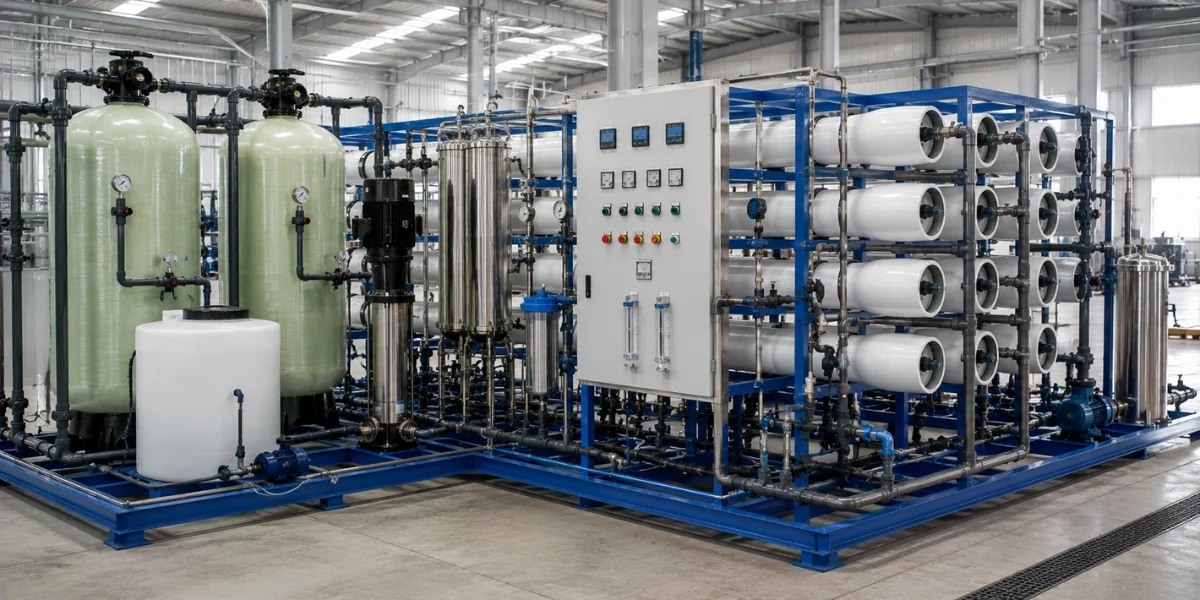
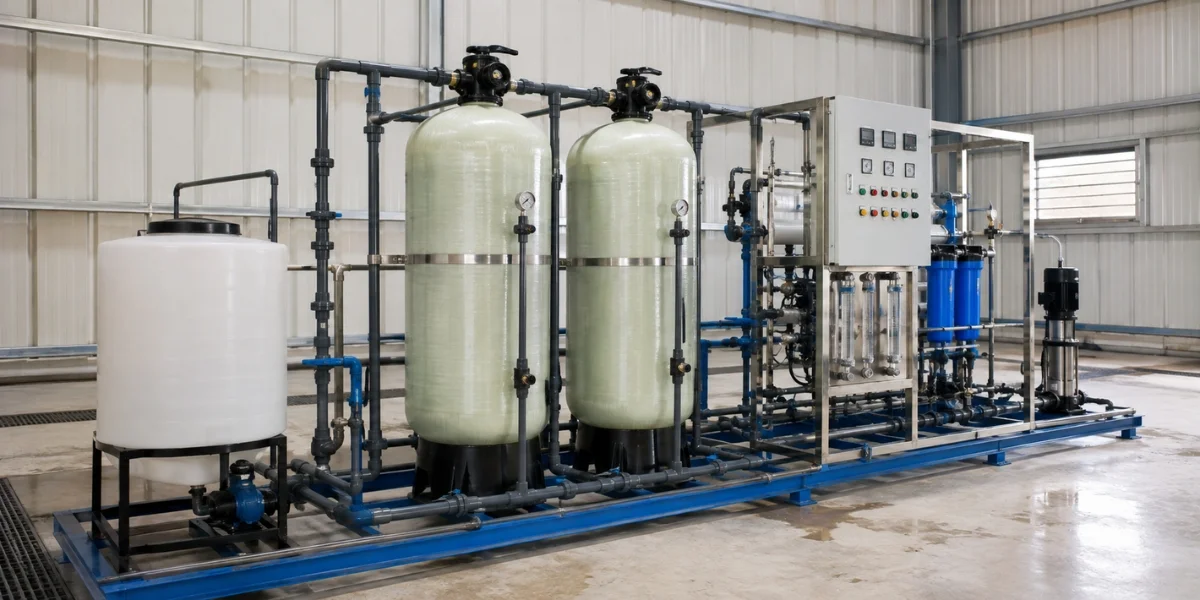
A well-engineered industrial DM plant consists of the following components, each playing a specific role in the purification process:
For integrated setups, DM plants are often installed downstream of multi-grade filtration systems and commercial RO plants to reduce incoming TDS load and extend resin service cycles.
Industries that switch to properly designed DM water systems report measurable improvements across multiple operational parameters:
Thermal power plants represent the largest consumers of demineralized water in India. High-pressure boilers in coal, gas, and renewable energy plants require feed water with conductivity below 0.1 microsiemens/cm and silica below 0.02 ppm. Any compromise in water quality leads to turbine blade deposits, boiler tube failures, and forced outages. DM water plants for power plants are typically high-capacity systems ranging from 50 m3/hour to several hundred m3/hour, often with redundant trains.
The pharmaceutical sector requires water meeting BIS, WHO, and Schedule M standards. Purified Water (PW) and Water for Injection (WFI) specifications demand conductivity below 1.3 microsiemens/cm and total organic carbon below 0.5 ppm. Mixed bed demineralized water plants for pharmaceutical industries are designed with validation protocols, sanitary construction, and online quality monitoring to meet CDSCO and US FDA expectations.
Chemical manufacturing processes use DM water in reactor cooling systems, catalyst preparation, dilution water, and washing operations. Ionic impurities in process water can catalyze unwanted side reactions, contaminate products, and degrade catalyst performance. DM plants for chemical industries are designed with chemical-resistant materials and higher capacity margins for continuous process operations.
Semiconductor fabrication, PCB manufacturing, and display panel production require ultra-pure water with resistivity above 15 megaohm-cm and particle counts in the sub-micron range. Even trace levels of dissolved ions can cause circuit failures. High purity water plants for electronics applications typically combine RO, mixed bed DM, and electrodeionization (EDI) in a polishing train.
Dyeing and finishing operations in the textile sector require soft, mineral-free water to achieve uniform dye uptake and consistent fabric quality. Hard water causes uneven dyeing, dye precipitation, and equipment deposits. Industrial DM water plants for textile industries help reduce chemical consumption and improve finished fabric quality.
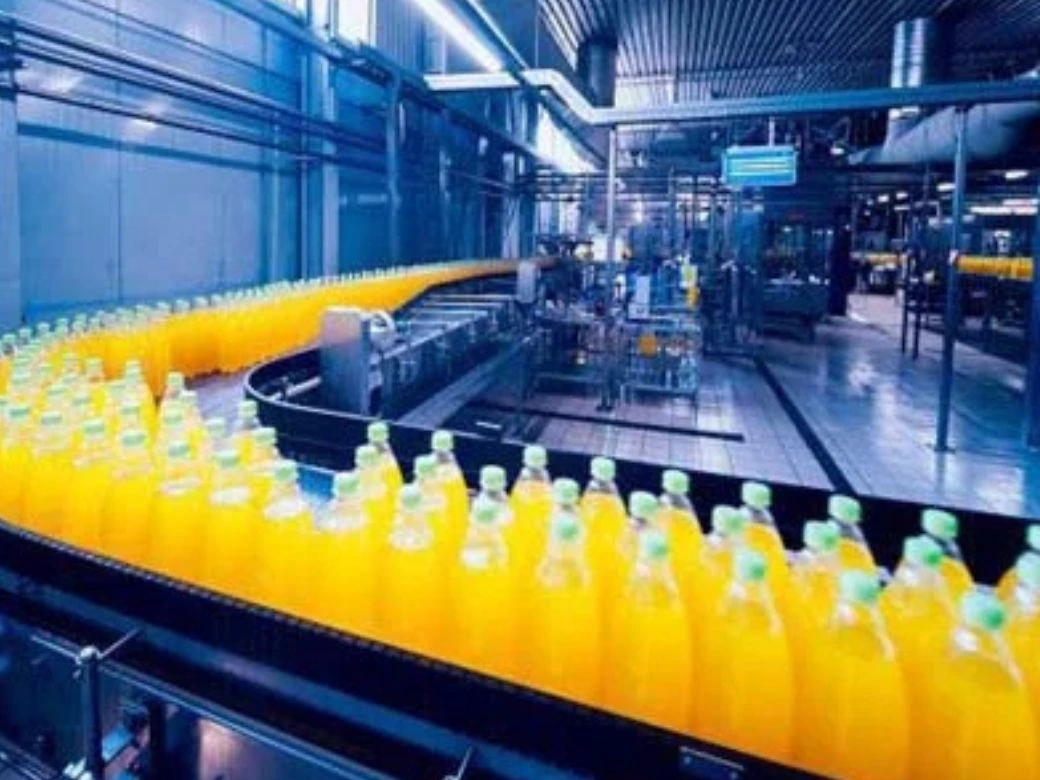
Water quality directly impacts the taste, shelf life, and regulatory compliance of food and beverage products. Carbonated soft drinks, brewery operations, dairy processing, and packaged water production all require water free of dissolved minerals that could affect taste or react with product ingredients. DM water systems for food processing are built with food-grade materials and comply with FSSAI water quality norms.
Vehicle painting, component washing, and cooling systems in automotive manufacturing require demineralized water to prevent mineral deposits on painted surfaces and ensure consistent heat exchange in cooling circuits. DM water systems for automotive industries are typically medium-capacity systems with automatic regeneration controls.
Across all industries — sugar mills, paper plants, chemical factories, hospitals, hotels, and commercial buildings — boilers require consistently demineralized feed water. Installing a DM plant for boiler feed water is one of the most cost-effective investments an operator can make, typically recovering its cost within one to three years through reduced fuel consumption and maintenance savings.
| Industry | Required Conductivity | Required TDS | Recommended System |
|---|---|---|---|
| High Pressure Power Boilers | < 0.1 µS/cm | < 0.05 ppm | Two-Bed + Mixed Bed |
| Pharmaceutical (PW/WFI) | < 1.3 µS/cm | < 1 ppm | Two-Bed + Mixed Bed |
| Electronics / Semiconductors | < 0.1 µS/cm | < 0.05 ppm | RO + Mixed Bed + EDI |
| Chemical Processing | < 5 µS/cm | < 5 ppm | Two-Bed DM |
| Low Pressure Industrial Boilers | < 10 µS/cm | < 5 ppm | Two-Bed DM |
| Food & Beverage | < 10 µS/cm | < 10 ppm | Two-Bed DM |
| Textile Dyeing | < 20 µS/cm | < 10 ppm | Two-Bed DM |
| Automotive Cooling Systems | < 20 µS/cm | < 10 ppm | Two-Bed DM |
| Laboratory Applications | < 1 µS/cm | < 1 ppm | Mixed Bed |
| Cooling Towers (process) | < 30 µS/cm | < 20 ppm | Two-Bed DM |
| Parameter | Specification |
|---|---|
| Capacity Range | 100 LPH to 200 m3/hour (customized higher capacities available) |
| Feed Water TDS | Up to 2000 ppm (higher TDS designs available with pre-treatment) |
| Output TDS (Two-Bed) | Less than 10 ppm |
| Output TDS (Mixed Bed) | Less than 1 ppm |
| Output Conductivity (Two-Bed) | 10 to 20 microsiemens/cm |
| Output Conductivity (Mixed Bed) | Less than 0.5 microsiemens/cm |
| Residual Silica | Less than 0.02 ppm (mixed bed) |
| pH of Output Water | 6.8 to 7.2 |
| Cation Resin Type | Strong Acid Cation (SAC) resin, gel or macro-porous type |
| Anion Resin Type | Strong Base Anion (SBA) resin, Type I or Type II |
| Vessel MOC | FRP / MS Rubber Lined / SS 316L (Quartz Lined) |
| Operating Pressure | 2.5 to 6 kg/cm2 |
| Automation Level | Manual / Semi-Automatic / Fully Automatic (PLC/SCADA) |
| Regeneration Chemicals | HCl (10% solution) for cation; NaOH (4% solution) for anion |
| Power Requirement | 0.5 kW to 15 kW depending on capacity and automation level |
| Installation Type | Skid-mounted / Civil foundation / Modular containerized |
The most commonly installed configuration in Indian industries. Consists of a separate cation exchanger and anion exchanger connected in series with a degasser unit between them. Produces output water with conductivity between 10 and 20 microsiemens/cm and TDS below 10 ppm. Suitable for low-pressure boilers, cooling systems, textile dyeing, and general process water applications.
A polishing unit that follows the two-bed system, or can operate independently for lower-volume, high-purity applications. Contains a homogeneous mixture of cation and anion resins in a single vessel, producing water with conductivity below 0.5 microsiemens/cm. Essential for pharmaceutical water systems, electronics manufacturing, and high-pressure boiler feed applications.
PLC or SCADA-controlled systems that automate the complete service and regeneration cycle. Conductivity sensors trigger automatic regeneration when output water quality falls below the set point. Reduces operator dependency, prevents breakthrough, and lowers chemical wastage through optimized regeneration sequences.
Heavy-duty systems designed for large-capacity industrial applications such as thermal power plants, steel mills, and refineries. These plants operate in multiple parallel trains with staggered regeneration schedules to ensure uninterrupted supply. Vessel diameters range from 600 mm to 2000 mm or above, with high-capacity resin loading.
Combines reverse osmosis as a pre-treatment stage with a downstream two-bed DM and mixed bed polisher. The RO system removes 90% to 95% of dissolved TDS, significantly reducing the ionic load on the resin beds and extending regeneration intervals. This configuration is increasingly preferred in India due to high raw water TDS in many regions.
Choosing the right demineralized water plant configuration requires careful evaluation of several factors. A wrong selection leads to poor water quality, excessive regeneration frequency, or oversized capital expenditure.
Both RO plants and DM plants produce purified water, but they work on fundamentally different principles and are suitable for different applications. Understanding the difference helps in selecting the right system or combination.
| Comparison Parameter | Demineralized Water Plant (DM) | RO Plant |
|---|---|---|
| Treatment Principle | Ion exchange resin technology | Semi-permeable membrane pressure-driven separation |
| TDS Removal Efficiency | 99.9% (near complete ionic removal) | 90% to 95% |
| Output Conductivity | Less than 0.5 µS/cm (mixed bed) | 50 to 150 µS/cm (typical) |
| Silica Removal | Greater than 99% (strong base anion resin) | 85% to 90% |
| Running Cost | Higher (chemical regeneration: HCl + NaOH) | Lower (electricity for pressure only) |
| Capital Cost | Lower for small capacities | Higher (membrane modules, high-pressure pump) |
| Water Recovery | 100% of service volume (no reject) | 70% to 75% (25% to 30% reject/brine) |
| Suitable For | High-purity applications: boilers, pharma, electronics | General process water, drinking water, cooling |
| Feed Water TDS Limit | Up to 500 ppm ideally (higher with pre-treatment) | Up to 2000 ppm (brackish water range) |
| Maintenance | Periodic resin regeneration and replacement | Membrane cleaning, antiscalant dosing |
| Automation | Manual to fully automatic | Semi-automatic to fully automatic |
| By-product / Waste | Spent acid and caustic regeneration effluent | Concentrated reject water stream |
| Scalability | Modular resin vessel addition | Membrane train addition |
For most industrial setups, the best approach is a combined commercial RO plant followed by a DM polishing stage. The RO system removes bulk TDS and protects the resin from high ionic loads, while the DM plant delivers the final high-purity output needed for critical applications.
As established industrial demineralized water plant manufacturers in India, Trity Environ Solutions brings engineering competence, technical depth, and PAN India service capability together in every project.
Trity Environ Solutions supplies industrial DM water plants to a wide cross-section of industries across India:
Trity Environ Solutions follows a structured installation process to ensure every demineralized water plant is delivered on time, installed correctly, and commissioned to specified performance standards.
Step 1 - Site Assessment and Water Analysis: Our team collects raw water samples and conducts a detailed analysis report. Site layout, available space, chemical storage requirements, and electrical supply are assessed.
Step 2 - Engineering and Design: Based on water analysis and capacity requirements, our engineers finalize the plant configuration, vessel sizing, resin volume, regeneration chemical quantities, and P&ID drawings.
Step 3 - Manufacturing and Quality Check: Pressure vessels are fabricated and rubber-lined or FRP-wound as specified. Resins are loaded and tested. The complete skid or modular system undergoes factory quality checks before dispatch.
Step 4 - Civil Work and Foundation: The installation site is prepared with concrete foundations, chemical storage containment, drainage channels for regeneration effluent, and electrical conduit.
Step 5 - Mechanical Installation: Vessels, piping, instrumentation, and the control panel are installed and interconnected as per the approved P&ID layout.
Step 6 - Chemical Loading and Resin Commissioning: Resins are loaded, backwashed, and pre-treated with regenerant chemicals to bring them to the correct ionic form before the first service cycle.
Step 7 - Commissioning and Performance Testing: The plant is operated through service and regeneration cycles. Output water quality — conductivity, TDS, pH, silica — is tested and documented to confirm compliance with design specifications.
Step 8 - Operator Training: Site operators are trained on service cycle operation, regeneration procedure, chemical handling safety, and routine maintenance. For plants connected to our operation and maintenance services, our team provides ongoing operational support.
Proper O&M practice is essential to maintaining DM water quality and maximizing resin life in an industrial DM water plant.
Resin Regeneration: Cation resin is regenerated using 10% hydrochloric acid (HCl) solution. Anion resin is regenerated using 4% sodium hydroxide (NaOH) solution. Regeneration frequency depends on raw water TDS and plant capacity — typically every 8 to 72 hours of service depending on the system design. Over-regeneration wastes chemicals; under-regeneration causes quality breakthrough.
Chemical Handling: HCl and NaOH are corrosive chemicals requiring proper storage tanks, bunded containment, protective personal equipment, and safe handling procedures. All chemical connections should use acid-resistant HDPE or rubber-lined piping. Regeneration effluent must be neutralized before discharge, in compliance with wastewater treatment plant and CPCB discharge norms.
Water Quality Monitoring: Continuous online conductivity meters at the plant outlet provide real-time quality indication. A conductivity rise above the set point signals resin exhaustion and triggers regeneration. Weekly lab checks for TDS, pH, and silica are recommended for critical applications.
Instrument Calibration: Conductivity meters, pH sensors, and flow meters should be calibrated quarterly using certified standards. Pressure gauge and level indicator checks should be included in the monthly maintenance schedule.
Preventive Maintenance: Key monthly checks include inspection of vessel internals for resin fouling or compaction, pump performance verification, valve leak checks, and chemical dosing pump calibration. Annual resin sampling and capacity testing help predict when resin replacement will be required, typically after 5 to 10 years depending on feed water quality and regeneration discipline.
Trity Environ Solutions provides comprehensive annual maintenance contracts covering all the above maintenance activities, along with emergency breakdown support and resin performance reporting.
The price of an industrial demineralized water plant in India varies significantly based on multiple design and project-specific factors. Quoting a standard price without knowing the full project scope is not meaningful — the right approach is to size the plant based on actual requirements and then evaluate the cost.
Key factors that influence DM plant price include:
We recommend requesting a detailed technical and commercial proposal based on your raw water report, required capacity, and desired output water quality. Contact Trity Environ Solutions for a no-obligation technical consultation and quotation.
Selecting the right industrial demineralized water plant manufacturer in India is a decision that affects your equipment reliability, operational efficiency, regulatory compliance, and long-term maintenance costs. A well-engineered DM water system pays for itself through reduced boiler fuel consumption, lower maintenance expenditure, and elimination of costly equipment failures caused by mineral scaling and corrosion.
Trity Environ Solutions has the engineering expertise, manufacturing capability, and PAN India service network to design and deliver customized DM water plants that precisely match your application requirements — from a compact two-bed system for a small industrial boiler to a multi-train high-purity water system for a pharmaceutical or power plant project.
Take the next step:
Call us at +91-9821030072 or email us at enquiry@trityenviro.com to discuss your demineralized water requirement with our specialists today.
STP and ETP plant manufacturing, installation, AMC and retrofit services for refinery, dairy, hospitality and religious institutions in Mathura, engineered for Taj Trapezium Zone (TTZ) and UPPCB compliance.
We are the best manufacturers and suppliers of MBBR Media in India. Moving bed biofilm reactor manuf...
Trity Environ Solutions manufacturers and suppliers of STP and ETP Plants in Udaipur. Sewage Treatme...
Trity Enviro Solutions is a leading manufacturer of oil skimmers. We provide innovative oil skimming...
Trity Enviro is the best STP and ETP plant manufacturer in Saharanpur. Our plants are designed...
STP and ETP plant manufacturing, installation, AMC and retrofit services for industries, hospitals, hotels and housing societies in Gorakhpur, including sugar mills and distillery units, backed by UPPCB-compliant engineering and design.
No.1 Sewage Treatment Plant Manufacturer & Supplier in India, Trity Environ Solutions manuf....
Trity Enviro Solutions is one of the best Sewage Treatment Plant and Effluent Treatment Plant manufac...
We provide customized STP and ETP plants in Allahabad (Prayagraj) for industries, hotels, hospitals, residential societies, and commercial projects. Our services include design, manufacturing, installation, commissioning, and AMC support for efficient wastewater treatment and water recycling solutions.
We are Industrial RO Plant Manufacturer in Delhi/NCR, Best Commercial RO Plant...