pH Full Form, Scale, and Its Critical Role in Wastewater Treatment and Industrial Compliance
Ask a chemistry student and they will tell you pH stands for potential of hydrogen. Ask a wastewater treatment operator and they will tell you it is one of the most important parameters they monitor every single day. Both answers are correct, and the gap between them tells you something important: pH is far more than a textbook concept.
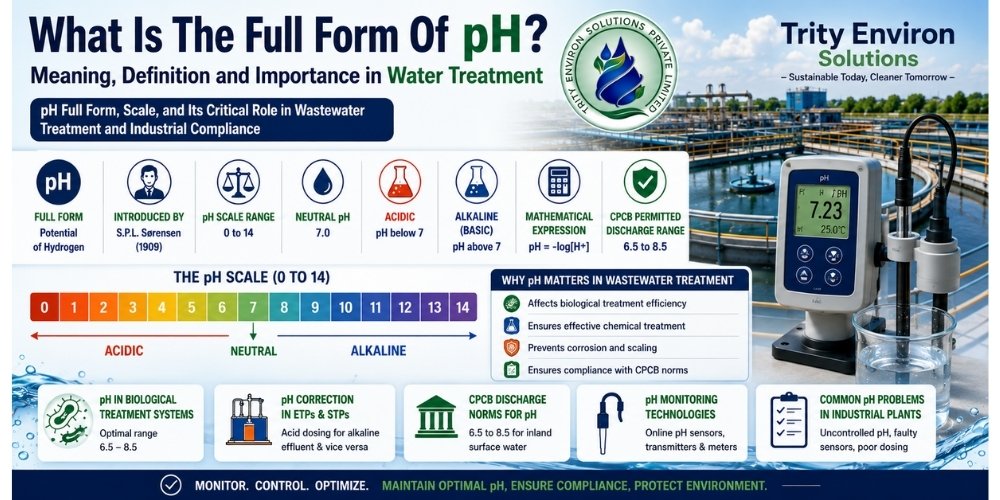
The full form of pH is Potential of Hydrogen. It is a numerical scale used to measure how acidic or alkaline a solution is, based on the concentration of hydrogen ions present in it. The concept was introduced by Danish biochemist Søren Peder Lauritz Sørensen in 1909 while he was working on enzyme activity studies at the Carlsberg Laboratory in Copenhagen. His work required a consistent way to express hydrogen ion concentration, and the pH scale was the result.
For industries operating effluent treatment plants (ETPs) and sewage treatment plants (STPs) in India, pH is not just a chemistry lesson. It directly affects biological treatment performance, chemical dosing requirements, pipe and equipment corrosion, regulatory compliance, and the quality of treated water discharged or reused. Getting pH wrong, consistently, is one of the fastest ways to fail a CPCB inspection.
Quick Answer: What Is The Full Form Of pH?
pH stands for Potential of Hydrogen
- Introduced by: S.P.L. Sørensen (1909)
- pH Scale Range: 0 to 14
- Neutral pH: 7.0
- Acidic: pH below 7
- Alkaline (Basic): pH above 7
- Mathematical Expression: pH = -log[H⁺]
- CPCB Permitted Discharge Range: 6.5 to 8.5
What Does pH Stand For?
The full form of pH is Potential of Hydrogen. The "p" comes from the German word "Potenz," meaning power or potential, and "H" is the chemical symbol for hydrogen. Together, pH represents the potential or activity of hydrogen ions in a solution.
Some sources also reference the Latin origin "Pondus Hydrogenii," which translates to "weight of hydrogen," reflecting Sørensen's original terminology. Over time, the most widely accepted full form in science and engineering has settled on Potential of Hydrogen.
The concept is straightforward in principle. Every aqueous solution contains hydrogen ions (H⁺) and hydroxide ions (OH⁻). When hydrogen ions dominate, the solution is acidic. When hydroxide ions dominate, it is alkaline. When both are in equal concentration, the solution is neutral. pH quantifies exactly where a solution sits on this spectrum.
The Science Behind pH
pH is mathematically defined as the negative logarithm of the hydrogen ion concentration in a solution:
pH = -log[H⁺]
Where [H⁺] is the molar concentration of hydrogen ions in moles per litre.
Because the scale is logarithmic, each unit change in pH represents a tenfold change in hydrogen ion concentration. A solution at pH 5 is ten times more acidic than a solution at pH 6, and a hundred times more acidic than pH 7. This is why even small pH shifts in an industrial effluent stream can have large effects on treatment processes, corrosion rates, and aquatic toxicity.
Pure water at 25°C has a pH of exactly 7.0. It dissociates into equal concentrations of H⁺ and OH⁻ ions, placing it exactly in the middle of the scale, which is why it is used as the reference point for neutrality.
Understanding the pH Scale
The pH scale runs from 0 to 14, though in extreme industrial conditions, values outside this range are theoretically possible.
Acidic Range (pH 0 to 6.9)
Solutions in this range have more hydrogen ions than hydroxide ions. The lower the number, the stronger the acid. Battery acid sits near pH 0, while black coffee is around pH 5. Industrial effluents from chemical plants, metal finishing units, and dye manufacturers are often strongly acidic before treatment.
Neutral (pH 7.0)
Pure water and, ideally, safely treated effluent that meets discharge standards. Most biological treatment processes perform best when operating near neutral pH.
Alkaline Range (pH 7.1 to 14)
Solutions with more hydroxide ions than hydrogen ions. Baking soda is around pH 8.5 while caustic soda (sodium hydroxide) approaches pH 14. Effluents from cement plants, textile scouring operations, and soap manufacturing are typically strongly alkaline.
pH Values of Common Substances
| Substance |
Approximate pH |
Classification |
| Battery Acid |
0.0 |
Strongly Acidic |
| Stomach Acid |
1.5 to 2.0 |
Strongly Acidic |
| Lemon Juice |
2.0 to 2.5 |
Acidic |
| Vinegar |
2.5 to 3.0 |
Acidic |
| Coffee |
5.0 |
Weakly Acidic |
| Rainwater |
5.6 |
Slightly Acidic |
| Pure Water |
7.0 |
Neutral |
| Seawater |
7.5 to 8.5 |
Slightly Alkaline |
| Baking Soda |
8.5 |
Mildly Alkaline |
| Bleach |
11.5 to 12.5 |
Strongly Alkaline |
| Caustic Soda |
13.0 to 14.0 |
Strongly Alkaline |
| Textile Effluent (untreated) |
9.0 to 12.0 |
Strongly Alkaline |
| Chemical Plant Effluent (untreated) |
2.0 to 5.0 |
Strongly Acidic |
Why pH Matters in Wastewater Treatment
pH is not a standalone parameter. It affects nearly everything happening inside a treatment plant, from how well biological organisms function to how effectively chemicals perform to whether the treated water meets discharge standards.
Effect on Biological Treatment
The microorganisms responsible for breaking down organic matter in activated sludge systems, MBBR reactors, and MBR systems have a narrow pH tolerance. Most aerobic biological treatment processes perform optimally between pH 6.5 and 8.5. Effluent arriving at the biological stage with pH below 5 or above 10 will inhibit microbial activity, reduce BOD and COD removal efficiency, and can cause complete biological process failure if the upset persists.
Effect on Chemical Treatment
Coagulants and flocculants used in primary treatment have optimal dosing pH ranges. Alum, for instance, works best between pH 6.0 and 8.0. Outside that range, floc formation is poor, and suspended solids and heavy metals pass through to downstream stages. pH control before and after chemical dosing directly impacts removal efficiency and chemical costs.
Effect on Corrosion and Equipment
Highly acidic effluent causes accelerated corrosion of pipelines, pumps, and treatment tanks. Strongly alkaline effluent leads to scaling and deposition in pipes and heat exchangers. Both conditions increase maintenance costs and shorten equipment life. Industries dealing with acidic or alkaline effluent streams and running them through inadequately protected infrastructure often discover this through expensive and avoidable equipment failures.
Effect on Discharge Compliance
CPCB norms specify pH 6.5 to 8.5 for treated effluent discharged into water bodies or on land. Effluent outside this range will trigger non-compliance notices regardless of how well other parameters perform. pH is always tested and is one of the first things inspectors check.
If your effluent treatment plant is regularly producing treated water with pH excursions, the issue usually lies in inconsistent raw effluent pH, inadequate neutralization capacity, or poorly designed chemical dosing systems.
pH in Biological Treatment Systems
Biological treatment is the backbone of most sewage treatment plants and industrial ETPs in India. The microbial communities doing the actual work of degrading organic pollutants are sensitive to pH in ways that directly affect plant performance.
Nitrification, the biological conversion of ammonia to nitrate, is particularly pH-sensitive. It works well between pH 7.0 and 8.0 and slows significantly below pH 6.5. For industries with high ammonia loads, such as food processing, distilleries, and fertilizer manufacturing, maintaining stable pH in the biological stage is essential for meeting ammonia discharge limits.
Anaerobic digestion, used in high-strength industrial effluent treatment and sludge digestion, has an even narrower optimal range of pH 6.8 to 7.2. When pH falls below 6, methanogens that drive the process are inhibited, leading to volatile fatty acid accumulation and process destabilization. Recovering an anaerobic system from severe pH shock is time-consuming and operationally disruptive.
For plants treating variable influent, particularly from batch industrial processes, pH fluctuation management is a real challenge. This is where proper ETP design, including adequate equalization capacity and automated pH correction, makes the difference between a plant that runs reliably and one that requires constant intervention. Well-designed sewage and effluent treatment systems always incorporate pH monitoring and correction as an integral part of the treatment train, not as an afterthought.
pH Correction in ETPs and STPs
Most industrial effluents do not arrive at the treatment plant at the right pH. Acid dosing or alkali dosing is the standard correction method, and how well it is implemented has a significant impact on operational costs and treatment consistency.
Acid Dosing (for Alkaline Effluent)
Sulfuric acid or hydrochloric acid is commonly used to bring high-pH effluent down to the treatment range. Sulfuric acid is more cost-effective in large volumes, while hydrochloric acid is preferred where sulfate addition would create downstream issues.
Alkali Dosing (for Acidic Effluent)
Sodium hydroxide (caustic soda), lime, or sodium carbonate is used to raise the pH of acidic effluents. Lime is lower cost but creates more sludge. Caustic soda is more expensive but easier to dose precisely with automated systems.
Automated pH Control Systems
Manual pH correction is inconsistent and creates frequent over- and under-dosing issues. Automated pH control systems use continuous pH sensors connected to chemical dosing pumps. When pH deviates from the setpoint, the system adjusts dosing in real time. This eliminates human dependency, reduces chemical consumption, and delivers consistently corrected effluent to the biological stage.
For any industry dealing with variable or extreme pH influent, automated pH correction is not an optional upgrade. It is essential for both compliance and operational cost management.
CPCB Discharge Norms for pH
The Central Pollution Control Board specifies pH limits for treated effluent under the Environment (Protection) Rules, 1986 and subsequent amendments.
- Discharge into inland surface water: pH 6.5 to 8.5
- Discharge on land for irrigation: pH 5.5 to 9.0
- Discharge into marine coastal areas: pH 6.0 to 8.5
- Discharge into public sewers: pH 5.5 to 9.0
State Pollution Control Boards may specify tighter standards depending on the sensitivity of receiving water bodies. Industries in ecologically sensitive zones should always verify state-specific standards alongside central norms.
pH is included in all CPCB online monitoring requirements under CEQMS. For large and medium-scale industries, continuous pH data must be transmitted to the CPCB server in real time. A plant without functional online pH monitoring is non-compliant regardless of whether its actual effluent pH is within limits.
pH Monitoring Technologies
Glass Electrode pH Meters
The most widely used pH measurement technology in industrial plants. A glass electrode generates a voltage proportional to hydrogen ion activity, which is converted to a pH reading. Accurate, reliable, and available in both portable and online configurations.
Online pH Sensors and Transmitters
Installed directly in treatment tanks or effluent channels for continuous monitoring. Data is transmitted to a control panel or SCADA system. Essential for CEQMS compliance and for automated pH correction systems.
Ion-Sensitive Field Effect Transistors (ISFETs)
A more robust alternative to glass electrodes in aggressive environments. ISFET sensors are less fragile and perform better in high-temperature or high-pressure applications.
Maintenance Considerations
pH electrodes require regular calibration using standard buffer solutions (typically pH 4.0 and 7.0 or 7.0 and 10.0 buffers). Glass electrodes have a typical service life of 12 to 24 months in continuous industrial service. Poorly maintained pH sensors produce inaccurate readings, which directly compromise compliance data and automated dosing performance. Regular calibration and timely sensor replacement are non-negotiable in any well-run treatment facility.
Common pH Problems in Industrial Plants
Most pH-related treatment failures share common root causes. Recognizing them early prevents compliance incidents and reduces operational costs.
- Uncontrolled acidic or alkaline raw effluent entering the plant without equalization: Equalization tanks are essential to buffer pH variability before treatment.
- Bypassed or non-functional pH correction systems: Chemical dosing pumps that fail without triggering alarms allow out-of-range effluent through to biological stages.
- Poorly calibrated or fouled pH sensors: Inaccurate readings lead to incorrect dosing and create a false sense of compliance.
- Sudden process changes in production: A shift in raw materials or cleaning chemical types can dramatically change effluent pH without warning. Treatment operators need to be informed of production changes that affect effluent quality.
- Inadequate neutralization capacity for peak loads: Systems designed for average pH loads may fail when batch discharge events produce extreme pH peaks.
Addressing these issues requires a combination of good plant design, reliable instrumentation, and operational discipline. Experienced wastewater treatment consultants who understand both the chemistry and the operational realities of industrial facilities can identify pH management gaps before they become compliance problems.
pH Comparison Table
| pH Range |
Classification |
Treatment Implication |
Common Industrial Source |
| 0 to 2 |
Strongly Acidic |
Immediate neutralization required before any biological treatment |
Metal finishing, battery manufacturing |
| 2 to 5 |
Acidic |
Alkali dosing required, equipment corrosion risk |
Chemical plants, dye units |
| 5 to 6.5 |
Mildly Acidic |
Minor pH correction needed |
Food processing, tanneries |
| 6.5 to 8.5 |
Acceptable/Neutral |
Within CPCB discharge limits |
Correctly treated effluent |
| 8.5 to 10 |
Mildly Alkaline |
Acid dosing required before discharge |
Textile scouring, soap manufacturing |
| 10 to 12 |
Strongly Alkaline |
Significant acid dosing required |
Cement plants, textile bleaching |
| 12 to 14 |
Extremely Alkaline |
Immediate neutralization required before any treatment |
Caustic cleaning waste, lime slurry discharge |
Future Outlook
pH monitoring technology is becoming smarter and more integrated. Wireless pH sensors, cloud-connected monitoring dashboards, and AI-driven dosing optimization systems are reducing manual dependency and improving dosing precision in industrial treatment plants across India.
As CPCB tightens online monitoring requirements and enforcement intensifies, having reliable, calibrated, and continuously operational pH monitoring is no longer optional. Industries that invest in quality instrumentation and well-designed pH correction systems operate with significantly fewer compliance disruptions and lower long-term chemical costs than those relying on manual checks and reactive corrections.
For industries evaluating ETP or STP upgrades, or setting up new treatment plants, building pH management into the core design from the beginning, not as a bolt-on, is what separates plants that run smoothly from plants that create constant operational headaches. Trity Environ Solutions, a trusted wastewater treatment company in India, designs and installs effluent and sewage treatment systems with pH monitoring and automated correction integrated as standard, ensuring consistent performance and compliance readiness from day one.
Frequently Asked Questions
1. What is the full form of pH?
The full form of pH is Potential of Hydrogen. It is a scale used to measure the acidity or alkalinity of a solution based on the concentration of hydrogen ions (H⁺) present. The concept was introduced by Danish biochemist S.P.L. Sørensen in 1909. The pH scale runs from 0 to 14, with 7 being neutral, values below 7 indicating acidity, and values above 7 indicating alkalinity.
2. What is the pH range allowed for industrial effluent discharge in India?
As per CPCB norms under the Environment (Protection) Rules, 1986, treated industrial effluent discharged into inland surface water bodies must maintain a pH between 6.5 and 8.5. Different limits apply for discharge to land (5.5 to 9.0) and marine areas (6.0 to 8.5). State Pollution Control Boards may specify tighter limits for sensitive receiving water bodies. Non-compliance with pH limits is a direct violation, regardless of how other effluent parameters perform.
3. Why does pH matter so much in ETP and STP operations?
pH affects nearly every treatment process in an ETP or STP. Biological treatment organisms have a narrow pH tolerance, typically 6.5 to 8.5, and outside this range, BOD and COD removal efficiency drops significantly. Chemical coagulation and flocculation also have optimal pH windows. Additionally, incorrect pH accelerates equipment corrosion, creates scaling in pipes, and can cause complete biological process failure under extreme conditions. pH control is foundational to reliable treatment performance.
4. How often should pH sensors be calibrated in a treatment plant?
For online continuous monitoring instruments used for CEQMS compliance, calibration should ideally be performed weekly using certified buffer solutions (typically pH 4.0, 7.0, and 10.0). Portable pH meters used for manual grab sampling should be calibrated at the start of each sampling session. Glass electrodes in continuous service typically need replacement every 12 to 24 months, though harsh effluents may require more frequent replacement. Poorly calibrated sensors produce inaccurate data that compromises both compliance reporting and automated dosing performance.
5. What chemicals are used for pH correction in industrial wastewater treatment?
For acidic effluents requiring pH increase: sodium hydroxide (caustic soda) for precise automated dosing, hydrated lime for large-volume low-cost applications, and sodium carbonate for specific process requirements. For alkaline effluents requiring pH reduction: sulfuric acid as the most cost-effective option for large volumes, and hydrochloric acid where sulfate addition is undesirable. Automated dosing systems with continuous pH feedback are strongly recommended over manual dosing for any facility treating variable influent, as they reduce chemical waste, improve consistency, and eliminate the compliance risk of manual overdosing or underdosing.