Advanced Wastewater Treatment Technologies Redefining Industrial Compliance and Water Reuse in India
The wastewater treatment landscape has shifted considerably over the last few years, and not gently. Industries running on decade-old effluent treatment plants (ETPs) are now contending with stricter pollution control norms, rising freshwater costs, and growing pressure from State Pollution Control Boards that have little patience for non-compliant discharge.
What is advanced wastewater treatment? It refers to a combination of biological, chemical, physical, and digital processes that go beyond conventional primary and secondary treatment to achieve higher effluent quality, water recovery potential, and sustained regulatory compliance. The definition is straightforward. The implementation is where most industries need expert guidance.
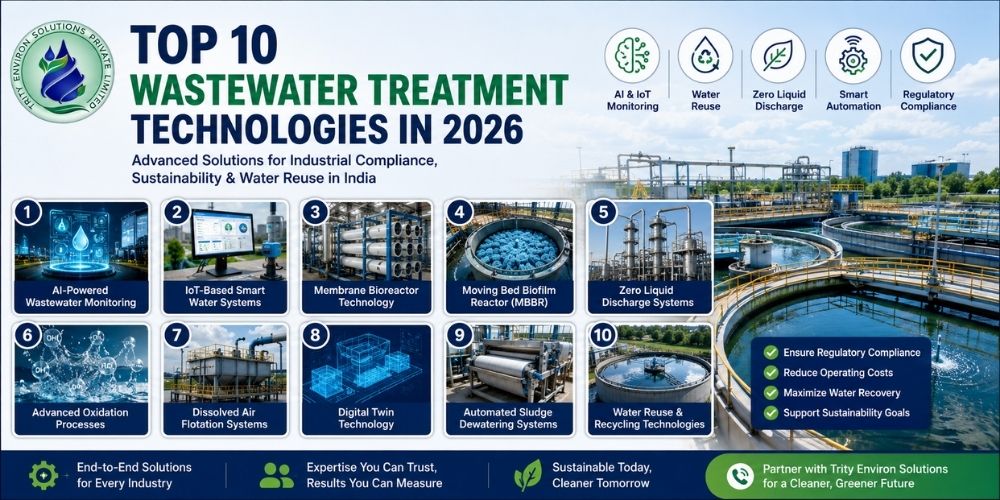
This article covers the ten most significant technologies reshaping industrial and municipal wastewater treatment in 2026, why Indian industries are adopting them rapidly, and what practical benefits they deliver on the ground.
Top Wastewater Treatment Technologies in 2026
- AI-Powered Wastewater Monitoring
- IoT-Based Smart Water Systems
- Membrane Bioreactor Technology
- Moving Bed Biofilm Reactor (MBBR)
- Zero Liquid Discharge Plants
- Advanced Oxidation Processes
- Dissolved Air Flotation Systems
- Digital Twin Technology
- Automated Sludge Dewatering Systems
- Water Reuse and Recycling Technologies
1. AI-Powered Wastewater Monitoring
For most treatment plants, inconsistent effluent quality is not a technology problem, it is a monitoring and response problem. Manual sampling twice a day simply cannot catch the kind of rapid influent fluctuations that pharmaceutical, textile, or food processing effluents throw at a system. By the time a lab result comes back showing a BOD spike, the non-compliant discharge may already have left the plant.
AI-powered wastewater monitoring systems address this directly. Using machine learning algorithms trained on plant-specific operational data, these systems analyze real-time sensor inputs, predict deviations before they breach permitted limits, optimize chemical dosing automatically, and alert operators to equipment stress before it becomes a breakdown.
The operational benefits are concrete. Plants that have integrated AI monitoring report reduced chemical consumption, lower energy costs from optimized aeration, and significantly fewer compliance incidents. For industries under CPCB's online monitoring mandate, AI systems complement CEQMS installations by adding a predictive layer on top of real-time reporting.
Manpower dependency has long been a vulnerability in plant operations. AI monitoring reduces dependence on skilled operators being physically present at all times, which matters especially for night-shift operations and multi-unit industrial facilities.
If your plant is still running on periodic manual testing and reactive fixes, the operational gap is costing you more than you realize. Exploring industrial wastewater treatment solutions with integrated monitoring is a practical starting point for most industries.
2. IoT-Based Smart Water Systems
IoT-based wastewater management involves placing a network of smart sensors, flow meters, pH probes, dissolved oxygen analyzers, and turbidity sensors across the treatment process. All data flows into a centralized dashboard accessible from a phone, laptop, or control room, giving operators complete visibility without needing to physically walk the plant.
The ability to monitor a sewage treatment plant (STP) or effluent treatment plant (ETP) remotely in real time has moved from being a value-add to a near-operational necessity. With CPCB mandating online continuous effluent quality monitoring (CEQMS) for large industries, IoT-enabled plants can stay audit-ready every single day rather than scrambling before inspections.
Predictive maintenance is another significant benefit. Sensors can flag early signs of pump wear, clogged diffusers, or aeration imbalances. Catching these issues before they cause operational downtime protects both treatment continuity and compliance records. A failed aerator that goes unnoticed for 12 hours can devastate biological treatment efficiency and result in a compliance violation.
For multi-site industrial operations managing plants across different locations, a unified IoT dashboard gives environmental managers a consolidated compliance view, which is valuable for corporate sustainability reporting and board-level ESG disclosures.
Water scarcity challenges are also pushing industries to monitor consumption and recovery more precisely. IoT systems make that level of granularity possible across large and complex treatment networks.
3. Membrane Bioreactor Technology
Membrane Bioreactor (MBR) technology combines biological treatment with ultrafiltration or microfiltration in a single compact system. It eliminates the need for secondary clarifiers by using membranes to separate treated water from the biological sludge. The result is consistently high-quality effluent, often meeting tertiary treatment standards without any additional polishing stage.
For industries where treated water will be recycled back into production processes, MBR provides a reliable and compact solution. The footprint is considerably smaller than conventional activated sludge systems, which is a real advantage for industries operating in dense industrial estates or urban locations where space is constrained.
MBR has seen strong adoption in India's pharmaceutical sector, commercial real estate, hospitality, and new township STP installations. Hospitals and pharmaceutical manufacturing units that generate high-strength effluent with complex organic compounds particularly benefit from MBR's superior removal efficiency.
Membrane fouling is the primary maintenance consideration. Regular chemical cleaning cycles, typically using sodium hypochlorite or citric acid, are necessary to maintain flux rates. Membrane replacement every five to eight years is a lifecycle cost that should be factored into any MBR investment decision. When properly designed and maintained, MBR systems deliver consistent performance over long operational periods and reduce the total cost of tertiary treatment significantly.
For new STP installations or existing plants requiring a quality upgrade, consulting an experienced STP manufacturer with MBR expertise ensures the system is properly sized and configured for your specific effluent profile.
4. Moving Bed Biofilm Reactor (MBBR)
MBBR technology enhances biological treatment by introducing small plastic carrier media into aeration tanks. These carriers circulate freely in the mixed liquor, and their internal surfaces provide an extremely large area for biofilm colonization. The biofilm communities are dense, active, and highly effective at breaking down BOD, COD, and ammonia nitrogen.
What makes MBBR particularly attractive in the Indian industrial context is its retrofit compatibility. An existing activated sludge system operating at 60 to 70 percent of its design capacity can often be upgraded to handle significantly higher loads simply by adding MBBR carriers. No new civil construction. No major equipment replacement. This approach has helped many industrial facilities manage growing effluent loads without the capital expenditure and downtime of a full plant rebuild.
MBBR handles load variations better than conventional systems because the biofilm adapts over time. This resilience is useful in food and beverage processing, breweries, distilleries, and municipal STPs where influent strength fluctuates daily depending on production schedules.
From an operational standpoint, MBBR generates less excess sludge than conventional activated sludge, directly reducing sludge disposal costs, which are often a significant and underappreciated operating expense. Carriers require minimal maintenance and typically last 10 to 15 years under normal operating conditions.
MBBR is increasingly specified in new sewage treatment plant designs across India, both for greenfield projects and for capacity augmentation of aging municipal and industrial systems.
5. Zero Liquid Discharge Systems
Zero Liquid Discharge (ZLD) is no longer a voluntary sustainability initiative. For textiles, distilleries, tanneries, thermal power plants, and sugar mills operating in India, ZLD is a regulatory requirement enforced by CPCB and State Pollution Control Boards. Non-compliance carries the risk of plant closure notices, which have been issued with increasing frequency in Gujarat, Tamil Nadu, and Maharashtra.
A ZLD system treats industrial wastewater through multiple stages, typically biological treatment, ultrafiltration, reverse osmosis, and evaporation or crystallization, recovering virtually all water for reuse within the plant. Concentrated brine or crystallized salts are the only outputs, collected as solid waste for disposal.
The upfront capital investment is substantial, and that is the honest answer. However, the financial calculus changes significantly in water-stressed industrial zones where freshwater procurement costs are high and environmental penalties for non-compliance are severe. Many industries in Rajasthan, Gujarat, and Tamil Nadu have seen ZLD pay for itself within three to five years purely from avoided water purchase costs and elimination of consent-to-operate renewal complications.
The critical factor in ZLD performance is whether the system is designed specifically for your effluent composition. High TDS, specific contaminants, or variable flow rates all affect which treatment train is appropriate. Generic packaged ZLD systems often underperform or face frequent operational issues in real industrial conditions. A customized ZLD plant developed by experienced wastewater treatment consultants accounts for these variables from the outset and avoids the costly re-engineering that poor initial design typically requires.
6. Advanced Oxidation Processes
Advanced Oxidation Processes (AOPs) generate highly reactive hydroxyl radicals that break down complex organic compounds which conventional biological treatment cannot degrade. Common configurations include ozonation, UV combined with hydrogen peroxide, Fenton's reagent, and photocatalytic oxidation.
Pharmaceutical effluents, pesticide manufacturing discharge, and textile dye effluents contain persistent organic pollutants that pass through biological treatment largely intact. AOPs oxidize these recalcitrant compounds into simpler molecules that biological systems can then process, or convert them directly into carbon dioxide and water.
In India's pharmaceutical cluster zones around Hyderabad, Ahmedabad, and Baddi, AOP systems are increasingly being integrated as pre-treatment or polishing stages in industrial ETPs. Growing scrutiny of pharmaceutical effluent quality by regulatory bodies and export compliance requirements are driving this adoption.
AOP systems consume more energy and require careful chemical handling compared to biological treatment. They work most cost-effectively as part of a combined treatment train rather than as standalone solutions. An AOP stage positioned correctly within the overall treatment sequence reduces the load on downstream biological systems and improves final effluent quality substantially.
7. Dissolved Air Flotation Systems
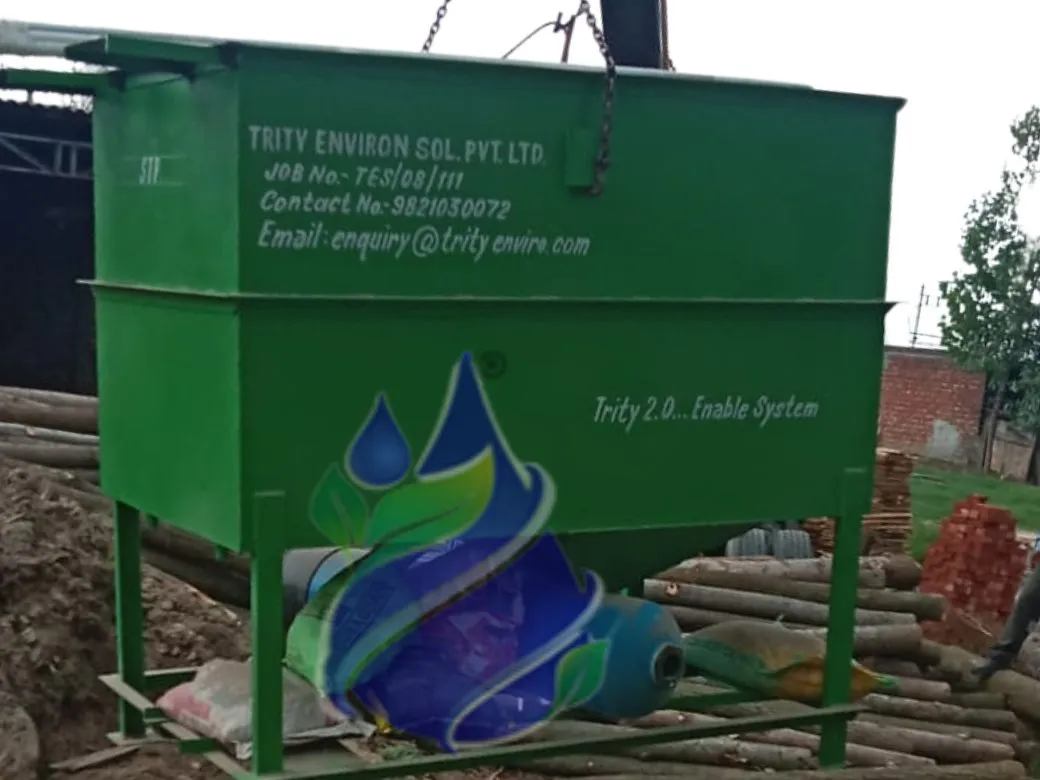
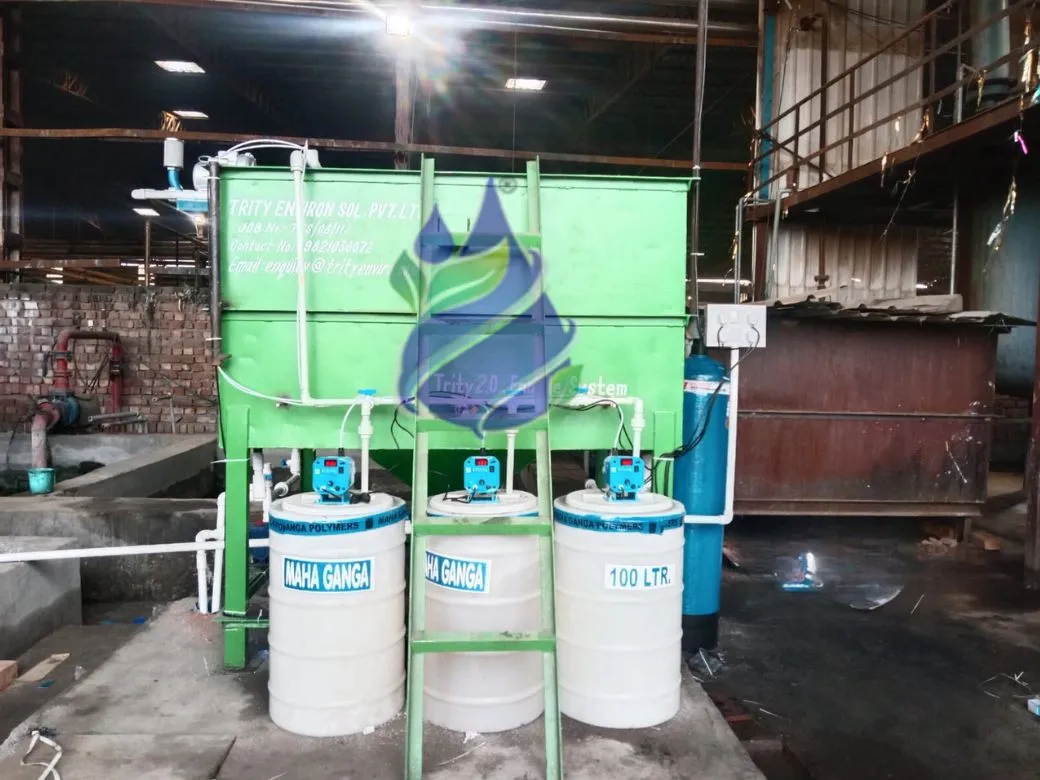
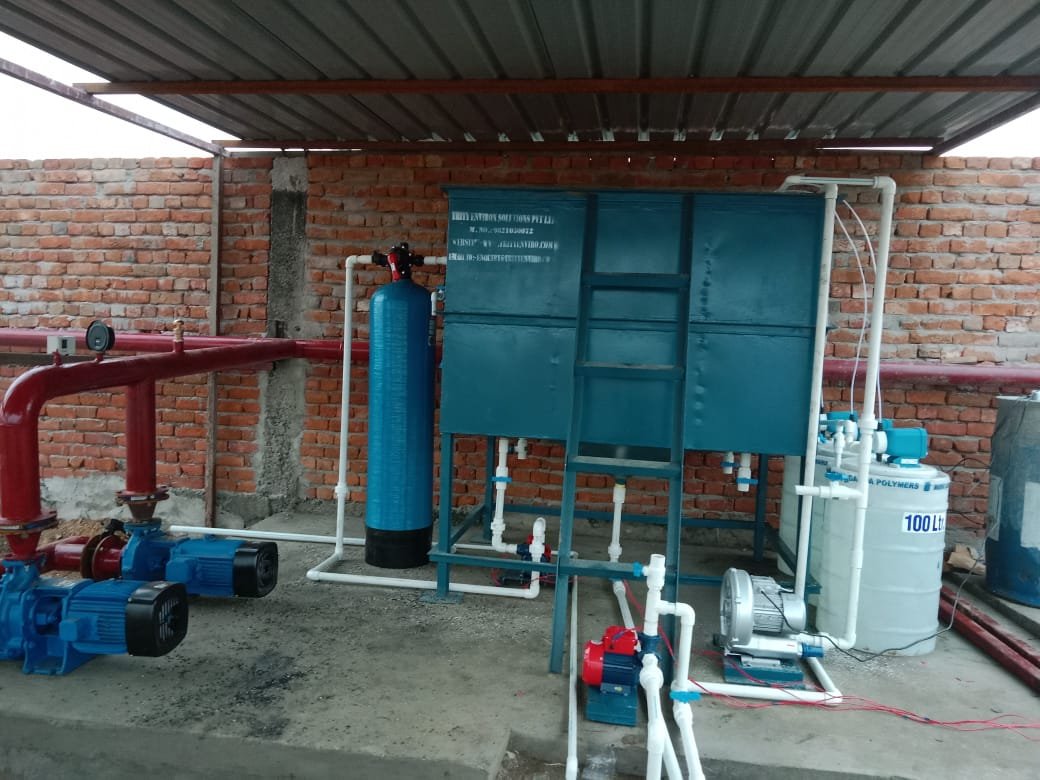
Dissolved Air Flotation (DAF) is a proven primary treatment technology for removing suspended solids, fats, oils, and greases (FOG) from wastewater. Micro-bubbles generated by releasing pressurized, air-saturated water into the treatment tank attach to solid particles and float them to the surface, where a mechanical skimmer removes the accumulated float.
DAF is a staple in food processing, dairy, poultry, fish processing, and paper manufacturing facilities, where FOG and suspended solids concentrations in raw effluent are consistently high. Effective primary treatment with DAF dramatically reduces the BOD and TSS load entering the biological treatment stage, improving overall system efficiency and reducing operating costs downstream.
Modern DAF units include automated control of skimmer speed, recycle ratio, and chemical coagulant or flocculant dosing. This level of automation significantly improves consistency, especially when influent quality fluctuates across production shifts. Plants that previously required constant manual adjustment have seen notable reductions in chemical consumption after automation upgrades.
The operational simplicity of DAF, combined with its reliable performance history, makes it one of the more dependable primary treatment investments available. Maintenance is straightforward, downtime is minimal, and performance is largely predictable when the system is properly sized and chemical dosing is correctly calibrated.
8. Digital Twin Technology
A digital twin is a virtual, dynamic model of a physical treatment plant built from actual process data. It mirrors what is happening in the real system in near real-time and allows engineers and plant managers to simulate process changes, model capacity scenarios, or troubleshoot operational problems without touching the live plant.
This has real practical value during plant upgrades and expansions. Before any civil or mechanical work begins, a digital twin allows the engineering team to test whether a proposed change will deliver the expected results under various influent conditions. Mistakes that would otherwise be discovered during costly commissioning are identified and corrected at the simulation stage.
In India, where a large number of industrial STPs and ETPs are being upgraded to comply with revised CPCB standards, digital twins are being used in the engineering and design phase of these projects. They shorten commissioning timelines, reduce project risk, and help plant operators build operational confidence before going live with new process configurations.
For large municipal STPs or multi-stage industrial treatment facilities, integrating digital twin capabilities with live IoT data creates a continuous performance intelligence layer that supports both day-to-day operation and longer-term capital planning decisions.
9. Automated Sludge Dewatering Systems
Sludge management is one of the more expensive and often poorly optimized aspects of industrial wastewater treatment. Every STP and ETP generates sludge as a biological and chemical treatment byproduct. How that sludge is handled directly affects operational costs, environmental compliance, and the overall efficiency of the treatment system.
High sludge disposal costs stem largely from poor dewatering. Wet, poorly conditioned sludge is heavy, expensive to transport, and difficult to dispose of compliantly. Automated sludge dewatering systems using screw press or belt filter press technology, combined with integrated polymer dosing controls, address this by producing consistently drier sludge cakes with lower transport volumes.
Automated polymer dosing is particularly important. Polymer requirement varies with sludge characteristics, which change constantly in most industrial facilities. Manual polymer addition tends to be inconsistent, leading to either overdosing that wastes chemical, or underdosing that produces wet cake. Automated systems optimize polymer consumption in real time, providing measurable chemical cost savings month over month.
For industries with significant sludge generation, such as textile ETPs, food processing plants, and municipal STPs, well-designed sludge dewatering can reduce overall sludge handling costs by 30 to 50 percent compared to poorly managed conventional systems. In some cases, dewatered sludge can be co-processed in cement kilns or used as soil amendment depending on its composition and applicable state regulations.
Integrating automated sludge handling into the initial ETP design is far more cost-effective than retrofitting it later. It also protects biological treatment stages from the sludge bulking issues that arise when dewatering is unreliable.
10. Water Reuse and Recycling Technologies
Industrial water reuse has moved past being an environmental responsibility talking point. It is a direct response to rising freshwater costs, tightening water allocation policies, and increasing water scarcity challenges in industrial corridors across India.
Water reuse systems are designed around the intended application. Process cooling reuse, boiler feed reuse, toilet flushing, and landscape irrigation all require different treated water quality standards. The treatment train, typically combining tertiary filtration, RO systems, and UV disinfection, is configured to meet those specific standards consistently.
In textile and paper manufacturing, treated water reuse rates of 70 to 80 percent are achievable with well-designed systems. For commercial buildings, institutions, and IT parks, treated greywater and sewage can cover a substantial share of non-potable demand, meaningfully reducing municipal water consumption and utility bills.
Beyond operational savings, water recycling systems support ESG commitments that are increasingly scrutinized by investors, international buyers, and sustainability certification bodies. Export-oriented manufacturers in textiles, garments, and food processing face growing buyer-side requirements for demonstrated water stewardship. A documented industrial water recycling program backed by actual recovery data is a concrete differentiator in those conversations.
Getting the treatment design right for your specific effluent quality and reuse application is what separates a high-performing water reuse system from one that delivers inconsistent results. Working with a wastewater treatment company in India that understands both the technical requirements and the regulatory framework ensures the system performs as intended from commissioning onward.
Technology Comparison Table
| Technology |
Primary Application |
Key Benefit |
Industries Best Suited |
| AI Monitoring |
Process optimization |
Predictive compliance, lower chemical use |
Pharma, textiles, food processing |
| IoT Smart Systems |
Remote real-time monitoring |
Audit-ready visibility, reduced downtime |
Multi-site industrial, commercial |
| MBR Technology |
Biological + membrane filtration |
Compact, reuse-quality effluent |
Pharma, hospitality, real estate STP |
| MBBR |
Biological treatment upgrade |
Retrofit-friendly, lower sludge output |
Food, breweries, municipal STP |
| ZLD Systems |
Total effluent recovery |
Zero discharge compliance |
Textiles, distilleries, thermal power |
| Advanced Oxidation |
Recalcitrant pollutant breakdown |
Degrades persistent organics |
Pharma, dyes, pesticide effluents |
| DAF Systems |
Primary treatment |
FOG and TSS removal |
Dairy, food processing, paper mills |
| Digital Twin |
Process simulation and planning |
Risk-free optimization and upgrades |
Large-scale STP and ETP upgrades |
| Automated Sludge Dewatering |
Sludge management |
Lower disposal costs, consistent cake dryness |
Textile ETP, food, municipal STP |
| Water Reuse Systems |
Water recovery and recycling |
Freshwater cost reduction, ESG compliance |
Water-stressed industrial zones |
Future Outlook
The next five years will bring more automation, sharper data intelligence, and deeper integration between treatment stages. Electrochemical treatment, bio-electrochemical systems, and nutrient recovery technologies are gaining early commercial ground. AI models will become more plant-specific and predictive as operational datasets mature. And the gap between facilities running modern treatment systems and those running aging infrastructure will widen on every front, compliance, cost, and operational reliability.
Regulatory pressure in India is not easing. CPCB and State Pollution Control Boards are revising discharge standards, expanding the industries subject to online monitoring, and enforcing ZLD requirements more actively. Industries that upgrade their treatment infrastructure now absorb those changes without operational disruption. Those that delay will face compliance crises at the least convenient moments.
Choosing the right ETP design company or STP manufacturer in India makes a measurable difference in how these technologies perform in practice. Equipment alone does not determine outcomes. System design, integration quality, commissioning rigor, and ongoing operational support all shape how well a plant actually performs against its targets. Trity Environ Solutions works with industries across India as an end-to-end wastewater treatment plant manufacturer, designer, and implementation partner, helping facilities select and deploy the right technologies for their specific effluent challenges and compliance requirements.
Frequently Asked Questions
1. What is the most cost-effective wastewater treatment technology for small industries?
For small to medium-scale industries, MBBR and DAF systems typically deliver the best balance between capital investment and treatment performance. MBBR is attractive for biological treatment because of its compact design, retrofit compatibility, and lower sludge generation. DAF handles primary treatment of high FOG effluents efficiently at relatively low operating cost. In many cases, combining both as a two-stage system provides comprehensive primary and secondary treatment within a manageable budget.
2. Is Zero Liquid Discharge mandatory for all industries in India?
ZLD is currently mandatory for specific regulated sectors including textiles (wet processing), distilleries, tanneries, sugar mills, and thermal power plants under CPCB and State Pollution Control Board directives. Industries operating in critically polluted industrial clusters or water-stressed zones may also face ZLD requirements regardless of sector. Given how frequently these regulations are revised, verifying current requirements for your specific industry and state with qualified wastewater treatment consultants is advisable before making any investment decisions.
3. How does IoT monitoring improve wastewater treatment compliance?
IoT-based monitoring provides continuous, real-time data on effluent parameters including pH, BOD, COD, TSS, dissolved oxygen, and flow rates. This supports CPCB's CEQMS mandate for large industrial units and ensures that compliance data is accurate, continuous, and auditable. Automated threshold alerts allow operators to respond to parameter deviations immediately, reducing the risk of violations. The system also builds a time-stamped data record that is invaluable during regulatory inspections or consent renewal applications.
4. Can existing ETPs and STPs be upgraded to incorporate modern technologies?
Yes, and most upgrades can be done without major civil reconstruction. MBBR carrier media can be added to existing aeration tanks to increase biological treatment capacity. IoT sensors and monitoring systems can be retrofitted across most existing plant configurations. Automated sludge dewatering can be added as a standalone module. The feasibility, cost, and scope of any upgrade depends on available space, existing infrastructure condition, and target effluent quality. A site assessment by experienced wastewater treatment consultants is the right starting point before committing to any upgrade investment.
5. What is the difference between MBR and MBBR technology?
MBR (Membrane Bioreactor) integrates biological treatment with membrane filtration to produce high-quality effluent suitable for direct reuse in a single compact unit. It replaces secondary clarifiers with ultrafiltration membranes. MBBR (Moving Bed Biofilm Reactor) uses plastic biofilm carriers to enhance biological treatment capacity within existing or new aeration systems. MBR delivers superior effluent quality and is preferred where water reuse is the primary goal. MBBR is preferred for capacity augmentation, retrofit projects, and systems where cost-effective biological treatment upgrade is the priority. Both technologies can also be combined as an MBBR-MBR hybrid system for facilities requiring both high capacity and high effluent quality output.