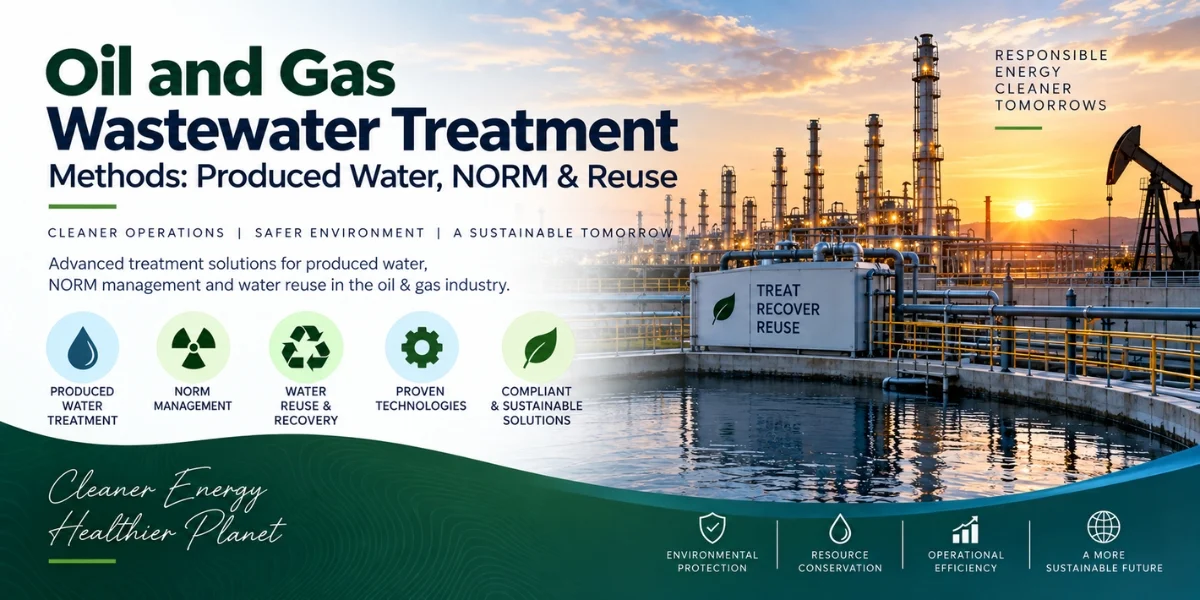
Oil and Gas Wastewater Treatment Methods: Produced Water, NORM & Reuse
A complete guide to oil and gas wastewater treatment, produced water, de-oiling, NORM removal, and desalination, from an experienced ETP manufacturer.

 ISO 9001:2015 & QCI Approved
Building a wastewater treatment plant is one thing. Keeping it running efficiently, compliantly, and within budget for years is a different challenge entirely. This guide breaks down the four biggest operational hurdles plants actually face and what works to solve them.
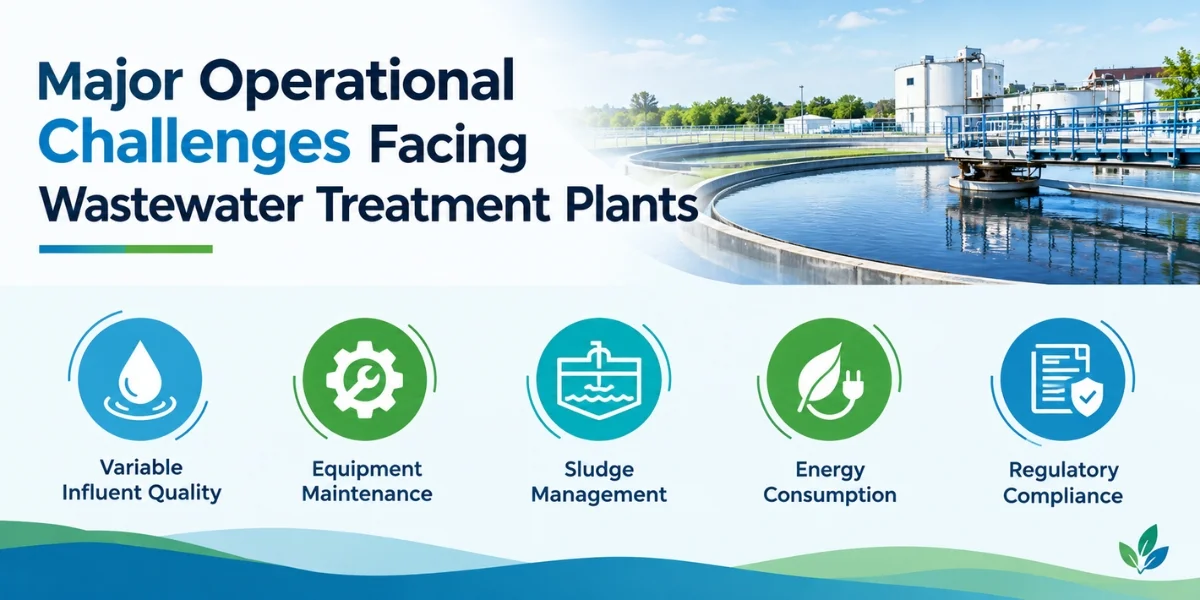
A wastewater treatment plant is the facility that treats sewage or industrial wastewater from domestic, commercial, or industrial sources before it is released back into the environment or reused, removing contaminants, pollutants, and pathogens along the way. Getting one designed and commissioned by an experienced wastewater treatment plant manufacturer is a major milestone, but it is only the starting point. Running a wastewater treatment plant efficiently, day after day, year after year, involves a set of operational challenges that catch many facility owners off guard, since the problems that show up after commissioning are rarely the ones anticipated at the design stage, or the ones a less experienced STP manufacturer or ETP supplier accounts for upfront. This guide covers the four major categories of operational challenge that wastewater treatment plants across India actually face, energy consumption, sludge management, regulatory compliance, and workforce and budget constraints, along with the practical solutions that address each one.
Aging infrastructure is one of the most persistent operational challenges facing wastewater treatment plants, particularly those built more than 10-15 years ago. Ageing pumps, blowers, and civil structures need increasing maintenance to keep running reliably, and every additional year of deferred upgrades raises both the maintenance cost and the risk of unplanned failure disrupting treatment continuity. Compounding this, most plants were sized for the population or production volume expected at design time, and continued urbanization or business growth steadily pushes actual load beyond original capacity, straining infrastructure that was never meant to handle today's volume.
Energy consumption compounds the infrastructure challenge further, and the scale of this cost is often underestimated. Wastewater treatment is estimated to consume 2-3% of a developed nation's total electrical power, and within a typical plant, biological treatment processes, primarily aeration, account for roughly 50-60% of total plant energy use. Since aeration blowers run continuously to keep biological treatment stages functioning, energy cost is not a marginal operating expense, it is frequently one of the largest line items in a plant's annual budget.
Practical solutions: Fine bubble diffusers and membrane-based aeration systems improve oxygen transfer efficiency significantly compared to older coarse bubble systems, directly cutting blower energy demand. Scheduled preventive maintenance on pumps, blowers, and motors catches efficiency losses before they compound into full failures. For plants approaching or exceeding original design capacity, modular expansion using technologies like MBBR sewage treatment plant or SBR sewage treatment plant systems, sourced from an experienced STP manufacturer, allows capacity to be added in stages without a full rebuild of existing infrastructure.
Sludge management is arguably the most underrated operational challenge in wastewater treatment, and one that many facility owners do not fully appreciate until the plant is already running. Every wastewater treatment plant generates sludge as a natural byproduct of the physical, chemical, and biological treatment process, and disposing of this sludge safely and consistently is a genuine, ongoing operational burden rather than a one-time consideration.
Beyond routine sludge volume, plants also face specific process upsets that disrupt day-to-day operation: sludge overflow when solids are not retained properly in clarification tanks due to poor flocculation or hydraulic overloading, excess foam and odour caused by filamentous bacteria growth or fats, oils, and grease entering the biological stage, and inefficient dewatering that leaves sludge too wet for cost-effective disposal or transport.
Practical solutions: A properly sized filter press or sludge dewatering system manufacturer-supplied equipment significantly reduces sludge volume before disposal, cutting both transport cost and landfill burden. Targeted coagulant and flocculant dosing addresses poor settling and sludge overflow at the source rather than after the fact. For plants dealing with recurring odour or foam problems, reviewing upstream oil and grease loading, and adding a dissolved air flotation (DAF) system or oil separation stage ahead of biological treatment, often resolves the underlying cause rather than just managing symptoms downstream.
Wastewater treatment plants operate under a layered regulatory structure, national laws set by the CPCB, state-level norms from the relevant State Pollution Control Board, and local municipal requirements that can vary significantly even between neighbouring jurisdictions. National and state regulations tend to be relatively consistent and easier to plan around, but local compliance requirements are where most plants run into difficulty, since discharge limits, reporting formats, and inspection expectations can differ from one municipality to the next.
Digital monitoring is also becoming a bigger part of the compliance picture. Centralised online tracking systems now allow pollution control authorities to monitor plant discharge data more closely than in the past, and non-compliance increasingly carries direct financial consequences through environmental compensation levied under the Polluter Pays principle, rather than just a warning notice.
Practical solutions: Confirming exact local discharge norms with the relevant municipal and state authority before finalizing plant design, rather than assuming national standards alone will suffice, avoids costly retrofits later. Maintaining consistent discharge quality records and testing schedules, ideally through automated online monitoring of key parameters like BOD, COD, and TSS, keeps a plant audit-ready at all times rather than scrambling before an inspection. Partnering with an experienced STP plant manufacturer or ETP manufacturer whose design already accounts for local variation reduces the risk of non-compliance surprises after commissioning.
Operating a wastewater treatment plant is a round-the-clock responsibility that depends on trained, certified personnel who understand both the biological process and the mechanical equipment involved. Globally and in India, the water and wastewater sector faces a growing workforce gap as experienced operators retire faster than new technicians are trained to replace them, and operator management alone can account for a substantial share, sometimes up to 30%, of a plant's total operational cost. Budget constraints compound this problem directly, since a facility without adequate budget cannot retain or train the skilled staff its treatment process genuinely requires, creating a cycle where technical corners get cut precisely where they matter most.
Climate change adds a further layer of operational risk that is becoming harder to ignore. More frequent and severe weather events, particularly heavy rainfall and flooding, can overwhelm hydraulic capacity, damage electrical and civil infrastructure, and disrupt treatment continuity in ways that older plant designs did not account for.
Practical solutions: Automation and SCADA-based monitoring reduce the day-to-day burden on operators by handling routine dosing, aeration control, and alarm monitoring without constant manual intervention, directly addressing both the workforce shortage and the operator cost line item. For facilities without the scale to justify a full in-house technical team, a professional Annual Maintenance Contract or outsourced operation and maintenance arrangement provides certified staffing and consistent performance without the overhead of a permanent large crew. On climate resilience, designing adequate hydraulic buffer capacity and elevating critical electrical equipment above expected flood levels are low-cost design choices at the outset that prevent expensive operational disruption later.
| Facility Type | Most Pressing Operational Challenge | Practical Focus Area |
|---|---|---|
| Municipal STP serving a growing township | Capacity strain from urbanization | Modular expansion, energy-efficient aeration |
| Industrial ETP for manufacturing units | Sludge management and process upsets | Dewatering equipment, dosing optimization |
| Housing societies with in-house STP | Skilled workforce and budget constraints | AMC and O&M outsourcing, automation |
| Coastal or flood-prone facility locations | Climate resilience | Hydraulic buffer design, elevated critical equipment |
Trity Environ Solutions is a leading sewage treatment plant manufacturer and effluent treatment plant manufacturer in India, designing sewage treatment plants and effluent treatment plants with these operational realities built into the design from day one, not addressed only after a plant starts underperforming. As an experienced wastewater treatment plant manufacturer and supplier, our engineering team accounts for realistic energy consumption, sludge handling requirements, and local compliance variation at the design stage, and every installation is backed by pan-India Annual Maintenance Contract and operation and maintenance support, so facilities without a large in-house technical team still get consistent, compliant performance for years. We are ISO 9001:2015 certified, QCI approved, and deliver CPCB-compliant engineering across municipal, residential, and industrial projects nationwide.
Energy consumption is typically the largest ongoing operational cost, with biological treatment processes like aeration accounting for roughly 50-60% of a plant's total energy use. Skilled operator management is the second major recurring cost, sometimes accounting for up to 30% of operational expense.
Every wastewater treatment plant generates sludge as a byproduct of treatment, and disposing of it safely and consistently, while avoiding process upsets like sludge overflow, foam, or odour, is an ongoing operational task that many facility owners underestimate until the plant is already running.
SCADA-based automation handles routine functions like dosing, aeration control, and alarm monitoring without constant manual intervention, reducing the daily burden on operators and helping facilities manage a growing global shortage of trained wastewater treatment personnel.
National and state-level discharge norms tend to be relatively consistent, but local municipal requirements can vary significantly between jurisdictions, and plants operating without confirming exact local norms at the design stage often face costly retrofits later.
More frequent and severe weather events, particularly heavy rainfall and flooding, can overwhelm a plant's hydraulic capacity and damage electrical or civil infrastructure not originally designed with this level of climate variability in mind, making resilience a growing part of operational planning.
Look for a manufacturer that designs around real operational constraints, energy-efficient aeration, adequate sludge handling capacity, and local compliance variation, rather than just a minimum-cost commissioning quote. Trity Environ Solutions is an ISO 9001:2015 certified STP and ETP manufacturer that builds these considerations into every plant design and backs installations with pan-India AMC and O&M support.
Facing operational challenges with your existing wastewater treatment plant, or planning a new installation?
Call +91-9821030072 or email enquiry@trityenviro.com, or request a free site assessment and our engineering team will help you design or optimize a plant built for real-world operating conditions.
A complete guide to oil and gas wastewater treatment, produced water, de-oiling, NORM removal, and desalination, from an experienced ETP manufacturer.
Learn how small changes in water pressure affect treatment systems, causing inefficiency, equipment wear, and poor water quality. Discover monitoring and regulation strategies.

Discover how eco-friendly technologies in wastewater treatment are redefining sustainability by improving efficiency, reducing costs, and promoting cleaner water for future generations.

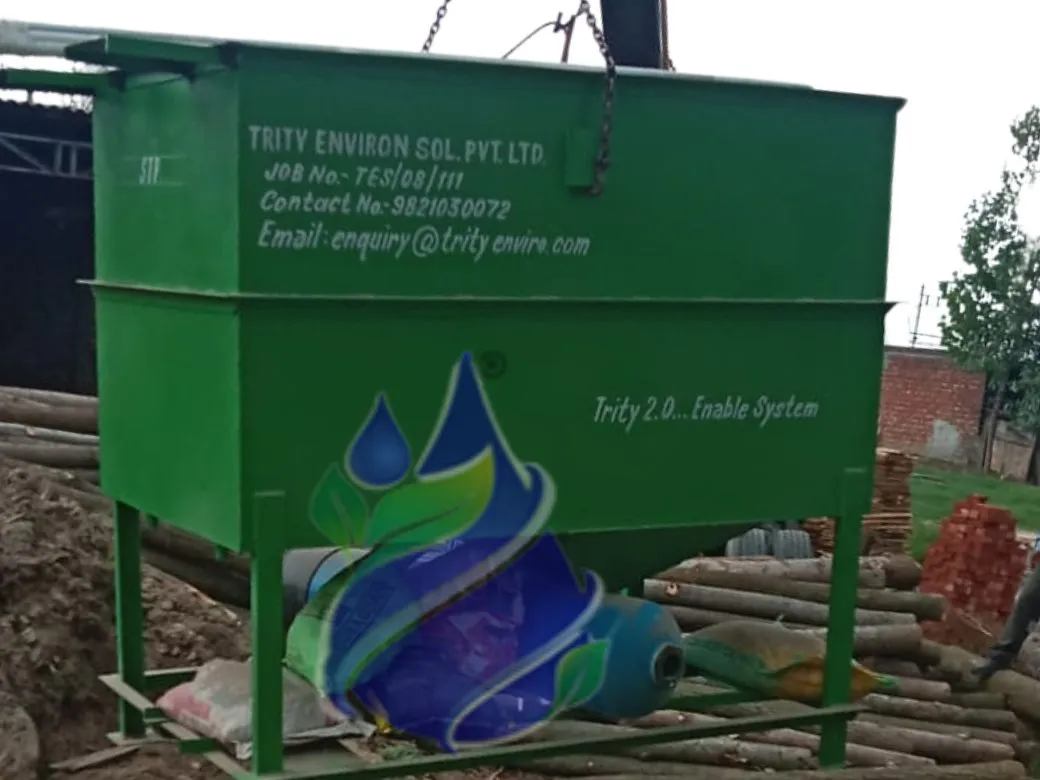



Discuss your requirements with our engineering team and get practical guidance for your project.