We are the best manufacturers and suppliers of MBBR Media in India. Moving bed biofilm reactor manuf...
Get a Free QuoteMBBR Bio Media is the core component of any Moving Bed Biofilm Reactor system. Without the right media, even a correctly designed MBBR reactor will underperform. The biofilm that grows on each media piece does the actual biological treatment work inside the reactor.
India's wastewater treatment sector is growing fast. Thousands of new STP and ETP plants start up every year. Contractors, ETP consultants, pharmaceutical units, food processors, and municipal project developers all need a reliable MBBR Media Manufacturer who understands biofilm growth, material durability, and system performance requirements.
Trity Enviro Solutions manufactures and supplies MBBR Bio Media from our production facility in Ghaziabad, Delhi NCR. We serve industrial factories, STP contractors, ETP consultants, pharmaceutical plants, food processing units, hotels, hospitals, real estate developers, and municipal projects across India.
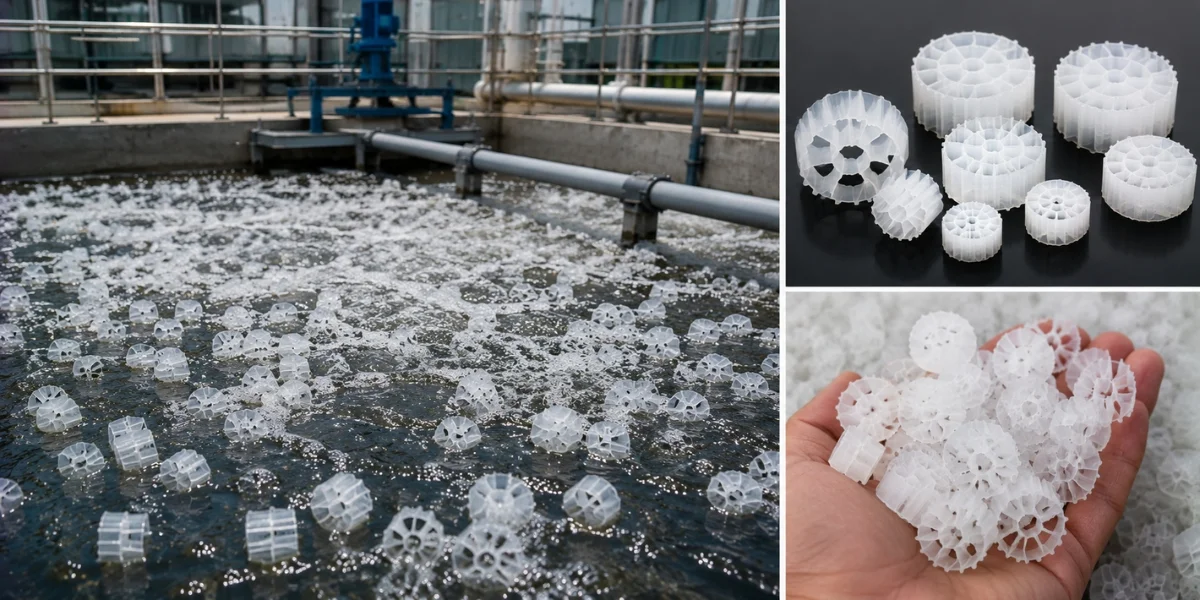
MBBR stands for Moving Bed Biofilm Reactor. The bio media placed inside this reactor carries a living biofilm of aerobic microorganisms. These organisms break down dissolved organic matter present in wastewater.
Each media piece has an internal protected surface area. This structure shields the biofilm from mechanical damage caused by air agitation and continuous water movement inside the reactor tank.
Unlike conventional activated sludge systems, MBBR technology keeps the biomass attached to the carrier. This makes the system more stable and more compact. The plant handles shock loads better without losing biological activity.
The media floats freely inside the aeration tank. Air supply through a diffused aeration system keeps it in continuous motion. This movement ensures uniform contact between wastewater, dissolved oxygen, and biofilm across the entire reactor volume.
Surface area per cubic metre of media is the most critical specification. Higher protected surface area means more biofilm per unit of reactor volume, which directly improves treatment efficiency.
When raw wastewater enters the MBBR reactor, it contacts thousands of freely moving plastic carrier media pieces. Aerobic bacteria colonise the surface of each carrier and form a dense, active biofilm layer.
The biofilm organisms consume dissolved organics, including BOD, COD, and nitrogen compounds. This aerobic treatment process brings contaminant concentrations down to levels suitable for discharge or further polishing treatment.
Air supply from the diffused aeration system keeps the media in continuous movement. It also provides the dissolved oxygen that aerobic microorganisms require to remain active. Maintaining dissolved oxygen above 2 mg/L inside the reactor is essential for stable biofilm health.
The treated effluent passes through retention screens at the reactor outlet. These screens hold the media inside the tank while allowing clarified water to flow forward to the next treatment stage.
In STP systems, correctly loaded MBBR technology reduces BOD by 85 to 95 percent. In industrial ETP plants, it handles high COD loads effectively when designed with the right media type and filling ratio.
Engineering Note: The most common failure we see in MBBR systems is excessive media filling. Overfilling the reactor above 65 percent of tank volume restricts media movement, reduces oxygen transfer, and weakens biofilm performance. Always follow the filling percentage specified for your media type and reactor design.
MBBR bio media works across a wide range of treatment applications. Industry-specific use cases include the following.
Industrial Effluent Treatment Plants (ETP): Textile, pharmaceutical, food processing, and chemical industries use MBBR technology to treat high-COD effluent before discharge. The attached growth process handles variable loads common in industrial production environments.
Municipal and Urban Sewage Treatment Plants (STP): Residential housing societies, townships, and municipal STPs rely on MBBR media for compact, efficient biological treatment. MBBR-based STPs require smaller reactor volumes compared to conventional extended aeration systems.
Pharmaceutical Wastewater Treatment: Pharmaceutical facilities generate effluent with complex organic compounds and active pharmaceutical ingredients. MBBR media supports the robust biological treatment needed to break down these residues before discharge.
Food Processing and Dairy Plants: High organic loads from food production respond well to MBBR-based aerobic treatment. The media handles seasonal and production-based load fluctuations without requiring system shutdown or re-seeding.
Hotels and Commercial Buildings: Commercial STPs for hotels, malls, and office complexes benefit from MBBR technology due to its compact footprint and reduced sludge generation.
Hospitals: Hospital wastewater carries pathogens, pharmaceutical residues, and elevated BOD. MBBR media provides the biological treatment stage before disinfection in hospital STP systems.
Chemical Industries: Effluent from chemical plants contains organic compounds requiring controlled biological treatment. MBBR media supports this process effectively when paired with a pre-treatment system.
Residential Sewage Treatment: Real estate developers and housing societies across Delhi NCR, Noida, Faridabad, Gurgaon, and other industrial zones rely on MBBR-based compact STP systems using our biofilm carrier media.
For complete ETP system design and installation, visit our Effluent Treatment Plant (ETP) page.
For STP solutions across residential, commercial, and industrial applications, see our Sewage Treatment Plant (STP) page.
Trity Enviro Solutions manufactures multiple types of MBBR carrier media to match specific project and loading requirements.
K1 MBBR Media: The K1 media is a cylindrical carrier with internal cross-fins. It offers a protected surface area of approximately 500 sq m per cubic metre. K1 media performs well for domestic sewage applications and light industrial effluent treatment.
K3 MBBR Media: K3 media provides a larger carrier structure with a higher protected surface area and greater biofilm growth capacity. It handles higher organic loading rates reliably. K3 media is widely used in industrial ETP applications across Haryana, Noida, and other industrial zones.
Wheel-Type Media: Wheel-type carrier media offers balanced surface area distribution and good biofilm retention. It suits both STP and ETP reactor configurations where uniform media movement is required.
Tube-Type Media: Tube media provides directional biofilm growth surfaces. It suits specific bioreactor designs where controlled flow patterns improve treatment performance.
Customised MBBR Carrier Media: For specific project requirements, we manufacture customised MBBR media with adjusted dimensions, surface area, and material density. Our engineering team discusses system design requirements before specifying media parameters.
All media types use virgin PE or HDPE material. Density is maintained between 0.92 and 0.96 g/cc to ensure correct floating behaviour inside the reactor tank.
The quality of MBBR bio media directly determines how well your wastewater treatment plant performs. Here is what you gain by specifying correctly manufactured media.
Improved BOD and COD Removal: High surface area media supports a larger active biofilm population. More biofilm per cubic metre of reactor volume means higher removal efficiency for the same reactor size.
Compact Plant Footprint: MBBR-based systems require smaller reactor volumes than conventional systems. This matters enormously for urban STP and ETP plants where civil construction space is limited and expensive.
Lower Sludge Generation: Attached growth systems produce significantly less excess sludge. This reduces sludge dewatering costs and disposal frequency over the plant's operational life.
Stable Biological Treatment: Biofilm attached to the media provides operational stability during load fluctuations. The system recovers faster after shock loads than suspended growth systems.
Easy Capacity Upgrade: Adding more media to an existing reactor increases treatment capacity without expensive civil construction or new reactor installation. This makes MBBR ideal for incremental capacity expansion.
Better Shock Load Handling: Industrial plants experience sudden load increases during production peaks. MBBR media maintains biological activity through these periods without process failure.
Energy-Efficient Treatment: Properly designed MBBR systems operate at lower energy consumption than extended aeration activated sludge systems of equivalent capacity.
Our MBBR media manufacturing facility is located at the GT Road industrial area, Ghaziabad. We use virgin HDPE and PE granules as the base material. No recycled plastic enters our production process.
Injection moulding controls dimensional consistency across every production batch. Surface area per cubic metre is validated against specification at each batch run before packaging.
We test each batch for buoyancy characteristics, structural integrity, dimensional accuracy, and surface finish before dispatch. Media that fails to meet specification does not leave our facility.
Packaging uses standard bulk bag formats suited for long-distance transport across India. We have supplied MBBR media to projects in Delhi NCR, Ghaziabad, Noida, Faridabad, Haryana, Rajasthan, Uttar Pradesh, and states across pan India.
Indian industrial buyers working with MBBR systems often face inconsistency in media quality from unverified suppliers. Low-density or improperly moulded media sinks in the reactor and reduces system performance. Our production process controls these variables at source.
We are not just a media supplier. Our team understands MBBR system design, reactor sizing, filling ratio calculations, and long-term biological treatment performance. This technical depth makes a real difference for clients who need more than just a product price.
When you order MBBR media from us, our engineers provide guidance on media type selection, filling ratio, and aeration requirements at no additional charge. This is practical support that reduces project risk.
We supply bulk quantities for large ETP and STP projects as well as smaller volumes for pilot plants and plant upgrades. Pan India delivery is standard. We handle shipments to industrial zones across Haryana, Delhi NCR, UP, Rajasthan, and beyond.
For complete wastewater treatment solutions that incorporate MBBR technology, visit our Wastewater Treatment Plant page. For turnkey project delivery, explore our Project Execution services.
We supply MBBR bio media for wastewater treatment projects across the following industries.
| Industry | Application |
|---|---|
| Pharmaceuticals | ETP for complex organics and API removal |
| Food Processing and Dairy | High BOD industrial wastewater treatment |
| Textiles and Dyeing | Colour, COD, and effluent biological treatment |
| Chemical Industries | Industrial effluent biological treatment stage |
| Hospitals | STP with pathogen load and pharmaceutical residue management |
| Hotels and Hospitality | Compact commercial STP systems |
| Municipal Contractors | Urban STP for housing and infrastructure projects |
| Commercial Complexes | Space-efficient MBBR-based STP systems |
| Real Estate Developers | Mandatory STP compliance for new construction projects |
| Industrial Wastewater Plants | High-load ETP systems across industrial zones |
Correct operation of MBBR reactors directly depends on how the media performs inside the tank. These guidelines come from field experience across multiple STP and ETP installations.
Maintain Correct Filling Ratio: For aerobic MBBR reactors, a media filling ratio of 30 to 50 percent of reactor volume is standard. Filling above 65 percent restricts media movement and reduces oxygen transfer efficiency.
Monitor Aeration Consistently: The diffused aeration system must maintain dissolved oxygen above 2 mg/L in the reactor. Below this level, aerobic biofilm activity drops and treatment performance declines.
Inspect Outlet Screens Regularly: Screen blockage is the most common operational issue in MBBR systems. Weekly inspection and cleaning prevents media loss and flow restriction issues that reduce treatment efficiency.
Avoid Chemical Overdosing Upstream: Excess coagulant or disinfectant reaching the MBBR zone damages the biofilm. Maintain correct chemical dosing in pre-treatment stages and monitor upstream chemistry carefully.
Allow Adequate Biofilm Establishment: New media requires 4 to 6 weeks for initial biofilm formation and maturation. Do not evaluate treatment performance before biological maturation is complete.
Track Media Inventory: Damaged or worn outlet screens allow media to escape the reactor over time. Regular physical checks of media quantity inside the tank help identify screen damage early.
For ongoing plant operation support, our Operation and Maintenance team handles scheduled inspections, biological health checks, and emergency plant support. We also offer Annual Maintenance Contracts for long-term wastewater plant performance assurance.
MBBR media is a small plastic carrier used inside Moving Bed Biofilm Reactor systems. It provides a protected surface area where aerobic microorganisms grow as a biofilm layer. This biofilm breaks down BOD, COD, and nitrogen in wastewater as the media moves freely through the aeration tank.
The media floats freely inside an aerated reactor. Microorganisms colonise its surface and form a dense biofilm. As wastewater flows through the reactor, the biofilm organisms consume dissolved organic matter and reduce contaminant concentrations.
We manufacture MBBR media using virgin HDPE (High Density Polyethylene) or PE material. Virgin material ensures consistent density, surface finish, and long-term durability. We do not use recycled plastic in our production process.
Our K1 media provides a protected surface area of approximately 500 sq m per cubic metre. K3 media offers a different surface area profile suited to higher organic loading applications. Exact specifications depend on the media type and project requirement.
Under normal operating conditions with correct aeration and flow design, MBBR media lasts 10 to 15 years. Chemical damage, abrasive wastewater, or extreme pH conditions can reduce service life.
The standard filling ratio for aerobic MBBR reactors is 30 to 50 percent of reactor volume. Filling above 65 percent restricts media movement and reduces treatment efficiency.
MBBR technology is used in pharmaceuticals, food processing, textiles, chemicals, hospitals, hotels, residential housing, municipal STPs, and industrial ETPs. Any facility requiring compact, reliable biological wastewater treatment benefits from MBBR.
Yes. We supply bulk MBBR media quantities for large-scale STP and ETP projects across India. We have delivered to projects in Delhi NCR, Ghaziabad, Noida, Faridabad, Haryana, Rajasthan, Uttar Pradesh, and other states.
MBBR media price depends on media type, surface area specification, required quantity, and delivery location. Contact our team with your reactor volume, filling ratio requirement, and media type for an accurate commercial quotation.
Yes. Our engineering team provides free technical consultation covering media type selection, filling ratio calculation, aeration requirements, and system performance expectations. Reach us through the contact page for project-specific guidance.
Discuss your STP or ETP requirements directly with our engineering team. We supply high surface area MBBR bio media for industrial and municipal wastewater treatment projects across India.
Request bulk supply pricing. Get technical consultation on media selection and filling ratios. Discuss your complete STP or ETP project requirements with our engineers.
Pan India delivery. Fast dispatch. Engineering support included.
Call us: +91-9821030072 Email: enquiry@trityenviro.com
Trity Environ Solutions manufacturers and suppliers of STP and ETP Plant in Gurgaon. Sewage Treatment...
No.1 Sewage Treatment Plant Manufacturer & Supplier in India, Trity Environ Solutions manuf....
Trity Environ Solutions manufacturers and suppliers of STP and ETP Plants in Faridabad. Sewage Treatment...
We are Industrial RO Plant Manufacturer in Delhi/NCR, Best Commercial RO Plant...
Trity Environ Solutions manufacturers and suppliers of STP and ETP Plants in Udaipur. Sewage Treatme...
Trusted Industrial Demineralized Water Plant Manufacturers in India for Power Plants, Pharma and Process Industries.
Trity Environ Solutions manufacturers and suppliers of STP and ETP Plant in Kanpur. Sewage Treatment...
Trity Enviro offers Zero Liquid Discharge Plant Systems in India for industrial wastewater treatment, water recovery, and zero discharge compliance across multiple industries.
Trity Enviro is the top leading manufacturer of ETP Plants for the Chemical industries....
Trity Environ Solutions manufacturers and suppliers of STP and ETP Plants in Dehradun. Sewage Treatment...