Diagram of Water Pollution
Explore the water pollution diagram highlighting sources and effects of pollutants. Understand how industrial, agricultural, and residential waste impacts water.

 ISO 9001:2015 & QCI Approved
Explore all types of water softeners in India — ion exchange, salt-free, magnetic & more. Find the right hard water solution for your home or industry in 2026.
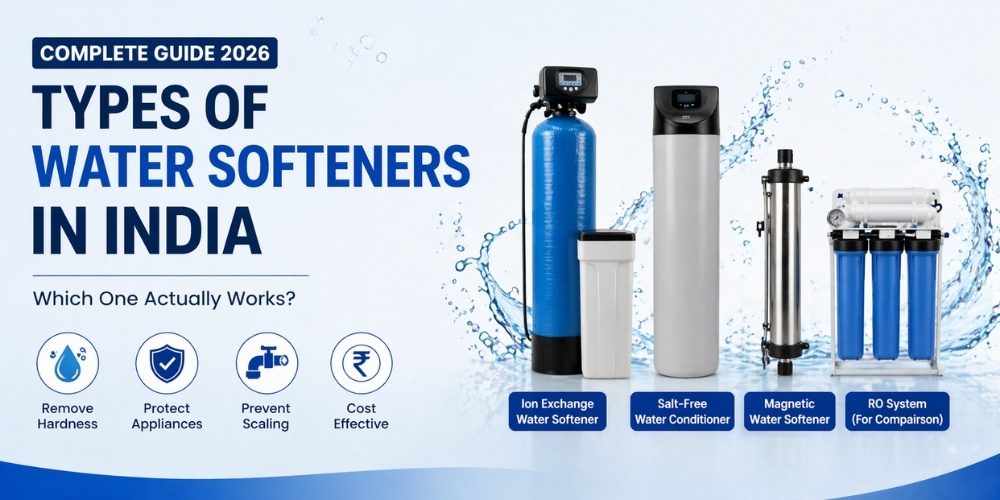
Walk into any hardware store in Ghaziabad, Jaipur, or Ludhiana and ask about water softeners you will likely get three different answers from three different people. One will push a magnetic device. Another will recommend salt-based ion exchange. The third might suggest just installing a better RO. None of them are entirely wrong. But none of them are asking the right question first which is: what does your water actually look like?
Hard water is not a minor inconvenience in India. If you have lived in North India for any length of time, you have seen the white crust forming around taps, the geyser that stopped heating efficiently after two years, the washing machine drum that looks like it has been through a decade of abuse. Borewell water across states like Uttar Pradesh, Rajasthan, Haryana, and Gujarat routinely comes in at hardness levels above 400 mg/L as CaCO3 well into the "very hard" classification. Municipal supply in cities like Faridabad, Meerut, and Delhi NCR frequently tests between 200–350 mg/L. That is more than enough to cause real damage over time.
The market for water softening solutions in India has grown considerably over the last decade. With that growth has come a fair amount of confusion between softeners and purifiers, between conditioning and softening, between what works on paper and what works in a borewell-fed apartment. This guide goes through each type of water softener available in India, explains how it works, where it is most appropriate, and where it falls short.
Most people notice hard water when they see scaling on taps or when their soap refuses to lather. What they often miss is the slower, costlier damage happening inside pipes and appliances. A geyser coil with 5mm of calcium scale loses roughly 8–10% of its heating efficiency. Pipeline joints in hard water areas experience significantly faster corrosion and blockage. In industries textile dyeing units, food processing plants, pharmaceutical facilities hard water causes direct production losses and equipment downtime. Most plant operators only realise the full cost of this after their first major equipment overhaul.
This is the most widely used and technically reliable type of water softener in India and globally. The working principle is straightforward: hard water passes through a tank filled with resin beads coated with sodium ions. As water flows through, calcium and magnesium ions bond to the resin, and sodium ions are released in exchange. The water leaving the tank is chemically softened no calcium, no magnesium.
Over time, the resin becomes saturated and needs regeneration. A brine (salt) solution is flushed through the tank, displacing the captured minerals and restoring the resin for the next cycle. The regeneration cycle typically runs overnight or during low-demand hours.
These systems work differently from ion exchange and this is where many buyers get misled. Salt-free conditioners do not remove calcium and magnesium from water. Instead, they convert these minerals into microscopic crystals that stay suspended in the water rather than bonding to pipe walls and heating surfaces. Technically, these are water conditioners, not softeners — a distinction that matters when you are setting expectations.
No salt, no electricity, no regeneration cycle. Maintenance is minimal. However, if you test the water after passing through a TAC system, the TDS reading will be unchanged the minerals are still present.
These devices use magnetic fields or electromagnetic coils placed around the incoming pipe to alter the charge of mineral ions. The claim is that this prevents the ions from bonding to surfaces, reducing scale formation.
The technology is real, but the evidence is mixed. For low-to-moderate hardness water, some users do see a reduction in new scale formation. For high-hardness borewell water the situation most Indian households and industries actually face the results are inconsistent. Most experienced water treatment engineers treat magnetic softeners as a supplementary measure rather than a primary solution. A decent rule of thumb: if hardness is above 300 mg/L, do not rely on a magnetic device as your only line of defence.
Best suited for: Low-hardness municipal water, as a secondary preventive measure alongside other treatment.
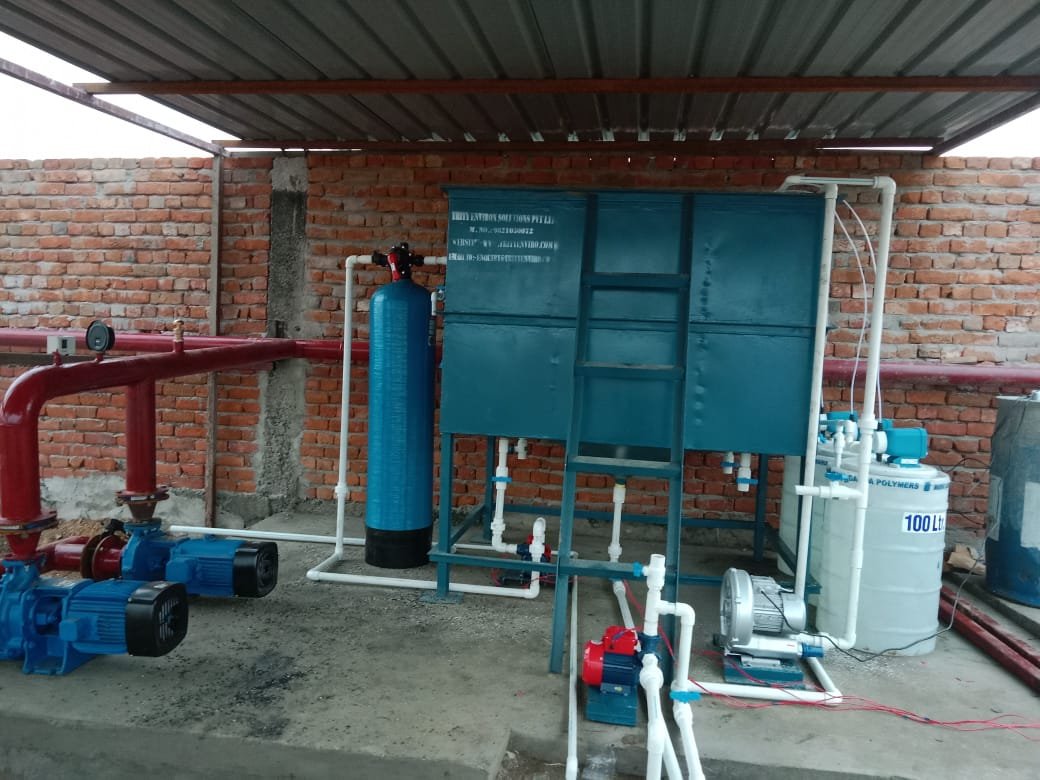
Same principle as standard ion exchange, but with two resin tanks working in alternation. When one tank is in its regeneration cycle, the second takes over — ensuring a continuous, uninterrupted supply of soft water around the clock.
Best suited for: Facilities where soft water supply cannot be interrupted — hospitals, hotels, apartment complexes, food processing units. In a standard single-tank system, there is a 1–2 hour regeneration gap that some operations cannot afford.
Large-scale commercial RO plants often incorporate a pre-softening stage. This is done to protect RO membranes high mineral content in feed water causes premature fouling and shortens membrane life significantly. A water softener upstream of the RO system acts as a pretreatment unit, reducing operating costs and extending the maintenance cycle.
A domestic RO unit does reduce hardness as a byproduct, since RO membranes reject dissolved minerals. But this is a secondary effect, not the system's design purpose — and it should not be treated as a substitute for a dedicated water softener where hardness is the primary concern.
This comparison causes more confusion than almost any other in water treatment. The short version:
An RO system removes a broad range of contaminants dissolved salts, bacteria, heavy metals, nitrates, fluorides, and yes, calcium and magnesium. It is primarily a purification system.
A water softener specifically targets calcium and magnesium. It does not address bacteria, heavy metals, or nitrates. It adds a small amount of sodium to the water in exchange for the hardness minerals it removes.
If the goal is protecting appliances and pipework from scaling a water softener is the right tool. If the goal is drinking water safety and reducing overall dissolved contaminants — an RO system is what you need.
For housing societies, commercial kitchens, hotels, and industrial setups, both are often used together: a softener in the pretreatment line, an RO system for final purification. This combined approach is standard practice in well-designed water treatment plant setups for large-scale installations.
The working principle is the same. The scale and engineering are not.
Domestic units typically handle 25–100 litres per hour, with resin volumes of 1–10 litres. Manual or semi-automatic regeneration, compact enough for a utility room or under-sink installation.
Industrial units range from 500 LPH to 50,000 LPH and above, designed for continuous operation with automated, timer-based regeneration. They are sized based on daily water consumption, inlet hardness, and required output quality.
Practical example: A 150-unit apartment complex in Noida relying on borewell water with hardness of 600 mg/L will typically require a 1,500–2,000 LPH water softener plant. A single household in the same area will manage adequately with a 25–50 LPH domestic unit. Getting the sizing right matters — an undersized unit leads to breakthrough hardness; an oversized unit wastes salt during regeneration.
For a properly engineered solution for housing societies or commercial complexes, a water softener plant designed around actual feed water parameters is the right approach not a catalogue selection.
A few questions worth answering before making a decision:
The types of water softeners available in India today cover a wide spectrum — from compact domestic ion exchange units to large multi-tank industrial systems, salt-free conditioners, and supplementary magnetic devices. No single type suits every situation.
For high-hardness borewell water — which describes a large portion of North and Central India ion exchange remains the most dependable choice. Salt-free conditioners work well for moderate hardness and low-maintenance priorities. Magnetic softeners are supplementary at best in high-hardness situations. And an RO system, while effective at reducing mineral content, is not a substitute for a dedicated softener where protecting appliances and plumbing is the objective.
The starting point for any decision is a water test. Once you know your hardness level, TDS, iron content, and daily demand, the right softener becomes a straightforward engineering decision rather than a guessing exercise.
If you are working on a housing project, apartment complex, or industrial facility and need to design a complete water treatment solution including softening, filtration, and discharge management contact the Trity Enviro Solutions team for a site-specific consultation.
Explore the water pollution diagram highlighting sources and effects of pollutants. Understand how industrial, agricultural, and residential waste impacts water.
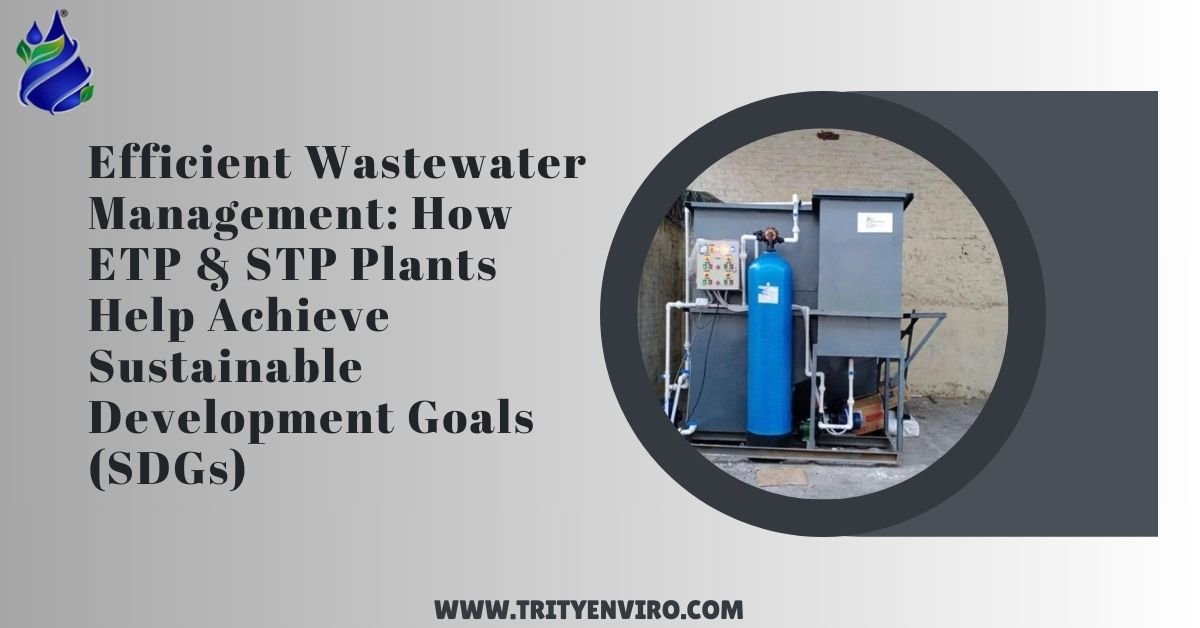
ETPs and STPs play a crucial role in achieving SDGs, ensuring clean water, reducing pollution, and supporting resource conservation for sustainable development.

Explore government policies, subsidies, and incentives driving sustainable water reuse for industries, agriculture, and urban infrastructure in India.

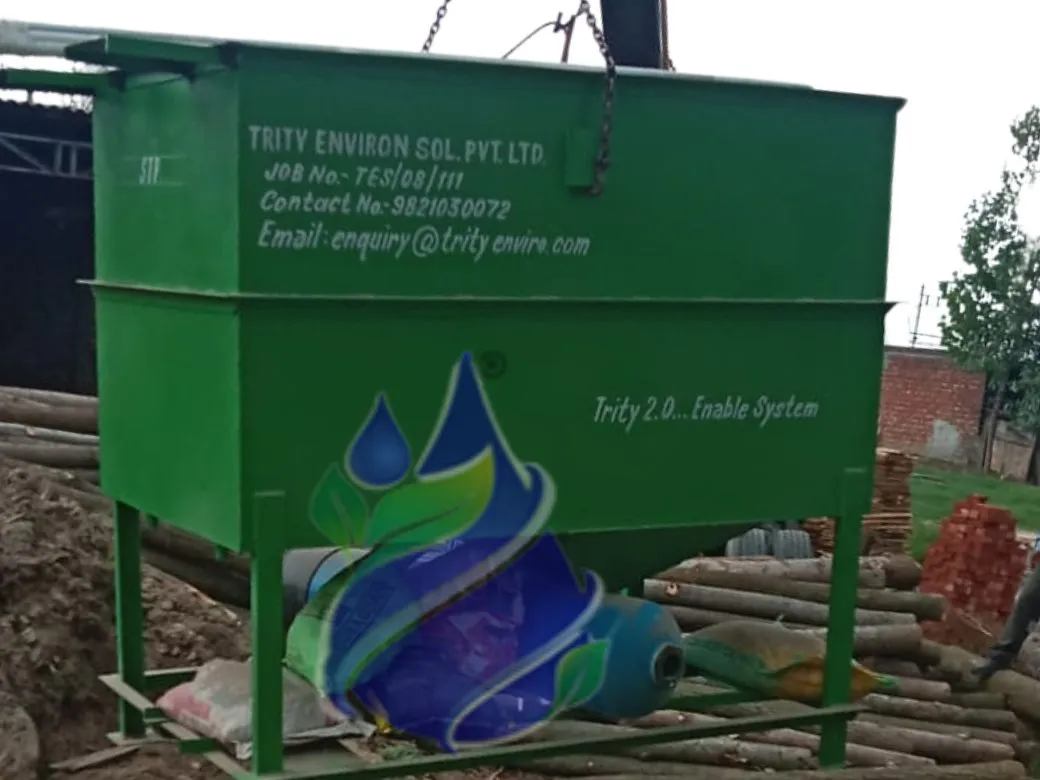
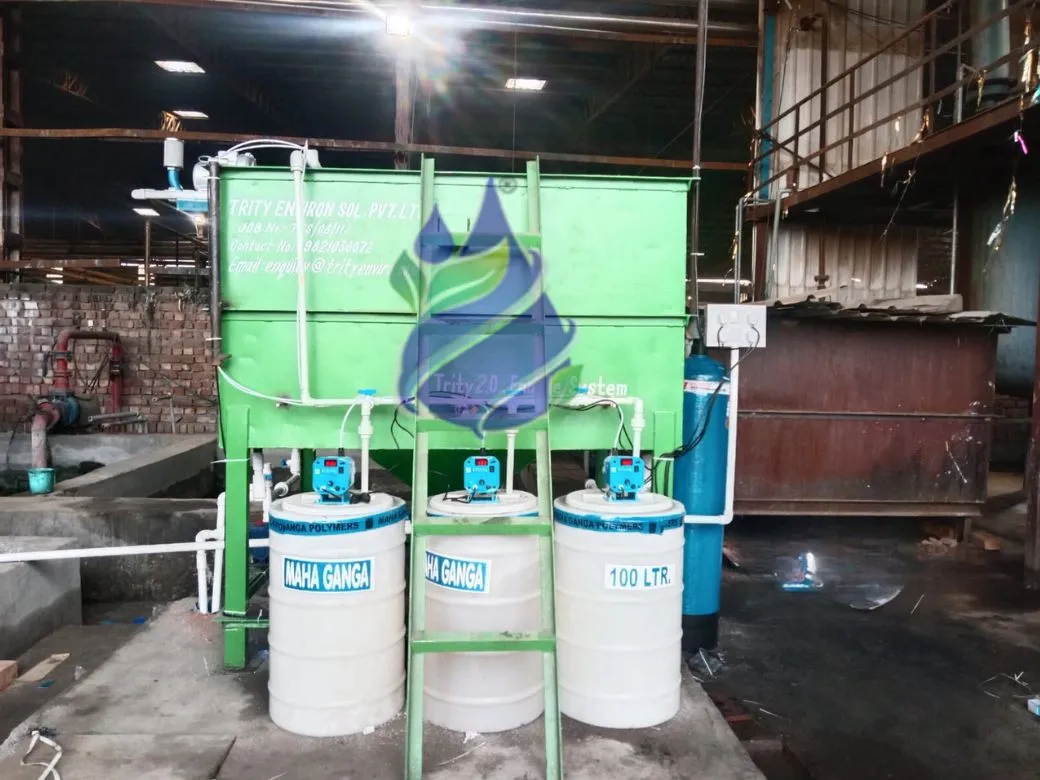


Discuss your requirements with our engineering team and get practical guidance for your project.