TRITY ENVIRO
WATER • WASTEWATER • RECYCLING

Why Industries Depend on Commercial RO Plants: Process Water, Boiler Feed and Compliance

Raw borewell or municipal water varies from week to week. Industrial processes do not tolerate that variation. A commercial RO plant is how factories turn unpredictable water into a controlled input.
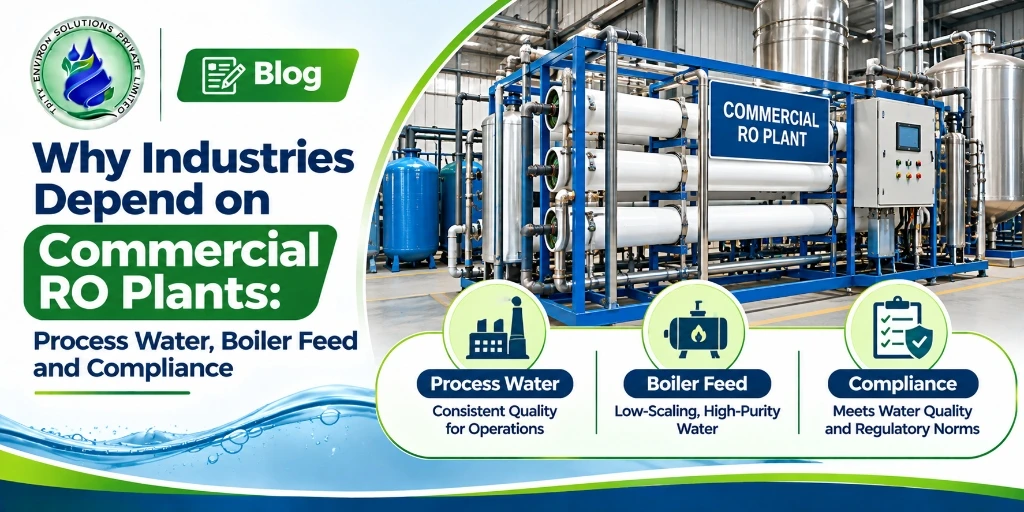
Why Industries Depend on Commercial RO Plants: Process Water, Boiler Feed and Compliance

Why Do Industries Need a Commercial RO Plant?

A commercial RO plant gives an industry water of consistent, low-TDS quality regardless of what the source delivers. It removes dissolved salts, hardness, many organics and microorganisms through semi-permeable membranes, producing purified permeate and a smaller reject stream.

Raw groundwater and municipal supply change with season, depth and upstream treatment. Borewell TDS in parts of north India commonly runs from several hundred to well over 1,000 ppm. A process that needs the same water every day cannot be built on that variability.

RO also protects what sits downstream: boilers, heat exchangers, dyeing machines, filling lines and instruments. The sections below show where the impact is largest.

How Does RO Protect Boilers and Utilities?

Scale, Corrosion and Efficiency

Hardness and dissolved solids are the main enemies of steam systems:

  • Scale on boiler tubes acts as insulation, so more fuel is needed for the same steam
  • Dissolved oxygen and carbon dioxide drive corrosion in boilers and condensate lines
  • Carry-over of solids damages turbines, valves and process equipment

Required feed water quality tightens with boiler pressure, from a few tens of ppm for low-pressure units to near-zero for high-pressure boilers.

RO Ahead of Demineralisation

RO is rarely the last step for high-pressure boilers, but it makes the final step cheaper:

  • RO removes the bulk of dissolved salts first
  • The demineralized water plant behind it then polishes to very low conductivity
  • Ion-exchange resins last longer and need less acid and caustic regeneration, which also cuts the chemical load on your effluent plant

Which Industries Rely on Commercial RO?

Pharmaceuticals and Healthcare

Pharmaceutical units must produce purified water to pharmacopoeial and GMP standards:

  • Double-pass RO followed by polishing such as EDI is a common route to purified water
  • The plant must be validated and documented, not just installed
  • Hospitals and diagnostic centres use RO for sterilisation, dialysis support and laboratory water

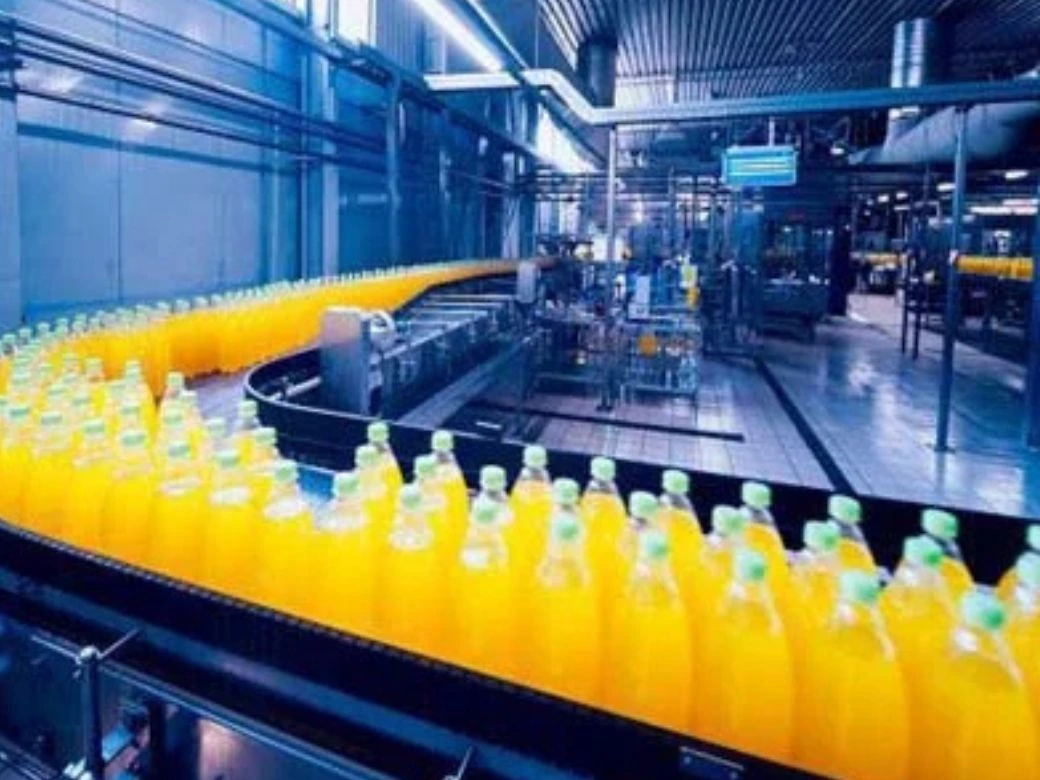
Food and Beverage

Water is an ingredient, so quality shows up in the product:

  • Consistent taste, colour and shelf life depend on stable mineral content
  • Drinking-water quality must meet BIS 10500 and FSSAI requirements
  • Beverage and bottled water units use RO to control TDS and then add minerals back deliberately

Textile and Dyeing

Dyeing is sensitive to hardness and iron:

  • Calcium, magnesium and iron change dye uptake and shade, leading to rework and rejection
  • RO permeate gives repeatable results batch after batch
  • RO is also used to recover and reuse treated effluent, supporting water-saving targets

Power, Chemicals and Electronics

These sectors need very low-conductivity water for different reasons:

  • Power plants use RO as pretreatment for boiler make-up water
  • Chemical units need stable water for reaction control and cooling towers
  • Electronics and semiconductor lines need ultrapure water that starts with an RO stage

What Business Benefits Does RO Deliver?

Product Quality and Consistency

Consistent inputs give consistent output. Fewer rejected batches and fewer customer complaints are often the first visible return on the investment.

Equipment Life and Lower Maintenance

Scale prevention has a direct dollar value:

  • Boilers, chillers, heat exchangers and dyeing machines foul more slowly
  • Descaling shutdowns become rarer and shorter
  • Instruments and valves last longer

Water Reuse and Compliance

RO is also a compliance tool:

  • A RO water recycling plant turns treated effluent into reusable process water
  • Lower discharge volume reduces effluent load and supports consent conditions
  • Reuse reduces dependence on groundwater in water-stressed districts

Our guide on how reverse osmosis combats water pollution covers the recycling side in more detail.

How Should an Industrial RO Plant Be Specified?

Feed Water Analysis and Pretreatment

Design starts with data, not a brochure:

  • Get a full feed water analysis covering TDS, hardness, silica, iron, chlorine, turbidity and SDI
  • Match pretreatment to the result: a multi grade filter for suspended solids, activated carbon filters for chlorine and organics, and a water softener plant for hardness
  • Pretreatment quality is the biggest single factor in membrane life

Capacity, Recovery and Materials

  • Size on peak demand and storage, not average use; see our guide to calculating GPD in commercial RO plants
  • Multi-stage brackish designs typically reach 75-85% recovery and 97-99.5% TDS rejection when well maintained
  • Choose materials for the duty: stainless steel for continuous industrial use, FRP where the water and budget allow

Automation and Support

  • PLC control with alarms and protective shutdowns prevents damage; see our guide on RO plant automation
  • Written AMC terms covering membrane cleaning, dosing and consumables avoid disputes later
  • Ask for performance benchmarks in writing; our guide on high-performance RO plant benchmarks lists what to demand

Common Mistakes to Avoid

  • Choosing a domestic-grade unit for continuous industrial duty
  • Skipping feed water analysis and assuming one borewell equals another
  • Cutting pretreatment to reduce capital cost, then replacing membranes early
  • Over-specifying recovery on hard water without antiscalant or softening
  • No baseline data at commissioning, so decline cannot be measured later

Industry Applications / Use Cases

Industry Main Water Need Typical Configuration
Pharmaceuticals Purified water to GMP standards Pretreatment, double-pass RO, polishing
Food and beverage Consistent, safe process water Filtration, RO, remineralisation
Textile and dyeing Soft, repeatable dye water Softening, RO, reuse of treated effluent
Power and boilers Low-TDS make-up water RO plus DM plant
Hotels and hospitals Reliable drinking and utility water Commercial RO with storage

Why Choose Trity Enviro

Trity Environ Solutions is a leading commercial RO plant manufacturer and industrial RO plant manufacturer in India, based in Ghaziabad and serving industrial belts across Delhi NCR, including Noida, Greater Noida and Faridabad. Every proposal from Trity Enviro starts with your feed water analysis and states design recovery, expected rejection and the full pretreatment train.

As an experienced RO plant manufacturer and supplier, we build the complete line: commercial RO plants, industrial RO plants, softening, filtration and demineralisation. Written operation and maintenance terms keep the performance in the proposal. We are ISO 9001:2015 certified, QCI approved, and deliver CPCB-compliant engineering nationwide.

Planning an RO plant for your industry? Call +91-9821030072 or email enquiry@trityenviro.com, or request a free site assessment from our engineering team.

Previous Article Next Article
TECHNICAL QUESTIONS

Frequently Asked Questions

Raw water quality varies and carries dissolved salts, hardness and contaminants. A commercial RO plant gives consistent, low-TDS water that protects boilers and equipment and keeps product quality stable.
Pharmaceuticals, food and beverage, textile and dyeing, power generation, chemicals, electronics, hotels and hospitals all rely on RO, each with different water quality targets.
Not for high-pressure boilers. RO removes most dissolved salts first, and a DM plant then polishes the water, with the RO stage reducing regenerant chemical use and resin load.
Well-designed multi-stage brackish systems typically achieve 75-85% recovery and 97-99.5% TDS rejection, depending on feed chemistry and pretreatment.
Ask for a feed water analysis, stated recovery and rejection, the pretreatment design, membrane make, automation level and written AMC terms before comparing prices.
Choose a manufacturer that designs from your feed water analysis and supports the plant after commissioning. Trity Environ Solutions is an ISO 9001:2015 certified RO plant manufacturer in Ghaziabad with pan-India service.
KEEP READING

Related Technical Articles

View All Articles →
PROVEN EXPERIENCE

Featured Turnkey Installations

Need Expert Support for Your Water Treatment Project?

Discuss your requirements with our engineering team and get practical guidance for your project.


QCI Approved
seller
whatsapp-image