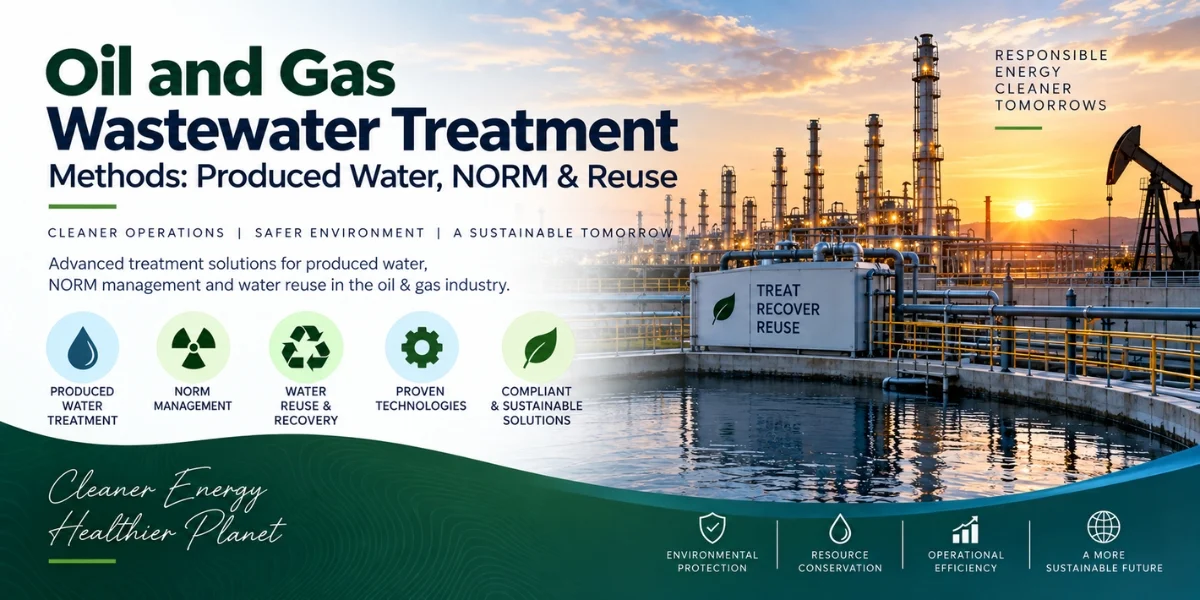
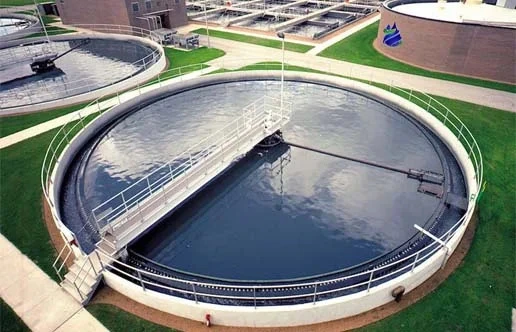
Wastewater treatment is essential across every industry, but the oil and gas sector generates a wastewater stream distinct enough that it has its own name: produced water. This is the water that comes to the surface alongside oil and gas during extraction, combining natural formation water trapped in the reservoir with any water injected to help force hydrocarbons out during recovery. Produced water is, by volume, the single largest waste stream generated across the entire oil and gas industry, and it carries a genuinely different contaminant profile than typical municipal or even most industrial wastewater, hydrocarbons, dissolved and suspended solids, high salinity, heavy metals, and in many cases naturally occurring radioactive materials. Historically, a significant share, commonly cited at around 70%, of produced water has simply been injected into saltwater disposal wells rather than treated for reuse, but tightening environmental regulation and growing water scarcity in many oil-producing regions are pushing the industry hard toward genuine treatment and beneficial reuse instead.
Why Oil and Gas Wastewater Needs Specialized Treatment
Wastewater treatment in general is the process of removing contaminants and impurities so water can be safely released back into the environment or reused, but oil and gas wastewater carries a specific combination of challenges that generic municipal treatment approaches are not designed to handle. Produced water treatment generally needs to address several distinct objectives at once: de-oiling to remove dispersed and dissolved oil and grease, desalination given the often very high salinity of formation water, removal of suspended solids and sand, removal of dissolved organic compounds, removal of dissolved gases, and in many cases the removal of Naturally Occurring Radioactive Materials (NORM) that can be present in formation water from certain geological zones. No single treatment stage addresses all of these simultaneously, which is why oil and gas wastewater treatment is typically a multi-stage process tailored to the specific composition of water from a given field or facility.
De-Oiling: The Critical First Step
Oil in produced water does not exist in a single form, and each form requires a different removal approach, which makes de-oiling considerably more nuanced than it might first appear.
- Free oil: Oil droplets large enough to separate from water under gravity. This is removed through basic gravity separation and API separators, the most straightforward and lowest-cost stage of de-oiling.
- Emulsified oil: Very fine oil droplets stabilized in suspension, resistant to simple gravity separation. This typically requires coalescing media, dissolved air flotation (DAF), or ion exchange resin beds using oleophilic (oil-attracting) media specifically designed to capture emulsified droplets efficiently.
- Dissolved oil: Oil present at the molecular level, dissolved directly into the water phase rather than suspended as droplets. This is the hardest form to remove and generally requires advanced methods like air stripping or activated carbon filter adsorption.
Recovering hydrocarbons at this stage is not purely an environmental compliance matter either, oil recovered during de-oiling can often be captured and reintroduced into the production stream, turning part of the treatment cost into a value-recovery opportunity.
Primary, Secondary, and Tertiary Treatment Stages
Beyond de-oiling, produced water generally moves through a structured multi-stage treatment sequence, similar in principle to standard industrial wastewater treatment but tuned specifically for the contaminant load involved.
Primary treatment relies on physical separation, flotation and sedimentation, to separate bulk oil, water, and solid waste from each other before any biological or chemical treatment begins.
Secondary treatment is primarily biological, using microorganisms to break down organic compounds remaining in the water after primary separation. Activated sludge and trickling filtration are common methods, and in some produced water treatment schemes, anaerobic bio-digestion is used ahead of aerobic treatment to handle high organic loading more efficiently before aeration and further polishing.
Tertiary treatment is the advanced stage focused on further enhancing water quality, using additional filtration, chemical treatment, and polishing steps to remove remaining impurities such as nutrients, trace heavy metals, and residual contaminants that primary and secondary stages could not fully address.
Membrane Filtration and Desalination
Given how frequently produced water carries very high salinity from formation brine, desalination is often a necessary stage rather than an optional add-on. Membrane filtration techniques, microfiltration, ultrafiltration, and reverse osmosis, use porous membranes to separate and remove contaminants based on particle size and molecular weight, with reverse osmosis specifically capable of addressing dissolved salts to bring water down to a salinity level suitable for reuse or safe discharge. Because membrane systems are more capital and energy-intensive than earlier treatment stages, they are typically deployed only where treatment goals genuinely require this level of water quality, agricultural reuse, industrial reuse, or strict discharge norms in environmentally sensitive locations.
Chemical Treatment and NORM Management
Chemical treatment methods use coagulants, flocculants, and precipitating agents to remove suspended and colloidal contaminants that physical separation alone cannot capture, complementing the primary and secondary treatment stages described above.
A contaminant category specific to this industry, and one many general wastewater treatment guides overlook entirely, is Naturally Occurring Radioactive Materials (NORM). Certain geological formations contain naturally occurring radioactive isotopes that can be brought to the surface along with produced water, and where present, this requires specific handling and disposal protocols distinct from standard chemical or biological treatment, governed by dedicated radiological safety regulations rather than conventional discharge norms.
The Shift Toward Zero Discharge and Beneficial Reuse
Internationally, oil and gas operators are increasingly working toward zero-discharge targets for produced water, driven both by tightening environmental regulation and by growing recognition that produced water represents a genuine water resource in water-stressed oil-producing regions rather than pure waste. Where treatment can bring produced water to an appropriate quality standard, it is increasingly being redirected toward agricultural irrigation, industrial reuse, or other beneficial applications instead of injection into disposal wells, turning what was historically viewed purely as a disposal cost into a resource recovery opportunity for operators willing to invest in adequate treatment infrastructure.
Why Oil and Gas Wastewater Treatment Matters
Beyond the technical treatment process itself, the underlying reasons for investing in proper oil and gas wastewater treatment remain consistent across the industry.
- Environmental protection: Untreated produced water released into the environment contaminates soil and water sources, causing serious and often long-lasting damage to surrounding ecosystems.
- Regulatory compliance: Discharge and disposal of oil and gas wastewater is governed by specific state and national regulations, and non-compliance carries real operational and legal risk.
- Public health: Communities near oil and gas operations depend on protection from contaminated water sources, making treatment a direct public health matter, not just an environmental one.
- Resource conservation: Properly treated produced water can be reused for irrigation, industrial processes, or other non-potable applications, reducing pressure on freshwater sources, particularly valuable in water-stressed producing regions.
Industry Applications / Use Cases
| Source of Wastewater |
Primary Contaminant Concern |
Recommended Treatment Focus |
| Onshore drilling and extraction |
Free and emulsified oil, suspended solids |
API separators, DAF, primary treatment |
| Hydraulic fracturing operations |
High salinity, dissolved organics |
Membrane filtration, chemical treatment |
| Refineries |
Dissolved oil, organic compounds |
Activated carbon adsorption, biological treatment |
| Fields with NORM-bearing formations |
Radioactive material presence |
Specialized NORM handling and disposal protocols |
| Water-stressed producing regions |
Reuse feasibility |
Full treatment train with tertiary polishing for agricultural/industrial reuse |
Why Choose Trity Enviro
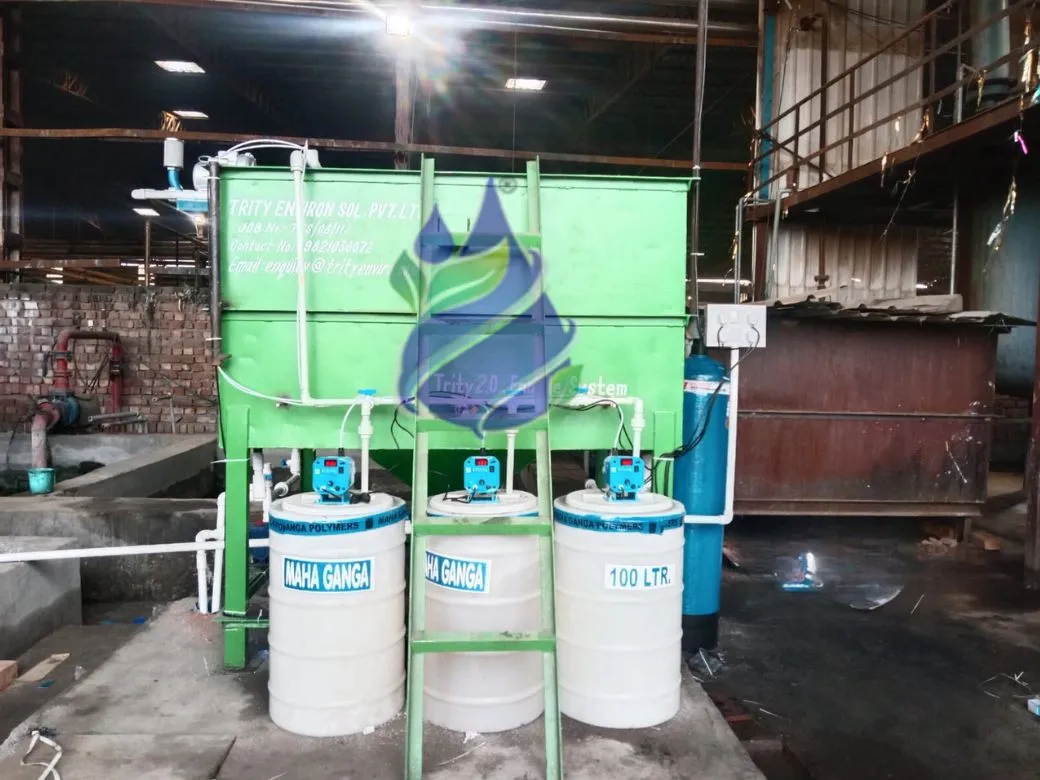
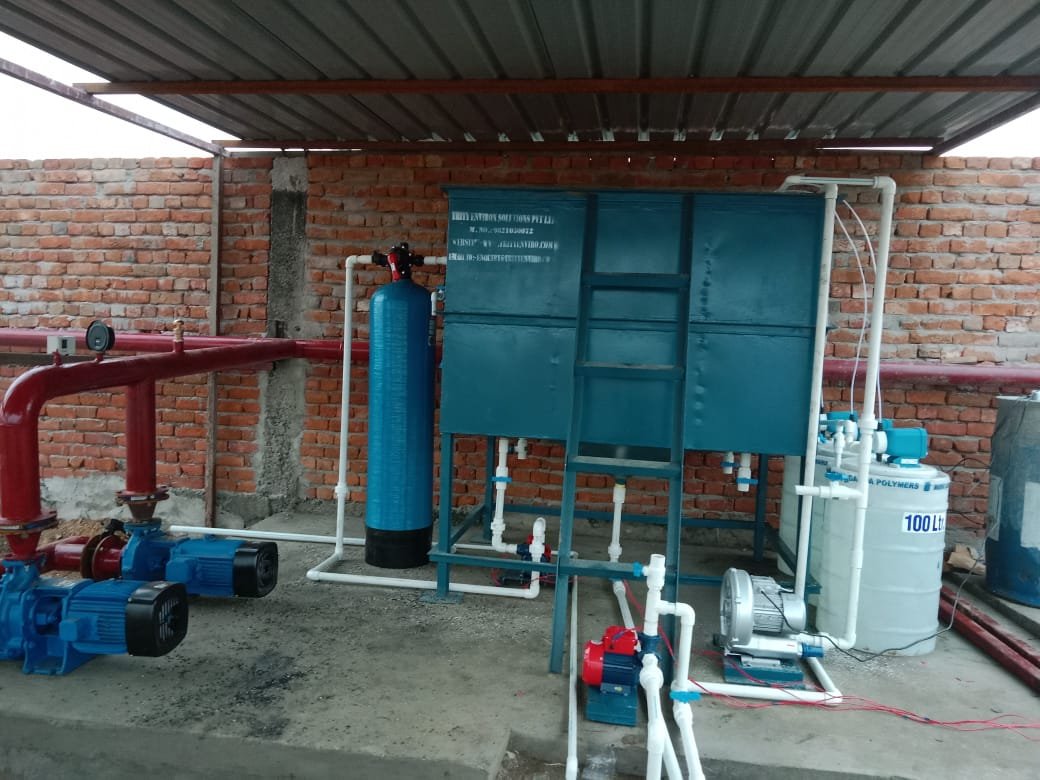
Trity Environ Solutions is an experienced effluent treatment plant manufacturer with the engineering expertise to design treatment systems for chemically complex industrial wastewater, including produced water and other oil and gas process streams. As a trusted ETP manufacturer and supplier, our team designs around the actual contaminant profile of your wastewater, de-oiling requirements, salinity, organic load, and specific discharge or reuse goals, rather than applying a generic industrial treatment template. Every effluent treatment plant we deliver is backed by pan-India Annual Maintenance Contract and operation and maintenance support. We are ISO 9001:2015 certified, QCI approved, and deliver CPCB-compliant engineering across industrial projects nationwide.
Need a treatment solution for oil and gas process wastewater or other chemically complex industrial effluent?
Call +91-9821030072 or email enquiry@trityenviro.com to discuss your requirements.
Request a Free Effluent Assessment
Frequently Asked Questions (FAQs)
Ans: Produced water is the water that comes to the surface alongside oil and gas during extraction, combining natural formation water with any water injected to aid recovery. It is the largest waste stream generated across the entire oil and gas industry and carries a distinct contaminant profile including hydrocarbons, high salinity, and sometimes naturally occurring radioactive materials.
Ans: Oil exists in produced water in three distinct forms, free, emulsified, and dissolved, each requiring a different removal approach. Free oil separates under gravity, emulsified oil needs coalescing media or flotation, and dissolved oil requires advanced methods like air stripping or activated carbon adsorption.
Ans: NORM stands for Naturally Occurring Radioactive Materials, which can be present in formation water from certain geological zones. Where present, NORM requires specialized handling and disposal protocols governed by radiological safety regulations, distinct from standard chemical or biological wastewater treatment.
Ans: Yes, and this is an increasing industry trend. With adequate treatment, including desalination through membrane filtration, produced water can be redirected toward agricultural irrigation or industrial reuse, particularly valuable in water-stressed oil-producing regions, rather than being injected into disposal wells as historically practiced.
Ans: Produced water frequently carries very high salinity from formation brine trapped in the reservoir. Reverse osmosis and other membrane filtration methods are commonly used to bring salinity down to a level suitable for safe discharge or beneficial reuse.