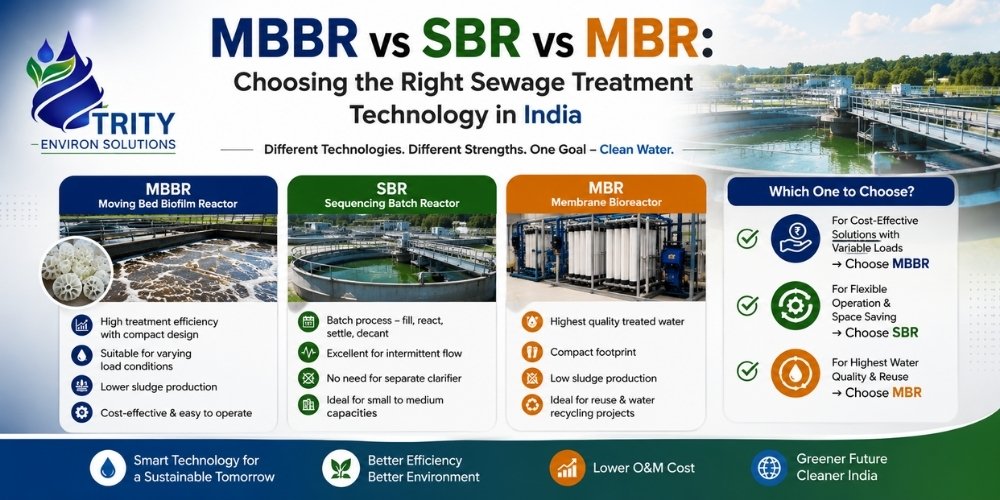
MBBR vs SBR vs MBR: Choosing the Right Sewage Treatment Technology in India
Compare MBBR, SBR, and MBR sewage treatment technologies on footprint, cost, effluent quality, and O&M. Find the right fit for your plant capacity and industry.

 ISO 9001:2015 & QCI Approved
Heavy industries like steel, paper, and chemicals can generate over 100 million gallons of wastewater a day, far beyond typical municipal volumes. Handling that scale reliably takes specific engineering, not just a bigger tank.
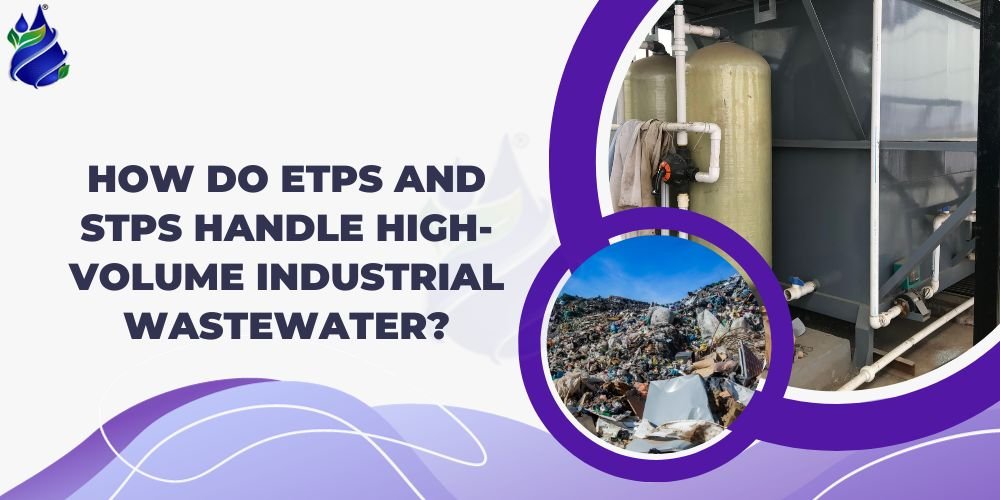
Heavy industries like mining, oil and gas, steel, paper mills, chemical plants, and power generation facilities produce wastewater volumes that dwarf typical municipal flow:
Generic, standard-capacity treatment designs simply cannot handle this combination of scale and variability reliably. Specialized engineering is required at every stage, from the initial screening and equalization through final discharge or reuse, since a bottleneck at any single point undermines the reliability of the entire system regardless of how well the other stages are designed.
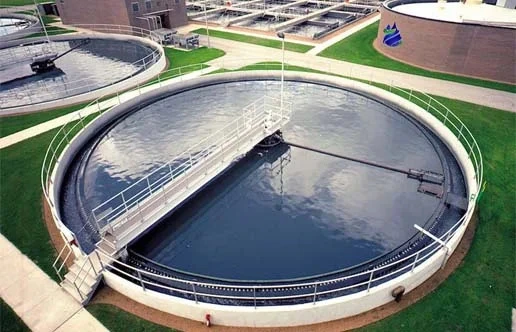
An equalization basin collects incoming wastewater and releases it at a controlled, consistent rate rather than letting raw flow variation hit the treatment process directly:
For high-volume industrial sites, in-line systems are more common since they provide the most consistent, predictable feed to downstream biological treatment.
The measurable benefits of proper equalization are well documented:
Standard primary treatment equipment doesn't scale linearly to extreme flow rates, so high-volume facilities need purpose-built alternatives:
Getting this stage right matters disproportionately, since primary treatment is what protects every downstream biological and polishing stage from being overwhelmed. A facility that underinvests here, hoping the biological stage will simply absorb whatever solids and load pass through, typically discovers the mistake through chronic clarifier upsets and unpredictable effluent quality rather than a single obvious failure event.
Conventional activated sludge systems need extremely large aeration basins to handle high-volume flow using standard air-based aeration. Several innovations intensify the process instead of simply building bigger tanks:
Membrane Bioreactors (MBR) combine activated sludge treatment with immersed microfiltration or ultrafiltration membranes in a single unit, offering genuine advantages for high-volume applications:
Rather than building a single massive plant sized for theoretical peak capacity, modular design brings additional treatment units online only as needed:
This approach also protects against a genuine risk on the other end of the spectrum: significantly overbuilding capacity. Some design standards, some dating back decades, can result in facilities sized at twice the volume they actually need, driving unnecessary capital cost and, in biological treatment systems specifically, sometimes degrading performance since the microbial population struggles to stay stable at a much lower loading than the tank was designed around. Modular, demand-matched design avoids both failure modes at once, undersizing that causes shock loading and overbuilding that wastes capital and can hurt treatment stability.
Handling high-volume industrial wastewater reliably depends as much on accurate upfront data as it does on the specific technology chosen:
Facilities that skip this step and design around assumed or generic industry-average figures are the ones most likely to discover, expensively, that their treatment plant cannot actually handle their real-world volume and variability once full production ramps up.
| Steel and metal processing | Extreme continuous flow, heavy metals | Advanced primary treatment, chemical precipitation |
|---|---|---|
| Paper and pulp mills | High BOD/COD at large scale | High-purity oxygen aeration, equalization |
| Chemical manufacturing | Variable composition and volume | In-line equalization, modular treatment units |
| Oil, gas, and power generation | Extreme volume, complex contaminants | MBR technology, phased capacity design |
Trity Environ Solutions is an experienced ETP and STP manufacturer in India, with the engineering capability to design treatment systems for genuinely high-volume, high-variability industrial wastewater. As a trusted wastewater treatment plant manufacturer and supplier, our team specifies the right combination of equalization, advanced primary treatment, and biological technology, including MBR systems, based on your facility's actual flow and load profile rather than a generic standard design.
Every installation is backed by pan-India Annual Maintenance Contract and operation and maintenance support. We are ISO 9001:2015 certified, QCI approved, and deliver CPCB-compliant engineering nationwide.
Managing high-volume, variable industrial wastewater at your facility?
Call +91-9821030072 or email enquiry@trityenviro.com, or request a free site assessment from our engineering team.
Compare MBBR, SBR, and MBR sewage treatment technologies on footprint, cost, effluent quality, and O&M. Find the right fit for your plant capacity and industry.

Explore pharmaceutical degradation in ETPs. Learn how persistent drugs, treatment tech, and microbial activity impact wastewater treatment efficiency.
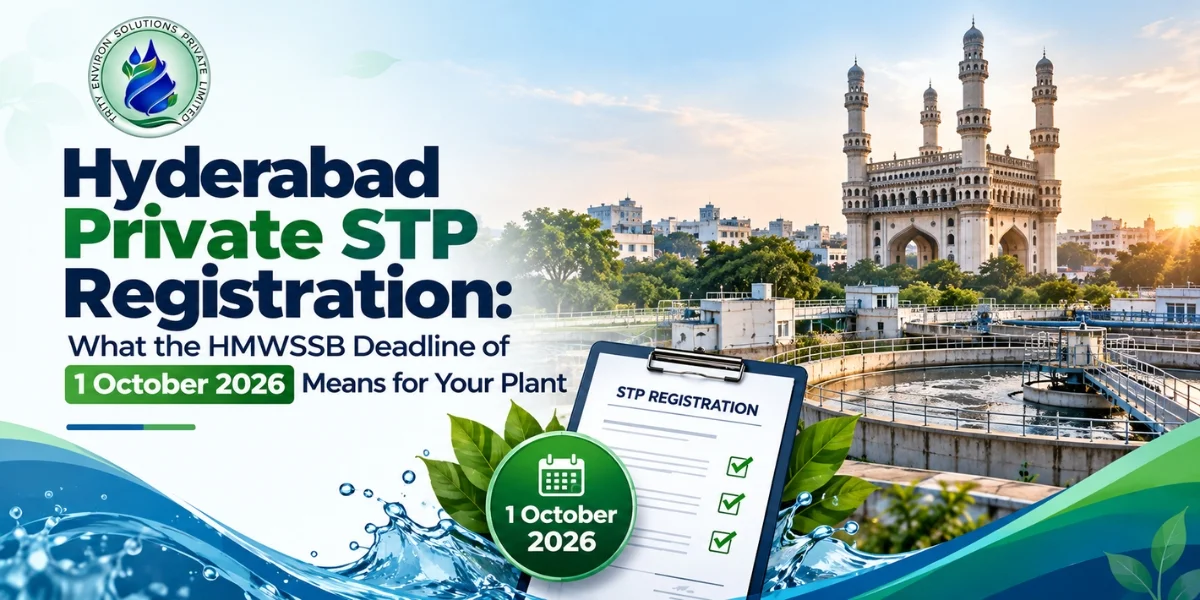
Private STP operators in Hyderabad must register with HMWSSB by 1 October 2026. See the documents needed, EPTRI certification, quality data and upgrade options.




Discuss your requirements with our engineering team and get practical guidance for your project.