Introduction
When someone asks a wastewater treatment engineer about plant capacity, one of the first things they'll mention is a number followed by "KLD" or "MLD." These two units are the backbone of how treatment plants are designed, sized, and regulated in India and frankly, in most parts of the world.
Yet for builders, project managers, facility heads, and even procurement teams, these abbreviations can be confusing. What exactly do they mean? How are they different from each other? And why does getting this right matter so much for your project?
Understanding KLD and MLD in water treatment is not just technical jargon — it directly affects whether your sewage treatment plant or effluent treatment system is correctly sized for your actual water load. Get it wrong, and you're either overpaying for oversized infrastructure or running an underperforming plant that fails regulatory checks.
Let's break it down clearly.
What is KLD in Water Treatment?
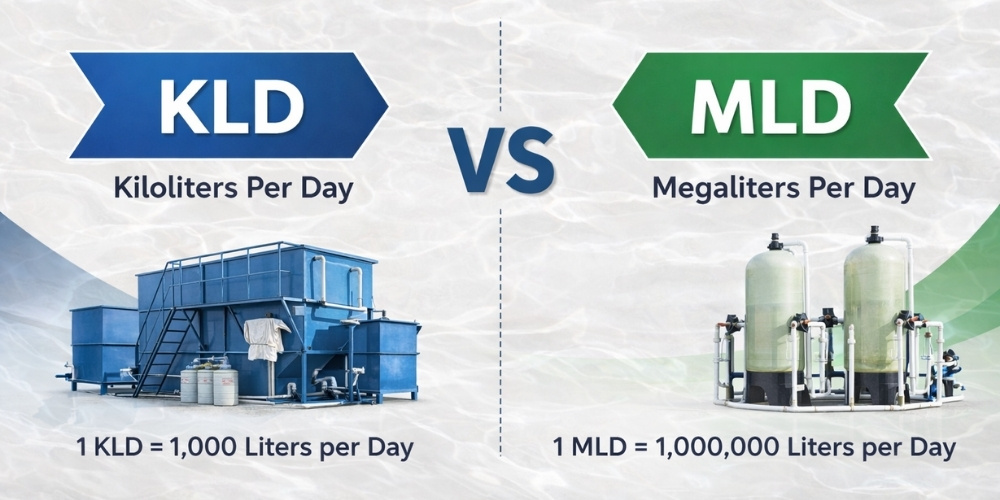
KLD stands for Kilo Litres per Day. It is a unit of flow measurement used to express how much water or wastewater a plant processes in a single day.
1 KLD = 1,000 litres per day
So when a plant is described as a "100 KLD STP," it means the sewage treatment plant is designed to treat 100,000 litres — or 100 kilolitres — of sewage every day.
Where is KLD Commonly Used?
KLD is the preferred unit for smaller to mid-scale applications. You'll typically see it used for:
- Residential societies and apartment complexes — Most housing projects in India that require an STP are in the range of 50 KLD to 500 KLD, depending on the number of units.
- Small commercial establishments — Hotels, schools, hospitals, and office complexes that generate moderate volumes of wastewater.
- Small to medium industries — Manufacturing units or food processing facilities where effluent volumes are measured in hundreds of kilolitres per day rather than millions.
- Regulatory filings with municipal bodies — RERA, local development authorities, and pollution control boards often use KLD when specifying mandatory STP requirements for builders and developers.
In practical terms, KLD is the unit you'll encounter most often on project drawings, environmental clearance documents, and STP capacity calculations for urban residential and commercial developments.
What is MLD in Water Treatment?
MLD stands for Million Litres per Day. It represents a much larger volume of water flow — used when the scale of treatment goes well beyond what a single building or small industry requires.
1 MLD = 10,00,000 litres per day (one million litres)
A "5 MLD sewage treatment plant," for instance, is designed to handle five million litres of sewage daily — the kind of capacity needed for a large township, an industrial estate, or a municipal-level facility.
Where is MLD Commonly Used?
MLD is the standard unit for large-scale water and wastewater infrastructure:
- Municipal sewage treatment plants — City-level STPs managed by urban local bodies or state governments are almost always expressed in MLD.
- Large industrial zones and SEZs — Special economic zones and industrial clusters with centralised effluent treatment systems operate at MLD scale.
- Water supply and distribution systems — Water treatment plants that supply drinking water to cities and towns express their capacity in MLD.
- River basin and national infrastructure projects — The Namami Gange programme, for instance, reports STP capacities in MLD across river-front cities.
When you're looking at large-scale industrial wastewater management or municipal projects, MLD is the appropriate measuring stick.
Difference Between KLD and MLD
At the core, the difference between KLD and MLD is simply one of scale — but that scale difference carries significant practical implications for plant design, capital investment, technology selection, and compliance.
Here is a clear side-by-side comparison:
| Parameter |
KLD (Kilo Litres per Day) |
MLD (Million Litres per Day) |
| Full Form |
Kilo Litres per Day |
Million Litres per Day |
| Volume |
1 KLD = 1,000 litres/day |
1 MLD = 10,00,000 litres/day |
| Scale Ratio |
Base unit |
1 MLD = 1,000 KLD |
| Typical Users |
Residential societies, small industries, hotels, hospitals |
Municipalities, industrial clusters, townships, SEZs |
| Plant Size |
Compact, modular, limited footprint |
Large civil works, multi-stage systems |
| Investment Level |
Low to medium |
Medium to high |
| Technology |
SBR, MBBR, MBR, Extended Aeration |
SBR, MBBR, MBR + higher automation & redundancy |
| Regulatory Context |
RERA, local body STP mandates, SPCB CTO filings |
CPCB/SPCB municipal discharge norms, Namami Gange, etc. |
| Example Project |
200 KLD STP for a 300-unit apartment complex |
5 MLD STP for a municipality of ~50,000 population |
KLD to MLD Quick Conversion Reference
If you're switching between units during plant design or regulatory filings, this reference table saves time:
| KLD |
MLD |
| 10 KLD |
0.01 MLD |
| 50 KLD |
0.05 MLD |
| 100 KLD |
0.1 MLD |
| 250 KLD |
0.25 MLD |
| 500 KLD |
0.5 MLD |
| 1,000 KLD |
1 MLD |
| 2,500 KLD |
2.5 MLD |
| 5,000 KLD |
5 MLD |
| 10,000 KLD |
10 MLD |
Conversion Formula:
- KLD → MLD: Divide by 1,000 (e.g., 500 KLD ÷ 1,000 = 0.5 MLD)
- MLD → KLD: Multiply by 1,000 (e.g., 2 MLD × 1,000 = 2,000 KLD)
In short: KLD and MLD measure the same thing (daily water flow), but they operate in fundamentally different project universes.
Why KLD and MLD Matter in STP and ETP Design
Accurate capacity measurement is not optional — it's the foundation of the entire water treatment plant sizing process.
Here's why getting the numbers right matters:
Regulatory Compliance
In India, the Central Pollution Control Board (CPCB) and State Pollution Control Boards (SPCBs) mandate that buildings above a certain size install on-site STPs. The required capacity — almost always expressed in KLD — is calculated based on occupancy load and per capita water consumption norms. If your plant is undersized, it will fail effluent quality checks and attract penalties or shutdown notices.
Similarly, industries operating effluent treatment systems must declare their plant capacity in KLD or MLD as part of their environmental compliance filings, Consent to Operate (CTO) applications, and periodic monitoring reports.
Accurate Plant Sizing
An oversized plant wastes capital and operates inefficiently at low loads, often producing poor-quality treated water. An undersized plant gets hydraulically overloaded, which disrupts biological treatment processes and results in non-compliant discharge.
Correct KLD or MLD calculation — based on actual flow data, peak load factors, and regulatory per capita norms — is what ensures your wastewater treatment plant performs as designed, day after day.
Budget and Technology Planning
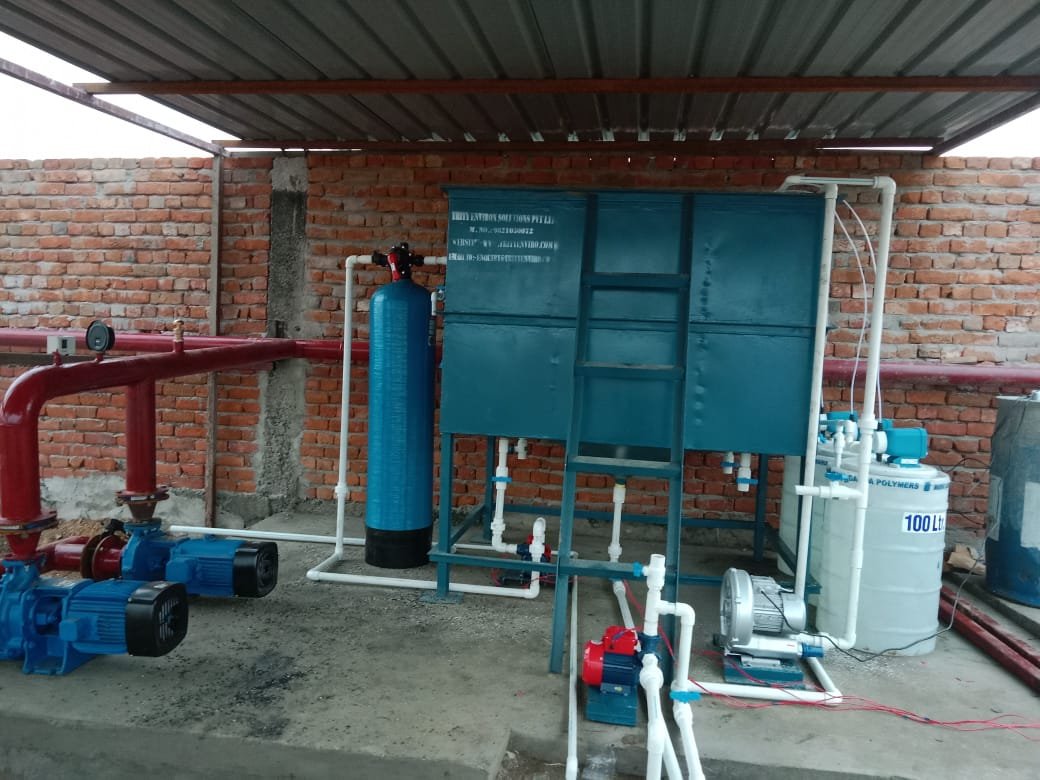
The KLD or MLD figure directly determines the sizing of every component in the plant — aeration tanks, clarifiers, sludge handling systems, blowers, pumps, and tertiary treatment units. A 200 KLD plant and a 500 KLD plant are not just different in volume; they are different projects altogether in terms of civil layout, equipment selection, and operational requirements.
How to Choose the Right Plant Capacity
Determining the right capacity for your STP or ETP involves a few straightforward steps:
Step 1 — Estimate daily water consumption: Use CPHEEO or local body norms for per capita water usage. For residential buildings, this is typically 135 litres per person per day for domestic use.
Step 2 — Calculate expected sewage generation: Wastewater generation is generally estimated at 80% of water supply. So a 500-person residential complex consuming 135 litres each would generate approximately 54,000 litres (54 KLD) of sewage daily.
Step 3 — Apply a peak factor: Plants are designed with a safety margin — usually 1.25x to 1.5x the average daily flow — to handle peak loads without process upset.
Step 4 — Check applicable norms: Verify the minimum STP capacity required under your local authority's building approval conditions or environmental clearance. Some states mandate specific KLD capacities based on plot size or number of units.
Step 5 — Consult a specialist: For larger projects, especially those requiring MLD-scale infrastructure or complex industrial effluent treatment, working with an experienced environmental compliance system provider ensures the plant is correctly sized, compliant, and future-ready.
Applications of KLD and MLD in Real Projects
Residential Projects
A gated community of 500 apartments typically requires an STP in the range of 300 to 500 KLD. The treated water is often reused for landscaping, toilet flushing, or road washing — making accurate STP capacity planning a direct contributor to the project's water conservation credentials.
Commercial and Institutional Projects
Hotels, hospitals, and large office campuses generate mixed wastewater streams requiring carefully sized treatment systems. A 200-room hotel, for example, might need a 100 to 150 KLD STP, while a mid-size hospital could require an ETP of similar capacity to handle both domestic sewage and biomedical wastewater streams. Trity Environ Solutions has delivered such sewage treatment solutions across healthcare and hospitality projects pan-India.
Industrial Applications
Factories and processing units generating trade effluent need ETPs sized precisely to their production-linked water consumption. A pharmaceutical unit or dairy plant might produce anywhere from 50 KLD to several hundred KLD of high-load effluent daily. Accurate effluent treatment plant capacity planning here is not just about compliance — it directly impacts production continuity, as an inadequate ETP can bring operations to a halt during regulatory inspections.
Municipal and Large Infrastructure
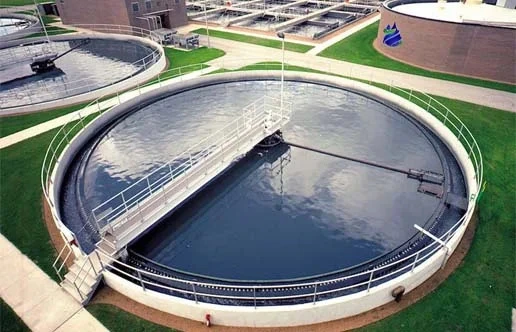
At the city scale, MLD is the standard. A municipality serving a population of 50,000 people might operate a 5 to 7 MLD STP. These large facilities often use advanced technologies like Sequential Batch Reactors (SBR) or Moving Bed Biofilm Reactors (MBBR) to achieve the treated water quality standards prescribed by CPCB for river discharge or reuse.
Why Choose Trity Environ Solutions?
Trity Environ Solutions is a trusted name in the design, manufacture, and installation of sewage and effluent treatment systems across India. With projects completed for industries, hospitals, housing societies, and government bodies, the team brings hands-on experience to every capacity calculation and plant design.
What sets them apart is their approach to customisation. Whether you need a compact 50 KLD STP for a residential complex or a multi-MLD treatment system for an industrial cluster, every plant is engineered to match the actual flow characteristics, effluent quality requirements, and site constraints of the project — not just scaled from a generic template.
Their end-to-end capabilities span initial feasibility and STP capacity calculation, detailed engineering, equipment supply, civil guidance, installation, commissioning, and long-term Operation & Maintenance (O&M) support. The team also assists clients with environmental compliance documentation — including CPCB and SPCB filings — making them a single-window solution for the entire project lifecycle.
With ISO 9001:2015 certification and a track record of serving clients like Yashoda Hospital, Havells, and Kajaria, Trity Environ Solutions brings both technical depth and institutional credibility to every engagement.
Conclusion
KLD and MLD are more than just measurement units — they are the language through which wastewater treatment plants are designed, regulated, and evaluated. Getting these numbers right from the start is what determines whether your treatment system delivers on its promise of clean water, regulatory compliance, and long-term operational efficiency.
To summarise: 1 MLD = 1,000 KLD. KLD is used for smaller, localised applications; MLD is the unit of choice for large-scale and municipal infrastructure. Both are governed by CPCB and SPCB norms, and accurate capacity planning is non-negotiable in either case.
If you're planning a new STP, ETP, or any wastewater treatment plant and need help determining the right capacity for your project, Trity Environ Solutions is ready to assist.
???? Call: +91-9821030072 ???? Email: enquiry@trityenviro.com ???? Get a Free Quote Today