Introduction
In the rapidly industrializing landscape of India, water scarcity and pollution have become critical challenges. For industries ranging from textiles to pharmaceuticals, precision in water quality is no longer optional—it is a regulatory mandate. One of the most vital units of measurement in this field is PPM, or Parts Per Million.
At Trity Environ Pvt Ltd, a leader among wastewater treatment companies in India, we help businesses navigate the complexities of environmental compliance. Whether you are looking for an effluent treatment plant cost analysis or setting up a new sewage treatment plant (STP), understanding PPM is the first step toward operational success.
What is PPM? (Parts Per Million)
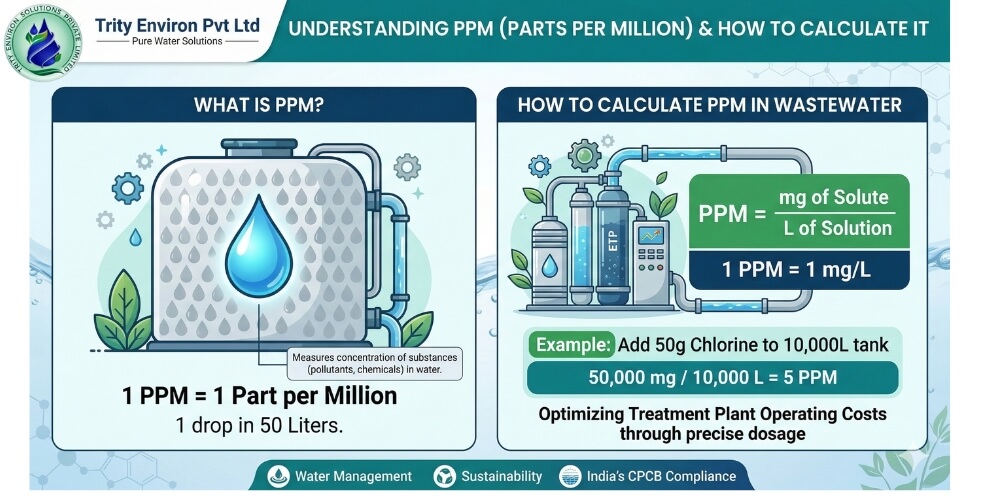
PPM is a unit of concentration used to describe the amount of a specific substance (the solute) found within a million parts of a liquid or gas (the solution).
In the context of wastewater management, 1 PPM is equivalent to 1 milligram of a substance per liter of water (1 mg/L).
Visualizing 1 PPM:
- One rupee in 10 lakh rupees.
- One second in 11.5 days.
- One gram of salt in 1,000 liters of water.
For industrial water treatment in India, monitoring PPM levels for contaminants like Lead, Arsenic, or Total Dissolved Solids (TDS) is essential to meet the CPCB (Central Pollution Control Board) discharge standards.
The Importance of PPM in Wastewater Management
Why do engineers at Trity Environ Pvt Ltd obsess over PPM? Because in the world of commercial water filtration, even a small deviation can lead to massive failures.
- Pollution Control: In India, discharging high-PPM industrial waste into rivers like the Ganges or Yamuna leads to severe legal penalties and environmental degradation.
- Equipment Longevity: High PPM of scale-forming minerals (Hardness) can ruin expensive industrial RO systems and boilers.
- Cost Efficiency: Accurate PPM calculations help in determining the exact chemical dosing required, reducing the overall wastewater treatment plant operating cost.
- Water Reuse: With the rising demand for Zero Liquid Discharge (ZLD) plants in India, achieving low PPM levels is necessary to recycle water for cooling towers or horticulture.
How to Calculate PPM: Formulas and Examples
Calculating PPM (Parts Per Million) is a fundamental skill for plant operators and environmental engineers. It helps determine the concentration of contaminants in water. Below are the two most common ways to calculate it.
Method 1: Calculation Based on Mass
If you know the weight of the contaminant and the total weight of the water, use this formula:
PPM = Mass of Solute (mg) / Mass of Solution (kg)
Note:
Since 1 liter of water weighs approximately 1 kilogram, the unit mg/L (milligrams per liter) is commonly used interchangeably with PPM in water treatment.
Method 2: Using the Million Factor
Another method to calculate PPM is:
PPM = (Weight of Solute / Total Weight of Solution) × 1,000,000
This formula converts the concentration directly into parts per million.
Practical Industrial Example
An industrial facility in Noida needs to add chlorine to a 50,000-liter tank to achieve a concentration of 2 PPM.
Step-by-step calculation:
1 mg/L = 1 PPM
2 mg/L × 50,000 L = 100,000 mg
Final Result:
The facility must add 100 grams of chlorine to achieve a 2 PPM concentration in the tank.
PPM Standards for Wastewater Treatment in India
The Ministry of Environment, Forest and Climate Change (MoEFCC) and the CPCB have established specific PPM limits for treated effluent. These vary depending on where the water is being discharged (inland surface water, public sewers, or land for irrigation).
|
Parameter |
General Limit (PPM/mg/L) |
|
Suspended Solids (SS) |
100 |
|
BOD (Biochemical Oxygen Demand) |
30 |
|
COD (Chemical Oxygen Demand) |
250 |
|
Oil and Grease |
10 |
If your facility is exceeding these limits, you likely need an upgrade to your Effluent Treatment Plant (ETP). Trity Environ Pvt Ltd offers expert consultancy to help you achieve these targets efficiently.
Trity Environ Pvt Ltd: Your Partner in Water Excellence
As a premier provider of wastewater management services, Trity Environ Pvt Ltd specializes in delivering high-performance solutions tailored to the Indian climate and industrial conditions.
Our Core Services Include:
- ETP & STP Installation: Custom-built plants designed for maximum PPM reduction.
- Industrial RO Plants: High-recovery systems for commercial water purification.
- AMC (Annual Maintenance Contracts): Regular monitoring of PPM levels to ensure your plant stays compliant 365 days a year.
Water Softening Systems: Specifically designed to tackle high PPM hardness in groundwater across India.
Ready to Optimize Your Water Treatment?
Don't let high PPM levels shut down your operations. Trity Environ Pvt Ltd offers the most cost-effective and technologically advanced wastewater management in India.
Would you like us to provide a free water quality analysis for your facility to check your current PPM levels?