
 ISO 9001:2015 & QCI Approved
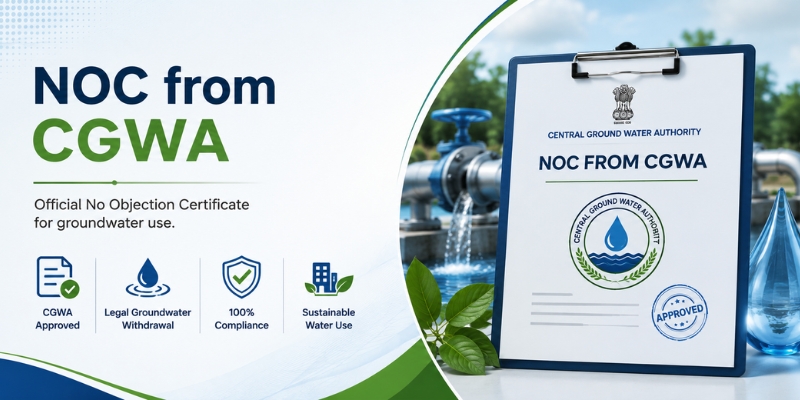
NOC from CGWA
Get expert assistance obtaining a No Objection Certificate (NOC) from CGWA for groundwater extraction, tube well construction, and industrial or commercial water use across India.
Why Groundwater Extraction Needs Central Clearance, Not Just a Borewell Contractor
If your business draws groundwater through a borewell or tube well for industrial, commercial, mining, or infrastructure use, you need a No Objection Certificate (NOC) from the Central Ground Water Authority (CGWA), a statutory body operating under the Ministry of Jal Shakti, constituted originally under the Environment (Protection) Act, 1986 following a Supreme Court direction in the M.C. Mehta vs Union of India case. Trity Environ Solution has guided industries across UP and Delhi NCR through this process for exactly the kind of unit that most often gets this wrong: a facility that assumed drilling a borewell was purely a civil works decision, not a regulatory one.
CGWA's core job is straightforward: India's groundwater is being extracted faster than it recharges in large parts of the country, and NCR sits inside the worst-affected belt. The national Dynamic Ground Water Resources Assessment 2025 put the country's overall Stage of Extraction at roughly 60.6%, but that number hides enormous regional variation. CGWB's own reporting flags North West India, specifically Punjab, Haryana, Delhi, and Western UP, as one of the country's most concentrated clusters of Over-Exploited assessment units. If your facility sits in Ghaziabad, Noida, Gurgaon, or anywhere in that belt, there is a real chance your unit falls in a Critical or Over-Exploited block, and that classification changes what you can and cannot do.
How CGWA Categorises Your Area, and Why It Decides Your Entire Application
Every block, taluka, or mandal in India is assessed annually by CGWB and classified based on its Stage of Extraction (SoE), the ratio of annual groundwater extraction to annual extractable recharge:
| Category | SoE Threshold | What It Means for a New NOC |
|---|---|---|
| Safe | Below 70% | Standard NOC process applies, extraction within sustainable limits |
| Semi-Critical | 70% to 90% | Signs of stress, NOC comes with tighter monitoring conditions |
| Critical | 90% to 100% | Extraction near the recharge limit, additional scrutiny and mandatory recharge measures |
| Over-Exploited (OE) | Above 100% | New commercial or industrial NOCs are generally not granted, with narrow exceptions |
This last row is the one that catches applicants off guard. In an Over-Exploited zone, CGWA does not issue NOCs for new major commercial or industrial activity, except for MSMEs and a few essential-use categories, and even then, the application must demonstrate that municipal or alternate water supply genuinely cannot meet demand. For a unit planning to set up in an OE block, the real first step isn't the NOC application, it's an honest water-sourcing feasibility assessment before land and equipment commitments are made.
Who Needs an NOC from CGWA
- New industrial units, factories, or manufacturing facilities extracting groundwater through borewells or tube wells
- Infrastructure projects: residential townships, commercial malls, IT parks, and similar large developments
- Mining operations requiring dewatering or water extraction
- Existing units seeking to expand extraction capacity or renew an expiring NOC
- Any entity operating in a Semi-Critical, Critical, or Over-Exploited assessment unit, regardless of scale, with limited exemptions for individual domestic users, rural drinking water schemes, and defence establishments
Step-by-Step Application Process
- Determine your assessment unit's category (Safe, Semi-Critical, Critical, or Over-Exploited) using the latest CGWB data for your block.
- Commission a Hydrogeological Report from a certified hydrogeologist, covering lithology mapping, pumping test data, drawdown analysis, and site-specific recharge potential. Generic or templated reports are, by CGWA's own account, the leading cause of NOC rejections under the current portal's automated screening.
- Apply through the Bhu-Neer portal, CGWA's online application system, uploading the hydrogeological report, groundwater quality data from a NABL-accredited laboratory, and a copy of your Consent to Establish or Environmental Clearance where applicable.
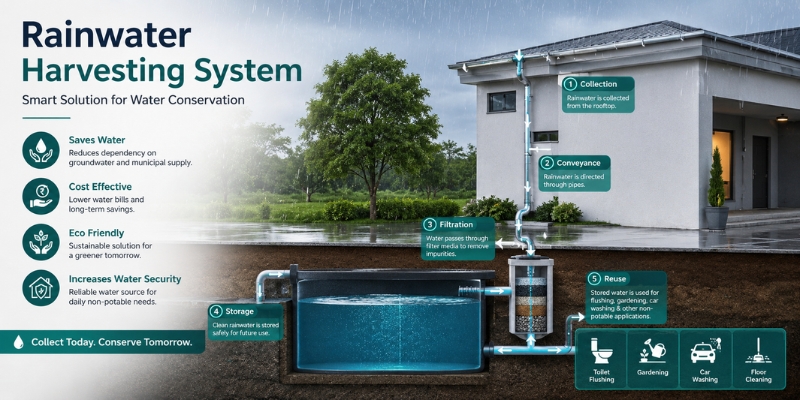
- Submit a Rainwater Harvesting or Recharge System plan, mandatory for all applicants regardless of category, since CGWA now requires a recharge commitment alongside every extraction approval.
- Pay applicable fees: a fresh NOC application currently carries a processing fee, separate from advance groundwater charges and any applicable penalties, payable through the Bharatkosh integrated gateway.
- Track and receive approval through the portal, with typical validity running 2 to 5 years depending on category and user type.
Documents Required
| Document | Notes |
|---|---|
| Hydrogeological Report | Certified hydrogeologist; mandatory for over-exploited and high-volume categories |
| Groundwater quality data | From a NABL-accredited laboratory |
| Copy of Consent to Establish / Environmental Clearance | Where the project already requires SPCB or MoEFCC clearance |
| Rainwater Harvesting / Recharge plan | Mandatory across all categories, not just OE zones |
| Water Audit Report (for existing users) | Uploaded online for renewal or expansion applications |
| Digital flow meter installation proof | Required at all abstraction points for ongoing monitoring |
Mandatory Ongoing Compliance, Not a One-Time Approval
An NOC is not the end of the compliance obligation. CGWA now requires installation of digital flow meters at every abstraction point, with monthly readings uploaded to the online portal, and periodic submission of groundwater quality data from accredited labs. A Rainwater Harvesting or Recharge System is a standing condition of the NOC itself, not a one-time construction item, and its functioning is subject to inspection. CGWA and State Ground Water Authorities also conduct compliance verification through independent agencies, and in December 2024 CGWA formally directed all states to report enforcement action, including borewells sealed and penalties imposed, against unauthorised extraction by industrial units, commercial establishments, and large housing complexes.
Penalties and Consequences of Non-Compliance
Groundwater extraction without a valid NOC is a violation under the Environment (Protection) Act, 1986, and CGWA's enforcement powers include immediate sealing of unauthorised borewells, environmental compensation penalties, and referral for cancellation of the unit's operating licence in serious cases. Facilities in Over-Exploited zones face the added risk of an NOC being denied outright at the application stage, which means the financial exposure isn't a fine after the fact, it's a stalled project with no water source secured before construction has already begun.
Why Trity Environ Solution for CGWA NOC Assistance
Trity Environ Solution's core manufacturing work, STP, ETP, and RO plants, sits directly next to CGWA's compliance requirements, since a facility's projected water demand, its recharge obligations, and its treatment plant sizing are not separate conversations, they're the same engineering problem viewed from two sides. We assist clients with category assessment for their specific block, coordination for hydrogeological survey and NABL lab testing, Rainwater Harvesting system design sized to the site's actual recharge obligation, and complete Bhu-Neer portal application support through to NOC grant.
Frequently Asked Questions
How do I know if my area is Safe, Semi-Critical, Critical, or Over-Exploited?
CGWB publishes block-wise Dynamic Ground Water Resource Assessment data annually. Your Hydrogeological Report will confirm your specific assessment unit's current category, since this can change year to year based on updated data.
Can I get an NOC if my facility is in an Over-Exploited zone?
Generally no for new major commercial or industrial activity, with narrow exceptions for MSMEs and cases where you can demonstrate that municipal or alternate water supply cannot meet demand. Drinking, domestic, and green belt use may still be permitted.
How long is a CGWA NOC valid?
Typically 2 to 5 years, depending on your assessment unit's category and the type of user, after which renewal is required.
Is Rainwater Harvesting mandatory even in Safe category areas?
Yes. A Recharge or Rainwater Harvesting System is a standing condition of the NOC across all categories, not just stressed zones.
What happens if I extract groundwater without an NOC?
It is a legal violation under the Environment (Protection) Act, 1986, and can result in your borewell being sealed, environmental compensation penalties, and in serious cases, referral for cancellation of your operating licence.
Do I need a separate NOC for each borewell, or one for the facility?
The NOC application covers your facility's total extraction and abstraction points as declared in your Hydrogeological Report; all points must have digital flow meters and are covered under the same approval, though expansion of extraction capacity requires a fresh or amended application.
Scope Highlights
Why Choose Trity Enviro Solutions?
Industry-certified environmental engineers delivering compliant, high-efficiency turnkey systems across India.
100% SPCB/CPCB Compliance
Complete regulatory clearance & legal liaison support.
Certified Engineers
Over a decade of industrial wastewater expertise.
Turnkey Execution
End-to-end design, fabrication, setup & commissioning.
Pan-India AMC & Service
24/7 technical hotline, scheduled visits & spare parts.
Frequently Asked Questions
Q1. What is a MBBR Media?
Moving bed biofilm reactor (MBBR) is a type of wastewater treatment process that was first invented by Prof. Hallvard Ødegaard at Norwegian University of Science and Technology in the late 1980s. For more detail call us on 8802624956
Q2. What is a digester tank?
The wet anaerobic digestion process is applied to liquid waste streams that are conveyable by liquid pumping. Sometimes wet systems are called Low Solids AD (LSAD). The Wet AD process can be done in reactors of two main configurations, continuously stirred tank reactors (CSTR) and plug flow reactors.
Q3. Which air pollutant is produced in anaerobic decomposition of organic matter?
Methane is the largest natural source of hydrocarbons. It's produced by the anaerobic decomposition of organic matter in bodies of water. -Trees and plants produce most of the remaining natural VOC's called terpenes. Volatile Organic Compounds - VOCs -Petroleum is the key source of man-made VOC pollution.
Q4. What is a sewage treatment plant?
The Sewage Treatment Plant process is similar to the way that a Septic Tank works but mechanical components provide a process to help break down solids to produce a cleaner, more environmentally friendly effluent.
Q5. What is the tertiary treatment of sewage?
Tertiary treatment is the final cleaning process that improves wastewater quality before it is reused, recycled or discharged to the environment. The treatment removes remaining inorganic compounds, and substances, such as the nitrogen and phosphorus.
Related Service Solutions
Rainwater Harvesting System

Technical Assistance on Web
Consent to Establishment
Related Industry Insights
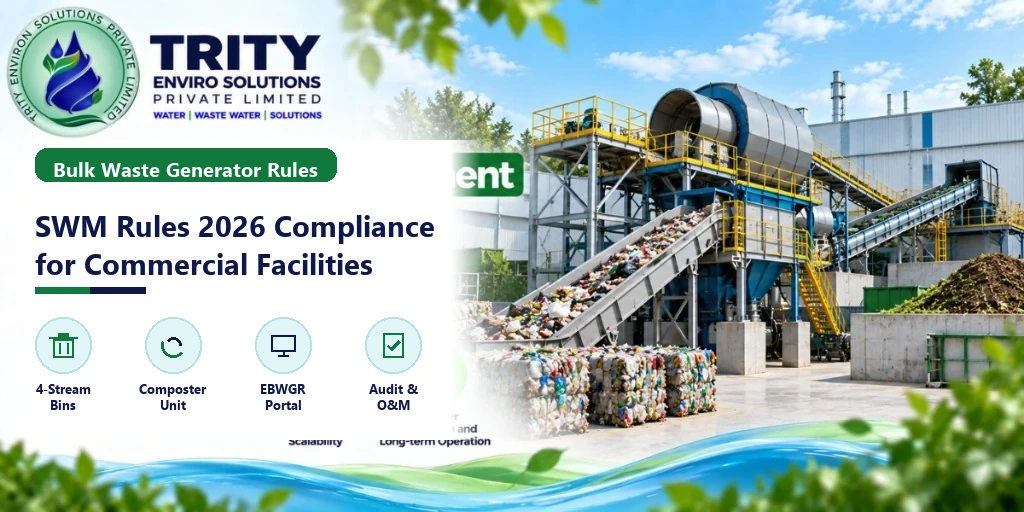
Bulk Waste Generator Compliance Under India's SWM Rules 2026: What Businesses Need to Set Up
A practical checklist for bulk waste generators under SWM Rules 2026: registration, four-stream segregation, on-site processing, EBWGR certificates and records.
Read Article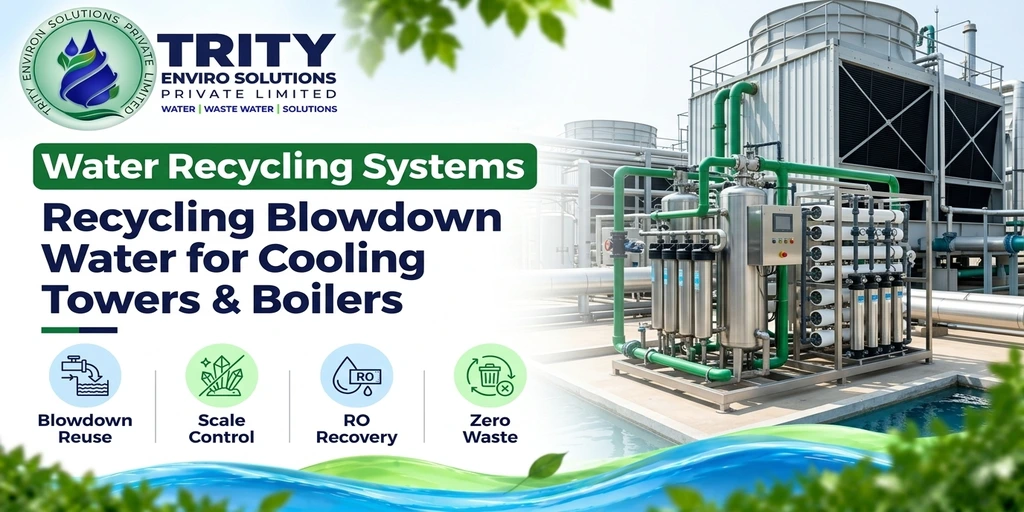
How to Design a Water Recycling System for Cooling Towers and Industrial Process Water
Design a water recycling system for cooling towers and process water: water balance, cycles of concentration, treatment train and payback, with an example.
Read Article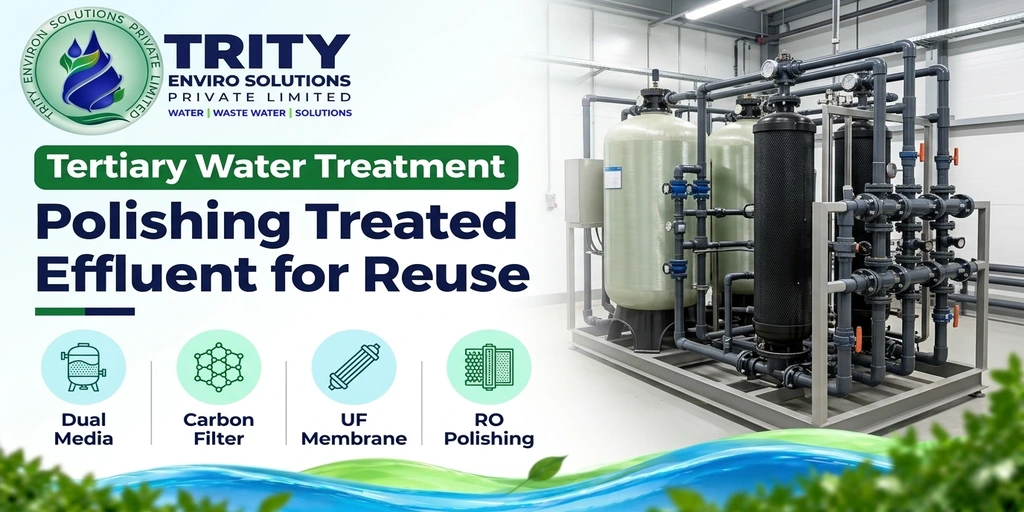
Tertiary Water Treatment for Industrial Reuse: When Filtration Alone Is Not Enough
Is filtration enough to reuse treated wastewater? Learn when you need UF, RO, softening or disinfection, and how to match tertiary treatment to each reuse.
Read ArticleFeatured Turnkey Installations











Need Expert Support for Your Water Treatment Project?
From regulatory compliance to turnkey engineering and O&M, our certified environmental engineers are ready to assist.

