Energy Recovery from STP Sludge via Anaerobic Digestion
Discover how anaerobic digestion of STP sludge generates biogas, reduces waste, and supports clean energy in sustainable wastewater treatment systems.

 ISO 9001:2015 & QCI Approved
Sand filtration in STP plants improves treated water quality by removing suspended solids. Learn its importance, working, and role in wastewater treatment.

One of the most common complaints we hear from housing societies and industrial clients goes something like this: "We installed the STP, it's running, but the treated water still smells funny and looks a bit cloudy. We can't use it for anything."
This is not a rare problem. It happens more often than people think, and in most cases, the biological treatment has actually done its job. The MBR or MBBR has broken down the organics. The secondary clarifier has settled the sludge. On paper, the water has been treated.
But here's what nobody tells clients upfront: secondary treatment alone doesn't deliver the kind of treated water quality that's actually usable for gardening, flushing, or cooling towers. There's a gap between "biologically treated" and "polished for reuse." Filling that gap is exactly what sand filtration in STP plants is designed to do.
A standard sewage treatment plant works in stages. Primary treatment removes the big stuff, solids, grit, grease. Secondary treatment is where the biological action happens; bacteria break down dissolved organics, BOD comes down, ammonia gets addressed. By the time water exits secondary treatment, it's largely free of harmful organic load.
But the water still carries fine suspended solids, residual turbidity, and sometimes trace odor compounds that biology alone won't eliminate. This is where tertiary treatment begins, and sand filtration is almost always the first unit in that stage.
Think of it like this: secondary treatment is the washing machine, and sand filtration is the rinse cycle. You wouldn't skip the rinse and consider the laundry done.
For a more detailed understanding of how each stage works in a complete system, read our guide on how sewage treatment plants clean wastewater.
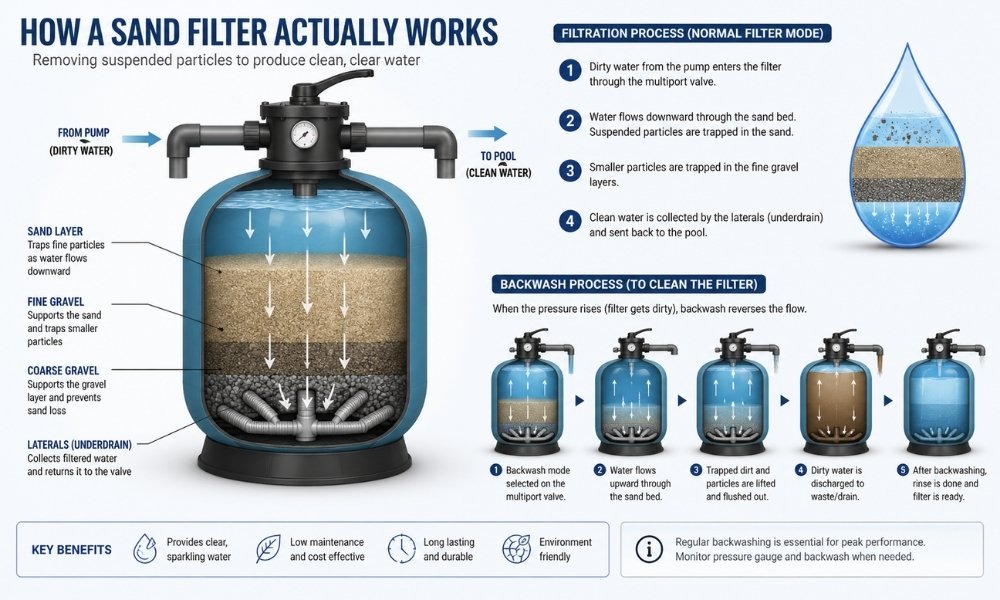
A pressure sand filter is essentially a closed vessel, usually a cylindrical FRP or MS tank, packed with graded layers of filtration media. The most common arrangement uses fine sand on top, coarser sand or gravel in the middle, and a support layer of larger gravel at the bottom.
Treated water is pumped into the filter from the top under pressure. As it travels down through these layers, the suspended particles get physically trapped in the voids between sand grains. Finer particles are captured near the surface; anything that makes it deeper gets caught in the lower layers. What exits from the bottom is noticeably clearer, lower in turbidity, and significantly improved in suspended solids removal.
The filter runs until the media gets clogged enough to restrict flow. At that point, it goes into backwash mode, water is forced upward through the media, flushing out the accumulated solids. This whole cycle repeats continuously during plant operation.
It sounds simple. It is simple. And that simplicity is actually one of its biggest advantages in field conditions where operators aren't always highly trained.
Over the years, working on STP plant installations across residential and industrial sites, the pattern has been consistent. When sand filtration is properly sized and maintained, the overall system performs well. When it's skipped or undersized to cut costs, the downstream problems compound quickly.
Here's what actually goes wrong without it:
Turbidity in reuse water. If treated water is being routed to flushing systems or cooling towers with high suspended solids, nozzles and pipes clog within months. Maintenance costs shoot up. Residents complain. Facility managers start blaming the STP.
Odor in reuse applications. Fine organic particles and biofilm-forming matter that pass through secondary treatment will generate odor as they break down further in storage tanks. A sand filter removes much of this before it reaches the reuse point.
Downstream equipment damage. UV disinfection units, which are now standard in most modern STP designs, lose efficiency rapidly if the water entering them is turbid. The UV light can't penetrate cloudy water effectively. You end up with a disinfection unit that's consuming power but not doing its job. The wastewater treatment plant design only works as intended when each stage is given clean input from the previous one.
Compliance failure. CPCB and state pollution control boards have specific parameters for treated water discharge: total suspended solids must typically be below 30 mg/L, and for water reuse applications the standard is even tighter. Without sand filtration, hitting these numbers consistently is extremely difficult.
In most STP applications, you'll encounter two types.
Pressure Sand Filters (PSF) are by far the most common in packaged and modular STP plants. They're compact, work under pump pressure, and can be easily sized for flow rates from 1 KLD to several hundred KLD. For residential societies, hotels, hospitals, and mid-sized industrial units, PSF is almost always the right choice.
Gravity Sand Filters work on a different principle, water flows down through the media by gravity alone, without pressure assistance. These are more common in large municipal treatment plants where very high volumes make pressurized systems impractical. They require more footprint but can handle larger flows with lower energy consumption.
For most projects we encounter, housing societies, commercial complexes, pharmaceutical units, food plants, a well-sized pressure sand filter is the practical and cost-effective solution.
This is where a lot of STP projects go wrong, and most of it is avoidable.
Wrong media specification. Using sand that's too fine causes rapid clogging and high backwash frequency. Too coarse, and fine particles pass right through. The effective size and uniformity coefficient of the media matter, and they need to match the actual influent quality coming out of secondary treatment.
Inadequate backwash design. A sand filter that isn't backwashed properly, at the right pressure and for the right duration, gradually loses efficiency. The media compacts, channeling starts, and water finds the path of least resistance rather than being filtered. We've seen filters on sites where backwash was never set up correctly from day one, and the system was basically useless within six months.
Undersizing for flow rate. To save on capital cost, some projects install a filter that's too small for the plant's peak flow. During peak hours, water shoots through so fast that contact time with the media is insufficient. The turbidity reduction is minimal, and clients wonder why the system isn't working.
No monitoring of differential pressure. This is the simplest diagnostic tool for a sand filter. If you're not tracking the pressure drop across the filter, you have no way of knowing when it's due for backwash or if something has gone wrong internally.
India's water reuse requirements are growing faster than the infrastructure supporting them. Under various CPCB and state PCB guidelines, STP-treated water from housing societies must be reused for horticulture and flushing. Many states now mandate it. Builders and developers who fail to demonstrate functional reuse systems face compliance issues during occupancy certificate applications.
At the same time, water quality in India varies significantly. Groundwater hardness, higher initial TSS in sewage from certain localities, and seasonal variations in load all mean that the STP, and the sand filter within it, has to be designed with some headroom. A filter that works perfectly in March may struggle in July if the design didn't account for monsoon-season load changes.
For any project that takes operation and maintenance seriously, sand filtration is one of the easiest systems to maintain consistently when it's correctly designed upfront.
At Trity Environ Solutions, sand filtration isn't an afterthought added to make the plant look complete on paper. It's engineered as an integral part of the treatment chain, sized based on actual secondary effluent quality, and paired with proper backwash controls and media specifications.
Every STP project we handle, from initial project execution to long-term operation support, is built on the understanding that a plant's real output is the treated water quality, not just the installed capacity. Our team has worked across residential, industrial, and government projects, and the consistent lesson is that getting the tertiary filtration stage right separates systems that actually perform from those that just exist on site.
Sand filtration is not glamorous. It doesn't have the technical complexity of an MBR or the appeal of a disinfection system. But in practical terms, it is the stage that determines whether treated water is actually fit for reuse or just technically processed.
As India moves toward stricter water reuse mandates and tighter discharge norms, getting this stage right will matter more and more. Investing in a properly designed sand filtration system today means fewer complaints, fewer compliance notices, and treated water that can genuinely substitute freshwater in non-potable applications.
That's the real value of sand filtration in STP, not just removing particles, but making the entire treatment investment worthwhile.
Sand filtration is a physical filtration process used in the tertiary treatment stage of a sewage treatment plant. Water passes through layers of graded sand and gravel media, which trap fine suspended solids, turbidity-causing particles, and residual organic matter that pass through biological treatment. The result is clearer, better-quality treated water suitable for reuse or compliant discharge.
Biological treatment handles dissolved organics and BOD reduction, which sand filtration cannot do. Sand filtration, on the other hand, removes the fine suspended particles that remain after biology. Placing the sand filter after biological treatment means it receives a lower-load input, extends its run time between backwashes, and produces polished water as the final output.
A pressure sand filter removes suspended solids and turbidity through physical trapping in sand media. An activated carbon filter removes dissolved compounds like chlorine, certain organic chemicals, and odor-causing substances through adsorption. In most STP tertiary treatment trains, PSF comes first, followed by carbon filtration where higher water quality is needed, such as for industrial reuse.
It depends on the quality of water entering the filter and the flow rate. In most residential STP applications, backwashing is needed every 24 to 48 hours. The best indicator is differential pressure across the filter. When the pressure drop reaches a preset limit, backwash should be initiated. Automated systems handle this without operator intervention.
Partially. Sand filtration removes fine organic particles that contribute to odor generation in storage tanks. However, for dissolved odor compounds, an activated carbon filter is more effective. In many STP designs, combining both in series delivers treated water that is virtually odor-free for reuse applications.
While the exact requirement varies by state and project type, CPCB guidelines and most state PCB regulations specify treated water quality standards that are very difficult to achieve without tertiary filtration. For water reuse mandates under housing society or commercial STP regulations, sand filtration is effectively a necessary component of any compliant system.
For technical guidance on STP design, filtration systems, and water reuse solutions, contact the Trity Environ Solutions team.
Discover how anaerobic digestion of STP sludge generates biogas, reduces waste, and supports clean energy in sustainable wastewater treatment systems.

Discover the dynamics of Biological Treatment in ETP Plants – an in-depth look at the advantages and drawbacks that define sustainable wastewater management. Uncover the pivotal role biological processes play in environmental solutions.

Effluent Treatment Plants help industries manage wastewater, removing toxins and pollutants to protect the environment, ensure regulatory compliance, and promote sustainability.




Discuss your requirements with our engineering team and get practical guidance for your project.