ISO 9001:2015 & QCI Approved
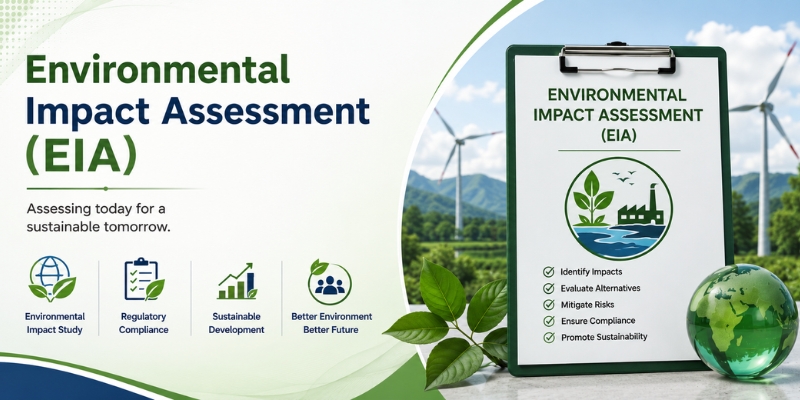
Environmental Impact Assessment
Get professional Environmental Impact Assessment (EIA) reports, scoping studies, and clearance support for industrial projects under the EIA Notification 2006 and 2026 amendments.
Why EIA Comes Before Everything Else on Larger Projects
The Environmental Impact Assessment (EIA) is the study that decides whether a project gets Environmental Clearance (EC), and for projects that need it, EC has to be in hand before you can even apply for Consent to Establish. It is governed by the EIA Notification, 2006, issued under Section 3 of the Environment (Protection) Act, 1986, and has since been amended more than 40 times, most recently in July 2026. Trity Environ Solution works with industrial and infrastructure clients across UP and Delhi NCR at exactly this earliest stage, because getting the EIA scope wrong, or missing a threshold that puts your project into a stricter category than expected, costs months later that a slightly more careful reading of the notification would have saved.
Not every project needs an EIA. The notification categorises activities into Category A (requiring central appraisal and clearance from MoEFCC) and Category B, which is further split into B1 (requiring a full EIA report, appraised at the state level) and B2 (exempted from a detailed EIA report, appraised through a simpler process). Getting this categorisation right at the outset determines whether your project is looking at a few months of appraisal or well over a year.
What Changed in July 2026
MoEFCC notified amendments in July 2026 specifically aimed at resolving project appraisal delays at the state level, a long-standing complaint from industries whose EC applications sat stalled whenever a State Environment Impact Assessment Authority (SEIAA) or State Expert Appraisal Committee (SEAC) became non-functional or backlogged. Two new standing bodies were established for this purpose:
- Standing Authority on Environment Impact Assessment (SAEIA): can assume the functions of a state's SEIAA for up to one year if that SEIAA is non-functional or is causing appraisal delays, keeping Category B1 clearance applications moving instead of stalling indefinitely.
- Standing Committee on Environment Impact Appraisal (SCEIA): performs the equivalent role for a state's SEAC, stepping in to appraise projects when the SEAC itself isn't functioning.
For a project proponent, the practical effect is that a state-level bottleneck is no longer an open-ended delay with no fallback mechanism, though the categorisation, scoping, and documentation requirements underneath these bodies remain unchanged.
Project Categories and What They Mean for Your Timeline
| Category | Appraisal Level | EIA Report Required? | Typical Timeline |
|---|---|---|---|
| A | Central (MoEFCC, via Expert Appraisal Committee) | Yes, full EIA Report and EMP | 12 to 18 months |
| B1 | State (SEIAA/SEAC, or SAEIA/SCEIA as fallback) | Yes, full EIA Report and EMP | 12 to 18 months |
| B2 | State (SEIAA/SEAC) | No detailed EIA report required | 3 to 6 months |
Certain activities listed in the notification's Appendix are exempted from prior environmental clearance entirely, though this exemption list is itself subject to periodic amendment, so it's worth verifying current status against the latest gazette notification rather than assuming a past exemption still holds.
The Five-Stage EIA Process
- Screening: Determines whether your project needs an EIA at all, and if so, which category it falls under. Application is filed in Form-I (and Form-1A where applicable) after the site is identified, before construction or land preparation begins.
- Scoping: For Category A and B1 projects, the EAC or SEAC issues Terms of Reference (ToR), specifying which environmental parameters your study must cover, your study area boundary, and baseline data requirements.
- Baseline data collection and EIA report preparation: A minimum of one season of baseline environmental data is collected, covering air quality, surface and groundwater quality, soil, ecology, noise, and the socioeconomic profile of the study area, typically within a 10 km radius. A QCI/NABET-accredited consultant prepares the full EIA Report and Environmental Management Plan (EMP), which must follow MoEFCC's prescribed General Structure and Content guidelines.
- Public consultation and hearing: Mandatory for most Category A and B1 projects, conducted in the project area with at least 30 days' public notice. Projects located within an industrial estate that already underwent estate-level public consultation may be exempted from a separate individual hearing under the relevant amendment, provided that estate-level consultation genuinely covered the project.
- Appraisal and decision: The EAC (Category A) or SEAC (Category B1) reviews the complete package, the Form-I, the EIA Report, the public consultation summary, and the proponent's responses to any queries, then recommends grant, grant with conditions, deferral pending more information, or rejection. MoEFCC issues the formal EC order for Category A projects; the SEIAA issues it for Category B.
Documents Typically Required
| Document | Notes |
|---|---|
| Form-I (and Form-1A, where applicable) | Initial screening application, filed after site identification |
| Pre-feasibility report | For most project types; construction/township projects submit a conceptual plan instead |
| Terms of Reference (ToR) | Issued by EAC/SEAC at the scoping stage for Category A and B1 |
| EIA Report and Environmental Management Plan | Prepared by a QCI/NABET-accredited consultant |
| Public consultation summary | Record of the public hearing and how concerns raised were addressed |
| Baseline environmental data | Minimum one season, covering air, water, soil, ecology, noise, and socioeconomic parameters |
Consequences of Proceeding Without Environmental Clearance
Undertaking construction or expansion on a project that requires EC without first obtaining it is a serious compliance failure, one that can result in a stop-work order, National Green Tribunal action, and in some cases forces a project into the post-facto clearance route, a process that is more scrutinised, more contested, and carries no guarantee of approval. Because EC is a precondition for CTE on qualifying projects, skipping this step doesn't just risk an EIA-specific penalty, it invalidates the basis for every subsequent SPCB consent the project would otherwise rely on.
Why Trity Environ Solution for EIA Support
We work alongside your EIA consultant from the categorisation stage onward, since a project's proposed ETP, STP, or other pollution control infrastructure feeds directly into the Environmental Management Plan the EIA report has to defend. Getting the treatment system design right at this stage means the EMP commitments your EC is granted on are commitments your later CTE and CTO applications can actually deliver on, rather than promises made too early by a design that hasn't been engineered yet. We assist with project categorisation review, coordination with accredited EIA consultants, pollution control system design input for the EMP, and documentation support through screening, scoping, and appraisal.
Frequently Asked Questions
Does every industrial project need an EIA?
No. Only projects and activities listed in the EIA Notification's schedule require one, and even among those, Category B2 projects are exempted from a full EIA report. Some listed activities are exempted from prior clearance entirely, subject to the current gazette notification.
How long does the EIA process take?
Category B2 projects can be cleared in roughly 3 to 6 months. Category A and B1 projects requiring a full EIA study typically take 12 to 18 months, covering scoping, baseline data collection, public consultation, and appraisal.
What is the difference between Category A and Category B projects?
Category A projects are appraised centrally by MoEFCC and always require a full EIA Report. Category B is split into B1, which also requires a full EIA Report but is appraised at the state level, and B2, which does not require a detailed EIA report.
What happens if my state's SEIAA is delayed or non-functional?
Since the July 2026 amendment, the Standing Authority on Environment Impact Assessment (SAEIA) can assume SEIAA functions for up to a year in such cases, and the Standing Committee on Environment Impact Appraisal (SCEIA) can similarly step in for a non-functional SEAC.
Can I get Consent to Establish before I have Environmental Clearance?
No, for projects that require EC. Environmental Clearance has to be obtained first for qualifying projects; CTE cannot be granted on the basis of an EC application that's still pending.
Is public hearing always required?
It's mandatory for most Category A and B1 projects, with at least 30 days' public notice. Projects within an industrial estate that already underwent estate-level public consultation may be exempted from a separate individual hearing, provided that consultation adequately covered the project.
Scope Highlights
Why Choose Trity Enviro Solutions?
Industry-certified environmental engineers delivering compliant, high-efficiency turnkey systems across India.
100% SPCB/CPCB Compliance
Complete regulatory clearance & legal liaison support.
Certified Engineers
Over a decade of industrial wastewater expertise.
Turnkey Execution
End-to-end design, fabrication, setup & commissioning.
Pan-India AMC & Service
24/7 technical hotline, scheduled visits & spare parts.
Frequently Asked Questions
Q1. What is a MBBR Media?
Moving bed biofilm reactor (MBBR) is a type of wastewater treatment process that was first invented by Prof. Hallvard Ødegaard at Norwegian University of Science and Technology in the late 1980s. For more detail call us on 8802624956
Q2. What is a digester tank?
The wet anaerobic digestion process is applied to liquid waste streams that are conveyable by liquid pumping. Sometimes wet systems are called Low Solids AD (LSAD). The Wet AD process can be done in reactors of two main configurations, continuously stirred tank reactors (CSTR) and plug flow reactors.
Q3. Which air pollutant is produced in anaerobic decomposition of organic matter?
Methane is the largest natural source of hydrocarbons. It's produced by the anaerobic decomposition of organic matter in bodies of water. -Trees and plants produce most of the remaining natural VOC's called terpenes. Volatile Organic Compounds - VOCs -Petroleum is the key source of man-made VOC pollution.
Q4. What is a sewage treatment plant?
The Sewage Treatment Plant process is similar to the way that a Septic Tank works but mechanical components provide a process to help break down solids to produce a cleaner, more environmentally friendly effluent.
Q5. What is the tertiary treatment of sewage?
Tertiary treatment is the final cleaning process that improves wastewater quality before it is reused, recycled or discharged to the environment. The treatment removes remaining inorganic compounds, and substances, such as the nitrogen and phosphorus.
Related Service Solutions
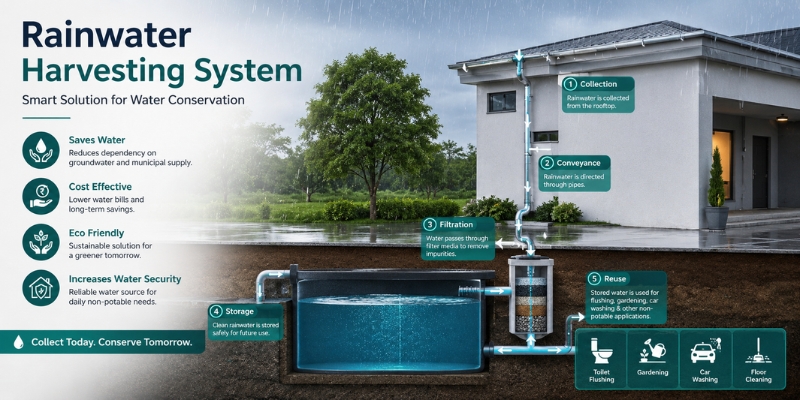
Rainwater Harvesting System

Technical Assistance on Web
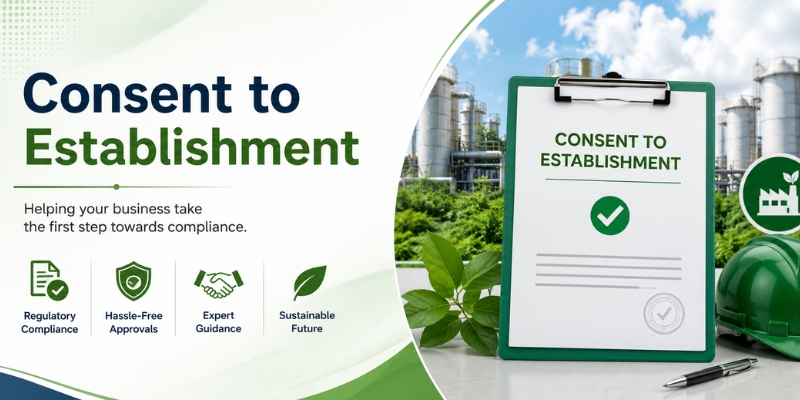
Consent to Establishment
Related Industry Insights
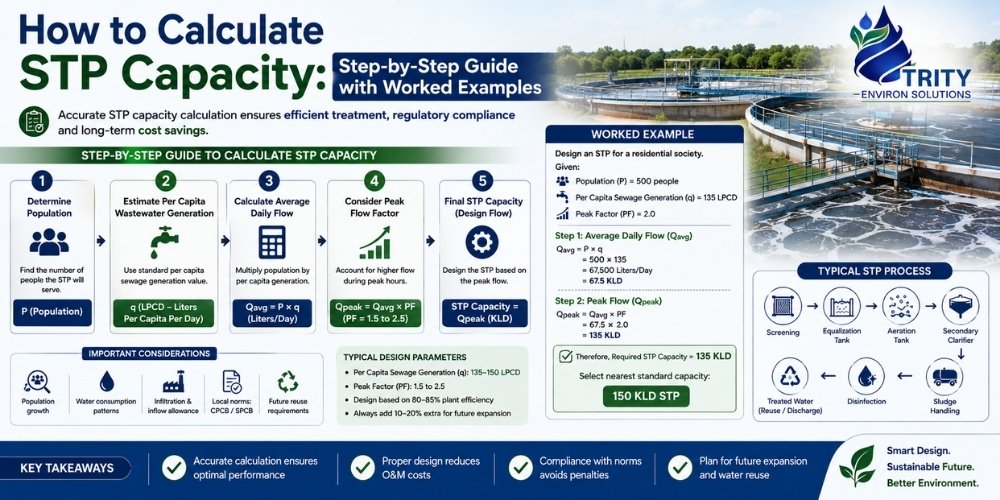
How to Calculate STP Capacity: Step-by-Step Guide with Worked Examples
Calculate STP capacity correctly with worked examples for residential, hotel, hospital, and industrial projects. CPHEEO-based formulas, peak factors, and tank sizing explained.
Read Article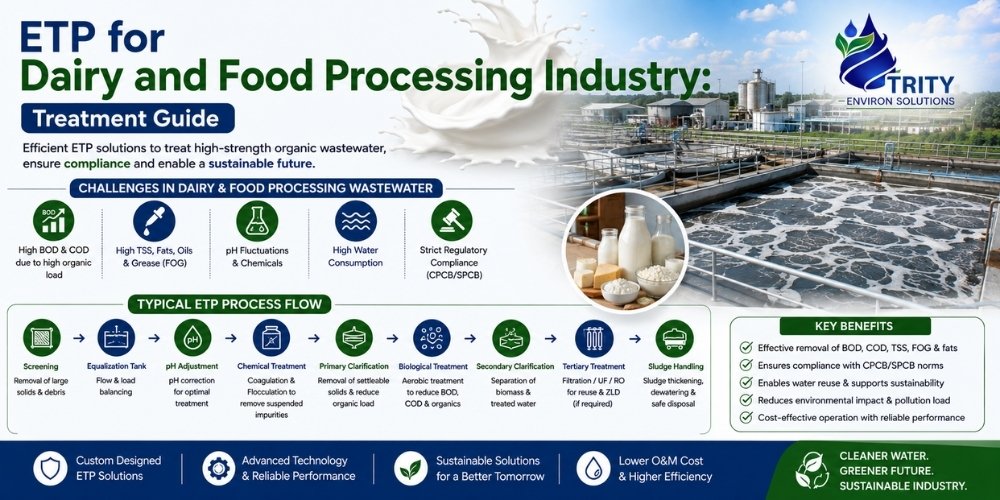
ETP for Dairy and Food Processing Industry: Treatment Guide
Dairy and food processing effluent carries high BOD, COD, and FOG that standard ETPs struggle with. See the treatment stages and technology choices that actually work.
Read Article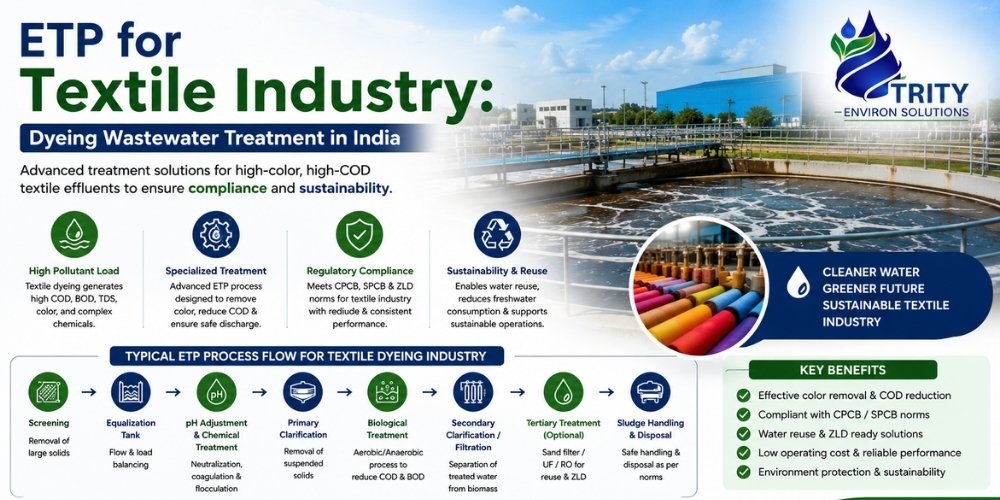
ETP for Textile Industry: Dyeing Wastewater Treatment in India
Textile effluent brings colour, high TDS, and variable pH that generic ETPs can't handle. See the treatment stages, technology choices, and compliance norms that actually work.
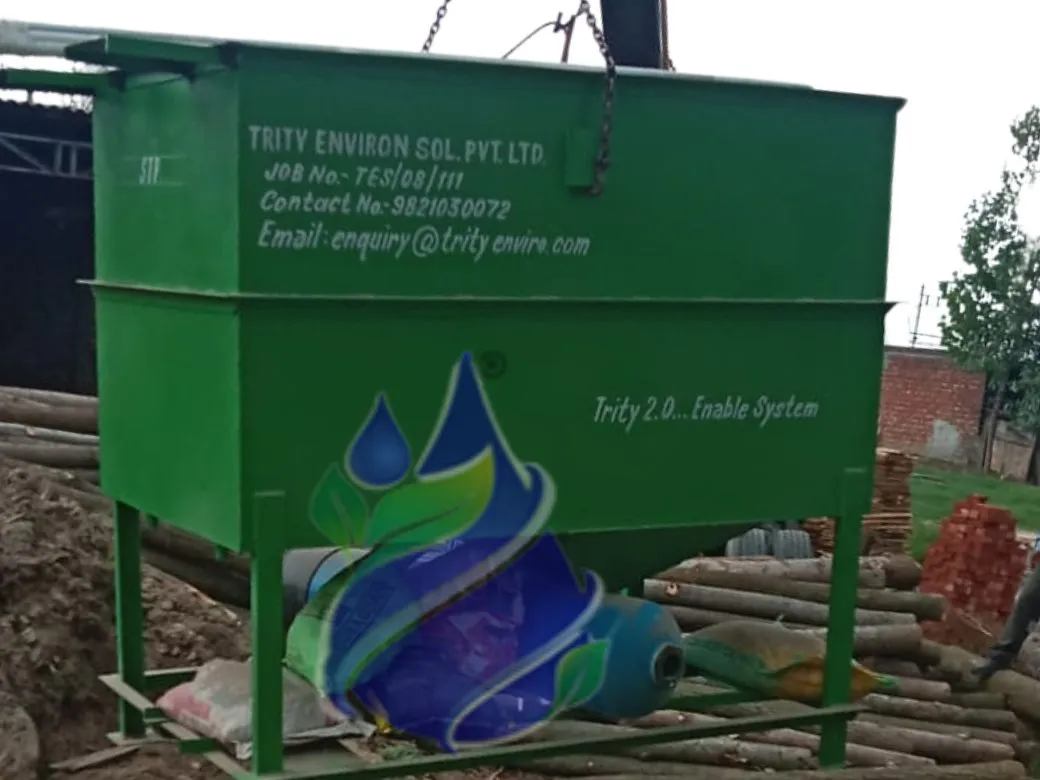
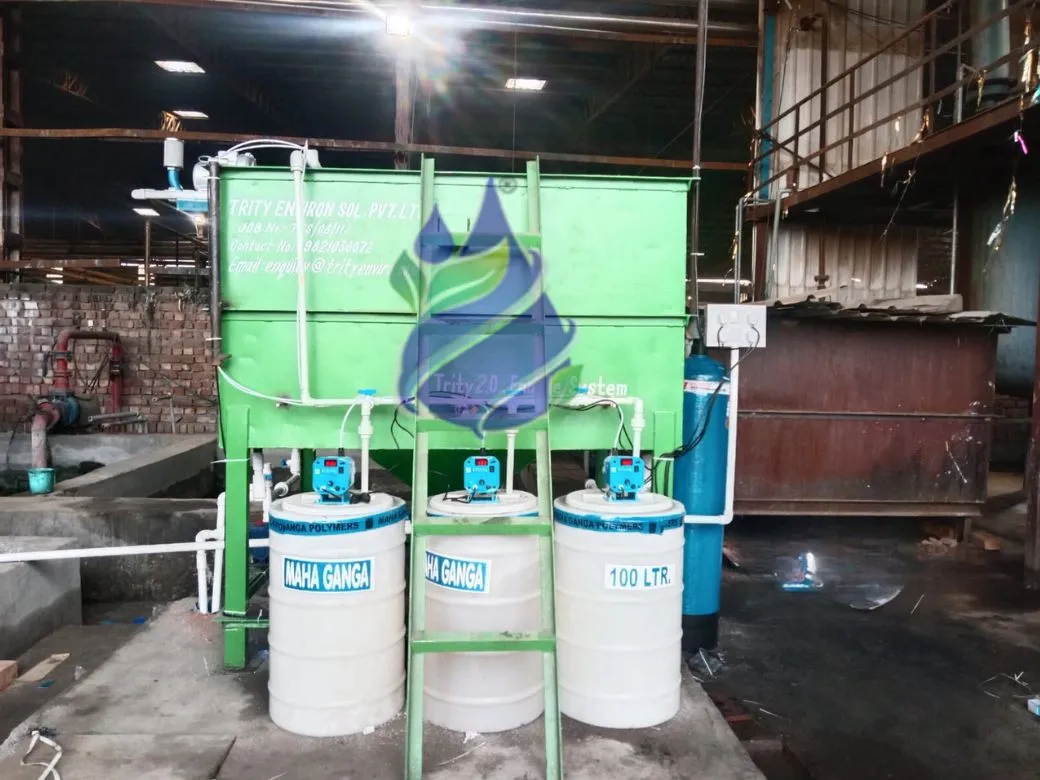
Read ArticleFeatured Turnkey Installations




Need Expert Support for Your Water Treatment Project?
From regulatory compliance to turnkey engineering and O&M, our certified environmental engineers are ready to assist.