ISO 9001:2015 & QCI Approved
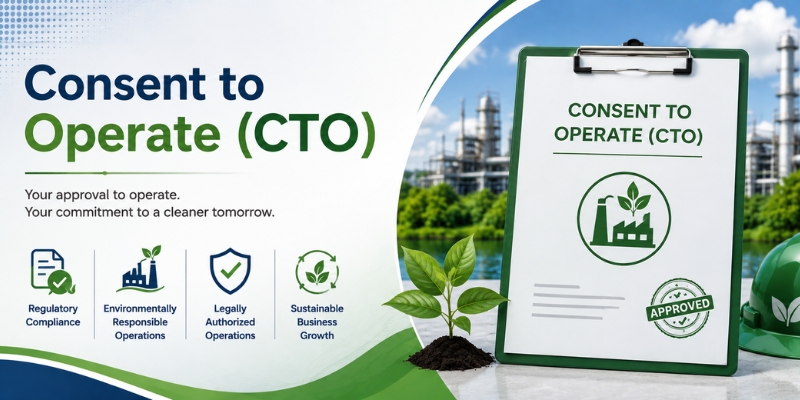
Consent to Operate
Get end-to-end support for obtaining Consent to Operate (CTO) approval, including commissioning documentation, effluent test reports, and SPCB liaison for your industrial facility.
The Approval That Actually Lets You Start Production
Consent to Operate (CTO) is the operational licence issued by the State Pollution Control Board (SPCB) under Section 25/26 of the Water (Prevention and Control of Pollution) Act, 1974 and Section 21 of the Air (Prevention and Control of Pollution) Act, 1981. Where Consent to Establish approves a design on paper, CTO verifies that what actually got built and commissioned, your ETP, your STP, your air pollution control equipment, performs the way it was supposed to. Trity Environ Solution has walked industries across UP and Delhi NCR through exactly the gap that trips up most first-time applicants: a plant that gets built slightly differently from what the CTE described, which then stalls the CTO application until the SPCB is satisfied the difference doesn't matter, or the applicant amends the original CTE.
Applications must typically be submitted at least one month before operations are set to commence, and SPCBs are expected to review and grant consent within roughly four months for a defined validity period. Running production without a valid CTO carries the same legal exposure as never having applied for one at all, regardless of whether construction was properly approved under CTE.
CTE Approves the Design, CTO Verifies the Build
This is the single most common point of confusion for new industries, and it's worth stating plainly: CTE is a promise, CTO is proof. If the as-built ETP or STP differs meaningfully from what was approved at the CTE stage, whether that's a different treatment technology, a lower actual capacity, or a changed discharge point, the SPCB can require a CTE amendment before it will grant CTO, which can delay a plant's commercial start by months, not weeks. This is precisely why pollution control system design and CTO documentation need to be handled by the same team: a mismatch here is expensive in a way that has nothing to do with the treatment technology itself being wrong, it's a paperwork-to-reality gap.
Industry Categories and What They Mean for Your CTO
SPCBs classify industries as Red, Orange, Green, Blue, or White (Exempted) based on a cumulative Pollution Index score. This classification determines your validity period, your renewal frequency, and how much scrutiny your renewal application gets.
| Category | Typical Renewal Timing | What to Expect |
|---|---|---|
| Red | File renewal ~3 months before expiry | Shortest validity, most frequent scrutiny, site inspection usually required at renewal |
| Orange | File renewal ~2 months before expiry | Moderate validity period and documentation burden |
| Green | File renewal ~6 weeks before expiry | Longer validity, lighter renewal burden |
| White (Exempted) | Not applicable | Units scoring 20 or below on the cumulative pollution index are exempt from both CTE and CTO, though registration may still be required |
Step-by-Step CTO Application Process
- Confirm CTE compliance. Verify your commissioned ETP/STP and pollution control equipment match what was approved under your Consent to Establish, or file a CTE amendment first if they don't.
- Commission your pollution control systems and generate initial performance data: effluent test reports, stack emission readings, and operational logs.
- File the CTO application through your state's online portal, typically the same OCMMS-based system used for CTE, at least one month before you intend to begin production.
- Submit supporting documents: layout plans showing effluent/emission point sources, lab test reports from an accredited laboratory, hazardous waste management plan where applicable, and proof of compliance with CTE conditions.
- Site inspection, more likely and more detailed for Red category units, verifying commissioned systems match declared capacity and performance.
- Grant of CTO, valid for a fixed period tied to your industry category, after which renewal is required before continued operation.
Documents Typically Required
| Document | Purpose |
|---|---|
| Copy of valid Consent to Establish | Confirms the facility was authorised to construct |
| Layout plan of effluent/emission point sources | Shows where discharge and emissions actually occur |
| Effluent and emission test reports | From an accredited laboratory, proving commissioned systems perform to standard |
| Hazardous waste management plan | Where the unit generates hazardous, e-plastic, or biomedical waste |
| Compliance undertaking | Confirms manufacturing process, capacity, and pollution load match the CTE application |
| Consent fee payment proof | Investment and category-linked, not flat |
Renewal, Amendment, and Transfer: Three Different Situations
Renewal is required before your CTO expires; running an expired CTO is treated exactly like operating without one. Many SPCBs allow self-certification for renewal where the industry's raw materials, processes, products, capacity, and pollution load are unchanged from the previous consent period, which meaningfully shortens the renewal cycle for stable operations.
Amendment is required whenever you increase capacity, add products, change raw materials, or modify your effluent or emission profile, and it must be filed before implementing the change, not after. A CTO only covers what the SPCB actually reviewed and approved.
Transfer does not happen automatically on a change of ownership through sale, merger, or inheritance. The new owner must apply for consent transfer and file a fresh compliance undertaking; until the SPCB reissues consent in the new name, operations technically lack valid authorisation, regardless of who held the original CTO.
UPPCB's Shift Toward Algorithmic Enforcement
Uttar Pradesh's OCMMS portal has moved toward AI-driven automated flagging for compliance monitoring, cross-referencing declared production capacity against Annual Environment Statement filings and Cess Returns. For Red category units in particular, this makes accurate, consistent declarations across your CTE, your CTO, and your annual filings more important than it was even a couple of years ago, since discrepancies that once might have gone unnoticed are now flagged automatically rather than discovered at the next physical inspection.
Penalties for Operating Without a Valid CTO
Violations under Section 41 of the Water Act and Section 37 of the Air Act can attract Environmental Compensation orders proportional to the severity and duration of the violation, alongside the SPCB's power to issue directions requiring immediate closure of the unit. A factory licence under the Factories Act, 1948 is a separate requirement issued by the labour department, not a substitute for CTO, and holding one does not protect a unit operating without valid pollution control consent.
Why Trity Environ Solution for CTO Support
We design and commission the ETP and STP systems your CTO application is verified against, which means the commissioning data, the effluent test reports, and the CTO documentation come from the same team that built the plant, closing the gap where a paper mismatch between CTE design and actual build stalls the entire application. We assist with commissioning performance testing, effluent and emission test report coordination through accredited labs, CTO application filing and SPCB liaison, and renewal or amendment support as your facility's production profile changes.
Frequently Asked Questions
Can I start production once I have Consent to Establish?
No. CTE only authorises construction. You need a separate CTO, granted after your pollution control systems are commissioned and their performance is verified, before you can legally begin commercial production.
What happens if my as-built ETP differs from what was approved in my CTE?
The SPCB may require a CTE amendment before it will grant CTO, which can delay your commercial start by months. This is why pollution control system design and CTO documentation should be coordinated by the same team from the start.
How often do I need to renew my CTO?
It depends on your industry category. Red category units typically renew most frequently with the shortest validity period, Orange less often, and Green the least often. White category units below the pollution index threshold are exempt from CTO entirely.
Can I renew my CTO without a fresh inspection?
Many SPCBs allow self-certification renewal if your raw materials, processes, products, capacity, and pollution load are unchanged from your last consent period. Red category units are more likely to face inspection at renewal regardless.
Does a CTO transfer automatically if the company is sold?
No. The new owner must apply for consent transfer and submit a fresh compliance undertaking. Operating without the SPCB having reissued consent in the new name is a compliance gap, even if the original CTO was valid.
What's the difference between a factory licence and a CTO?
A factory licence is issued under the Factories Act, 1948 by the labour department. A CTO is issued under the Water and Air Acts by the SPCB. Both are required, and one does not substitute for the other.
Scope Highlights
Why Choose Trity Enviro Solutions?
Industry-certified environmental engineers delivering compliant, high-efficiency turnkey systems across India.
100% SPCB/CPCB Compliance
Complete regulatory clearance & legal liaison support.
Certified Engineers
Over a decade of industrial wastewater expertise.
Turnkey Execution
End-to-end design, fabrication, setup & commissioning.
Pan-India AMC & Service
24/7 technical hotline, scheduled visits & spare parts.
Frequently Asked Questions
Q1. What is a MBBR Media?
Moving bed biofilm reactor (MBBR) is a type of wastewater treatment process that was first invented by Prof. Hallvard Ødegaard at Norwegian University of Science and Technology in the late 1980s. For more detail call us on 8802624956
Q2. What is a digester tank?
The wet anaerobic digestion process is applied to liquid waste streams that are conveyable by liquid pumping. Sometimes wet systems are called Low Solids AD (LSAD). The Wet AD process can be done in reactors of two main configurations, continuously stirred tank reactors (CSTR) and plug flow reactors.
Q3. Which air pollutant is produced in anaerobic decomposition of organic matter?
Methane is the largest natural source of hydrocarbons. It's produced by the anaerobic decomposition of organic matter in bodies of water. -Trees and plants produce most of the remaining natural VOC's called terpenes. Volatile Organic Compounds - VOCs -Petroleum is the key source of man-made VOC pollution.
Q4. What is a sewage treatment plant?
The Sewage Treatment Plant process is similar to the way that a Septic Tank works but mechanical components provide a process to help break down solids to produce a cleaner, more environmentally friendly effluent.
Q5. What is the tertiary treatment of sewage?
Tertiary treatment is the final cleaning process that improves wastewater quality before it is reused, recycled or discharged to the environment. The treatment removes remaining inorganic compounds, and substances, such as the nitrogen and phosphorus.
Related Service Solutions
Rainwater Harvesting System

Technical Assistance on Web
Consent to Establishment
Related Industry Insights
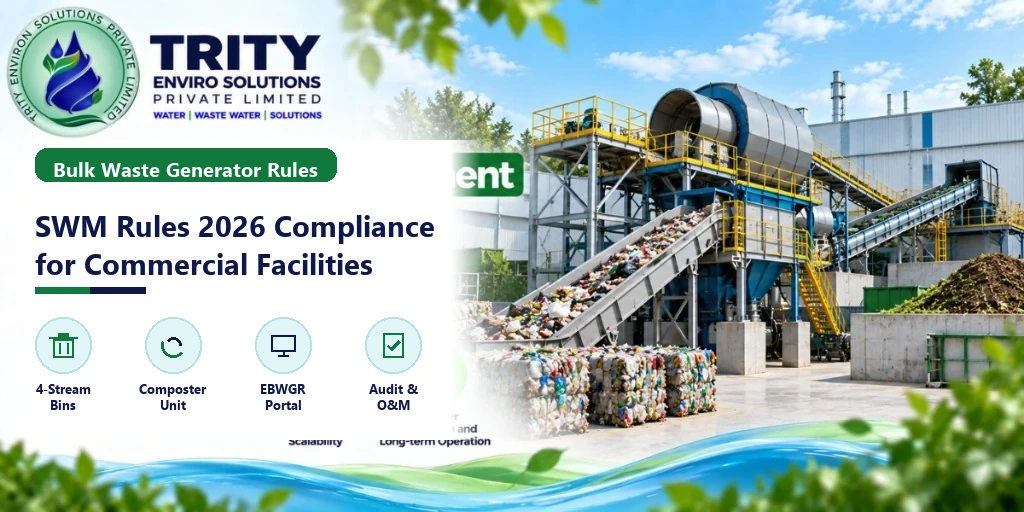
Bulk Waste Generator Compliance Under India's SWM Rules 2026: What Businesses Need to Set Up
A practical checklist for bulk waste generators under SWM Rules 2026: registration, four-stream segregation, on-site processing, EBWGR certificates and records.
Read Article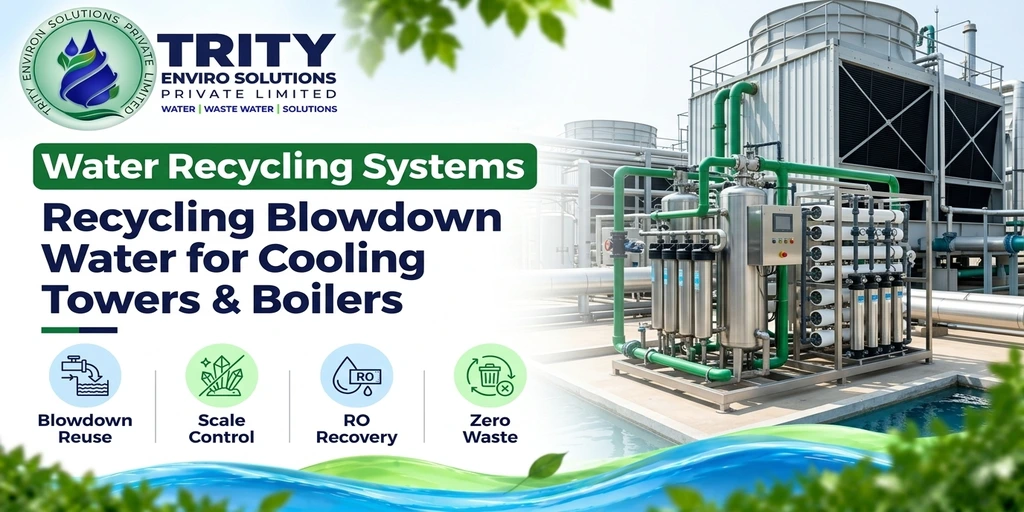
How to Design a Water Recycling System for Cooling Towers and Industrial Process Water
Design a water recycling system for cooling towers and process water: water balance, cycles of concentration, treatment train and payback, with an example.
Read Article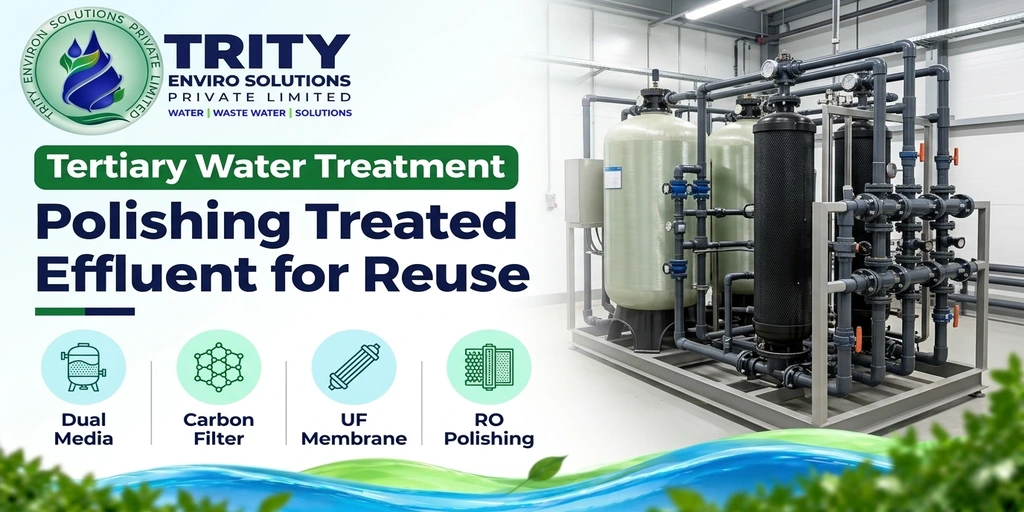
Tertiary Water Treatment for Industrial Reuse: When Filtration Alone Is Not Enough
Is filtration enough to reuse treated wastewater? Learn when you need UF, RO, softening or disinfection, and how to match tertiary treatment to each reuse.
Read ArticleFeatured Turnkey Installations





Need Expert Support for Your Water Treatment Project?
From regulatory compliance to turnkey engineering and O&M, our certified environmental engineers are ready to assist.