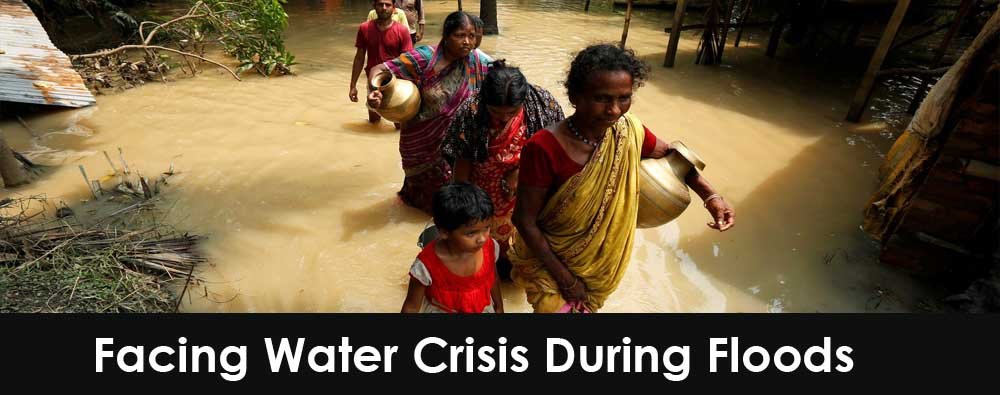
Facing Water Crisis During Floods? How to Purify Water Safely
Floods bring water everywhere but almost none of it safe to drink. Learn why this happens in India and the right way to purify water during and after a flood.

 ISO 9001:2015 & QCI Approved
Protect the biology and cut running cost by fixing the inlet. Here is what to remove, in what order, before wastewater reaches your main treatment stage.
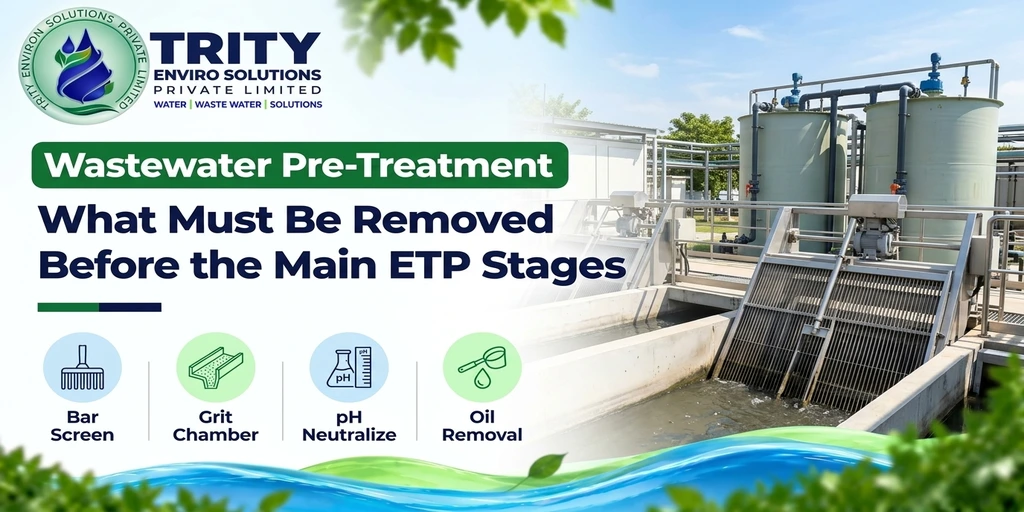
When an effluent treatment plant performs badly, the first instinct is to blame the biological stage. Add more bacteria, run the blowers harder, increase the chemicals. Very often the real problem sits upstream. A rag has wrapped around a pump impeller. A slug of acid has dropped the pH to 3. Oil has coated the surface of the aeration tank. Hot wash water has pushed the temperature to 45 C. A solvent spill has killed the culture.
None of these are failures of the main plant. They are failures of pre-treatment, the set of stages that condition wastewater before it reaches the core of the ETP. Pre-treatment removes what the main process cannot handle, evens out what it does not like and neutralises what would harm it. It is relatively cheap, and it protects the most expensive part of the plant.
This guide explains what to remove before the main ETP and why: solids, oil and grease, pH extremes, heat, toxic and inhibitory compounds and flow and load variations. It covers the order of the stages, gives examples for textile, pharma, food, metal finishing and chemical industries and shows what to ask a supplier. It is written for plant heads, EHS officers and project engineers planning a new ETP or fixing an underperforming one.
Biological treatment is sensitive. Bacteria work best in a narrow band of pH, temperature, nutrients and toxicity, and they do not like sudden changes. Physico-chemical stages such as coagulation and flotation are sensitive to flow and pH as well. Moving equipment, such as pumps, mixers and scrapers, does not tolerate rags, sand or plastics.
In broad terms, the main plant needs inlet water that is free of large solids and grit, low in free oil, near neutral in pH, at a moderate temperature, steady in flow and load and free from compounds that kill bacteria. Pre-treatment exists to deliver exactly that.
The cheapest pre-treatment is not to mix streams in the first place. Keep strong, toxic or concentrated streams separate from dilute wash water and cooling blowdown. Send concentrated mother liquors, spent acids, solvent washes and plating baths to their own treatment line, and send clean cooling water to reuse. Segregation shrinks the main plant, because it does not have to treat large volumes of clean water mixed with a small volume of difficult waste, and it avoids spreading toxicity through the whole flow.
A short survey of every drain in the plant, with flow, pH and a simple test, often reveals streams that should never have been combined.
The usual sequence runs from coarse to fine, and from protecting equipment to protecting biology.
A coarse bar screen with openings of about 20 to 50 mm catches large debris. A fine screen, with openings of a few millimetres, removes fibres, plastic pieces, hair, textile lint and food particles. Mechanical or self-cleaning screens suit continuous plants, and manual screens suit small plants with regular attention. Grit chambers remove sand, metal particles and heavy mineral solids that wear pumps and settle in tanks. Industries such as textile, food processing, tanneries, foundries and engineering units generate a lot of grit or fibre and benefit most.
Oil and grease coat bacteria, clog diffusers, form scum and carry into the discharge. Free oil can be removed with an oil water separator such as a TPI or CPI unit, and floating oil can be collected by an oil skimmer. Where the oil is emulsified or finely dispersed, or where there are fats and fine suspended solids, dissolved air flotation after chemical conditioning is used. As a working target, many designers aim to bring oil and grease down to a low level, often below about 50 mg/L, before the biological stage, but your process supplier should confirm the figure. Our guide on oil water separator selection and our article on DAF system selection cover each in detail.
An equalization tank evens out flow and concentration, and it is usually the most valuable pre-treatment stage. See our article on equalization tank design for sizing.
Neutralisation brings pH into the range the next stage needs. For biological treatment this is typically about 6.5 to 8.5. Use acid or alkali dosing with a pH controller, a well mixed tank and enough retention time, often 10 to 30 minutes, for the reaction. Where the wastewater is strongly acidic or alkaline, two stage neutralisation with separate probes gives better control. Remember that lime or caustic dosing can add solids or salts.
Cooling protects the biology and the equipment. Biological systems generally prefer temperatures below about 35 to 40 C. Hot wastewater from boiler blowdown, dyeing, washing or condensate needs a cooling tower, heat exchanger or a large balancing volume before it reaches the aeration tank. Heat recovery can sometimes turn this into a saving.
Some compounds must be treated at their source in a dedicated step, because they poison bacteria or cannot be removed in the main plant.
Each of these needs correct reagents, pH, contact time and sludge handling. Consult a process engineer before designing them, since poor design is dangerous as well as ineffective.
A pre-treatment design is only as good as the data behind it. Start with a drain survey: walk the plant with the process engineers and list every wastewater source, how it is generated, how often and how much. Mark each stream on a layout drawing. Then measure flow at the main drains, using a bucket and stopwatch for small flows, a portable flow meter for large ones or pump records where available.
Sample each major stream and the combined flow over at least one full production cycle, and ideally a week. Use composite samples taken at intervals, and also grab samples during known peaks or batch dumps. Test pH, temperature, TSS, COD, BOD, oil and grease, TDS and any process specific parameters, such as colour, ammonia, sulphide, phenol, chromium or solvents. Note which streams are intermittent, which are continuous and which carry the toxic or inhibitory compounds. This data lets the designer decide what to segregate, how big the equalization tank must be, which neutralisation reagents to use and whether any stream needs special treatment. Keep the raw data and share it with every supplier so that quotations are comparable.
Pre-treatment usually accounts for a modest part of the ETP cost and avoids a large share of operating problems. Include in your budget the screens, grit removal, oil separation, equalization tank with mixing, neutralisation tanks with dosing pumps and pH probes, cooling equipment, sump pumps, flow meters and instrumentation, and the chemical storage and dosing system. Plan for the sludge from each stage as well, including screenings, grit, oil and chemical sludge. A filter press for sludge dewatering handles the chemical sludge.
Add the cost of a sampling programme at the start. A week of samples at each major drain, with flow, pH, COD, TSS, oil and relevant toxics, gives the data that all of these designs depend on. It is far cheaper than redesigning after commissioning.
Our effluent treatment plant designs integrate pre-treatment from the start, with physico-chemical and biological stages sized for your effluent, and an annual maintenance contract keeps the front end working.
| Parameter / Stage | Target Optimal Range | Failure Impact / Risk | Corrective Engineering Action |
|---|---|---|---|
| Screening | Coarse about 20 to 50 mm, fine a few millimetres, kept clear | Pump blockage, rags in tanks, damaged equipment | Install or upgrade screens, add automatic cleaning, add grit chamber |
| Oil and grease to biological stage | Commonly below about 50 mg/L, confirmed by process designer | Coated bacteria, diffuser fouling, scum, failed samples | Add oil separator, skimmer or DAF, segregate oily drains |
| pH to biological stage | About 6.5 to 8.5 | Bacterial inhibition, corrosion, chemical waste | Install two stage neutralisation with feedback control |
| Temperature to biological stage | Generally below about 35 to 40 C | Reduced biological activity, odour, equipment damage | Cool hot streams, add balancing volume, recover heat |
Trity Environ Solutions is an ISO 9001:2015 certified and QCI-approved effluent treatment plant manufacturer and supplier in India, delivering robust, high-efficiency systems engineered for CPCB and SPCB regulatory compliance.
Every installation is supported by pan-India Annual Maintenance Contract and Operation and Maintenance services.
Floods bring water everywhere but almost none of it safe to drink. Learn why this happens in India and the right way to purify water during and after a flood.

Explore how advanced MBR technology enhances wastewater treatment with smart systems, energy efficiency, and sustainable solutions for industries and cities.
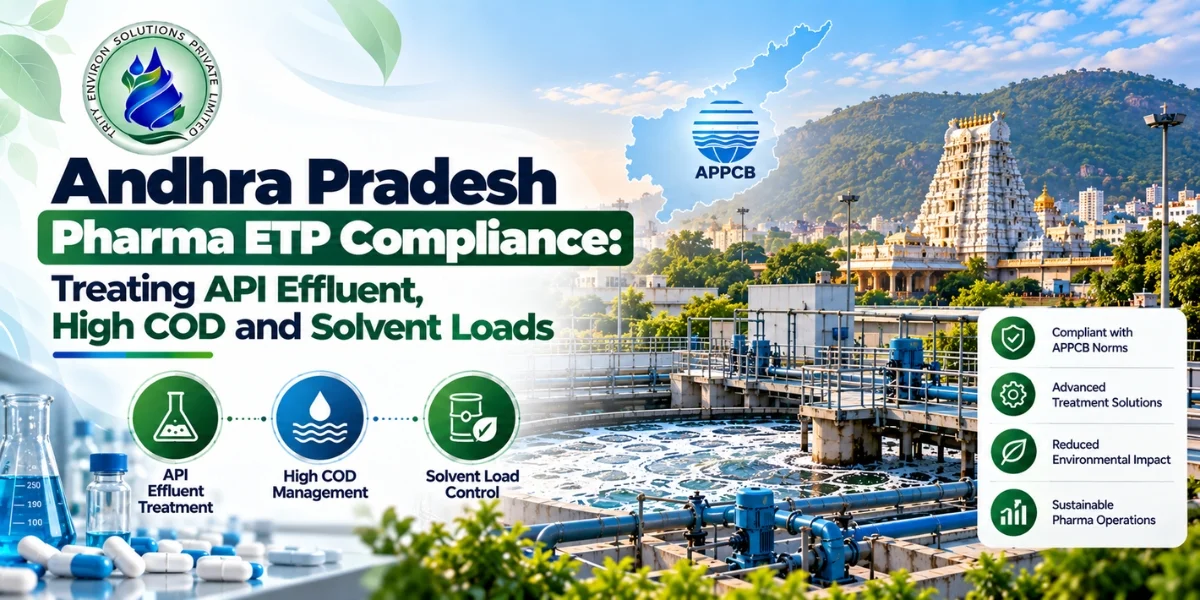
A practical guide to pharma ETP compliance in Andhra Pradesh: API residues, high COD, solvents, treatment stages, ZLD and how to plan an upgrade.











Discuss your requirements with our engineering team and get practical guidance for your project.

