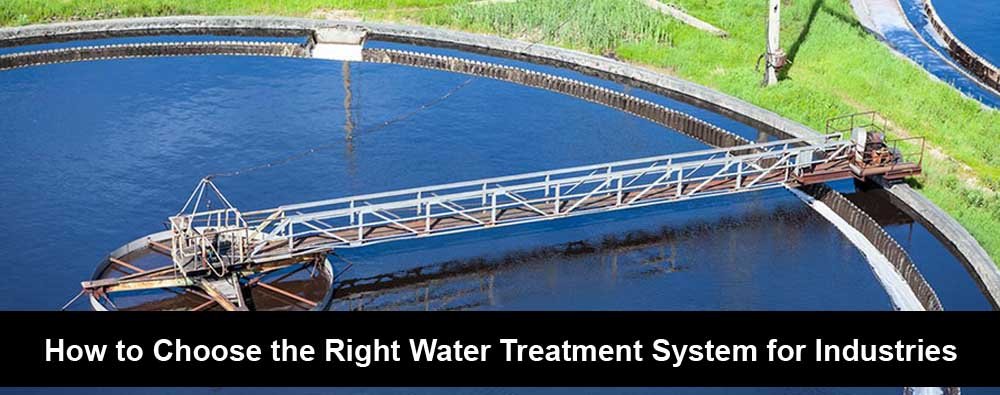
How to Choose the Right Water Treatment System for Industries in India
Learn how to choose the right STP, ETP, or RO plant for your industry in India, covering CPCB/SPCB compliance, sizing, and cost. Get expert guidance.

 ISO 9001:2015 & QCI Approved
Pharma wastewater needs a plant built around your process, not a template. Here is how Andhra Pradesh units can design, run and upgrade an ETP that stands up to inspection.
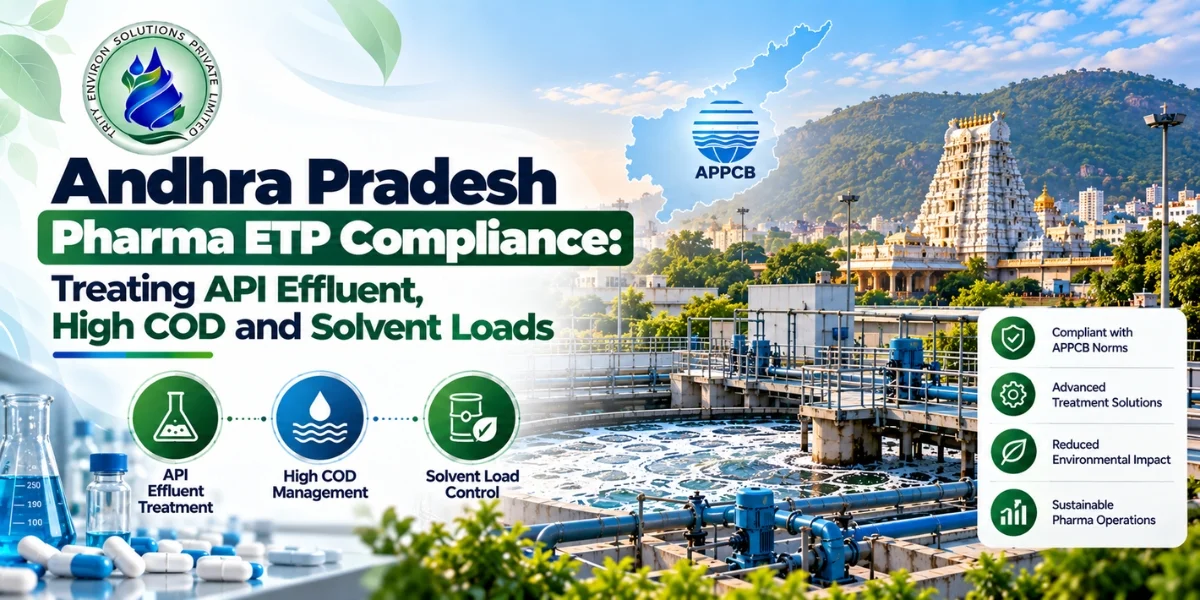
Ask an operator at a bulk drug unit near Visakhapatnam or Hyderabad's outskirts which part of the plant causes the most anxiety, and the ETP will probably come first. Pharmaceutical effluent does not behave like domestic sewage or even like most industrial wastewater. Its COD can reach thousands of milligrams per litre, it can contain solvents and active ingredient residues that harm bacteria, and it changes from batch to batch.
Andhra Pradesh has a large pharmaceutical manufacturing belt, and it is also India's largest aquaculture producer. That combination puts pharma effluent under close watch, since discharge that reaches water bodies can affect fisheries and farms downstream. Regulators, communities and buyers, especially export customers who audit environmental compliance, all pay attention.
This guide explains how to plan and operate a pharma ETP in Andhra Pradesh, from source segregation to zero liquid discharge, so that the plant treats effluent consistently and your records hold up in an audit. It is written for plant heads, EHS officers and project engineers at bulk drug and formulation units.
Three features make pharma wastewater a specialist job.
Process streams carry unreacted raw materials, intermediates, active pharmaceutical ingredient (API) residues, organic solvents such as methanol, acetone or toluene, and salts from neutralisation. Some of these compounds are toxic to the bacteria that a normal biological plant relies on. Others are simply slow to degrade, which leaves COD behind even after long aeration. Salts raise TDS, which biology cannot remove.
Pharma units run in batches. One reactor wash can be strongly acidic and high in COD, while the next is dilute and neutral. If everything flows into one tank without control, the biological stage sees a chaotic feed. A good design absorbs that variation instead of hoping for a steady state.
Checking Biodegradability
The BOD to COD ratio gives a quick sense of treatability. A ratio above about 0.5 usually means biology will work well. A ratio well below 0.3 suggests hard to degrade organics, which may need chemical oxidation or evaporation instead. Measure it for each stream before you finalise the design.
Before designing anything, draw a water balance for the whole site. List every source, such as borewell, municipal supply and recycled water, and every use, such as process, washing, cooling, boiler feed, utilities and domestic. Show what leaves as product, evaporation, effluent and sludge. A water balance reveals where effluent can be reduced at the source, which streams are concentrated and which are dilute, and how much water a reuse system could actually recover. Auditors from export markets often ask for it, and designers cannot size an ETP correctly without it.
A pharma ETP works in stages, and every stage protects the next one.
Separate streams at source. Concentrated mother liquors and solvent-rich washes go to a high COD line for strong treatment such as evaporation, incineration or solvent recovery. Dilute washings and utility blowdown go to the general ETP line. Segregation typically reduces the size and cost of the entire plant.
Pre-treatment includes neutralisation, coagulation, flotation and sometimes advanced oxidation such as Fenton treatment to break down toxic compounds before biology. An equalisation tank with mixing and enough retention time is essential, and a dissolved air flotation unit helps where oils or fine suspended solids are present.
For high COD streams, anaerobic treatment removes much of the load with low energy and produces biogas. An anaerobic digester can serve this stage where the effluent is suitable. After that, aerobic treatment such as activated sludge or MBBR polishes the remaining COD and BOD. Our page on biological ETP systems explains the choices.
If your unit is small or space is limited, an MBBR-based system can raise capacity within a small footprint.
Where consent conditions or site location demand zero liquid discharge, the treated stream passes through ultrafiltration and RO. The reject stream goes to a multiple effect evaporator and agitated thin film dryer, and salts are disposed of as solid waste. This route reuses most of the water and eliminates liquid discharge, but it is expensive to run. Size it with real data. See our zero liquid discharge systems for configurations.
Solvents are the most expensive contaminant to send to an ETP, both in COD load and in lost material. Distillation and recovery at the process block cut the load reaching the plant, reduce fire and vapour risk in tanks and can pay for themselves through recovered solvent. Where recovery is not possible, keep solvent-rich streams out of the general drain and send them for incineration or authorised co-processing. Never rely on the biological stage to handle concentrated solvent, since it can kill the culture in hours.
Pharma ETP sludge may carry residues and is often classed as hazardous waste, so storage, labelling, transport and disposal need documentation and authorised handlers. Dewater sludge to reduce volume, keep it under cover on an impermeable floor and record every dispatch. A filter press for sludge dewatering or decanter centrifuge can cut disposal volumes sharply, which lowers cost and simplifies audits.
Regulators and customer auditors focus on outcomes and on evidence.
Expect questions on consent conditions, treatment stages, outlet quality against limits, sludge and hazardous waste handling, solvent management and record keeping. Auditors from export markets often look for a clear water and effluent balance, calibrated instruments and documented operating procedures. Where an online monitoring system is required by your consent, keep calibration and maintenance logs up to date.
Failures are usually predictable. Plants run without segregation and overload biology. Toxic batches are dumped into equalisation without warning. Anaerobic reactors are started without proper seeding or pH control. Evaporators foul with scaling salts. Operators lack training on pharma specific hazards. Sludge, which may carry residues, is stored casually.
Fixes begin with process discipline: communicate batch schedules to ETP operators, install pH and flow measurement, keep spares for critical pumps and dosing equipment, and train operators. Our technical guide on ETP for the pharmaceutical industry goes deeper into process design and compliance.
A pharma ETP project sits between process engineering and environmental compliance, so choose a partner who understands both.
Costs depend on flow, COD load, salt content, the presence of solvents and whether ZLD is required. The largest cost items are usually evaporators, membranes, high grade materials of construction and instrumentation. Running cost includes steam or power, chemicals, membrane replacement and salt disposal. Ask each supplier for both capital and operating cost projections over five years.
If your unit is expanding, design the ETP for the future load, but in modules, so you do not pay for idle capacity on day one.
You can read more on our regional page for ETP and STP plant manufacturers in Andhra Pradesh and on our pharmaceutical effluent treatment plant offering. After commissioning, consider operation and maintenance support if your ETP team is small.
Pharma ETP projects take longer than general ETPs because of characterisation studies, segregation piping and specialised equipment. A rough path is one to two months for sampling, pilot or bench trials and design, followed by three to five months for fabrication, delivery and installation, and several weeks for start-up and stabilisation. Anaerobic reactors in particular need time to build a granular sludge, so plan for a slow ramp up rather than a fast one.
Before a regulator or a customer audit, confirm that you have a current water balance, a process flow diagram of the ETP, calibrated instruments, a chemical inventory, sludge manifests, laboratory reports for inlet and outlet, training records for operators and a maintenance log for every major equipment item. Keep them in one place, and make sure the numbers in different documents agree with each other.
Pharma ETPs tend to have high operating costs because of steam for evaporation, chemicals for oxidation, membrane replacement and hazardous sludge disposal. When comparing options, ask for the operating cost per cubic metre for each stream, and check how much of it depends on the quality of your segregation. A plant that treats a small, concentrated stream and a large, dilute stream separately is often cheaper to run than one that mixes them and treats everything to the toughest standard.
| Parameter / Stage | Target Optimal Range | Failure Impact / Risk | Corrective Engineering Action |
|---|---|---|---|
| BOD to COD ratio of stream | Above 0.5 suits biological treatment; below 0.3 needs oxidation or evaporation | Biology fails or outlet COD stays high | Segregate stream, add advanced oxidation or evaporation |
| pH into biological stage | 6.5 to 8.5 | Bacteria inhibited, sludge loss | Add pH control with feedback dosing before biology |
| Anaerobic reactor temperature and pH | About 30 to 38 °C mesophilic range, pH near 6.8 to 7.4 | Poor gas production, souring, reactor failure | Control temperature, alkalinity and load; seed properly |
| Evaporator feed scaling | Steady feed with pretreated salts | Scale, low efficiency, frequent cleaning | Softening or antiscalants, correct feed conditioning |
Trity Environ Solutions is an ISO 9001:2015 certified and QCI-approved pharmaceutical effluent treatment plant manufacturer and supplier in India, delivering robust, high-efficiency systems engineered for CPCB and SPCB regulatory compliance.
Every installation is supported by pan-India Annual Maintenance Contract and Operation and Maintenance services.
Looking to upgrade or install a high-performance ETP system for your pharma unit? Call +91-9821030072 or email enquiry@trityenviro.com, or request a free engineering consultation from our technical team.
Learn how to choose the right STP, ETP, or RO plant for your industry in India, covering CPCB/SPCB compliance, sizing, and cost. Get expert guidance.
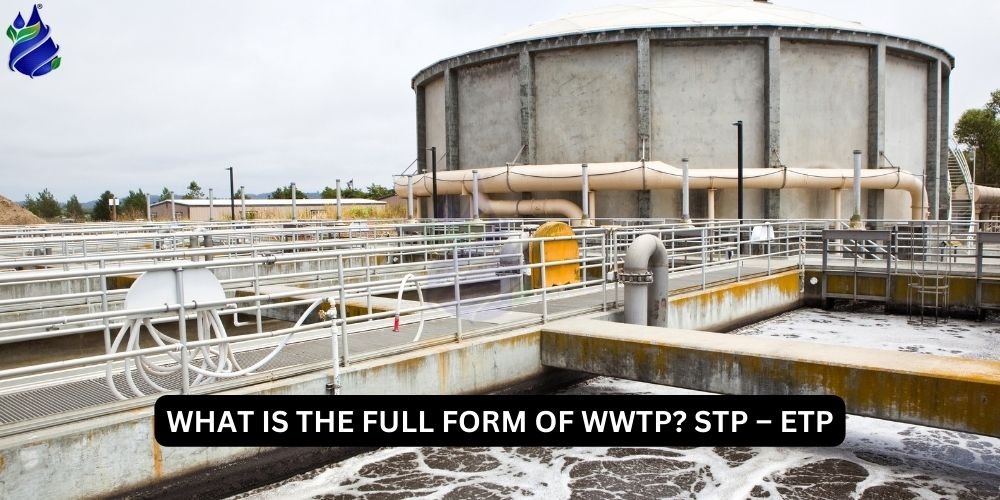
WWTP, STP, and ETP full forms explained with real CPCB data on how many exist in India, and which term actually applies to your project.
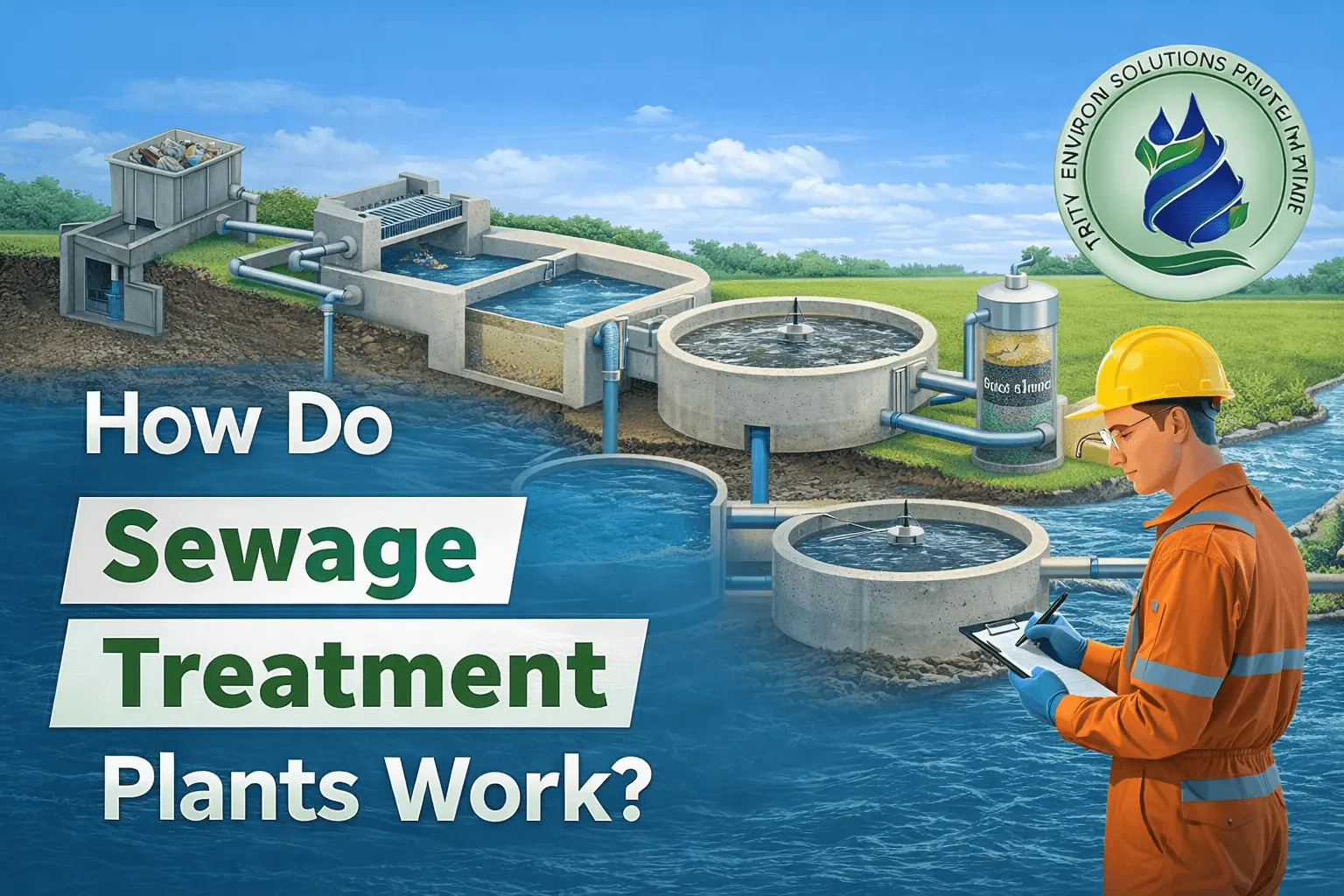
Learn how sewage treatment plants clean wastewater through screening, sedimentation, aeration, and filtration processes before releasing safe treated water.




Discuss your requirements with our engineering team and get practical guidance for your project.