Redefining Clean Water: How Wastewater Is Shaping the Future of Global Resources
Wastewater is no longer waste—it’s a valuable resource for global water sustainability. Advanced treatment technologies are reshaping water reuse, tackling scarcity.

 ISO 9001:2015 & QCI Approved
Dairy and food processing effluent carries high BOD, COD, and FOG that standard ETPs struggle with. See the treatment stages and technology choices that actually work.
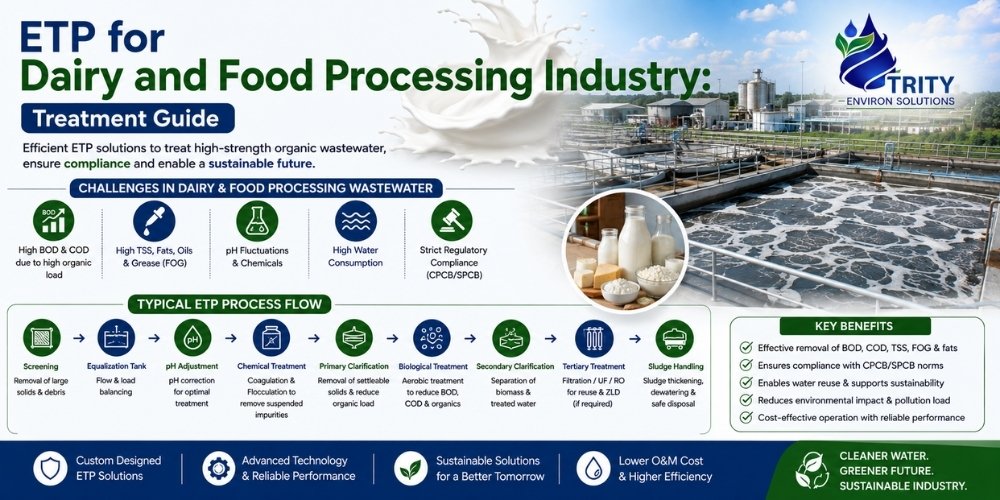
Dairy and food processing wastewater does not contain the toxic chemicals or heavy metals that make pharma or chemical effluent dangerous, and this often leads to underinvestment in treatment design. That assumption is a costly mistake. Milk processing, dairy product manufacturing, and food processing operations generate effluent with BOD levels that can run several times higher than typical sewage, along with high COD, fat, oil, and grease content, and organic solids that decompose quickly and generate strong odour if not handled properly. A treatment system sized like a standard sewage plant will fail fast under this kind of load. This guide covers what a correctly designed ETP for dairy and food processing units actually needs, the technology choices that work for this specific effluent profile, and where compliance requirements differ from lighter industries.
Fat, oil, and grease content is the single biggest design factor that separates dairy and food effluent from most other industrial wastewater. Milk processing, cheese and paneer production, and general food manufacturing all generate wastewater with FOG levels that can quickly foul downstream equipment, coat biological treatment media, and reduce oxygen transfer efficiency in aeration tanks if not removed early in the treatment train. Skipping or undersizing FOG removal is one of the most common reasons dairy ETPs underperform relative to their design specification.
Organic load is consistently high and can spike sharply. Whey, a byproduct of cheese and paneer manufacturing, carries an exceptionally high BOD and COD load, often several times higher than the dairy's general process wastewater, and a facility that does not segregate or specifically account for whey discharge can see its combined effluent overwhelm a treatment system sized around average flow assumptions. Batch production schedules common in food processing, where cleaning-in-place cycles happen at specific times of day, also create sharp flow and load spikes that a poorly sized equalization tank cannot absorb.
Rapid biological decomposition creates odour and corrosion issues that other industries rarely face to the same degree. Because dairy and food waste is highly biodegradable, it begins breaking down quickly even before reaching the treatment plant, which means equalization tanks and early treatment stages need adequate aeration or agitation simply to prevent septic conditions and the hydrogen sulphide odour that comes with them.
Screening and equalization come first, and equalization capacity needs to specifically account for CIP cycle timing and any batch-driven spikes rather than being sized around a flat average flow rate. Undersized equalization is one of the most common root causes of downstream treatment failures in this sector.
Fat, oil, and grease removal is the next critical stage, and this is where dairy ETP design diverges most from general industrial wastewater treatment. Dissolved Air Flotation is the standard technology for this role, using fine air bubbles to float fats and oils to the surface for skimming before the wastewater reaches biological treatment. Trity's Dissolved Air Flotation systems are specifically engineered for this front-end separation role, and getting this stage right protects every downstream process from the fouling and efficiency loss that unremoved fats otherwise cause.
Biological treatment for dairy and food effluent frequently uses a combined anaerobic-aerobic approach given the high organic load involved. An anaerobic stage, typically a UASB reactor, handles the bulk of the high BOD and COD reduction efficiently while producing biogas as a useful byproduct, a genuine advantage for dairy plants given the volume of organic load they generate. Trity's Anaerobic Digester systems are built for exactly this high-strength pre-treatment role. An aerobic polishing stage follows, commonly MBBR given its compact footprint and tolerance for the load variability typical of batch food processing operations, bringing BOD and COD down to levels that meet CPCB and SPCB discharge norms.
Tertiary treatment and disinfection close out the process, particularly important for food processing facilities given the pathogen and hygiene sensitivities inherent to food manufacturing. Filtration and UV or chlorine disinfection are commonly included even where treated water is only being discharged, not reused, given the food-safety context these facilities operate within.
Sludge handling matters more in this sector than the relatively benign nature of the waste might suggest, since dairy and food processing sludge, being highly organic, decomposes and generates odour quickly if not dewatered and disposed of promptly. Trity's Sludge Dewatering Instrument range reduces sludge volume and speeds up the handling process, which matters both for odour control and for keeping disposal costs manageable given the volume of sludge high-BOD effluent tends to generate.
Dairy and food processing facilities fall under CPCB's Orange category in most classifications, a step below the Red category assigned to pharma and chemicals but still subject to meaningful discharge norms covering BOD, COD, TSS, and oil and grease specifically, given how central FOG removal is to this sector's compliance picture. Facilities discharging into municipal sewer systems typically face separate, often less stringent limits than those discharging directly into water bodies, though FOG limits for sewer discharge are usually still strict given how quickly fats can damage municipal sewer infrastructure.
Biogas recovery from anaerobic treatment is increasingly factored into dairy plant economics, not just compliance. With UASB-based pre-treatment already handling the bulk of organic load reduction, many dairy facilities now use the resulting biogas for boiler fuel or on-site power generation, turning what used to be purely a treatment cost centre into a partial energy offset. This is worth factoring into the overall project economics when evaluating anaerobic pre-treatment against a purely aerobic design, particularly for larger facilities where the biogas volume generated is substantial enough to meaningfully offset fuel or electricity costs rather than being a marginal byproduct. Even at smaller scale, the reduction in sludge volume and odour that comes with anaerobic pre-treatment often justifies the additional infrastructure on operational grounds alone, independent of the energy recovery benefit.
Trity Environ Solutions has directly operated and maintained an Effluent Treatment Plant at a dairy facility in Bulandshahr, part of a broader industrial belt that also includes ceramics, steel, and paint manufacturing. This kind of direct operational experience, monitoring and maintaining a live dairy ETP rather than only designing one, is what surfaces the practical issues that matter in this sector: FOG buildup in pipework if DAF maintenance lapses, seasonal flow variation tied to milk procurement volumes, and the odour management challenges that come with organic sludge if dewatering schedules slip. Facilities across the broader food and beverage sector, referenced in Trity's work across industrial belts like Baddi-Barotiwala-Nalagarh, follow a similar pattern of high organic load requiring the staged treatment approach described in this guide.
| Consideration | MBBR-based system | SBR-based system |
|---|---|---|
| Fit with batch CIP cycles | Handles load swings well through biofilm resilience | Cycle timing can be tuned around CIP schedules |
| Operating complexity | Lower, simpler day-to-day operation | Moderate, needs consistent automation |
| Retrofit suitability | Easier to add into existing tankage | Requires more substantial civil and control changes |
| Best fit | Facilities prioritizing lower operating cost and simpler maintenance | Facilities with very predictable batch cycles wanting tighter effluent control |
For a broader technical comparison covering MBR as well, our guide on MBBR vs SBR vs MBR breaks down the mechanics of each technology in more depth.
Dairy wastewater volume and strength do not stay constant through the year, and a treatment system designed around a single average condition will underperform during peak periods. Milk procurement in India typically rises during the flush season, generally the cooler months when cattle produce more milk, and falls during the lean season. Processing volumes at the plant follow this same cycle, which means effluent flow and organic load can swing meaningfully between seasons at the same facility. A treatment system sized only around annual average flow risks being undersized during flush season peaks, precisely when the highest compliance risk exists.
Product mix shifts also affect effluent characteristics beyond pure volume. A dairy producing more ghee or butter during certain periods generates a different fat load profile than one focused on liquid milk packaging, and a plant that shifts between products seasonally needs treatment capacity, particularly DAF capacity, sized around its highest-fat production period rather than an averaged product mix.
Dairy processing offers more genuine byproduct and reuse opportunities than most other food sectors, largely because of the value locked up in what would otherwise be waste streams. Beyond biogas recovery from anaerobic treatment, whey itself has commercial value when properly segregated, since whey protein concentrate and related products are increasingly in demand, meaning a segregation strategy designed primarily for treatment efficiency can sometimes also open a byproduct revenue stream, depending on the facility's scale and market access.
Water reuse is also more straightforward in dairy processing than in industries with heavier chemical contamination, since treated effluent, once brought to appropriate quality through the staged treatment process described above, is often suitable for non-contact uses like cooling, floor washing, or landscaping without the extensive tertiary treatment that industries with persistent chemical contaminants would require. Facilities evaluating reuse investment should map which specific uses on-site could accept treated water at a moderate quality standard before investing in the more extensive tertiary treatment needed for higher-grade reuse applications such as boiler feed water.
Undersizing DAF capacity relative to actual FOG load is the most common and most damaging mistake in this sector, since fats and oils that pass through an undersized DAF stage go on to foul biological treatment media and reduce aeration efficiency, creating a cascade of downstream problems from a single upstream shortfall.
Failing to segregate high-strength streams like whey from general process wastewater leads to combined effluent that is harder and more expensive to treat than if the high-strength stream had been captured and routed separately, either for dedicated treatment or for byproduct recovery where volumes justify it.
Underestimating equalization capacity for CIP-driven flow spikes creates shock loads that hit downstream biological treatment at predictable times of day, an issue that proper equalization sizing around actual production schedules, not flat averages, would prevent.
Neglecting sludge handling frequency given how quickly organic dairy and food processing sludge decomposes leads to odour complaints and operational headaches that a properly sized dewatering schedule would avoid.
This usually points to a FOG removal shortfall rather than a biological treatment capacity issue. Fats and oils that are not adequately removed upstream coat biological treatment media and reduce oxygen transfer, degrading the performance of even a correctly sized biological stage. Checking DAF performance is usually the first troubleshooting step before assuming the biological stage itself needs expansion.
It often should be, given how much higher its BOD and COD load is compared to general process wastewater. Facilities generating significant whey volumes, particularly from cheese or paneer production, benefit from segregating this stream either for dedicated high-strength treatment or for byproduct recovery, rather than diluting it into the combined effluent stream where it can overwhelm a treatment system sized around average loads.
It depends on volume and organic load. Larger dairy facilities generating high BOD and COD loads generally see a strong case for anaerobic pre-treatment given both the treatment efficiency gains and the biogas recovery potential. Smaller units with lower organic load may find a purely aerobic system, such as MBBR, sufficient without the added complexity of anaerobic digestion.
Most dairy and food processing operations fall under the Orange category, one step below the Red category assigned to pharma and chemical manufacturing, though specific discharge limits for BOD, COD, and oil and grease still apply and require proper treatment design to meet consistently.
Maintenance frequency depends on load, but DAF systems in dairy applications generally need more frequent skimming and cleaning attention than in lower-FOG industries, given the volume of fat and oil these facilities generate. A structured AMC with scheduled DAF maintenance is one of the most effective ways to prevent the downstream fouling issues that come from a neglected fat removal stage.
Effluent flow and organic load typically rise during the flush season when milk procurement peaks and fall during the lean season, so a treatment system sized only around annual average conditions risks being undersized exactly when compliance risk is highest. Equalization and biological treatment capacity should be sized around peak flush-season load rather than an averaged figure.
Often yes, and more readily than in industries with heavier chemical contamination. Once properly treated through the staged process described above, treated water is frequently suitable for non-contact uses like cooling, floor washing, or landscaping without needing the extensive tertiary treatment that industries with persistent chemical contaminants would require for similar reuse applications.
Need an ETP designed around your actual dairy or food processing effluent? Trity Environ Solutions has directly operated and maintained ETP systems for dairy facilities, including a live plant in Bulandshahr, built on real operational experience rather than standard templates. Get in touch for a technical consultation.
Wastewater is no longer waste—it’s a valuable resource for global water sustainability. Advanced treatment technologies are reshaping water reuse, tackling scarcity.

Learn what TDS level means in water, how it's measured, ideal TDS ranges for drinking water, health impacts, and how RO systems reduce high TDS effectively.
Wastewater recycling conserves freshwater, reduces pollution, and boosts sustainability. Explore technologies that transform wastewater into a valuable resource for industries.

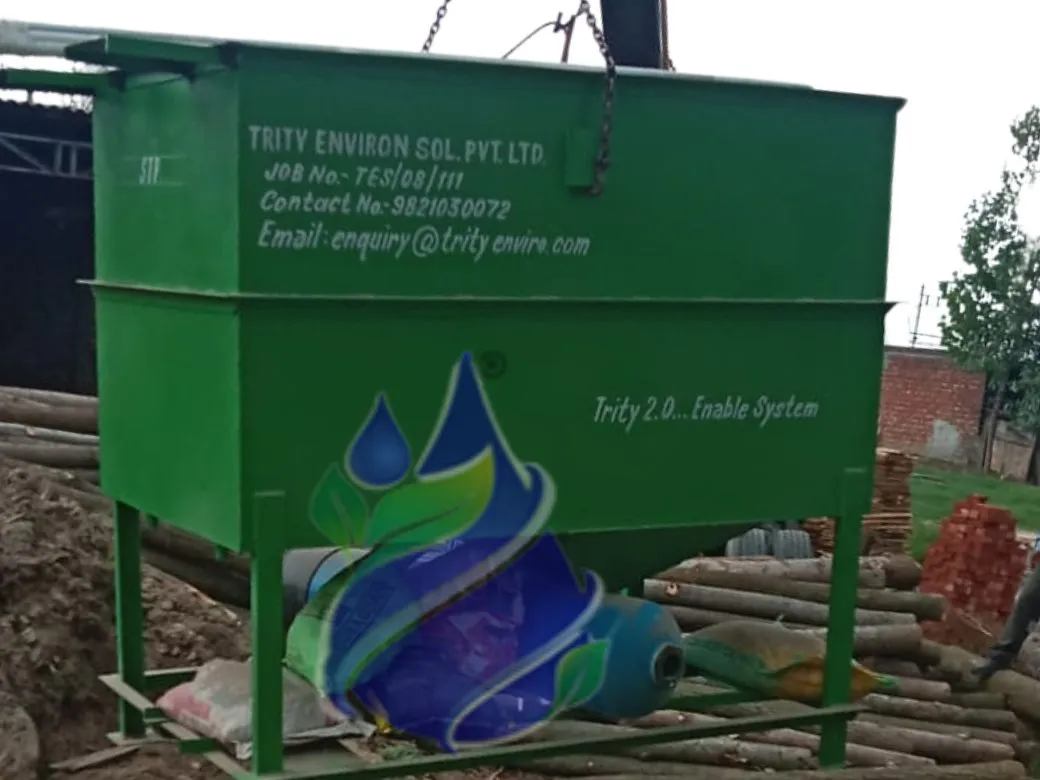
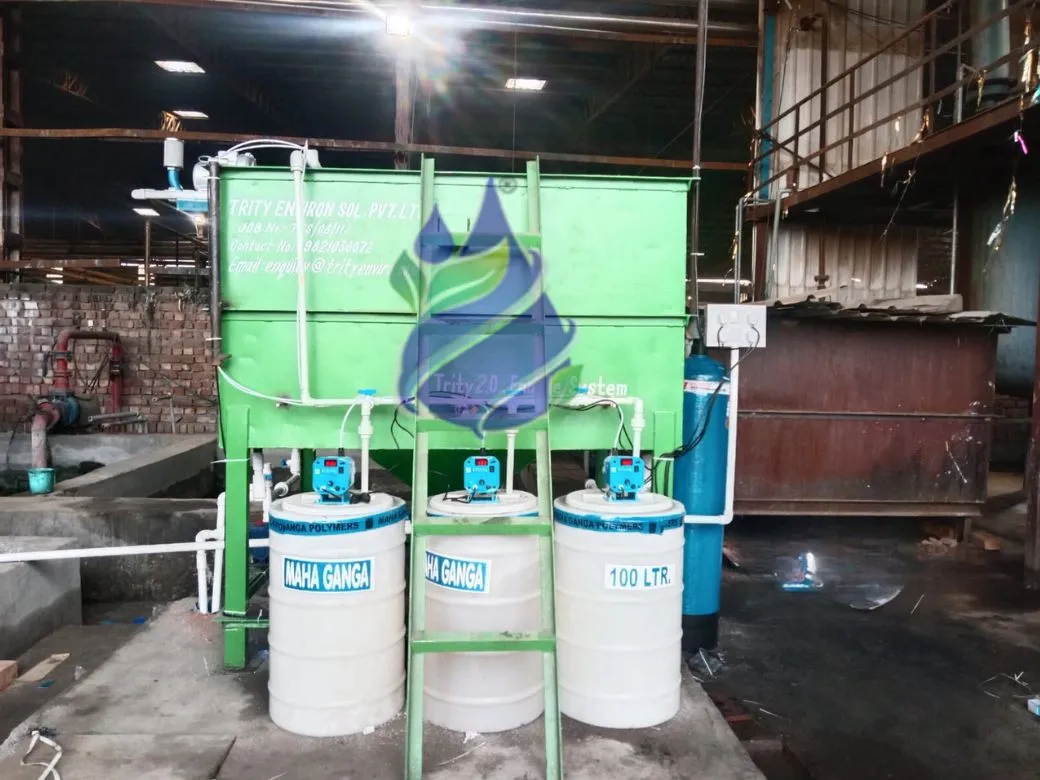



Discuss your requirements with our engineering team and get practical guidance for your project.