
Incentivizing Water Reuse: Government Policies That Encourage Sustainable Practices
Explore government policies, subsidies, and incentives driving sustainable water reuse for industries, agriculture, and urban infrastructure in India.

 ISO 9001:2015 & QCI Approved
Matching tertiary treatment to the reuse application avoids both over-investment and failed reuse. Here is how to decide what your treated water needs next.
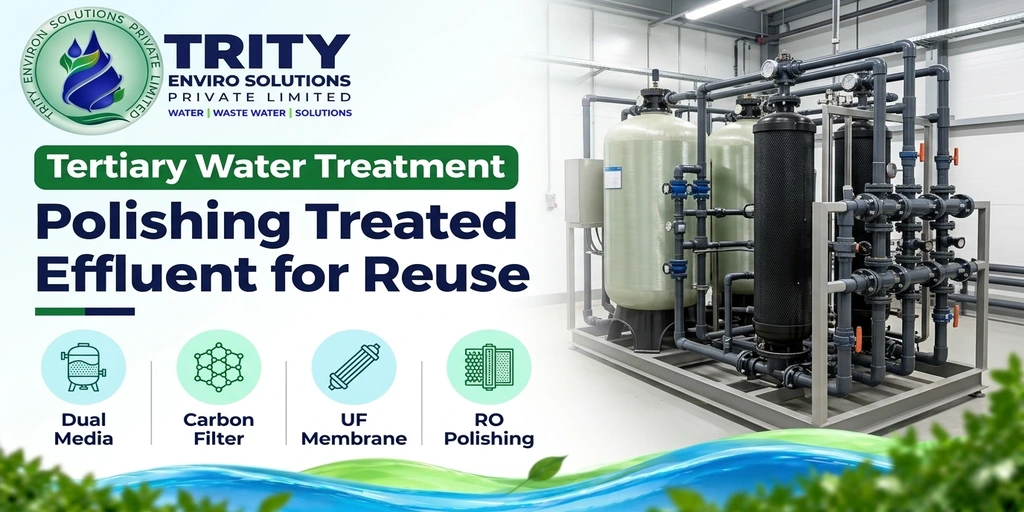
A well run STP or ETP produces water that looks clean. It is clear, odourless and meets the discharge norms on the consent. Many facilities then add a sand filter and a carbon filter, call it tertiary treatment and plan to reuse the water for cooling, process or boiler make-up. Some months later the cooling tower is scaling, a heat exchanger is fouling, the RO is plugging, or someone has noticed that the treated water still carries ammonia and a faint colour.
The reason is simple. Filtration removes suspended particles. It does little to remove dissolved salts, hardness, ammonia, silica, soluble organics or many microorganisms. Whether that matters depends entirely on what you want to do with the water.
Tertiary treatment is the stage after secondary biological treatment that polishes the water to the quality the end use requires. It is not one process, but a menu: filtration, activated carbon, ultrafiltration, softening, reverse osmosis, ion exchange, advanced oxidation and disinfection. The art lies in picking only what the reuse needs.
This guide explains what each stage does, what quality different reuse applications need, how to decide when filtration alone is not enough, how to build a train and what to ask a supplier. It is written for plant heads, utility engineers and EHS officers planning to recycle treated wastewater in industries, hotels, campuses and large buildings.
Most new STPs in India are expected to meet strict discharge standards. Following an NGT order of April 2019, the most stringent category calls for BOD of about 10 mg/L, COD of 50 mg/L, TSS of about 20 mg/L, total nitrogen of 10 mg/L and faecal coliform of 100 MPN per 100 mL (desirable) to 230 MPN per 100 mL (permissible), with relaxed values for other categories. Many state boards hold apartment and commercial STPs to the tighter end. Industrial ETPs follow limits in their consent, which vary by industry.
Meeting the discharge norm does not make the water ready for every reuse. It means that it can be released safely. Reuse has its own quality needs, set by the equipment and process that will use it. There is no single national reuse standard, so designers work from the equipment manufacturer's water quality requirements and from good practice.
A pressure sand filter or multi grade filter removes suspended solids and turbidity. An activated carbon filter removes residual chlorine, colour, odour and some dissolved organics. Together they give clear, polished water that is fine for many uses.
They do not remove dissolved salts and TDS, hardness, silica, ammonia, most soluble COD, dissolved metals, and many bacteria and viruses. Disinfection with chlorine, UV or ozone deals with the microorganisms, and RO or ion exchange deals with the dissolved material.
Work backwards from the end use. Ask: what does this use require, and what does the treated water already provide?
These are the easiest reuses. Water for toilet flushing needs low turbidity, no odour, low colour and a disinfectant residual so that stored water does not grow bacteria. Gardening and landscaping need low pathogens and acceptable salinity so that plants are not harmed. Construction uses such as curing and dust suppression are tolerant of moderate quality. For all three, a well run STP followed by sand filtration, carbon filtration and chlorination is often enough. Mark treated water pipes and taps clearly, and keep a storage tank with a residual disinfectant.
These are harder. A cooling tower concentrates everything in its make-up water. At four cycles of concentration, the TDS, hardness, silica and chloride inside the tower are about four times higher than in the make-up. Reuse water therefore has to be clean enough to survive that concentration. Ammonia can attack copper alloys and feed biological growth. Hardness and silica set scaling limits, and organic matter fuels biofouling. Practical designs for treated sewage or ETP effluent used as cooling make-up commonly include filtration, UF and RO, or at least softening, with a biocide and corrosion inhibitor programme. Published work on reclaimed municipal wastewater has shown that adding RO can raise the achievable cycles of concentration many times and cut make-up use considerably.
Process uses depend on the product and customer standards. Boiler make-up needs very low hardness, silica and conductivity, so RO followed by polishing or a DM stage is standard. Our article on DM plant vs RO plant covers the choice.
A typical train grows in steps:
1. Pressure sand and activated carbon filtration: For turbidity, colour, odour and chlorine. See our tertiary treatment plant.
2. Ultrafiltration: For consistent turbidity, bacteria and colloids, and as a protective stage for RO. See our ultra filtration system and our guide on when to choose UF before RO.
3. Softening or antiscalant dosing: Where hardness or silica limits recovery.
4. Reverse osmosis: For dissolved salts, ammonia, soluble organics and low conductivity. See our RO water recycling plant.
5. Disinfection: Chlorine, UV or ozone to control microorganisms in storage and distribution.
6. Advanced oxidation or ion exchange: For specific colour, recalcitrant organics or ammonia where required.
RO produces a reject stream, often 20 to 40 percent of the feed in reuse applications, with concentrated salts. It needs a plan: further concentration, use in non-critical applications or evaporation through a zero liquid discharge system.
Measure first. Test the treated water for TDS, hardness, alkalinity, silica, ammonia, COD, colour, turbidity and bacteria across a few weeks, and compare it with the requirement of the end use. The gap tells you which stages to add. For the full recycling design, including cooling tower water balance, see our article on how to design a water recycling system for cooling towers and process water.
A reuse system should be commissioned against the quality targets in the design, not just against flow. Test the water after each stage during commissioning: turbidity after filtration, residual chlorine after the carbon filter, SDI at the membrane inlet, conductivity of RO permeate and the microbiological quality at the point of use. Record baseline pressures and flows for each stage, since these become the reference for later performance checks.
In operation, install online instruments where they matter most: turbidity and chlorine residual at the outlet of filtration, conductivity on RO permeate and pressure differential across filters and membranes. Add alarms and an automatic diversion to drain or storage if the quality leaves the allowed range, so that poor water never reaches the cooling tower or process. Keep a weekly laboratory check for parameters that cannot be measured online, such as hardness, silica, ammonia and bacteria counts. Maintain a simple register of results, cleaning dates and replacements. These records help in troubleshooting, in warranty discussions and in satisfying a customer or regulator who asks how you manage reuse water.
Capital cost rises steeply as you add membranes. Running cost includes power, chemicals, cartridges, membrane replacement, cleaning and operator time. Compare the total against the cost of fresh water, tanker water and the cost of discharge or treatment of any effluent you avoid. In water scarce locations, or where fresh water is expensive or rationed, reuse often pays back well. Where fresh water is cheap and plentiful, only the simplest tertiary stages may make sense, unless regulation requires more.
Reliability matters too. Reuse systems depend on the upstream plant. If the STP or ETP is unstable, tertiary stages will suffer. Fix the biological stage first, and keep a bypass route to a safe discharge or storage, so that a quality upset does not shut down production.
See our wastewater recycling system and our article on treated wastewater reuse in Telangana for a regional example of how reuse frameworks are developing, and consider an annual maintenance contract to keep filters, membranes and instruments working.
| Parameter / Stage | Target Optimal Range | Failure Impact / Risk | Corrective Engineering Action |
|---|---|---|---|
| STP discharge quality (strictest NGT category) | BOD about 10, COD 50, TSS about 20, total nitrogen 10 mg/L, faecal coliform 100 to 230 MPN/100 mL | Cannot be discharged or reused, notice from board | Upgrade biological stage, add filtration and disinfection |
| Turbidity and SDI to membranes | Low turbidity, SDI below about 3 to 5 | Fast RO fouling, frequent cleaning | Add UF, improve filtration, check backwash |
| Hardness, silica and ammonia in cooling make-up | Low enough to allow the planned cycles, with ammonia controlled | Scale, corrosion of copper alloys, biofouling | Add softening or RO, adjust chemical programme |
| Disinfection residual in storage and distribution | Maintained at the level needed for the use | Bacterial growth, odour, health risk | Add chlorination or UV with monitoring and a residual check |
Trity Environ Solutions is an ISO 9001:2015 certified and QCI-approved tertiary treatment plant and wastewater recycling system manufacturer and supplier in India, delivering robust, high-efficiency systems engineered for CPCB and SPCB regulatory compliance.
Every installation is supported by pan-India Annual Maintenance Contract and Operation and Maintenance services.
Explore government policies, subsidies, and incentives driving sustainable water reuse for industries, agriculture, and urban infrastructure in India.
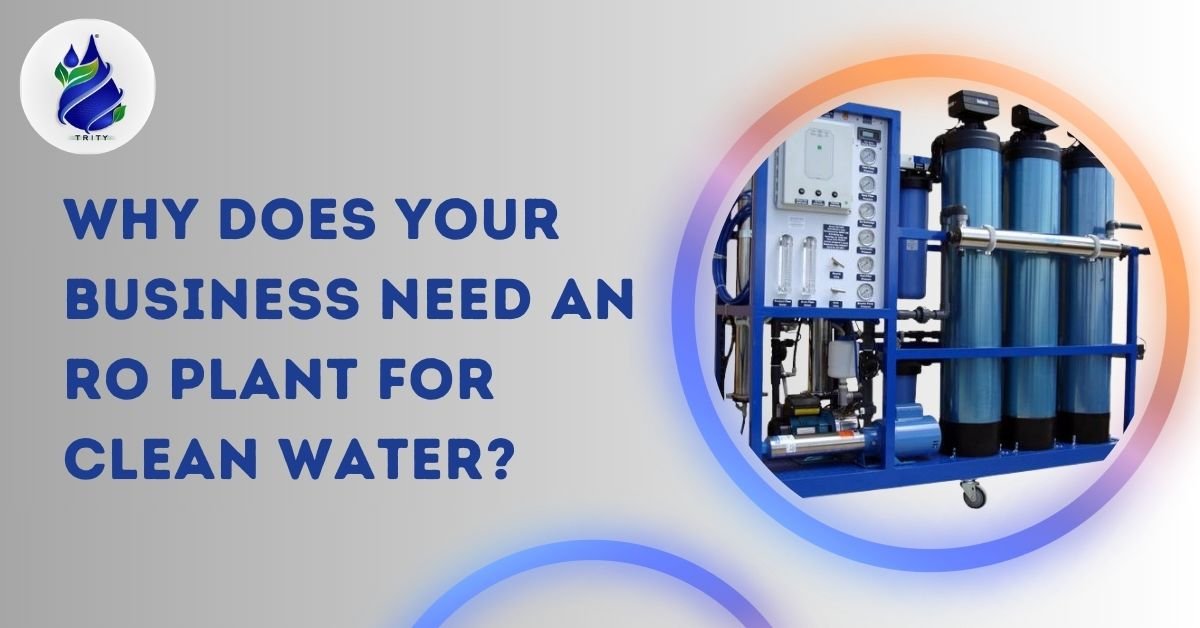
RO plants ensure clean, safe water for businesses, reduce costs, improve product quality, and enhance sustainability while meeting industry water purity standards.

How to identify and remove iron bacteria from well water, shock chlorination, pasteurization, and why UV alone won't work against biofilm.











Discuss your requirements with our engineering team and get practical guidance for your project.

