How Much Does a Commercial Water Softener Cost in India?
Real commercial water softener prices in India by capacity, salt-based vs salt-free systems, running cost, and the ROI case for equipment protection.

 ISO 9001:2015 & QCI Approved
Textile effluent brings colour, high TDS, and variable pH that generic ETPs can't handle. See the treatment stages, technology choices, and compliance norms that actually work.
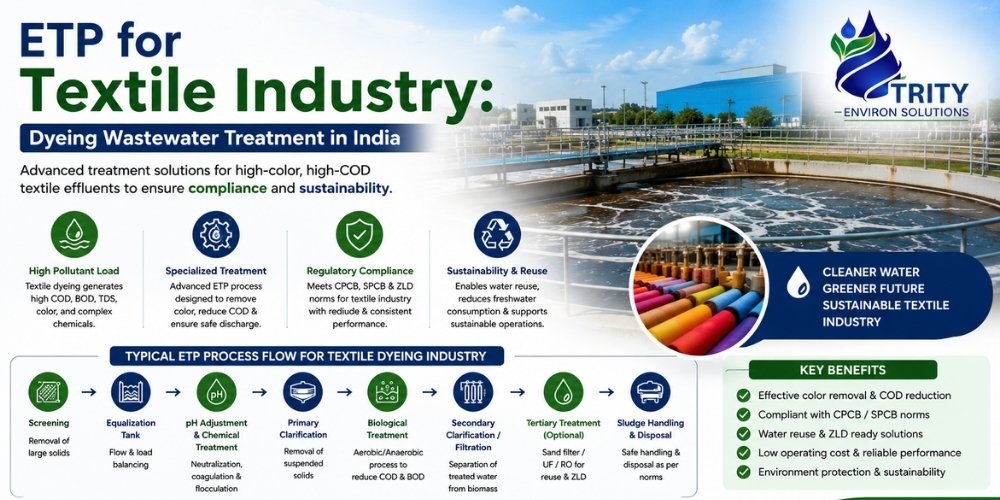
Textile wastewater does not carry the same organic load as sewage or even most food-processing effluent, and this sometimes leads plants to underdesign their ETP on the assumption that a lighter treatment train will do. That assumption fails quickly once colour, high total dissolved solids, and swinging pH from dyeing and bleaching cycles enter the picture. A textile unit running reactive dyes one batch and vat dyes the next can see its influent characteristics shift meaningfully from day to day, and an ETP sized around a single "average" effluent profile struggles to hold CPCB and SPCB discharge norms consistently. This guide covers what a correctly designed textile ETP actually needs, the technology choices involved, and where textile-specific compliance requirements differ from general industrial norms.
Colour is the defining challenge in textile effluent, and it is also the hardest parameter to remove using standard biological treatment alone. Unfixed dyes that wash off during processing are chemically stable by design, since dyes are engineered to resist breakdown on fabric, and that same stability makes them resistant to the biological degradation that removes BOD and COD in a conventional treatment train. A plant relying purely on biological treatment will often meet its BOD and COD limits while still failing colour discharge norms, which is a common and avoidable compliance gap.
High total dissolved solids from salt-heavy dyeing processes create a second major challenge. Reactive dyeing in particular uses large quantities of sodium chloride or sodium sulphate to drive dye fixation, and this salt load passes largely unchanged through biological treatment, meaning it needs to be addressed through separate mechanisms if discharge or reuse limits require it. This is one of the main reasons textile clusters are increasingly moving toward ZLD requirements, since conventional treatment alone cannot bring high-TDS effluent down to safe discharge levels.
Wide pH swings between processing stages add a third layer of complexity. Scouring and bleaching operations tend to run alkaline, while some finishing and washing stages run acidic, and a plant processing multiple fabric batches through different stages simultaneously can see influent pH swing significantly within a single day. Equalization and pH correction capacity needs to be sized for this variability rather than for a single assumed value.
Primary treatment starts with screening and equalization, and equalization capacity matters more here than in most other industries given how much textile effluent characteristics vary batch to batch. Following equalization, coagulation and flocculation using appropriate chemical dosing help settle suspended solids and begin addressing colour, often paired with Tube Settler Media to improve settling efficiency within a compact tank footprint.
Colour and oil removal frequently rely on Dissolved Air Flotation ahead of biological treatment, particularly for units processing synthetic fibres where oils and waxes from fibre processing add to the suspended and floating solids load. Trity's Dissolved Air Flotation systems are commonly specified for exactly this front-end separation role in textile ETP designs, reducing the load reaching the biological stage and improving overall treatment reliability.
Biological treatment handles the organic load, and technology choice here matters for textile applications specifically. Sequencing Batch Reactor systems are frequently used in textile ETPs because the batch nature of the process pairs naturally with the batch nature of textile dyeing operations, allowing cycle timing to be adjusted around production patterns. Trity's Sequencing Batch Reactor systems are built for this kind of variable-load application, though MBBR is also used where a more continuous, lower-maintenance option fits the site better.
Tertiary treatment is where colour removal is finished and where reuse becomes possible. Activated carbon filtration is commonly used to adsorb residual colour and trace organics that survive biological treatment, and Trity's Activated Carbon Filters are frequently paired with textile ETP systems for exactly this polishing role. For units targeting water reuse for washing or dyeing operations, this stage is often followed by ultrafiltration or reverse osmosis to bring treated water to a quality suitable for reintroduction into the process.
Sludge from a textile ETP tends to carry residual dye and chemical load, and proper handling matters both for disposal cost and for avoiding secondary pollution from improperly managed sludge. Trity's Sludge Dewatering Instrument range reduces this sludge volume before disposal, simplifying what is otherwise one of the more overlooked cost centres in textile effluent management.
Textile dyeing and processing units fall under stricter regulatory scrutiny than the sector's relatively low organic load might suggest, largely because of the colour and TDS issues described above. CPCB discharge norms for textile effluent typically specify limits not just for BOD, COD, and TSS, but also for colour, which is measured and regulated separately from the standard organic pollution parameters most other industries are judged on.
Several major textile clusters in India, particularly in Tamil Nadu, Gujarat, and parts of Rajasthan, now operate under Zero Liquid Discharge mandates, driven by a combination of high water stress in these regions and a history of pollution incidents tied to dyeing effluent discharge into local water bodies. Common Effluent Treatment Plants (CETPs) serving clusters of smaller dyeing units in these regions have in several cases faced closure or capacity restrictions when member units failed to meet pre-treatment norms before discharging into the shared system, which has pushed even small individual units toward taking their own pre-treatment obligations more seriously rather than relying entirely on the CETP to handle non-compliant discharge. Even outside these specific clusters, the direction of regulatory travel for textile wastewater has been consistently toward stricter colour and TDS limits over the past several years, which makes designing new textile ETPs to be ZLD-ready a reasonable precaution rather than an unnecessary expense. Trity's Effluent Treatment Plant designs for textile clients typically build in this forward compatibility, integrating evaporator and condensate recovery pathways into the original design where the client's location or growth plans make future ZLD compliance likely.
| Consideration | SBR-based system | MBBR-based system |
|---|---|---|
| Fit with batch dyeing operations | Strong, cycle timing adapts to batch patterns | Handles continuous flow well, less naturally suited to sharp batch swings |
| Effluent quality | Very good, strong BOD/COD removal | Good, may need more tertiary support for colour |
| Operating complexity | Moderate, needs consistent automation | Lower, simpler day-to-day operation |
| Load variability tolerance | Good, cycle adjustment handles swings | Good, biofilm resilient to shock loads |
| Typical fit | Dyeing and processing units with clear batch cycles | Units with more continuous production patterns or tighter operating budgets |
Neither technology removes colour on its own to the degree textile discharge norms require, which is why both are typically paired with dedicated colour-removal stages such as coagulation, DAF, or activated carbon rather than relying on the biological stage alone.
Different dye classes behave differently in an ETP, and treating them identically is a common source of underperformance. Reactive dyes, widely used on cotton and other cellulosic fibres, are highly water-soluble and carry a heavy salt load from the fixation process, making them among the hardest dyes to remove through conventional coagulation alone since their solubility resists settling. Disperse dyes, used mainly on polyester and synthetic fibres, behave differently again, generally settling out more readily with coagulation and flocculation but often bringing oily residues from fibre finishing agents that call for dissolved air flotation ahead of the biological stage.
Vat and sulphur dyes, common in denim and certain cotton processing, introduce their own complications, including strongly alkaline or reducing conditions during the dyeing process itself that need to be neutralized before the effluent reaches biological treatment, since an extreme pH can damage the microbial population a biological stage depends on. A textile facility running multiple dye classes through the same effluent stream, which is common in composite mills handling both cotton and synthetic fabric, needs an ETP design that accounts for this variability rather than one tuned to a single dye class.
Textile manufacturing is one of the most water-intensive industrial sectors, and dyeing in particular consumes large volumes of fresh water per batch. This makes water reuse an unusually strong economic case in this industry compared to sectors with lower water intensity, since the freshwater cost savings from reuse can offset a meaningful share of the additional treatment investment required to reach reuse-grade quality.
Treated water reuse for washing operations, which typically has a lower quality bar than reuse for dyeing itself, is usually the easiest starting point for units looking to reduce freshwater dependence without the full investment required for dyeing-grade reuse water. Reuse for the dyeing process itself demands considerably tighter control over residual colour, hardness, and TDS, since even small variations in water quality can affect dye uptake and shade consistency, which is a quality concern as much as an environmental one for textile manufacturers. Units evaluating a reuse investment should generally start by mapping which specific process stages could accept lower-grade reused water before designing tertiary treatment capacity around the more demanding dyeing-grade requirement.
The Delhi NCR industrial belt, particularly around Gurugram and Faridabad, includes a dense concentration of textile dyeing and garment processing units alongside its better-known pharma and chemical clusters. Colour removal for textile and garment units in this belt is a recurring design requirement, and it illustrates a pattern seen across most Indian textile hubs: units operating in mixed industrial estates alongside other sectors often face tighter enforcement precisely because of the visible colour in any discharge failure, which draws pollution control board attention faster than a colourless but equally non-compliant discharge would.
Undersizing colour removal capacity relative to biological treatment is the single most common mistake, since a plant designed primarily around BOD and COD removal targets can meet those parameters comfortably while still failing colour norms, leading to compliance issues that surface only after the plant is already operating.
Ignoring TDS and salt load in the initial design creates problems that often only become visible once reuse or ZLD compliance becomes a requirement. A plant that was never designed with TDS management in mind is considerably more expensive to retrofit for ZLD than one that included even basic provision for it from the start.
Underestimating equalization requirements for batch-driven flow variability leads to shock loads hitting downstream treatment stages, particularly in facilities processing multiple dye types or fabric batches through the same effluent stream without adequate buffering capacity.
Treating sludge management as an afterthought is a recurring issue given how much dye and chemical residue textile sludge can carry compared to sludge from lower-chemical-load industries. Sizing dewatering capacity appropriately from the outset avoids costly manual handling later.
This happens because dyes are chemically engineered to resist breakdown, which is exactly what makes fabric colourfast but also makes dye residue resistant to the biological treatment that removes BOD and COD. Colour requires a dedicated removal stage, typically coagulation, DAF, or activated carbon filtration, rather than relying on biological treatment alone.
Not universally, but it is mandatory in several major textile clusters, particularly in Tamil Nadu, Gujarat, and parts of Rajasthan, where water stress and past pollution incidents have driven stricter enforcement. Even outside mandatory zones, the regulatory trend for textile wastewater has been toward tighter colour and TDS limits, which makes ZLD-ready design a reasonable precaution for new plants.
SBR generally fits dyeing operations well because its batch cycle naturally aligns with the batch nature of dyeing processes, offering strong flexibility for variable loads. MBBR works well for units with more continuous production patterns or where lower operating complexity is a priority. Neither removes colour on its own, so both need to be paired with dedicated colour-removal stages.
High TDS from sodium chloride or sodium sulphate used in reactive dyeing passes largely unchanged through biological treatment, meaning it needs separate handling if discharge or reuse limits require TDS reduction. This is a primary driver behind ZLD requirements for many textile clusters, since conventional treatment alone cannot bring high-TDS effluent to safe discharge levels.
Often yes. Adding a dedicated colour-removal stage, such as an activated carbon filtration unit or improved coagulation and flocculation ahead of the existing biological stage, can meaningfully improve colour removal without requiring a complete plant rebuild, provided the existing tankage and hydraulics have room to accommodate the additional stage.
They benefit from different emphasis within the same overall treatment train. Reactive dyes, being highly water-soluble with heavy salt content, resist simple coagulation and need careful attention to TDS management, while disperse dyes tend to settle more readily but often bring oily residues that call for dissolved air flotation ahead of biological treatment. A facility processing both should design equalization and pre-treatment to handle this variability rather than assuming a single dye profile.
Yes, though the starting point matters. Reuse for washing operations generally requires a lower treatment standard than reuse for dyeing itself, making it a more accessible first step for smaller units with limited capital available for tertiary treatment. Full dyeing-grade reuse water demands tighter control over residual colour and TDS and is usually a later-stage investment once washing-grade reuse is already in place.
Need a textile ETP designed around your actual dyeing and processing effluent? Trity Environ Solutions has engineered ETP systems for textile and dyeing units across India's major industrial belts, built around real influent characterization rather than standard templates. Get in touch for a technical consultation.
Real commercial water softener prices in India by capacity, salt-based vs salt-free systems, running cost, and the ROI case for equipment protection.

Integrate wastewater management with urban planning using Water-Sensitive Urban Design for sustainability, water reuse, and climate resilience
Discover how Trity Environ Solutions can help you conserve water and promote sustainability with our advanced sewage treatment plants. Contact us for expert consultation and seamless installation!




Discuss your requirements with our engineering team and get practical guidance for your project.