Introduction: Some Solids Refuse to Settle
Most treatment plants rely on gravity. Heavy solids settle in a clarifier, and clear water leaves from the top. That works until the effluent contains things that do not sink: fats from a dairy, oil from a slaughterhouse, fibres from a paper mill, fine algae, light flocs from a textile dye bath. These float, drift or hang in suspension, and a settling tank either misses them or needs to be enormous.
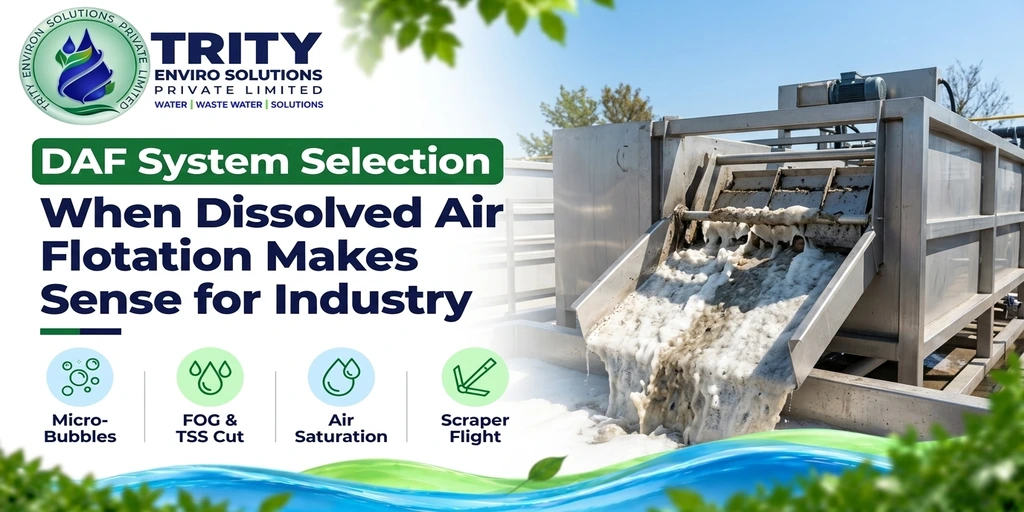
Dissolved air flotation (DAF) takes the opposite approach. It makes light particles rise. Microscopic air bubbles attach to oil droplets and fine solids and lift them to the surface as a thick float layer, which a scraper removes. The clarified water leaves from below. Because the particles are carried up by bubbles instead of waiting to sink, DAF works in a small footprint and at much higher loading rates than settling.
DAF is not a universal solution. It does not remove dissolved COD, it needs chemical conditioning, it uses power and it produces a wet sludge that must be handled. In the right place it is superb, and in the wrong place it is an expensive tank.
This guide explains how DAF works, which industries and effluents suit it, how it compares with settling tanks and oil separators, how to size a unit and what to ask a supplier. It is written for plant heads, EHS officers and project engineers in food, dairy, meat, edible oil, textile, paper, chemical and oily wastewater applications.
How a DAF System Works
Bubble Generation and the Recycle System
In the most common design, a portion of the treated water is recycled, pumped into a pressure vessel (the saturator) and mixed with compressed air at a pressure of several bar, commonly about 4 to 6 bar. Under pressure, a large amount of air dissolves in the water. This air saturated water is then released into the flotation tank through special nozzles or valves. The sudden drop in pressure releases the dissolved air as a cloud of very fine bubbles, typically some tens of microns in size.
The bubbles attach to the particles in the wastewater and make them lighter than water. The particle and bubble clusters rise to the surface and form a float layer, usually a few percent solids, which a scraper pushes into a sludge hopper. Heavier solids that sink are collected from the bottom by a second scraper. Typical recycle flows are a fraction of the main flow, often in the range of 10 to 50 percent, depending on the design and the load.
Chemical Conditioning
Most industrial wastewaters need chemical conditioning before the DAF. A coagulant such as alum, ferric chloride or PAC destabilises fine particles and emulsified oil, and a polymer then binds them into flocs strong enough to attach to bubbles. Correct pH, dose and mixing are essential, since poor flocculation is the commonest reason for DAF underperformance. A jar test with your own effluent gives the starting doses, and online pH control keeps them stable.
With good conditioning, a DAF can often remove most suspended solids and the bulk of fats, oil and grease, with a significant drop in particulate COD. Without it, the same unit may do little.
When DAF Makes Sense
Effluents That Suit DAF
- Meat, poultry and fish processing: Fats, blood and proteins.
- Edible oil refining and soap: Emulsified oil and fatty acids.
- Textile and dyeing: Fine fibres and colour bodies after coagulation. See textile ETP.
- Pulp, paper and packaging: Fibres and fillers.
- Laundries, car washes and workshops: Oil and detergent loaded water.
- Tertiary or pre-treatment duties: Algae removal, or removal of fine solids before membranes.
DAF also fits where space is limited and where sludge from a settling tank would be too thin and bulky.
DAF Versus Settling and Oil Water Separators
A settling tank or lamella clarifier works well for dense mineral or chemical flocs, and it is cheap and simple. It struggles with light, fatty or fibrous solids. A DAF handles these but costs more to buy and run.
An oil water separator removes free oil by gravity and is the right first stage for oily water from workshops and DG yards. It does not remove emulsified oil or fine solids. Many plants use an oil water separator first, then DAF to polish. Our guide on TPI vs CPI separator selection explains the first stage.
DAF will not remove dissolved COD, salts or dissolved colour. If most of your COD is soluble, DAF alone will not meet the limits, and a biological stage or chemical oxidation must follow.
Sizing and Design Points
Hydraulic Loading and Recycle Ratio
DAF units are sized on surface hydraulic loading: flow divided by the flotation surface area, expressed in m/m/h. Values depend on the effluent and design, and a broad range from a few to about ten m/m/h is common for industrial applications, with lower values for difficult effluents and for plants that need very high removal. Solids loading, in kg of solids per m per hour, is checked as well, since heavy loads can overwhelm the scraper and the float layer.
The air to solids ratio guides the recycle rate and the saturator pressure. Too little air leaves particles unfloated. Too much air creates turbulence that breaks flocs. A manufacturer's design for your wastewater should show the assumed values and the reasoning.
As an illustration, a flow of 30 m/h at a loading of 6 m/m/h needs about 5 m of flotation area before margin. A 20 percent recycle flow of 6 m/h would be saturated at about 5 bar. A supplier should confirm such figures with pilot or experience data.
Sludge, Power and Layout
DAF float is wet, often 2 to 5 percent solids, and its volume can be a few percent of the flow. Plan sludge handling at the design stage: a float sludge tank, a transfer pump and dewatering. A filter press for sludge dewatering or sludge dewatering system reduces the volume you send out. Fatty sludge from food units can sometimes go to an anaerobic digester for energy recovery.
Power is used by the recycle pump, the air compressor, the scraper drive and chemical dosing pumps. Place the DAF after screening and equalization, so that flow and load are steady, since DAF performs poorly under sudden swings. Our equalization tank page covers this stage, and the broader sequence is explained in our article on industrial wastewater pre-treatment before the ETP.
Materials matter. Stainless steel or coated carbon steel resists corrosion from acid dosing and salts. Covers and vents help control odour and aerosol from the float.
Jar Tests and Pilot Trials Before You Buy
Because every industrial effluent is different, the most reliable way to size and specify a DAF is to test your own wastewater. A jar test takes a few hours and uses small beakers to compare coagulants, polymers, doses and pH. It tells you which chemicals form strong floc and what dose gives the clearest water. A bench flotation test with a laboratory saturator goes one step further, showing how fast the float rises, how thick it is and how much oil and solids it removes at different recycle ratios.
For large or critical plants, a pilot DAF run on site for a week or two, covering several production days, gives the strongest evidence. It shows how the unit copes with batch changes, cleaning chemicals and peaks, and it gives real data on float volume, chemical use and outlet quality. Many suppliers offer pilot units or can arrange a visit to a working plant with similar effluent. Ask for these results to be written into the proposal as the design basis.
Take samples that represent the full range of production, not only a good day. A DAF designed on a clean sample will struggle on a bad one, and the supplier's guarantee will not help if the sample was unrepresentative. Keep the test records. They are valuable later when you troubleshoot or when you need to prove that the plant performs as promised.
Cost, Operation and Choosing a Supplier
Operating Cost and Common Problems
The main running costs are chemicals, power, sludge handling and operator attention. Chemicals are usually the largest. Optimising the dose through regular jar tests and online control can cut cost significantly.
Common problems and their usual causes:
- Poor float formation: Wrong coagulant dose, incorrect pH or too little polymer
- Float breaking up: Overloaded surface, turbulence or too much air
- Cloudy outlet: Underdosed chemicals or an overloaded unit
- Scraper jams: Heavy float or worn components
- Nozzle blockage: Scale or solids in the recycle line
Train operators to read the float layer. A thick, firm, evenly spread float means good performance, and thin watery float or visible solids at the outlet mean trouble.
Questions to Ask Before You Order
- What effluent data and loading did you design for, and what removal of TSS, FOG and COD do you guarantee?
- What recycle ratio, saturator pressure and surface loading do you propose?
- What coagulant and polymer system is included, with pH control?
- How is float sludge handled and what is its expected solids content?
- What materials are used, and how are corrosion and odour managed?
- What is the power and chemical consumption?
- What support, spares and training do you provide?
You can read about our dissolved air flotation systems and how they fit into our effluent treatment plant designs and food and beverage ETP solutions. An annual maintenance contract keeps pumps, nozzles and scrapers in good order.
Industry Comparison / Operational Parameter Table
| Parameter / Stage |
Target Optimal Range |
Failure Impact / Risk |
Corrective Engineering Action |
| Saturator pressure |
Commonly about 4 to 6 bar |
Too few bubbles, poor flotation |
Check compressor, nozzles and saturator level |
| Recycle ratio |
Often about 10 to 50 percent of flow, set by design |
Insufficient air or turbulence if wrong |
Adjust recycle flow, verify with jar and air tests |
| Surface hydraulic loading |
A few to about 10 m/m/h depending on effluent |
Solids carryover if too high |
Add area, equalize flow, reduce peaks |
| Coagulant and polymer dose |
Set by jar test, with pH control |
Poor floc, cloudy outlet, wasted chemicals |
Install pH control, repeat jar tests, calibrate dosing pumps |
Why Choose Trity Enviro
Trity Environ Solutions is an ISO 9001:2015 certified and QCI-approved dissolved air flotation (DAF) system manufacturer and supplier in India, delivering robust, high-efficiency systems engineered for CPCB and SPCB regulatory compliance.
Every installation is supported by pan-India Annual Maintenance Contract and Operation and Maintenance services.
Free Engineering Consultation
DAF System Selection for Industrial Wastewater: When Dissolved Air Flotation Makes Sense
Looking to upgrade, size, or install a high-performance treatment plant? Speak with our senior wastewater and water engineers today for expert sizing calculations, UKPCB/CPCB compliance support, and zero liquid discharge planning.
Request a Free Site Assessment