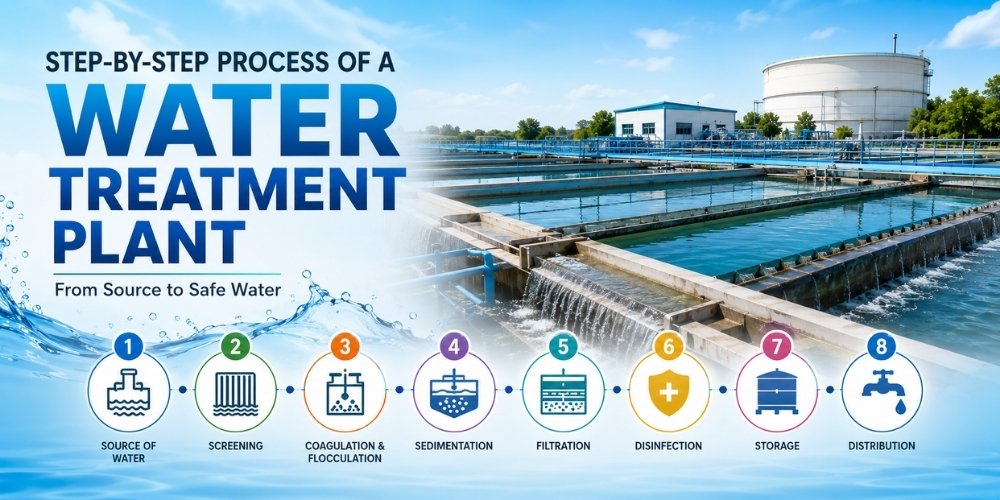
Step-by-Step Process of a Water Treatment Plant
Learn the complete step-by-step process of a water treatment plant, including screening, coagulation, sedimentation, filtration, disinfection, sludge handling, and compliance standards.

 ISO 9001:2015 & QCI Approved
A separator only removes the oil that is free to rise. Learn how to match plate type, size and layout to your effluent before you buy.
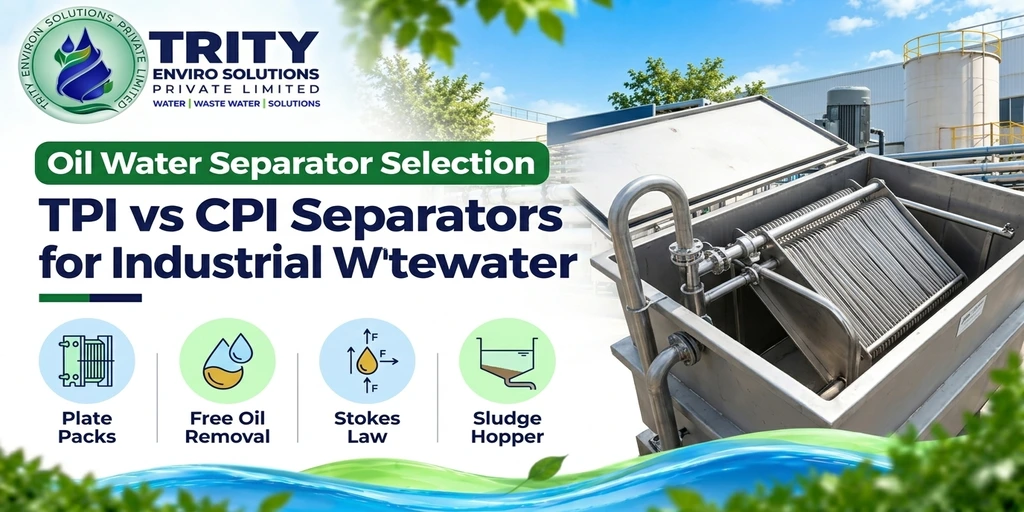
Oil does not look dangerous. A thin film on the surface of a collection tank seems like a housekeeping issue. But in an effluent or sewage treatment plant, oil does real damage. It coats bacteria and starves them of oxygen, it blinds membranes and filters, it clogs diffusers, it carries into the final discharge and fails the oil and grease limit, and in vehicle workshops and DG yards it brings a fire risk as well.
CPCB's general standard for discharge to inland surface water sets a low limit on oil and grease, of the order of 10 mg/L, and many consents are tighter. Meeting it starts with removing free oil at the front of the plant, before the biological stage, with a simple and reliable device: the oil water separator.
Buyers hear several names. API separators, tilted plate interceptors (TPI), corrugated plate interceptors (CPI), parallel plate separators, oil skimmers and DAF units all get mentioned, often as if they were interchangeable. They are not. Each handles a different kind of oil and a different droplet size.
This guide explains how oil exists in wastewater, how TPI and CPI separators work, how to size one with a worked example and how to buy well. It is written for plant heads, EHS officers and project engineers in workshops, power plants, refineries, food units, metal working, automobile and engineering industries.
Oil in water comes in three forms:
Many buyers install a separator and then find oil still in the outlet. Usually the oil was emulsified. Wash bays, workshops using detergents, food units and metal working fluids often produce emulsions. A simple jar test, left standing for an hour, tells you quickly: if the water stays milky, the oil is emulsified.
How fast an oil droplet rises depends strongly on its diameter. Stokes' law shows that rise velocity increases with the square of the droplet diameter and with the difference in density between oil and water, and decreases as the water becomes more viscous. Halve the droplet size and the rise velocity falls to a quarter. That is why a tank that removes 150 micron droplets easily may do little for 30 micron droplets.
In a simple gravity separator, such as an API unit, wastewater flows slowly through a long tank. Oil droplets rise to the surface during the time the water spends inside, and a skimmer collects them. API designs target droplets of about 150 microns and larger. To handle smaller droplets, the tank would need to be enormous.
Plate separators solve this by placing a pack of closely spaced inclined plates in the flow path. Each plate adds surface area without adding floor space. Oil droplets only need to rise a short distance, from the water between two plates to the underside of the plate above, where they coalesce into larger drops and slide upward along the plate to the surface. Solids slide down the plates into the sludge hopper. The result is a unit that is much smaller than an API tank and able to remove smaller droplets.
TPI (tilted plate interceptor) uses flat plates tilted at an angle, often about 45 to 60 degrees. CPI (corrugated plate interceptor) uses corrugated plates, which increase the effective surface and channel the oil to the crest of each corrugation. Many designs of both types are rated to remove droplets down to about 20 to 60 microns, with outlet free oil often guaranteed in the range of 10 to 50 mg/L depending on inlet oil and droplet size. Check each supplier's guarantee and the test conditions behind it.
In practice:
If your water carries sticky solids, grease or sludge, choose wider plate spacing and add a screen or grit trap upstream. Closely spaced plates foul quickly in dirty water.
The core of sizing is Stokes' law:
Rise velocity = g x (pwater poil) x d (18 x u)
where g is gravity, p is density, d is the droplet diameter and u is the viscosity of water. The required plan area is the flow divided by the rise velocity, and a plate pack gives that area in a compact volume because the projected area of the plates counts. Designers then apply a factor of safety, often 1.2 to 1.5, for turbulence and uneven flow.
A workshop wastewater stream carries oil with a specific gravity of 0.85 at 30 C, with a design flow of 20 m/h. The target is to remove droplets of 60 microns and above.
The required projected area is 20 m/h 1.3 m/h = about 15 m. With a factor of safety of 1.5, the design area is about 23 m. A conventional tank would need that much surface area on the floor. A plate pack with, for example, 30 plates of around 0.8 m projected area each delivers it inside a compact unit of a couple of square metres of footprint.
Take this as an illustration only. Real designs also consider plate spacing, flow distribution, oil retention volume, solids loading, winter viscosity and the flow variation. A reputable supplier should show the calculation.
Oil separators handle flammable liquids, so safety is part of the design. Light hydrocarbons such as petrol or solvent can release vapours in the separator, and these accumulate in covered tanks and pits. Provide ventilation, keep ignition sources away, use flameproof electrical fittings where the area is classified and never allow hot work near the unit without a permit. Fit a cover or a grating that keeps rainwater out and prevents people and vehicles from falling in. Provide a spill containment bund around oil storage tanks, and keep absorbent material at hand.
Recovered oil is a waste with value and with obligations. Store it in a labelled closed tank with a bund, record each removal and hand it only to authorised recyclers or disposal agencies, keeping the manifests with your hazardous waste records. If the oil carries solvents or heavy metals, ask your consultant how it should be classified. Sludge from the hopper may also be hazardous in some industries, so test it before choosing a disposal route.
An oil water separator is a low maintenance unit, but it is not maintenance free. Skim the oil regularly into a closed oil tank, and send it to an authorised recycler or disposal agency, since waste oil is regulated. Clear settled sludge from the hopper at set intervals. Clean the plate pack with a water jet or detergent if oil or solids have built up, and check that the weirs are level so that flow is even across the pack.
Place the separator before any pump, if possible. A pump shears oil droplets into smaller ones that are harder to separate, so gravity flow into the separator works better than pumped flow. Also remember that a separator removes oil, not dissolved pollutants. It is the first stage, followed by equalization, treatment and polishing. For floating oil in tanks, a belt or disk oil skimmer for ETP and STP can collect it continuously. For finer droplets and grease, a DAF unit comes after the separator.
For the full picture of what to remove before the main plant, read our article on industrial wastewater pre-treatment before the ETP.
Our oil water separator range includes TPI and CPI based units, and our effluent treatment plant designs integrate them at the front of the process. An annual maintenance contract covers cleaning, oil removal and inspection.
| Parameter / Stage | Target Optimal Range | Failure Impact / Risk | Corrective Engineering Action |
|---|---|---|---|
| Droplet size removed | API about 150 micron and above, TPI and CPI often about 20 to 60 micron and above | Oil passes through if droplets are smaller than design | Add DAF or coalescer, avoid pumping before the separator |
| Outlet free oil | Commonly guaranteed in the range of 10 to 50 mg/L, based on inlet conditions | Fails oil and grease limit, coats biology | Improve separation, add polishing stage, fix emulsions |
| Plate pack condition | Clean plates with free flow between them | Clogging, short circuiting, poor separation | Wash plates, add screen upstream, widen spacing |
| Oil and sludge removal | Regular skimming and hopper clearing | Oil carryover, odour, fire risk | Set schedule, install oil tank and sludge pump |
Trity Environ Solutions is an ISO 9001:2015 certified and QCI-approved oil water separator manufacturer and supplier in India, delivering robust, high-efficiency systems engineered for CPCB and SPCB regulatory compliance.
Every installation is supported by pan-India Annual Maintenance Contract and Operation and Maintenance services.
Learn the complete step-by-step process of a water treatment plant, including screening, coagulation, sedimentation, filtration, disinfection, sludge handling, and compliance standards.
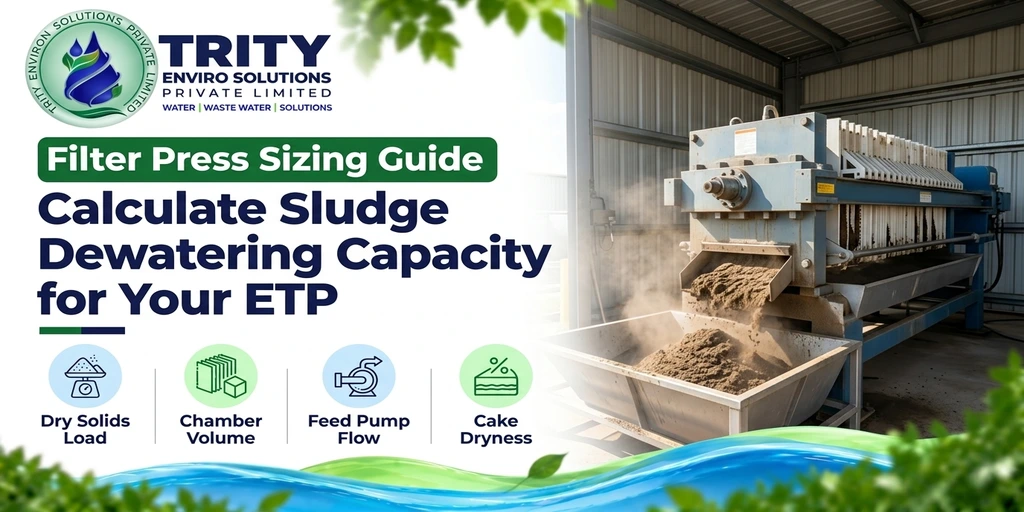
Calculate filter press size from daily dry solids, cake dryness and cycle time. Includes a worked example, plate selection tips and supplier questions.
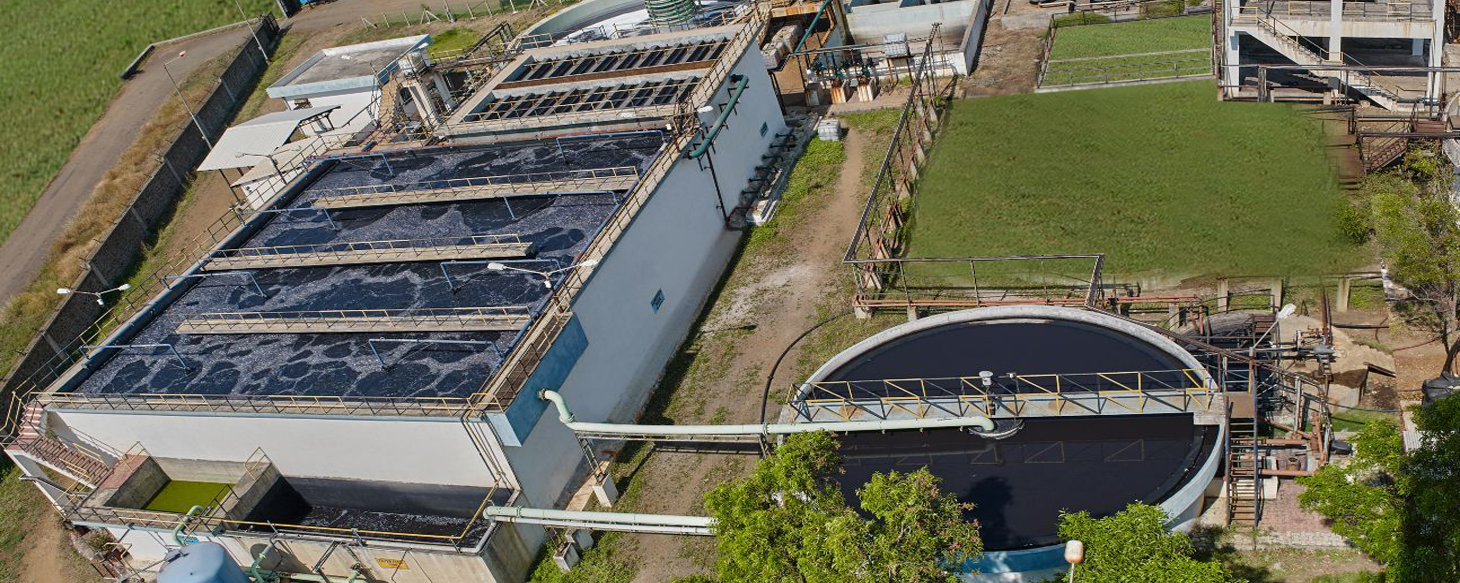
Complete guide to Pharmaceutical Effluent Treatment Plants. Learn the 4-stage ETP process, treatment technologies, regulatory compliance, and environmental benefits.











Discuss your requirements with our engineering team and get practical guidance for your project.

