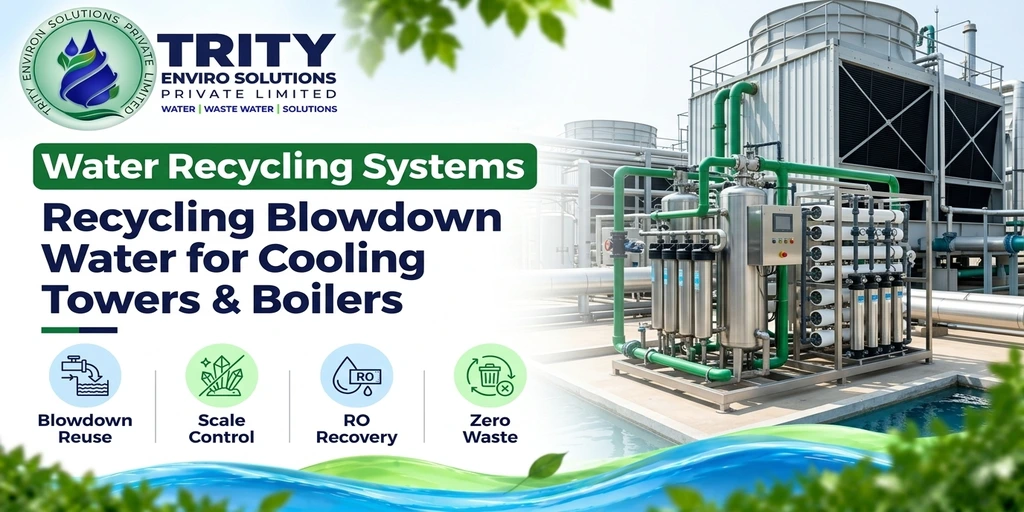
How to Design a Water Recycling System for Cooling Towers and Industrial Process Water
Design a water recycling system for cooling towers and process water: water balance, cycles of concentration, treatment train and payback, with an example.

 ISO 9001:2015 & QCI Approved
An equalization tank is the cheapest insurance a treatment plant can buy. Learn how to size it with a worked example and avoid the mistakes that make it a smelly holding pond.
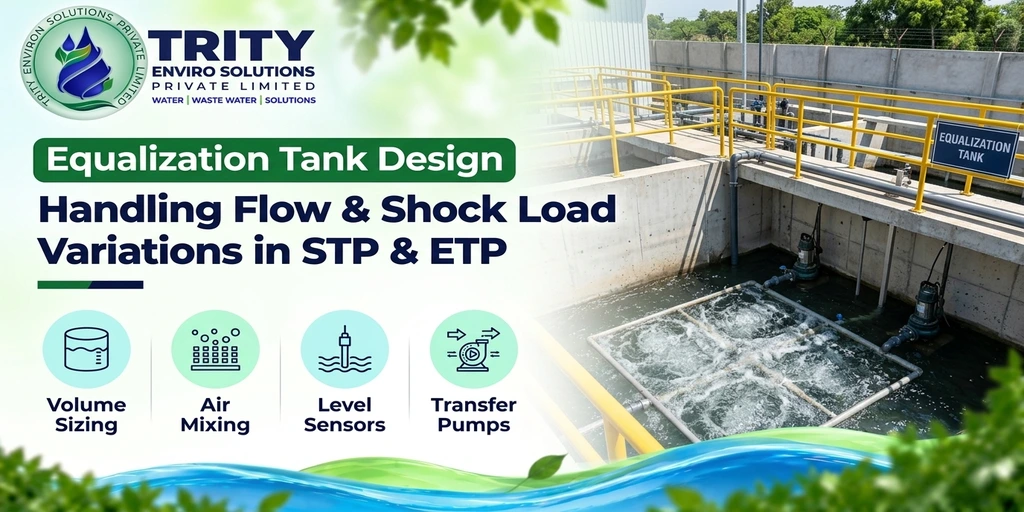
A biological treatment plant is a living system. The bacteria in the aeration tank adjust to the food they receive, the oxygen available and the conditions around them. They can handle a steady diet very well. What they cannot handle is a sudden change: a two hour burst of strong flow at breakfast time in a hotel, a batch dump of acidic wash water in a chemical unit, a slug of dye bath in a textile factory, a week of heavy rain on a combined drain.
Flow and load are never constant. Domestic sewage swings between a quiet night flow and a morning peak that can be three to four times the average. Industrial plants discharge in batches, by shift or by product. If these swings arrive at the treatment plant unmodified, the result is washout of sludge, upset biology, poor settling and failed samples.
An equalization tank (also called an equalisation or balancing tank) sits at the front of the plant and absorbs the swings. Wastewater flows in as it is produced and is pumped out at a steady rate. The tank evens out flow, evens out concentration, can neutralise pH and gives the operator time to react.
This guide shows how to design one properly: how to size it from the flow pattern with a worked example, how to mix and aerate it, how to control pH and level and what to check in a supplier's proposal. It is written for plant engineers, consultants and buyers of STPs and ETPs in hotels, hospitals, campuses, residential projects and industries.
Flow equalization smooths hydraulic variation so that downstream equipment sees a near steady flow. Load equalization smooths concentration, so that a strong batch is blended with weaker flow before reaching the biology. A well designed tank does both. It reduces the size of the units that follow, since they can be designed for the average flow instead of the peak, and it improves the performance of every one of them.
The benefits are practical. Biological plants perform more steadily. Chemical dosing becomes more accurate because flow is constant. Clarifiers do not wash out solids during peaks. Pumps and blowers run in a narrower range. Overall, a plant with a good equalization tank is smaller, cheaper to run and easier to operate than one without.
In an in-line arrangement, all flow passes through the tank, so both flow and load are evened out. This is the usual choice for STPs and most ETPs. In a side-line arrangement, flow above a set rate is diverted into the tank and returned later. It reduces tank volume but evens out only part of the load. Side-line tanks are used in some large municipal systems and for storm flows.
Equalization volume is usually expressed as a retention time at average flow. For domestic sewage in hotels, hospitals, campuses and apartments, typical designs fall in the range of about 4 to 8 hours of average daily flow, with larger values where the flow pattern is very uneven. For industrial effluent with batch discharges, designers often use 8 to 24 hours, depending on batch size and variability. Some plants add extra volume for emergency storage, when a process upset sends unacceptable effluent that must be held back.
A rule of thumb is a starting point. The right volume comes from the actual flow pattern.
Consider a hotel STP that treats 200 m/day. The plant runs at a constant rate of 200 24 = 8.33 m/h. The inflow pattern over a day is:
Calculate the cumulative difference between inflow and the constant outflow, starting from 6 am when the tank is assumed empty:
The maximum accumulated volume is 56.7 m. Add a margin of about 20 percent for operating level range, dead volume below the pump suction and variation between days, giving about 68 m. That equals about 8 hours of average flow, in line with the upper end of the usual range for a hotel. If the pattern changes with occupancy, run the calculation for the busiest day, not the average one.
For industrial effluent, plot the batch discharge schedule the same way and also look at concentration, such as COD or pH, so that the tank volume is enough to blend strong batches.
An unmixed equalization tank is just a settling tank. Solids settle, organic matter goes septic, hydrogen sulphide forms and the tank becomes the odour source of the whole plant. Mixing prevents this.
Two common methods are air mixing and mechanical mixing. Air mixing with coarse bubble diffusers does two jobs, mixing and supplying a little oxygen. A commonly quoted design range for air requirement in equalization tanks is about 0.01 to 0.015 m/min per m of tank volume. For the 68 m tank in the example, that is about 0.7 to 1.0 m/min, or 41 to 61 m/h of air. Our bubble air diffusers include coarse bubble options for this duty, and our article on air diffuser selection for STP and ETP explains the types.
Submersible mixers are another choice, using roughly 5 to 10 W per m in many designs. They avoid the oxygen input, which suits some industrial effluents where aeration would strip volatile compounds or cause foaming. Choose based on the effluent.
Ahead of the tank, fit a screen to remove rags and plastics, and a grit chamber if the sewage carries sand. Where oil and grease are present, add an oil trap or oil water separator before the tank, since oil collects on the surface and goes septic.
In an ETP, the equalization tank is often the best place to neutralise pH. Acid and alkali streams that arrive at different times partly neutralise each other in the tank, and any remaining correction is made with dosing pumps controlled by a pH probe in a well mixed zone. Keep the probe clean and calibrated. A pH probe in a dead zone gives readings that mean nothing.
Temperature also matters. Hot process streams can be cooled by the volume of the tank, but very hot effluent may need a cooling stage first to protect the biology, which usually prefers temperatures below about 35 to 40 C.
For flow control, use level sensors and transfer pumps with variable frequency drives, or a duty and standby set of pumps with a flow control valve and flow meter. The aim is to deliver a steady flow to the plant. Include a high level alarm, a low level cutoff to protect pumps and an emergency overflow route.
Plants that can receive an unexpected bad batch, such as a spent acid dump or a toxic wash, benefit from an emergency holding arrangement. A separate small tank or a section of the equalization tank can be isolated and used to hold unacceptable wastewater until it is tested and released slowly. Provide a diverter valve and a pump so that suspect flow can be redirected without stopping production. A high level alarm and an overflow to a safe containment area protect the plant during power failures or pump breakdowns. Planning this at the start costs very little compared with a spill that kills the biology and shuts the plant for weeks.
Equalization tanks are built in reinforced concrete, or fabricated in FRP, MS with lining or HDPE for smaller plants. Concrete is common for large volumes and below ground installation. Choose a floor with a slope to a sump so that sludge and grit can be pumped out. Include manholes for entry, ventilation, covers to control odour and a vent line connected to a small odour control system if the site is near people. Provide access for cleaning, since every equalization tank accumulates solids over time.
The tank should be sized not just for flow but for the whole plant sequence. It sits after screening and before biological treatment, and its output feeds the main plant. Our equalization tank page covers the options, and the same tank forms part of every sewage treatment plant and effluent treatment plant we design.
Also consider the larger picture of what should happen before the main plant. Our article on industrial wastewater pre-treatment before the ETP covers screening, oil removal and neutralisation, and an annual maintenance contract keeps mixers, pumps and instruments in order.
| Parameter / Stage | Target Optimal Range | Failure Impact / Risk | Corrective Engineering Action |
|---|---|---|---|
| Retention time at average flow | About 4 to 8 hours for domestic sewage, 8 to 24 hours for batch industrial effluent | Shock loads, biological upset, failed samples | Resize from cumulative flow, add volume or batching control |
| Air mixing rate | About 0.01 to 0.015 m/min per m of tank volume | Settling, septic conditions, odour | Add or rebalance diffusers, or fit mixers |
| pH after neutralisation | About 6.5 to 8.5 before biological treatment | Bacteria inhibited, corrosion, chemical waste | Fit pH controller with feedback dosing, keep probe clean |
| Outflow rate | Steady, controlled by pumps, valve and flow meter | Surges to downstream units, poor settling | Install VFD or flow control, check level instruments |
Trity Environ Solutions is an ISO 9001:2015 certified and QCI-approved equalization tank and sewage and effluent treatment plant manufacturer and supplier in India, delivering robust, high-efficiency systems engineered for CPCB and SPCB regulatory compliance.
Every installation is supported by pan-India Annual Maintenance Contract and Operation and Maintenance services.
Design a water recycling system for cooling towers and process water: water balance, cycles of concentration, treatment train and payback, with an example.
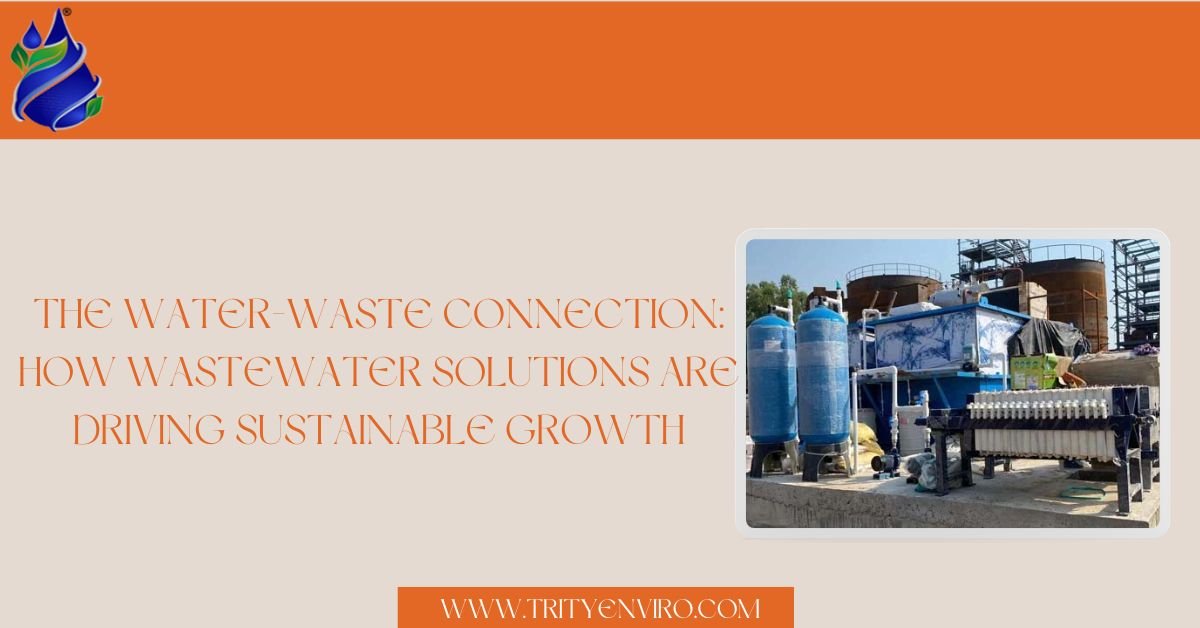
Explore how wastewater treatment drives sustainability in industries, reducing costs and protecting ecosystems. Learn about innovative solutions and real-world applications.
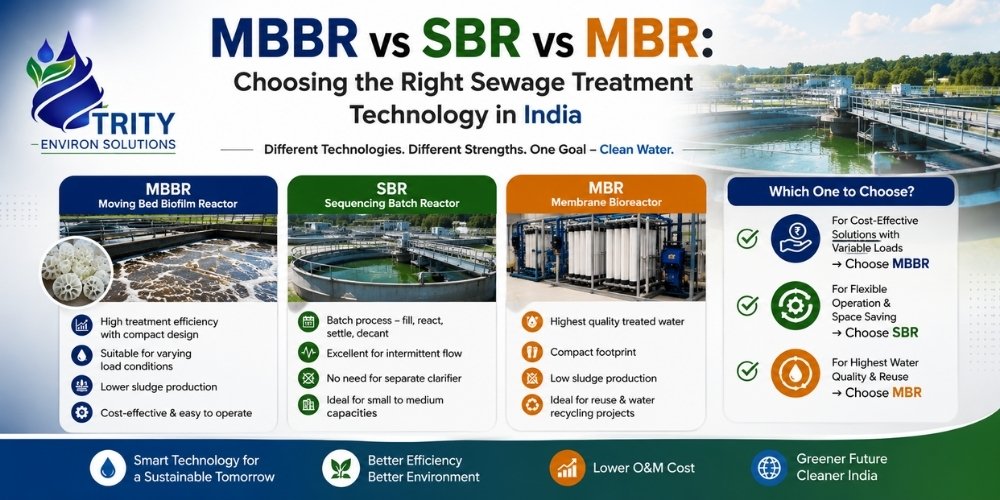
Compare MBBR, SBR, and MBR sewage treatment technologies on footprint, cost, effluent quality, and O&M. Find the right fit for your plant capacity and industry.











Discuss your requirements with our engineering team and get practical guidance for your project.

