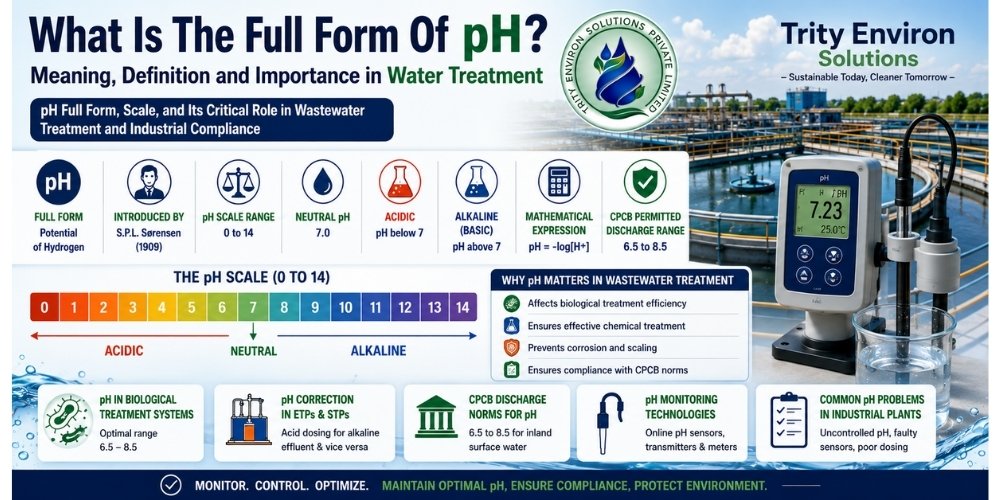
What Is The Full Form Of pH? Meaning, Definition and Importance in Water Treatment
The full form of pH is Potential of Hydrogen. Learn its meaning, scale, importance in wastewater treatment, CPCB pH norms, and pH correction in ETP and STP systems.

 ISO 9001:2015 & QCI Approved
From the bar screen to the disinfection tank, here is what happens at every step inside a sewage treatment plant, in plain language.
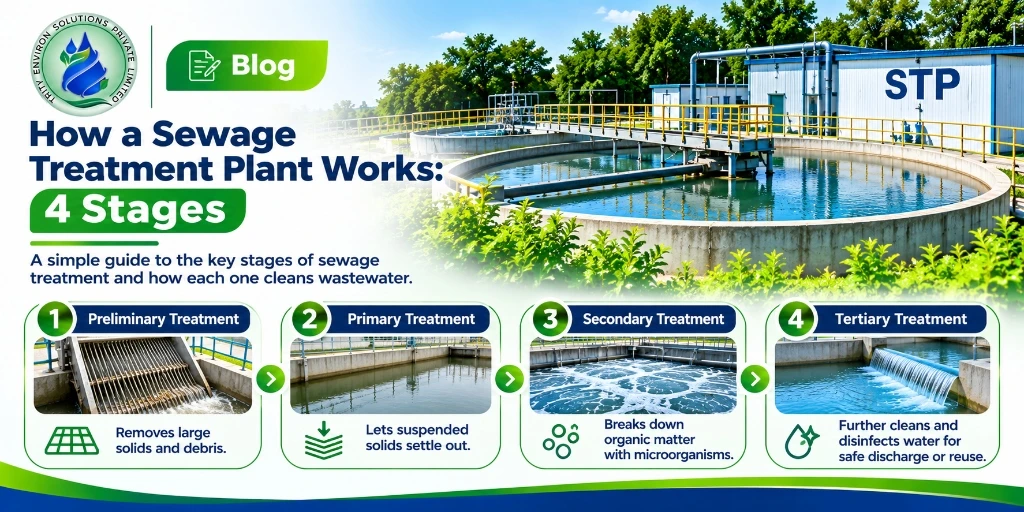
Almost every large apartment complex, hotel, hospital and campus in India has a sewage treatment plant, usually tucked into a basement or a corner of the compound. Residents hear a blower hum and see a tank, but few know what actually happens inside. That is a pity, because understanding the plant is the first step to running it well and to spotting trouble before it becomes a notice from the pollution control board.
The idea behind a sewage treatment plant (STP) is simple. Sewage is about 99 percent water, and the remaining one percent is dirt: solids, organic matter, nutrients and microorganisms. The plant separates the solids, lets bacteria eat the organic matter and then polishes and disinfects the water. The bacteria do the real work, and the plant's job is to give them the right conditions.
Engineers describe the process in stages. Preliminary treatment removes what can damage equipment. Primary treatment settles out heavy solids. Secondary treatment, the biological heart of the plant, removes dissolved organic matter. Tertiary treatment polishes and disinfects the water. Alongside, sludge is collected, thickened and dewatered.
This guide walks through the four stages, explains the main technologies, gives working numbers and shows the sizing of a 100 KLD extended aeration plant as an example. It is written for residents, committee members, facility managers and students who want to understand an STP. At Trity Enviro, we design and maintain STPs for homes, hotels, hospitals and industries across India.
Raw sewage arrives carrying rags, plastics, hair, grit and grease. The bar screen catches the large items. A grit chamber lets sand and heavy particles settle. A grease trap or oil skimmer removes fats, which would coat bacteria later. Then an equalization tank collects the flow, evens out the morning and evening peaks and mixes the sewage so the biological stage sees a steady diet. Our guide to equalization tank design shows how to size it.
In larger plants, a primary settling tank allows heavy organic solids to sink, removing some of the BOD and suspended solids before the biological stage. Small plants often skip it, because extended aeration systems are designed to handle raw screened sewage.
This is where the cleaning happens. In an aeration tank, air is blown through the sewage by diffusers, and bacteria multiply on the organic matter, converting it to new bacterial cells, carbon dioxide and water. A dense brown culture of bacteria forms flocs, and the mixture is called mixed liquor. The flocs then flow to a secondary clarifier, a quiet tank where they settle to the bottom while clear water leaves from the top. Most of the settled sludge, called return activated sludge, is pumped back to the aeration tank to maintain the bacterial population, and a small portion is removed as waste sludge.
The key readings here are dissolved oxygen, typically about 1.5 to 3 mg/L, pH of about 6.5 to 8.5 and mixed liquor solids, which for extended aeration are commonly about 3,000 to 4,000 mg/L. Our guide to STP problems and solutions explains what to do when they drift.
The water from the clarifier is usually clear but still carries fine solids and microorganisms. Pressure sand filters remove suspended particles, activated carbon filters remove colour and odour and disinfection, by chlorine or UV, kills pathogens. The treated water is stored in a tank for reuse in flushing and gardening or for discharge. Where more is needed, such as nitrogen removal, ultrafiltration or RO for cooling towers, further stages can follow. See our tertiary treatment plant page and our guide to ammonia and nitrogen removal in STP.
Our comparison of MBBR vs SBR vs MBR helps with the choice, and our article on package STP vs RCC STP explains how to build it.
The waste sludge from the clarifier is mostly water. It is collected in a sludge holding tank, thickened by settling and then dewatered with a filter press, screw press, centrifuge or drying beds. The dewatered cake is used as manure after stabilisation where permitted, or sent to authorised disposal. Regular sludge wasting keeps the biology healthy, and neglecting it is a common cause of poor outlet quality. See our guides to sludge dewatering options and the filter press for sludge dewatering.
Consider an extended aeration STP for 100 KLD of sewage with BOD of 250 mg/L and 4 m side water depth.
This example is illustrative, and a real design depends on your load, temperature, process and norms. Our guide on how to calculate STP capacity explains how to find the design flow in the first place.
Costs depend on capacity, process, format and the quality needed. Running costs include power for blowers, chemicals, sludge handling, manpower and maintenance, and aeration is usually the largest power user. Compliance means a valid consent, treated water that meets the norms in it, such as the NGT STP norms for the stricter category with BOD of about 10 mg/L, records and regular testing. Our STP operation and maintenance checklist gives the routine, and our guide to BOD, COD, TSS and TDS explains the lab numbers.
Trity Enviro's sewage treatment plant range covers every stage described here, and an annual maintenance contract keeps the plant running well.
As a rough guide, preliminary treatment removes screenings and grit with little change in BOD. Primary settling, where used, removes about a third of BOD and perhaps half of suspended solids. The biological stage removes the bulk of the remaining BOD, often above 90 percent overall in a well run plant, and the clarifier removes most of the biomass. Tertiary filtration removes remaining fine solids, and disinfection reduces coliform by several orders of magnitude. These are typical ranges and not guarantees, since actual results depend on load, temperature, operation and design. Looking at inlet and outlet values stage by stage helps you find where a problem begins.
A short daily walk keeps a plant healthy. Check the screen and clear it. Look at the equalization tank for floating scum and make sure it is being mixed. Measure dissolved oxygen and pH in the aeration tank, and note the colour and smell. Look at the clarifier for clear overflow and a stable sludge blanket. Confirm that blowers and pumps are running without unusual noise. Check filter gauges and the chlorine dose, then read the flow and energy meters and write everything in the logbook. Five or ten minutes spent this way catches most problems early, and our maintenance checklist gives a full routine.
| Parameter / Stage | Target Optimal Range | Failure Impact / Risk | Corrective Engineering Action |
|---|---|---|---|
| Equalization tank | About 6 to 8 hours of average flow, mixed | Shock loads, odour, poor treatment | Resize from flow pattern, restore mixing |
| Aeration tank DO and MLSS | DO about 1.5 to 3 mg/L, MLSS about 3,000 to 4,000 mg/L for extended aeration | Poor BOD removal, bulking, foam | Service blowers and diffusers, adjust sludge wasting |
| Secondary clarifier overflow rate | Commonly about 8 to 16 m3/m2/day for extended aeration | Solids carryover, turbid outlet | Increase area, fix weirs, control return sludge |
| Disinfection | Residual or UV dose sufficient for coliform limit | Failed coliform test, health risk | Adjust chlorine dose or contact time, clean UV lamps |
Trity Environ Solutions is an ISO 9001:2015 certified and QCI-approved sewage treatment plant manufacturer and supplier in India, delivering robust, high-efficiency systems engineered for CPCB and SPCB regulatory compliance.
Every installation is supported by pan-India Annual Maintenance Contract and Operation and Maintenance services.
Looking to install or upgrade a high-performance STP with Trity Enviro? Call +91-9821030072 or email enquiry@trityenviro.com, or request a free engineering consultation from our technical team.
The full form of pH is Potential of Hydrogen. Learn its meaning, scale, importance in wastewater treatment, CPCB pH norms, and pH correction in ETP and STP systems.

The real economic case for municipal ETP investment: revenue models, financing options like PPP, and why the maintenance gap matters as much as building.
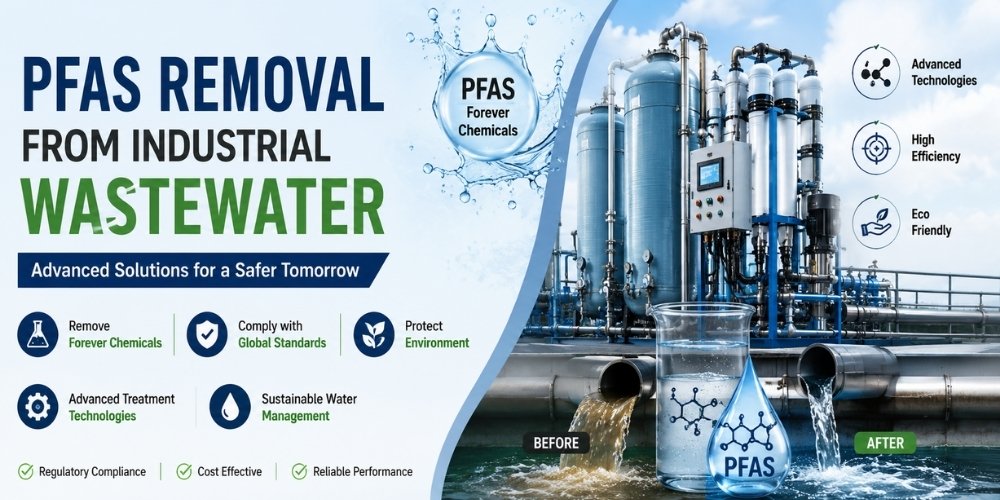
Complete guide to PFAS removal from industrial wastewater. Compare GAC, RO, ion exchange and AOP technologies, costs, and India's 2026 regulations.











Discuss your requirements with our engineering team and get practical guidance for your project.

