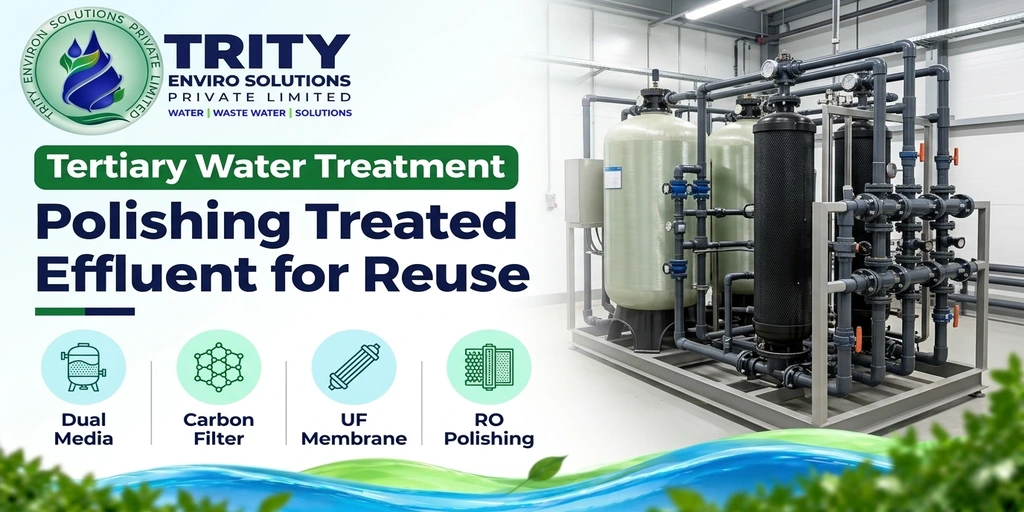
Tertiary Water Treatment for Industrial Reuse: When Filtration Alone Is Not Enough
Is filtration enough to reuse treated wastewater? Learn when you need UF, RO, softening or disinfection, and how to match tertiary treatment to each reuse.

 ISO 9001:2015 & QCI Approved
The right diffuser can cut aeration power by a third. Learn which type suits your tank and how to calculate how many you need.
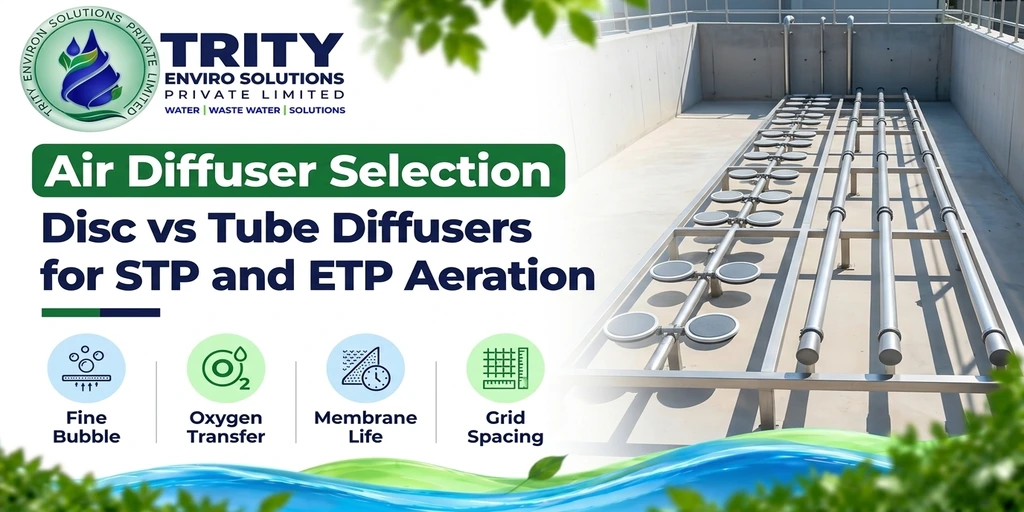
In a biological sewage or effluent treatment plant, aeration is the largest single use of electricity. The blower gets the attention, because it is the machine you can hear. But the diffusers at the bottom of the tank decide how much of that air turns into dissolved oxygen for the bacteria and how much simply bubbles to the surface and escapes.
A plant fitted with poorly chosen or badly spaced diffusers can use 30 to 50 percent more air than a well designed one to deliver the same oxygen. That extra air shows up as a larger blower, a higher power bill, more noise and, in many cases, a plant that still struggles with low dissolved oxygen in corners of the tank.
This guide explains how to choose an air diffuser for STP and ETP aeration. It compares disc and tube types, explains fine and coarse bubble use, shows how to size the number of diffusers from the oxygen demand with a worked example and lists what to check on membranes, layout and maintenance. It is written for plant engineers, consultants and buyers who want an aeration system that performs for years.
A diffuser breaks compressed air into bubbles as it enters the water. Oxygen then dissolves across the surface of each bubble into the wastewater. The more surface area per unit of air, and the longer the bubble stays in the water, the more oxygen is transferred.
Fine bubble diffusers make bubbles of a couple of millimetres, which gives a large surface area for a given volume of air. They are the standard for activated sludge, extended aeration, SBR and MBR tanks, where oxygen transfer efficiency matters. Coarse bubble diffusers make bubbles of several millimetres or more through holes or slots in a pipe or plate. They transfer less oxygen per unit of air but are tougher, clog less and give strong mixing. They are used in equalization tanks, grit chambers, sludge holding tanks and some MBBR tanks, where mixing or media movement matters as much as oxygen.
Oxygen transfer efficiency rises with the depth of water above the diffuser, because bubbles stay in contact longer and the pressure is higher. For fine bubble systems, standard oxygen transfer efficiency is often in the range of about 5 to 8 percent per metre of submergence in clean water. At a 4 metre water depth this gives something like 20 to 30 percent. In real wastewater, efficiency is lower because of surfactants, solids and biology, and designers apply a correction called the alpha factor, which for fine bubble systems is often in the range of 0.5 to 0.7.
This is why shallow tanks use more air for the same oxygen and why increasing the depth of an aeration tank can cut power use.
A disc diffuser is a flat circular plate with a perforated flexible membrane on top. Common diameters are around 9 to 12 inches. Air enters beneath the membrane, lifts it slightly and escapes through tiny slits, forming fine bubbles. When the blower stops, the membrane seals again, which prevents backflow of water and solids into the pipe.
Discs are laid out over the floor of the tank on a grid of pipes, giving uniform coverage. They suit square or wide tanks, such as extended aeration tanks and SBRs, and they allow the number of diffusers to be adjusted across the tank, putting more near the inlet where oxygen demand is highest. Typical design airflow per disc falls in the range of about 2 to 6 Nm/h. Running a disc well above its design airflow lowers efficiency, and running far below it can cause uneven distribution.
A tube diffuser is a long cylinder, often with a membrane sleeve wrapped around a rigid support, mounted horizontally on a header. It offers a large membrane area per unit of floor space and can handle high airflow per unit. Tube diffusers suit long, narrow tanks, grids that must be retrievable and installations where the diffuser header is fixed along one wall. Many designs allow the grid to be lifted out for maintenance without draining the tank.
Their disadvantage is that tube layouts may give less uniform coverage than a full-floor disc grid. They can also sit higher above the floor, which reduces effective submergence slightly. Good designs account for these effects.
Diffuser sizing works backward from the oxygen the bacteria need. The steps are the same for sewage and effluent, though the numbers differ.
Consider a 200 KLD sewage treatment plant with raw BOD of 250 mg/L, using extended aeration in a tank with 4 m side water depth.
1. BOD load: 200 m/day x 250 g/m = 50 kg BOD per day.
2. Actual oxygen requirement: For extended aeration, which includes nitrification and endogenous respiration, designers often use around 1.5 kg of oxygen per kg of BOD, or about 75 kg O per day, which is about 3.1 kg O per hour.
3. Convert to standard conditions: Field oxygen transfer is lower than clean water at 20 C. With an alpha factor of 0.6, beta of 0.95, a water temperature of 30 C and a dissolved oxygen target of 2 mg/L, the correction factor is about 0.44. The required standard oxygen transfer rate is 3.1 0.44 = about 7.1 kg O per hour.
4. Oxygen transfer efficiency: At 4 m submergence and about 5.5 percent per metre, standard efficiency is about 22 percent.
5. Airflow: Air contains about 0.28 kg of oxygen per Nm. Air needed = 7.1 (0.28 x 0.22) = about 115 Nm/h. Add 10 to 20 percent for margin, giving roughly 130 to 140 Nm/h.
6. Number of discs: At a design flow of about 3 Nm/h per disc, 115 to 140 Nm/h requires about 38 to 47 discs.
Treat the above as a design example, not a rule. Your actual BOD, temperature, depth, process and manufacturer's data will change the result. The same airflow then feeds the blower selection, which we cover in our article on air blower selection for STP and ETP.
Good layout spreads diffusers to match oxygen demand. In a plug flow tank, put more diffusers at the inlet end and fewer at the outlet, a practice called tapered aeration. Keep diffuser spacing even enough to avoid dead zones. Use valves on each header so that air can be balanced, and install a drop pipe design that gives equal pressure to every header. Make sure the pipework is sized so that velocity stays within reasonable limits, since pressure losses in the grid add to blower pressure.
Level the grid. If diffusers sit at different heights, those that are shallower will release more air and the deeper ones less. Fix the grid securely so that it does not float or shift when the tank is filled and emptied.
The membrane is the working part of the diffuser, and the material decides how long it lasts. EPDM is the common choice for domestic sewage and many industrial wastes. Silicone tolerates higher temperatures and has less tendency to absorb oil and plasticisers. Polyurethane is used where abrasion resistance matters. PTFE coated membranes resist harsher chemicals and fouling. Match the material to your effluent: a pharma or chemical effluent with solvents needs a different choice from a housing society sewage plant.
Membranes age by hardening, scaling and clogging. A typical life is several years, often in the range of three to six, though it depends on operation. Signs of ageing are rising back pressure, uneven bubble patterns and higher power use. Plan to inspect the grid when the tank is emptied, and replace membranes in batches before they fail.
You can see our range of bubble air diffusers and our sewage treatment plant designs. For a full process overview, read our comparison of MBBR vs SBR vs MBR, and keep the system healthy with an annual maintenance contract.
| Parameter / Stage | Target Optimal Range | Failure Impact / Risk | Corrective Engineering Action |
|---|---|---|---|
| Standard oxygen transfer efficiency | About 5 to 8 percent per metre of submergence for fine bubble in clean water | High air demand, oversized blower, high power bill | Use fine bubble, increase depth, check diffuser condition |
| Airflow per disc | Commonly about 2 to 6 Nm/h | Poor efficiency if too high, uneven flow if too low | Add diffusers or rebalance headers |
| Dissolved oxygen in aeration tank | About 1.5 to 3 mg/L | Poor treatment and odour if low, wasted power if high | Adjust airflow, add DO control, fix dead zones |
| Membrane condition | Clean, flexible, with fine even bubbles | High back pressure, coarse bubbles, torn membranes | Clean or replace membranes, check for scaling and oil |
Trity Environ Solutions is an ISO 9001:2015 certified and QCI-approved bubble air diffuser manufacturer and supplier in India, delivering robust, high-efficiency systems engineered for CPCB and SPCB regulatory compliance.
Every installation is supported by pan-India Annual Maintenance Contract and Operation and Maintenance services.
Is filtration enough to reuse treated wastewater? Learn when you need UF, RO, softening or disinfection, and how to match tertiary treatment to each reuse.
Discover why flow equalisation is crucial for efficient sewage treatment. It regulates wastewater flow, prevents overloads, and enhances environmental protection.
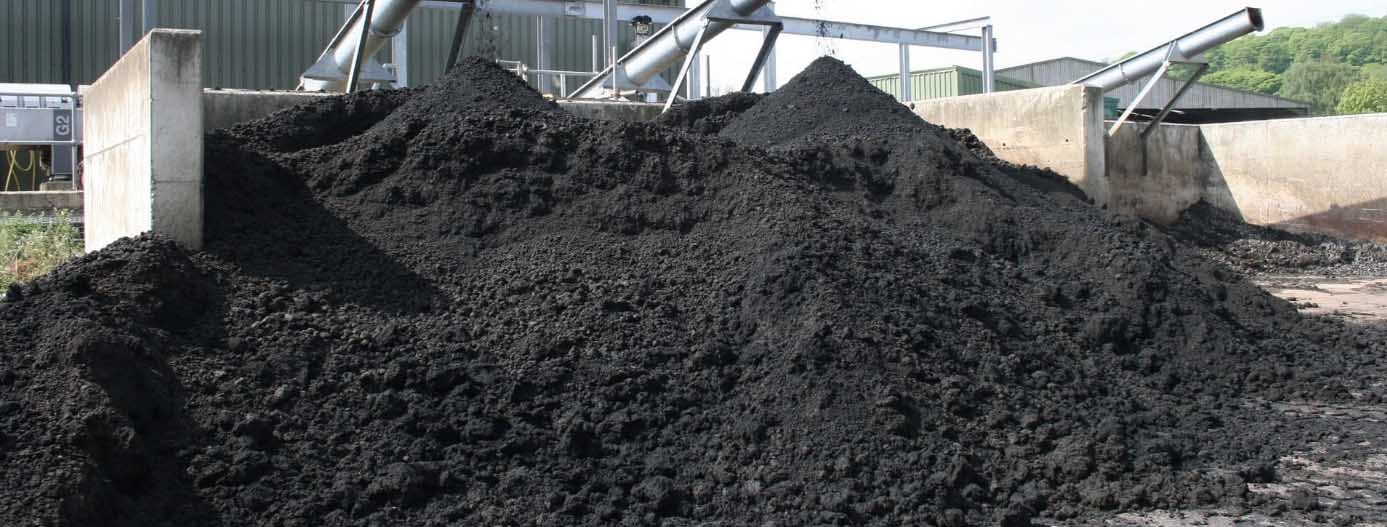
Discover how sludge and untreated sewage affect the environment, water bodies, and marine life. Learn about sludge management, wastewater treatment, and sustainable disposal practices in India.











Discuss your requirements with our engineering team and get practical guidance for your project.

