Introduction: A Housing Society STP Needs a Routine, Not Heroics
Most housing society STPs do not fail because of a design fault. They fail because nobody is checking them. The operator works alone, the committee changes every year, the AMC visit happens once a quarter and the logbook has missing pages. Then comes the monsoon, or a rise in occupancy, or a blower breakdown on a Sunday, and the plant slides from healthy to smelly in a week.
The cost of this neglect is real. Residents complain about odour, treated water fails the sample, the local pollution control board sends a notice and the society ends up paying for emergency repair, tanker removal of sewage and sometimes environmental compensation. In some states, authorities have made clear that occupiers of buildings are responsible for keeping the STP working, and they can be charged compensation if it is not.
A good maintenance routine is cheap by comparison. It takes an operator perhaps an hour or two a day, a weekly check by a supervisor and a monthly lab test. This guide gives you a practical STP operation and maintenance checklist for housing societies, split into daily, weekly, monthly, quarterly and yearly tasks. It includes a simple logbook format, a spares list, safety points and what to demand from an AMC provider. It is written for RWA committees, facility managers and STP operators.
The Daily and Weekly Routine
Daily Operator Checks
Walk the plant at the start and end of each shift, in the same order every time: screen chamber, equalization tank, aeration tank, clarifier, sludge holding tank, filters, disinfection tank, treated water tank and blower room. At each point note what you see, hear and smell.
- Screen and grit chamber: Remove rags, plastics and debris from the bar screen. Clean the chamber.
- Equalization tank: Check the water level, confirm that air mixing is working and look for floating grease or scum.
- Aeration tank: Check the air pattern from the diffusers, the colour of the liquor (a healthy tank is usually brown) and foam. Measure dissolved oxygen and pH with portable meters.
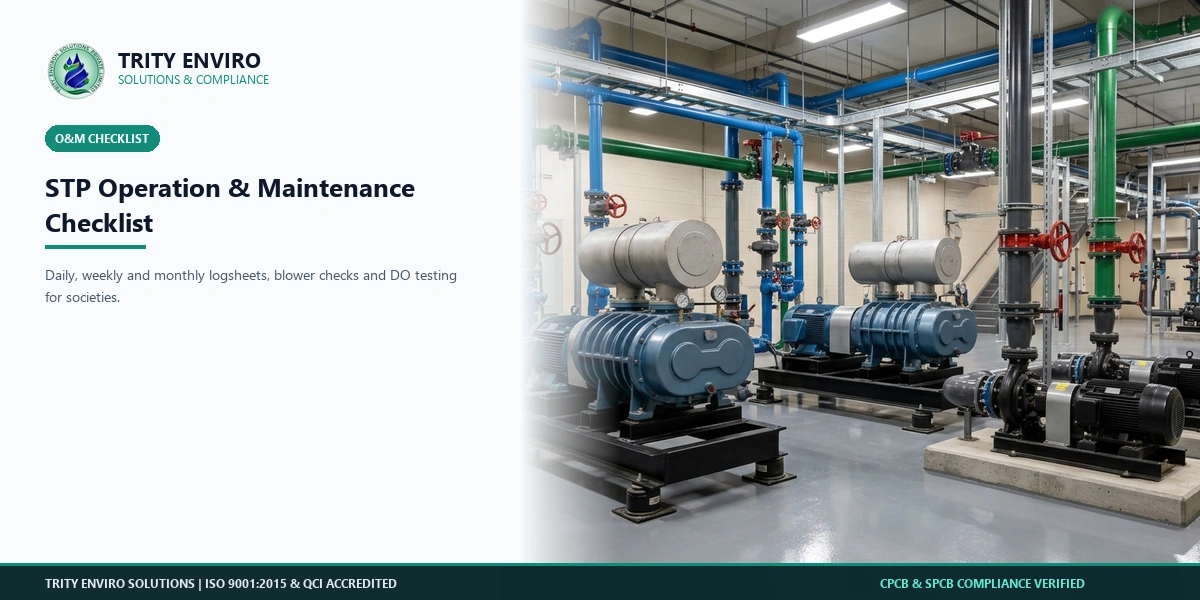
- Blowers: Check that the duty blower is running, listen for unusual noise, feel for excess heat, confirm the oil level and check the discharge pressure gauge.
- Clarifier: Look for a clear overflow, a stable sludge blanket and floating solids. Operate the skimmer or scum remover.
- Sludge return and waste pumps: Confirm that the return sludge flow is steady and that waste sludge is drawn on schedule.
- Filters and disinfection: Check the pressure gauges on pressure sand and carbon filters and the chlorine dose or UV lamp status.
- Treated water: Check clarity, smell and residual chlorine at the outlet. Note the quantity reused for flushing or gardening and the quantity discharged.
- Flow and power readings: Record inlet flow, outlet flow, blower running hours and energy meter readings.
Rotate duty and standby equipment on a fixed schedule, for example weekly, so both are kept in working condition.
Weekly Tasks for the Supervisor
- Run the 30 minute settling test (SV30) on aeration tank liquor and note the result.
- Measure MLSS at the lab or with a field meter, and calculate SVI.
- Clean diffuser flow patterns by inspecting bubble uniformity, and note any dead zones.
- Backwash pressure sand and carbon filters as recommended.
- Check chemical dosing tanks and refill chlorine or polymer.
- Clean the grease trap and the scum removal points.
- Inspect pump seals, belts and couplings for wear and leaks.
- Review the week's logbook for trends in DO, pH, flows and power use. A slow change is often the first sign of trouble.
Monthly, Quarterly and Yearly Maintenance
Monthly Tests and Servicing
- Laboratory test of inlet and outlet: BOD, COD, TSS, pH and ammonia at least monthly, or as often as your consent requires. Add faecal coliform if the water is reused. Use an accredited lab and keep the reports.
- Blower service: Change or clean intake filters, check belt tension, top up or change oil as the maker recommends and check the relief valve.
- Panel and electricals: Check starters, overload relays, indicator lamps and earthing. Tighten loose connections. Clean dust from the panel.
- Sludge handling: Dewater or remove sludge on schedule, and check the dewatering equipment. Our guide on sludge dewatering options explains how to choose and run them.
- Tank and civil inspection: Look for leaks, cracks, corrosion of metal parts and blocked overflow pipes.
- Treated water tank: Clean the tank, check the level controls and make sure that the transfer pump works.
Quarterly and Yearly Work
- Quarterly: Inspect diffusers by lowering water level if practical, or by observing air patterns. Clean or replace clogged diffusers. Check and calibrate DO and pH meters against standards. Review the spares stock. Test the standby power or alarm systems.
- Yearly: Drain and inspect tanks where practical, remove accumulated sludge and sand, check coatings and repair concrete. Overhaul blowers and major pumps, replace worn bearings and seals, and calibrate flow meters. Check the lifting equipment, ladders, covers and guards. Review plant capacity against occupancy, since a society that has grown may need an upgrade. Our guide on how to calculate STP capacity shows how to check.
- Consent and compliance: Check the validity of your consent, any conditions on monitoring and reporting, and any notices from the board. Renew in time.
Plan diffuser membrane replacement every few years, and media top-up if your plant uses MBBR, as explained on our MBBR sewage treatment plant page.
Records, Spares and Safety
The Logbook and What to Record
A plant without records is hard to defend. Keep a bound logbook or a digital register with, at minimum:
| Item |
Frequency |
| Date, shift, operator name |
Every shift |
| Inlet and outlet flow, blower hours, power reading |
Daily |
| DO, pH, observations of colour, smell, foam |
Daily |
| SV30, MLSS, SVI |
Weekly |
| Chemicals used and stock |
Daily or on use |
| Sludge removed, quantity and destination |
On each removal |
| Lab test results |
Monthly |
| Breakdowns, repairs, spares used |
As they occur |
Have the supervisor sign the log weekly, and review it in the monthly committee meeting. Keep reports and logs for inspection.
Spares, Safety and Operator Skills
Keep a basic spares stock: spare belts, filters, fuses, pump seals, a spare diffuser set, probes for pH and DO, chlorine, polymer and oil. A missing spare can turn a one hour repair into a week long outage.
- *Safety** matters in an STP. Tanks and sumps can contain hydrogen sulphide and low oxygen, which can kill. Never enter a tank without ventilation, a gas check, a trained standby person and permission. Provide handrails, covers on openings, non-slip surfaces, good lighting and first aid. Insist that operators wear gloves, boots and masks. Electrical work must be done by a qualified electrician, with isolation and lockout procedures.
- *Operator skills** decide the plant's health. A trained operator who understands DO, SV30 and MLSS is worth more than a new blower. Ask your service provider to train the operator and to leave a written checklist. Our article on STP problems and solutions explains what to do when a reading is out of range.
Cost, AMC Scope and Choosing a Service Provider
What a Good AMC Covers
An annual maintenance contract is more than a visit. A useful scope includes:
- Scheduled preventive visits, with a written report after each one
- Laboratory tests of inlet and outlet
- Servicing of blowers, pumps, filters and dosing systems
- Chemicals and consumables, either included or priced clearly
- Operator training and supervision
- Emergency breakdown response within a stated time
- Spares supply, with a clear list of what is covered and what is chargeable
- Support with consent renewal, returns and inspections
A full operation and maintenance service, where the provider supplies the operator and runs the plant, suits societies that do not want to manage staff.
Questions to Ask Before You Sign
- How often will your engineer visit, and what exactly will they do?
- What is included in the price, and what is extra?
- How fast will you respond to a breakdown, day or night?
- Who supplies chemicals and spares?
- Will you provide the lab reports and logbook review each month?
- Can you show references from similar societies?
- What happens if the plant fails a compliance test?
Our sewage treatment plant range and service teams support societies across India, from new installations to upgrades.
Seasonal Checks: Monsoon, Summer and Festival Peaks
Some risks come with the calendar. In the monsoon, check that stormwater does not enter the sewer or STP, keep covers and gratings secure, inspect the electrical panel for damp and make sure standby power works. In summer, blower rooms get hot, so check ventilation and oil levels, and expect lower dissolved oxygen in warm water, which may call for more air. In winter, cold water slows nitrification, so watch ammonia. During festivals, weddings and holidays, occupancy and kitchen load change, so expect peaks, and prepare the equalization tank and the operator for them. Plan major servicing for the quiet months, and avoid shutdowns just before occupancy peaks or an expected inspection.
If your plant serves a large society, consider a short monthly review meeting between the operator, the service engineer and two committee members. Ten minutes spent on the logbook, the lab report and any complaints usually prevents most of the surprises described above.
Industry Comparison / Operational Parameter Table
| Parameter / Stage |
Target Optimal Range |
Failure Impact / Risk |
Corrective Engineering Action |
| Daily DO and pH readings |
DO about 1.5 to 3 mg/L, pH about 6.5 to 8.5 |
Odour, poor treatment, failed samples |
Adjust air, check blowers and diffusers, correct pH sources |
| Blower and pump servicing |
Oil, belts and filters on schedule, spare on standby |
Breakdown, loss of aeration, odour |
Follow the service calendar, rotate duty, keep spares |
| Laboratory testing |
Monthly or as per consent, with reports filed |
No evidence of compliance, late detection of problems |
Use an accredited lab, track results, act on trends |
| Logbook and records |
Complete, signed weekly, reviewed monthly |
Weak defence in inspection, hidden drift |
Use a fixed format, assign responsibility, keep copies |
Why Choose Trity Enviro
Trity Environ Solutions is an ISO 9001:2015 certified and QCI-approved sewage treatment plant manufacturer and supplier in India, delivering robust, high-efficiency systems engineered for CPCB and SPCB regulatory compliance.
Every installation is supported by pan-India Annual Maintenance Contract and Operation and Maintenance services.
Free Engineering Consultation
STP Operation and Maintenance Checklist for Housing Societies: Daily, Weekly, Monthly and Yearly
Looking to upgrade, size, or install a high-performance system? Speak directly with our senior environmental engineers today for expert sizing calculations, CPCB/SPCB compliance support, and turnkey execution. Call +91-9821030072 or email enquiry@trityenviro.com.
Request a Free Site Assessment