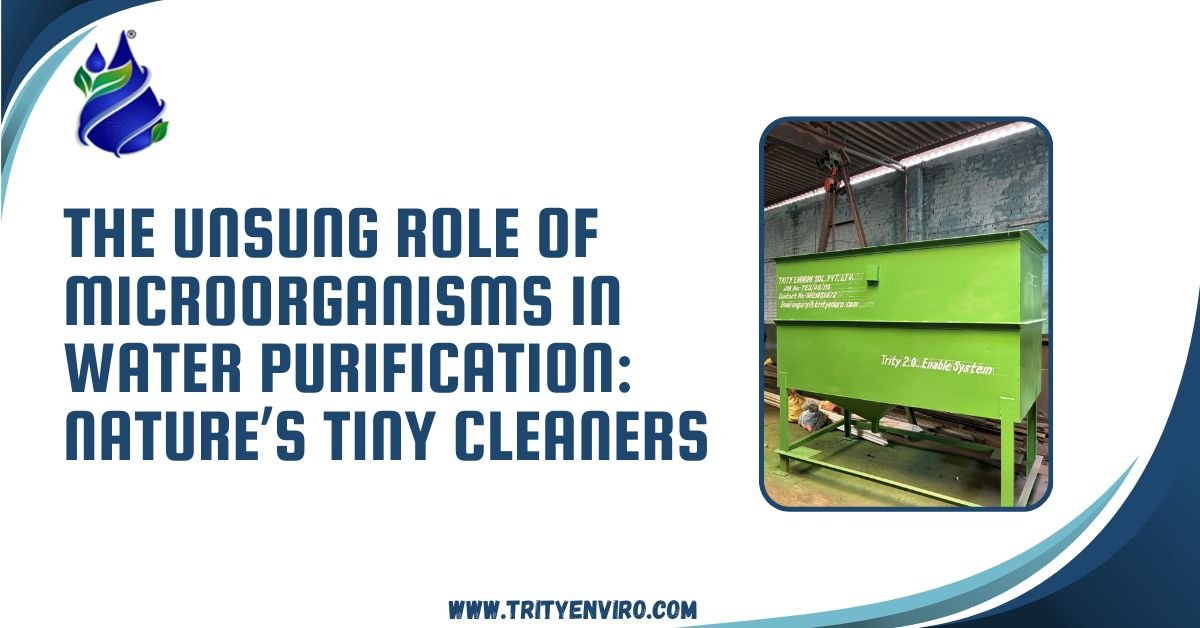
The Unsung Role of Microorganisms in Water Purification: Nature’s Tiny Cleaners
Discover how bacteria, fungi, and algae purify water naturally, playing a crucial role in wastewater treatment and environmental health.

 ISO 9001:2015 & QCI Approved
Compare MBBR, SBR, and MBR sewage treatment technologies on footprint, cost, effluent quality, and O&M. Find the right fit for your plant capacity and industry.
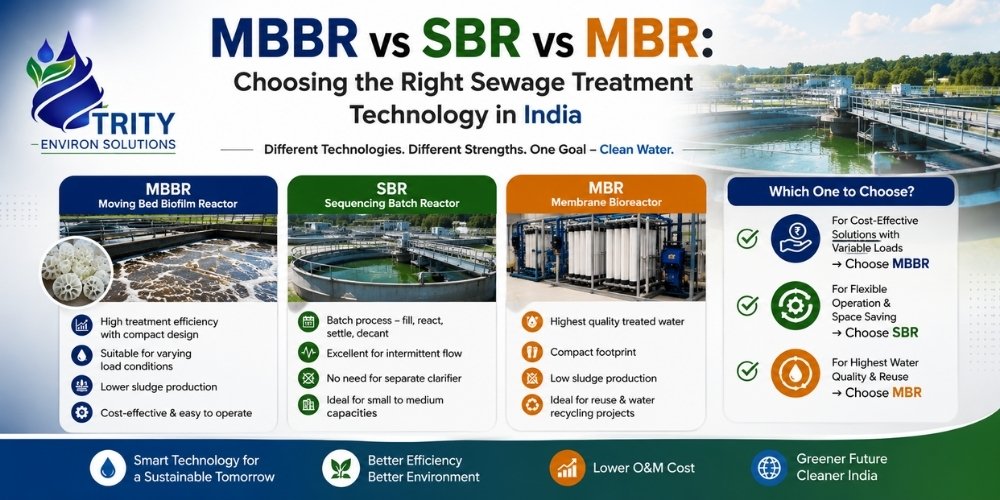
Ask five wastewater consultants which sewage treatment technology is best and you will likely get five different answers, and all five could be correct for their specific project. MBBR, SBR, and MBR are the three most commonly specified biological treatment technologies for STP projects in India today, and each one solves the same underlying problem (removing organic pollutants and suspended solids from sewage) through a genuinely different mechanism. The right choice depends less on which technology is "better" in the abstract and more on your available plot size, your budget, your discharge or reuse requirements, and how much operator attention you can realistically provide. This guide walks through how each system works, where each one holds a clear advantage, and how to think through the decision for your own project.
MBBR, or Moving Bed Biofilm Reactor, treats wastewater using small plastic carriers that float freely inside the aeration tank. Bacteria colonize the surface of these carriers and form a biofilm, and this biofilm does the actual work of breaking down organic matter in the sewage. Because the biomass lives on the carrier surface rather than floating loose in the water, MBBR systems can hold a much higher concentration of active bacteria per cubic meter of tank volume than a conventional activated sludge system, which is what allows the technology to treat more sewage in a smaller footprint.
The carriers stay in constant motion through aeration, which keeps the biofilm exposed to fresh wastewater and oxygen without needing a separate return-sludge system. This makes MBBR genuinely low-maintenance compared to the other two technologies covered here. There is no membrane to foul and no complex timing sequence to manage. It also handles sudden shock loads reasonably well, since the biofilm is more resilient to short-term fluctuations than suspended bacteria would be.
Where MBBR falls short is effluent polish. It typically delivers good but not exceptional treated water quality, generally sufficient for standard CPCB and SPCB discharge norms but not always clean enough for direct high-grade reuse without an additional tertiary stage. Trity Environ Solutions supplies MBBR media designed for exactly this balance of compact footprint and low operational complexity, and it remains one of the most widely specified technologies for housing societies, hotels, and mid-capacity industrial STPs where plot space is tight but budgets are not unlimited.
SBR, or Sequencing Batch Reactor, takes a completely different approach. Instead of treating wastewater continuously as it flows through a series of tanks, an SBR treats sewage in batches inside a single tank, cycling through fill, react, settle, and decant phases in sequence. Each phase happens in the same physical space, just at a different point in time, which is what allows an SBR to combine functions that would otherwise need separate aeration tanks and clarifiers.
This time-based operation gives SBR systems a strong advantage in effluent quality and nutrient removal, particularly for BOD and COD reduction, since the settle phase allows for quiet, undisturbed sedimentation before decanting. It also gives operators real flexibility. Cycle timing can be adjusted to handle variable flow patterns, which matters for sites where sewage generation swings sharply between peak and off-peak hours, such as hotels, hospitals, and commercial complexes.
The tradeoff is sensitivity. SBR systems are more affected by power interruptions and sudden load spikes than MBBR, since the precise sequencing depends on consistent automation and timing. They also demand more attentive operation than MBBR, though considerably less than MBR. Trity manufactures its Sequencing Batch Reactor systems for exactly the kind of project where consistent effluent quality matters more than absolute simplicity of operation, commonly residential group housing societies and mid-sized commercial establishments across India.
MBR, or Membrane Bioreactor, combines biological treatment with ultrafiltration membranes, and this is the technology that produces the cleanest treated water of the three by a meaningful margin. After the biological stage breaks down organic pollutants using suspended bacteria, the wastewater passes through membranes fine enough to physically block bacteria, pathogens, and suspended solids from passing through. The result is treated water that consistently reads below 5 mg/L for both BOD and TSS, a standard that is difficult to hit reliably with either MBBR or SBR alone.
Because the membrane handles solid-liquid separation, MBR systems eliminate the need for a separate secondary clarifier entirely, which gives them the smallest physical footprint of the three technologies for an equivalent treatment capacity. This makes MBR the default choice in space-constrained urban sites and for applications where treated water needs to be reused directly, most commonly hospitals, pharmaceutical facilities, and premium hospitality projects where flushing or landscaping reuse is part of the design brief from day one.
The cost of that performance is higher capital expenditure and meaningfully higher operating cost, largely driven by membrane replacement and the need for trained operators who understand membrane fouling, cleaning cycles, and flux management. MBR is not the right call for a project trying to minimize AMC costs or one without access to skilled operational staff. Trity Environ covers MBR as part of its broader Sewage Treatment Plant range for exactly the sites where the premium is justified by space constraints or reuse requirements.
| Parameter | MBBR | SBR | MBR |
|---|---|---|---|
| Footprint | Compact | Moderate | Smallest |
| Effluent quality | Good | Very good | Excellent (BOD/TSS under 5 mg/L) |
| Capital cost | Lower | Moderate | Highest |
| Operating cost | Lower | Moderate | Highest |
| Power sensitivity | Handles interruptions well | Sensitive to power/timing disruption | Sensitive, needs consistent power |
| Operator skill needed | Low | Moderate | High |
| Shock load tolerance | Good | Moderate | Moderate |
| Best suited for | Housing societies, hotels, mid-capacity industrial STPs | Residential complexes, hospitals, commercial establishments with variable flow | Hospitals, pharma facilities, premium hospitality, direct-reuse projects |
No single technology is correct across every industry, and the right fit usually comes down to what the treated water needs to do after it leaves the plant. Pharmaceutical facilities and hospitals, where treated sewage is often reused for flushing or cooling, tend to gravitate toward MBR because the effluent quality supports reuse without an expensive tertiary polishing stage. Trity's project experience in the Baddi-Barotiwala-Nalagarh pharmaceutical belt, detailed on the Baddi STP and ETP manufacturer page, reflects exactly this pattern, where pharmaceutical and healthcare clients specifically request MBR for its reuse-grade output.
Residential housing societies and hotels, where the priority is usually reliable CPCB-compliant discharge without maximizing reuse, more commonly land on MBBR or SBR depending on available plot size and flow variability. Commercial and institutional campuses with strong daily flow swings, like IT parks or educational institutions, often favor SBR for the flexibility its batch cycle offers in handling that variability.
Industrial units treating trade effluent through an ETP rather than an STP follow a somewhat different logic, since the biological stage is often just one part of a longer treatment train that includes chemical precipitation, oil and grease separation, or ZLD-ready evaporation and condensate recovery depending on the effluent characteristics. Trity's Effluent Treatment Plant range integrates any of the three biological technologies covered here into a larger process design built around the actual influent characterization for that specific industry.
A significant share of technology decisions in India are not new-build decisions at all but retrofits of underperforming or undersized existing plants. MBBR carriers can generally be introduced into an existing activated sludge tank with minimal civil work, which makes it the easiest and least disruptive retrofit option when an old plant needs a capacity or performance boost without a full rebuild. Converting an existing system to SBR or MBR operation typically demands more substantial civil and mechanical changes, since both technologies depend on tank geometry, automation, and control systems that differ meaningfully from a conventional continuous-flow design.
If your existing plant is failing to meet consent-to-operate parameters and a full rebuild is not financially viable, an MBBR retrofit is usually worth evaluating first before committing to a more expensive SBR or MBR conversion.
Capital cost differences between the three technologies are real but often smaller than people expect once tankage, civil work, and electricals are included in the comparison rather than just the biological treatment component in isolation. The larger long-term difference shows up in operating cost. MBR membrane replacement, skilled operator salaries, and higher power draw for membrane scouring add up meaningfully over a plant's operating life, while MBBR tends to be the cheapest to run day to day, and SBR sits in between.
This is why the decision should never be made on capital cost alone. A cheaper MBBR system that fails to meet discharge norms and draws pollution control board penalties will cost far more over five years than a correctly specified SBR or MBR system that meets consent conditions from day one. Regular water quality testing under a proper AMC arrangement is what actually protects that long-term cost picture, regardless of which technology is installed.
The single biggest mistake is letting capital cost drive the decision in isolation. A vendor quoting the lowest upfront price is often quoting MBBR without checking whether the site's discharge requirements or reuse goals actually call for SBR or MBR. The system might get installed, pass initial commissioning, and then fail to hold consent parameters six months later once loads stabilize at real occupancy, which ends up costing far more in penalties, retrofits, and lost time than choosing correctly the first time would have.
A second common error is oversizing or undersizing the plant against future occupancy rather than current flow. This matters more for MBR and SBR than MBBR, since both depend on tightly tuned automation and membrane or cycle capacity that does not flex easily once installed. A residential society commissioning a plant before full occupancy needs a design that accounts for the ramp-up in flow over the following one to two years, not just day-one numbers.
A third mistake, particularly common in industrial ETP projects, is treating the biological stage selection as the entire decision. MBBR, SBR, and MBR are all secondary biological treatment technologies, and for many industrial effluents, the pre-treatment stage (chemical precipitation, oil and grease separation, equalization, or ZLD-ready evaporation for high-TDS streams) matters just as much for compliance as which biological technology sits downstream of it. Choosing MBR for its superior effluent polish does not fix a plant that lacks proper primary treatment for heavy metals or high suspended solids upstream.
Finally, plants are sometimes specified around what a particular vendor manufactures rather than what the site actually needs. Since Trity manufactures all three technologies in-house, from MBBR media to Sequencing Batch Reactor systems to MBR-based plants, the technology recommendation for a given project is based on site assessment and influent characterization rather than which single product line a smaller manufacturer happens to specialize in.
Before finalizing a technology, it helps to work through these questions in order rather than starting with a vendor's recommendation:
MBBR generally has a lower capital cost and lower ongoing operating cost than SBR, primarily because it does not require the same level of automation and precise timing control that SBR depends on. SBR delivers better effluent quality in exchange for that added cost and complexity.
Not consistently. MBBR typically delivers good treatment sufficient for standard CPCB and SPCB discharge norms, but it does not match the sub-5 mg/L BOD and TSS levels that MBR achieves through membrane filtration. Projects requiring direct water reuse usually need MBR or an MBBR system paired with an additional tertiary treatment stage.
Yes, SBR is used in ETP applications, particularly for industries like chemicals and textiles where the batch process helps handle variable effluent characteristics. However, industrial effluent often needs additional pre-treatment stages ahead of the biological process depending on the specific pollutants present, such as heavy metals or high color load.
Because MBR eliminates the need for a separate secondary clarifier, it typically requires the smallest footprint of the three technologies for an equivalent treatment capacity, which is why it is the default recommendation for space-constrained urban sites and vertical high-density projects.
It depends on whether reuse is part of the plan. Hotels focused purely on CPCB-compliant discharge often choose MBBR for its lower operating cost, while premium hospitality projects that want treated water for landscaping or flushing reuse frequently specify MBR for the higher effluent quality.
MBBR carriers can usually be retrofitted into an existing activated sludge tank with minimal civil work, making it the most practical upgrade path for an underperforming plant. Converting to SBR or MBR typically requires more significant tank and control system changes, so these conversions are usually only justified when a fuller plant upgrade is already being planned.
Yes. SBR and MBR both depend on continuous, precisely timed automation, so unplanned power interruptions disrupt their treatment cycles more severely than they disrupt MBBR, where the biofilm on the carriers continues functioning through short outages without the same reliance on exact sequencing. Sites in areas with an inconsistent grid, including many hill and semi-urban locations across India, should factor backup power capacity into the technology decision itself, not just into the electrical design after the technology is chosen.
Not every compliance failure means the technology choice was wrong. Many underperforming plants are simply not receiving adequate AMC support, meaning irregular sludge wasting, inconsistent aeration, or missed water quality testing rather than a fundamental design mismatch. A proper site audit that reviews actual influent load against the original design capacity, along with a review of maintenance history, should come before deciding whether the fix is better operation or a genuine technology change.
Need help deciding which technology fits your project? Trity Environ Solutions designs, manufactures, and commissions MBBR, SBR, and MBR-based STP and ETP systems across India, sized against your actual site conditions and discharge requirements rather than a standard template. Get in touch for a technical consultation.
Discover how bacteria, fungi, and algae purify water naturally, playing a crucial role in wastewater treatment and environmental health.
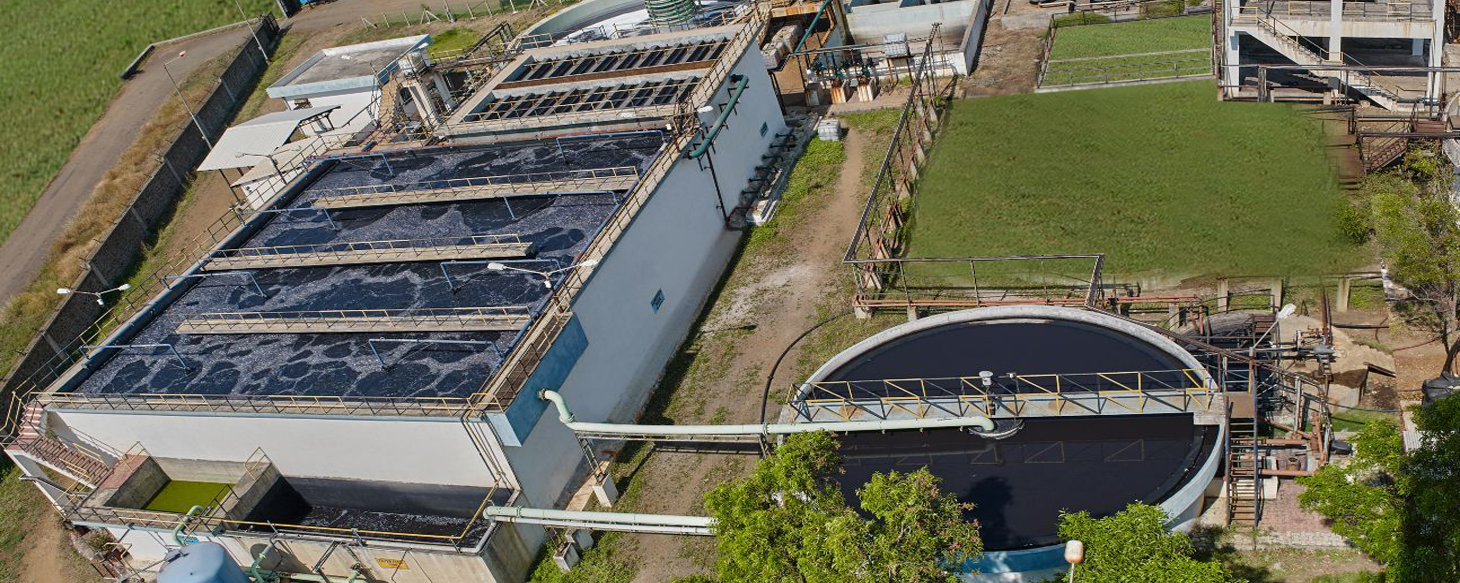
Complete guide to Pharmaceutical Effluent Treatment Plants. Learn the 4-stage ETP process, treatment technologies, regulatory compliance, and environmental benefits.
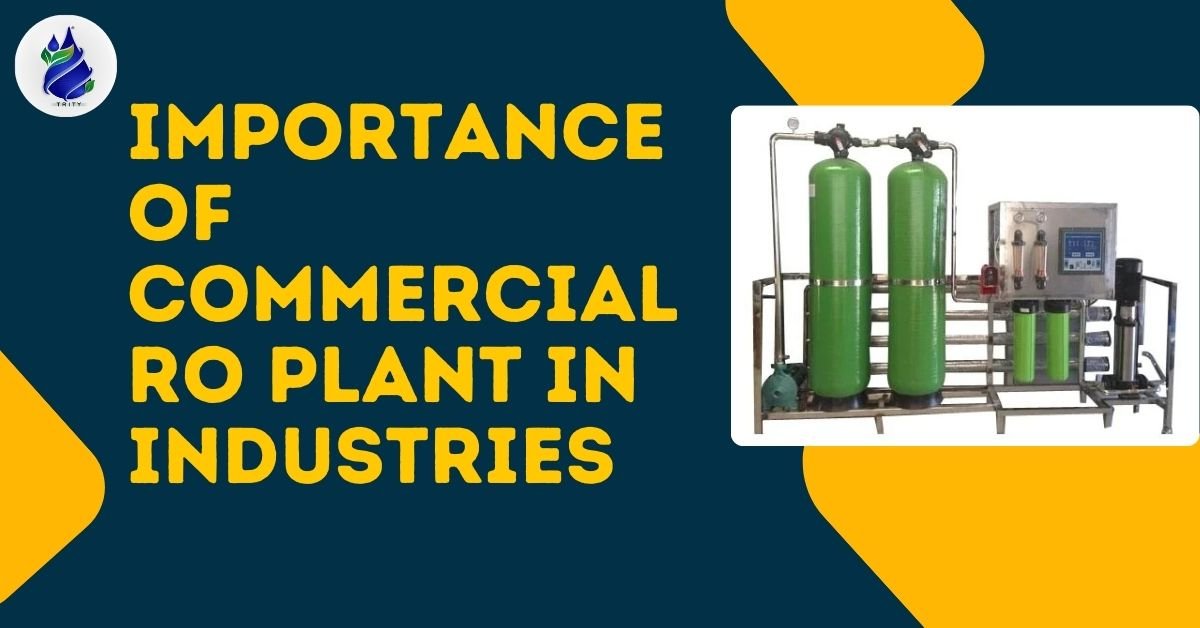
Discover the vital role of Commercial RO Plants in industries, enhancing water quality, reducing costs, and promoting sustainability for eco-friendly operations.




Discuss your requirements with our engineering team and get practical guidance for your project.