Introduction: The Machine That Decides Your Power Bill
Walk into the blower room of a sewage or effluent treatment plant and you are standing next to the biggest consumer of electricity on the site. Aeration commonly accounts for the largest share of a biological plant's energy use, and the blower is the machine that supplies it. Manufacturer guidance on effluent plants notes that the capital cost of a lobe blower may be under 5 percent of the total plant investment, while the blower's running cost can make up a very large share of the plant's energy bill.
That is the paradox of blower selection. The purchase looks small, so it is often treated as a commodity: pick a model with the required airflow, check the price, order. But a blower bought on price alone can cost many times its purchase price in electricity over its life, and a blower sized without thought can run at the wrong point on its curve, overheat or trip on pressure.
This guide explains how to select an air blower for STP and ETP aeration. It covers how to calculate airflow and pressure from the oxygen demand with a worked example, how lobe, screw, centrifugal and turbo blowers compare, how to control the blower to save energy and what to check on noise, installation and maintenance. It is written for plant engineers, consultants and buyers of STPs, ETPs and industrial aeration systems.
Start With Oxygen Demand, Airflow and Pressure
A blower is selected on two numbers: how much air it must deliver and the pressure it must deliver it at. Both come from the process, not from the catalogue.
From BOD Load to Airflow
Airflow follows from the oxygen requirement, the efficiency of the diffusers and the water depth. Take the same 200 KLD sewage plant used in our guide on air diffuser selection for STP and ETP: a BOD load of 50 kg per day, an oxygen requirement of about 75 kg per day (roughly 3.1 kg per hour) and a standard oxygen transfer requirement of about 7.1 kg per hour after correcting for temperature, alpha and dissolved oxygen. With fine bubble diffusers at 4 m submergence and about 22 percent standard efficiency, the airflow comes to about 115 Nm/h, or about 130 to 140 Nm/h with a design margin.
Express airflow in normal cubic metres per hour (Nm/h), not actual m/h, because the oxygen content depends on mass, not volume. Blower suppliers often quote at standard inlet conditions, so check the basis. Hot ambient air is less dense and carries less oxygen. A blower that delivers 140 Nm/h at 20 C may deliver noticeably less in a hot blower room at 40 C. Altitude has a similar effect.
Working Out the Required Pressure
Blower discharge pressure is the sum of several parts:
- Water depth above the diffusers: 4 m is about 0.39 bar
- Diffuser pressure loss: often a few hundredths of a bar when clean, rising as membranes age
- Pipework, valves and header losses: a few hundredths of a bar
- Intake filter and silencer losses
- A margin for fouling and clogging over time
For the example, these add up to roughly 0.5 bar gauge. Many designers add a further allowance of 0.05 to 0.1 bar for diffuser ageing so that the blower is not at its limit after a few years. Remember also that any extra water level, such as in a tank with high operating level, adds to the pressure.
As a rough indication of power, delivering about 140 Nm/h at 0.5 bar needs around 3 to 4 kW of shaft power for an efficient blower, so a motor of about 5.5 kW is typical. Always rely on the manufacturer's performance curve for the final number.
Blower Technologies Compared
Roots Lobe, Rotary Screw, Centrifugal and Turbo Blowers
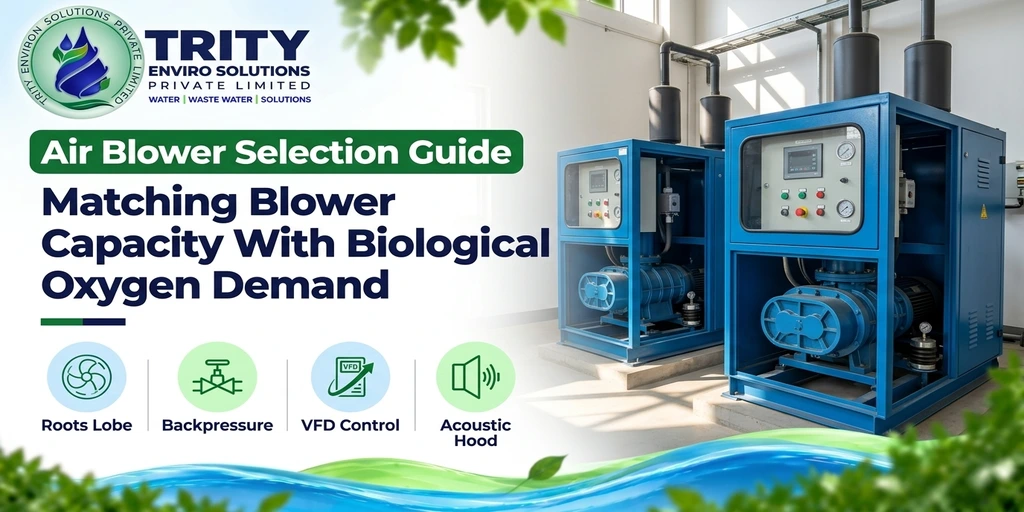
Roots (lobe) blowers are positive displacement machines that deliver nearly constant volume against varying pressure. They are simple, robust, widely available and cost-effective for the pressure range of most small and medium STPs, roughly up to about 0.7 bar. Their drawbacks are noise, pulsation, heat generation and efficiency that falls at higher pressure. They need silencers and acoustic hoods.
Rotary screw blowers use two meshing screws with internal compression. They are more efficient than lobe blowers at higher pressures, run smoother and quieter and handle a wider range of conditions. Manufacturer guidance recommends screw technology for pressures above about 0.5 bar. One manufacturer notes that a screw blower can operate from full capacity down to about 25 percent with very little change in its specific power, which makes it a good match for plants with variable demand.
Centrifugal and high speed turbo blowers use impellers rather than positive displacement. They are efficient and oil free, with low noise and vibration, and suit larger plants with steady demand and higher airflow. Their cost is higher and the turndown range narrower in some designs, and they depend on electronic controls.
Regenerative (side channel) blowers are used for small flows and low pressure, such as tiny package plants and some tank mixing duties. They are compact but not suited to the larger flows in most STPs.
Which Type Suits Which Plant
- Small STPs and ETPs, up to a few hundred KLD, with modest depth: Roots lobe blowers, duty and standby
- Plants with deeper tanks or higher back pressure: Rotary screw blowers
- Larger plants with high airflow and steady demand: Turbo or centrifugal blowers
- Plants with strongly varying load: Screw or lobe blowers with variable frequency drives and DO control
Choice also depends on service availability in your region, spare parts and the skills of the operator.
Control, Energy and Installation
VFD and Dissolved Oxygen Control
The biggest saving in aeration energy usually comes from supplying only the air the bacteria need. Dissolved oxygen (DO) controlled blowers read a DO probe in the aeration tank and adjust the blower speed with a variable frequency drive. During low load, such as at night, airflow falls, and at peak load it rises. Manufacturer guidance for effluent plants recommends DO feedback control because it supports the biology while cutting energy cost.
Positive displacement blowers deliver volume in proportion to speed, so a VFD gives a direct way of controlling airflow, though there are minimum speed limits for cooling and lubrication. Make sure the drive and the motor are suited to the blower, and that the minimum speed still gives enough air for mixing.
Without DO control, many plants run the blower at full speed all day and rely on blowing off excess air through a relief valve or running on and off by timer. Both waste energy and strain the equipment.
Standby, Noise, Intake and Room Design
Every plant should have a standby blower, usually 100 percent of the duty capacity, so that a failure does not stop aeration. Alternate duty and standby weekly to keep both in good order and share wear.
Noise is a real issue, especially in residential projects and hospitals. Blowers can produce high sound levels, so specify an acoustic enclosure, an intake silencer and a discharge silencer, and check the local noise limits for your zone and time of day. Mount blowers on anti-vibration pads and use flexible connectors.
The intake needs clean air. Fit a filter, protect it from rain and dust, and place it away from hot exhaust. A blower room needs ventilation, because blowers reject a lot of heat, and a hot room reduces both airflow and life. Install a pressure relief valve, a non-return valve on each discharge and pressure and temperature gauges. Pipe the discharge so that it drains condensate and does not allow water from the aeration tank to flow back to the blower.
Cost, Maintenance and Choosing a Supplier
Lifecycle Cost
Compare blowers on lifecycle cost over eight to ten years, not on purchase price. Include energy at your tariff, using the blower's power at the actual duty point and load profile, plus maintenance, spares such as belts, bearings, oil and filters, and downtime risk. A more efficient blower or one with better turndown often pays back its higher price within a couple of years, especially for plants that run all day.
Maintenance includes checking oil level and changing oil as recommended, replacing belts and filters, inspecting bearings and seals, cleaning the intake and checking the relief valve. Neglect shows up as overheating, noise or falling airflow. Skilled repair also matters: a good blower service partner can rebuild lobes, replace bearings and restore performance at far less cost than a new machine.
Questions to Ask Before You Order
- What airflow and pressure did you design for, and at what inlet conditions?
- What are the power consumption, efficiency and noise level at the duty point?
- What is the turndown range, and how does the blower work with a VFD and DO control?
- Is a standby blower, acoustic enclosure and silencer included?
- What is the lifecycle cost estimate and what spares are recommended?
- How quickly can your service engineer reach my site?
- What does the warranty and the maintenance contract cover?
Blower selection fits inside the larger plant design. Our sewage treatment plant and effluent treatment plant pages show how aeration, diffusers and blowers combine, our bubble air diffusers set the back pressure the blower must overcome, and an annual maintenance contract or operation and maintenance service keeps the aeration system in good order.
Industry Comparison / Operational Parameter Table
| Parameter / Stage |
Target Optimal Range |
Failure Impact / Risk |
Corrective Engineering Action |
| Blower discharge pressure |
Water depth plus losses, about 0.5 bar for a 4 m tank with margin |
Low airflow if too low a rating, overload if back pressure rises |
Check diffuser clogging, valves and relief setting |
| Airflow at duty point |
Design Nm/h with 10 to 20 percent margin, checked at site temperature |
Low DO if undersized, wasted power if oversized |
Resize blower, add VFD, correct for temperature and altitude |
| Dissolved oxygen in aeration tank |
About 1.5 to 3 mg/L, controlled by DO feedback |
Poor treatment or high power bills |
Install DO probe and VFD control, calibrate regularly |
| Blower room temperature and noise |
Ventilated room, acoustic enclosure, noise within local limits |
Overheating, reduced life, complaints |
Add ventilation, enclosure and silencers, check filter condition |
Why Choose Trity Enviro
Trity Environ Solutions is an ISO 9001:2015 certified and QCI-approved sewage and effluent treatment plant manufacturer and supplier in India, delivering robust, high-efficiency systems engineered for CPCB and SPCB regulatory compliance.
Every installation is supported by pan-India Annual Maintenance Contract and Operation and Maintenance services.
Free Engineering Consultation
Air Blower Selection for STP and ETP: How to Match Blower Capacity With Aeration Demand
Looking to upgrade, size, or install a high-performance treatment plant? Speak with our senior wastewater and water engineers today for expert sizing calculations, UKPCB/CPCB compliance support, and zero liquid discharge planning.
Request a Free Site Assessment