Liquid Waste Management Rules: What Bulk Users Must Do
Trity Enviro explains the draft Liquid Waste Management Rules: bulk user limits, EUR certificates, reuse targets and how to prepare your wastewater system.

 ISO 9001:2015 & QCI Approved
Ammonia passes through a basic STP untouched. Here is how nitrification and denitrification work, and how to size a plant that meets nitrogen limits.
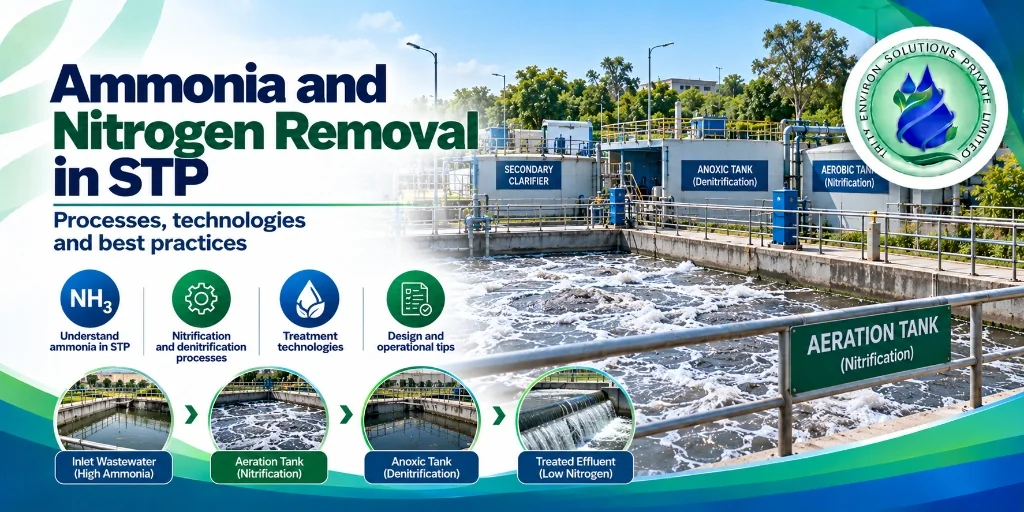
A sewage treatment plant can produce water that is clear, odourless and low in BOD, and still fail a sample because of nitrogen. Raw domestic sewage typically carries tens of milligrams per litre of nitrogen, mostly as ammonia and organic nitrogen from urine and food waste. A basic biological plant designed only for BOD removal does little about it. Some ammonia is taken up into new bacterial cells, but much of it passes through, or is converted to nitrate, which is no longer ammonia but still nitrogen.
Why does it matter? Ammonia is toxic to aquatic life, it consumes oxygen as it converts in a river or lake, and excess nitrogen feeds algae. Regulators have started to treat it seriously. The NGT order of April 2019 on STPs set limits that vary by category, and for the most stringent category it calls for BOD of about 10 mg/L, TSS of about 20 mg/L, COD of 50 mg/L and total nitrogen of 10 mg/L, with faecal coliform of 100 MPN per 100 mL (desirable). Many state boards write similar numbers into consent conditions for apartments, hospitals and hotels.
Removing nitrogen is a two step biological job. First, bacteria convert ammonia to nitrate in an oxygen-rich zone, a process called nitrification. Then, other bacteria convert nitrate to harmless nitrogen gas in an oxygen-free zone, a process called denitrification. A plant needs both, in the right proportions, with enough alkalinity, carbon and time.
This guide explains how the two steps work, what conditions they need and how to design for them, with a worked example for a 200 KLD plant. At Trity Enviro, we design MBBR, SBR and extended aeration plants for nitrogen limits, and the numbers below reflect common design practice. It is written for consultants, facility managers and plant operators.
Nitrogen enters sewage mostly as total Kjeldahl nitrogen (TKN): organic nitrogen plus ammonia. In domestic sewage, TKN is often around 35 to 50 mg/L, higher in hostels, hospitals and hotels where water use per person is low and the sewage is stronger. Industrial effluent from food, pharma and fertiliser units can carry much more.
In the plant, organic nitrogen is converted to ammonia, a small part is taken up into biomass and removed with waste sludge, and the rest must be nitrified and denitrified, or removed by other means. Nitrate and nitrite from other sources add to the total.
Standards come at three levels. Schedule VI general standards set ammonia and nitrogen limits for some discharge routes. The NGT's STP norms add limits for BOD, COD, TSS, nitrogen and coliforms by category, with total nitrogen of about 10 mg/L for the stricter category and somewhat higher for others. Your SPCB consent sets the value that binds you, and it may be stricter or looser than the NGT table. Check the exact numbers in your consent before designing.
Nitrification is carried out by slow growing bacteria that need plenty of oxygen and time. The reaction consumes about 4.57 kg of oxygen per kg of ammonia nitrogen oxidised, and it destroys about 7.14 kg of alkalinity (as CaCO3) per kg of ammonia nitrogen. For a sewage with 33 mg/L of ammonia to be nitrified, that is about 235 mg/L of alkalinity gone, so a sewage with low alkalinity may need chemical dosing to keep pH above about 7.
The bacteria grow slowly, so the plant must keep them: sludge age (solids retention time) must be long enough that they are not washed out. Many extended aeration plants run a sludge age of 15 to 30 days, which is well above the minimum for nitrification at warm temperatures. At lower temperatures, the required sludge age rises sharply, as described in our guide on STP performance in winter.
Denitrification happens when bacteria that normally breathe oxygen switch to breathing nitrate, in a zone with no free dissolved oxygen, called anoxic. They need a carbon source, which is the BOD in the incoming sewage. Each kg of nitrate nitrogen reduced returns about 2.86 kg of oxygen equivalent and about 3.57 kg of alkalinity, which recovers roughly half of what nitrification used. That is a bonus: good denitrification lowers aeration energy and stabilises pH.
For this to work, nitrate made in the aerobic tank must be brought back to the anoxic zone. A pump sends internal recycle of mixed liquor from the end of the aeration tank to the anoxic tank at a flow commonly two to four times the inflow. A rule of thumb is that a pre-anoxic zone needs about 4 to 5 kg of readily degradable BOD for each kg of nitrate nitrogen removed. When the sewage is weak, or when BOD has been consumed before the anoxic zone, an external carbon source such as molasses, methanol or acetate may be dosed.
Consider a 200 KLD STP with raw sewage TKN of 40 mg/L, BOD of 250 mg/L and alkalinity of 250 mg/L as CaCO3. The target is effluent total nitrogen of 10 mg/L or less.
These are design estimates. Actual plants vary with temperature, loading and hydraulics, and the final sizing should follow a proper design calculation. Our guide to air blower selection shows how the extra oxygen demand feeds into blower sizing, and air diffuser selection covers the layout, while how to calculate STP capacity covers the hydraulic side.
If your existing STP fails ammonia or nitrogen limits, the usual routes are, from least to most disruptive:
Cost depends on tank volumes, mixers, pumps, blowers and civil work, and a media retrofit is usually the least costly. Get a short monitoring programme first, with temperature, TKN, ammonia, nitrate, alkalinity, BOD and MLSS, so that the design fits the actual plant.
Trity Enviro's sewage treatment plant designs and upgrades can be built for nitrogen limits, and an annual maintenance contract keeps probes, pumps and blowers working.
| Parameter / Stage | Target Optimal Range | Failure Impact / Risk | Corrective Engineering Action |
|---|---|---|---|
| Aerobic zone DO | About 2 mg/L or higher | Nitrification slows, ammonia in outlet | Service blowers and diffusers, add DO control |
| Sludge age | Commonly 15 to 30 days for extended aeration, longer in cold weather | Loss of nitrifiers, high ammonia | Reduce wasting gradually, add MBBR media |
| Alkalinity and pH | pH about 7 or higher, residual alkalinity enough to buffer nitrification | pH drop, nitrification stalls | Dose bicarbonate or soda ash, maximise denitrification recovery |
| Internal recycle ratio | Often about 2 to 4 times inflow in pre-anoxic designs | High nitrate in outlet, total nitrogen exceedance | Adjust recycle pump, check mixing and anoxic volume |
Trity Environ Solutions is an ISO 9001:2015 certified and QCI-approved sewage treatment plant manufacturer and supplier in India, delivering robust, high-efficiency systems engineered for CPCB and SPCB regulatory compliance.
Every installation is supported by pan-India Annual Maintenance Contract and Operation and Maintenance services.
Trity Enviro explains the draft Liquid Waste Management Rules: bulk user limits, EUR certificates, reuse targets and how to prepare your wastewater system.
A practical guide to pharma ETP compliance in Andhra Pradesh: API residues, high COD, solvents, treatment stages, ZLD and how to plan an upgrade.
Looking for reliable water treatment plant manufacturers in Delhi/NCR? Compare the top 5 industrial RO, STP, and ETP companies on compliance, customization, and after-sales support.











Discuss your requirements with our engineering team and get practical guidance for your project.

