
From Raw Sewage to Pure Water: The Fascinating Process You Didn’t Know About
Discover the multi-step process of turning raw sewage into clean water through advanced filtration and disinfection, ensuring safe, reusable water for the future.

 ISO 9001:2015 & QCI Approved
Every STP makes sludge, and every tonne of water in it costs money to haul. Here is how filter presses, screw presses, belt presses, centrifuges and drying beds compare.
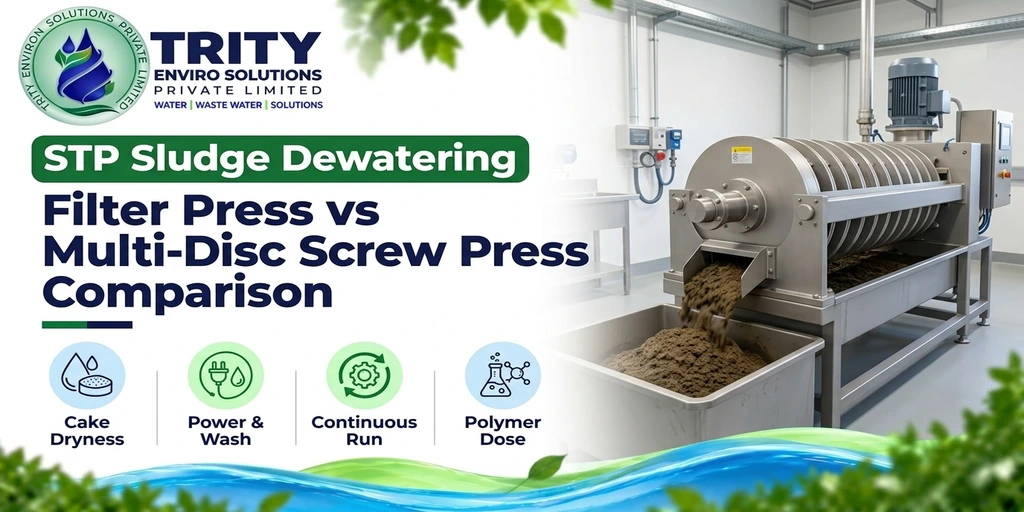
When a housing society, hotel, hospital or municipal body buys a sewage treatment plant, the conversation centres on the biological process, the tank sizes and the treated water quality. Sludge comes up last, often as an afterthought. Yet sludge is where many STP budgets go wrong.
A typical extended aeration STP removes sludge as a thin slurry, often 1 percent solids or less when drawn from the clarifier or digester. Ninety nine percent of what you pay a contractor to haul away is water. A dewatering machine squeezes much of that water out, reducing sludge volume to a fraction and turning a pumpable liquid into a stackable cake.
The choice of machine, though, is not obvious. Filter presses, screw presses, belt presses, decanter centrifuges and drying beds all dewater sludge, and each suits a different situation. Filter presses give the driest cake but run in batches. Screw presses are compact and run quietly and continuously on small flows. Belt presses handle larger flows at moderate dryness. Centrifuges are compact and automatic but cost more and use more power. Drying beds need almost no machinery but a lot of land and good weather.
This guide compares the options on the factors that matter, gives you a simple selection method and lists what to ask a supplier. It is written for STP operators, facility managers, consultants and procurement teams. For the detailed calculation of filter press capacity, see our companion article on filter press sizing.
Not all STP sludge is the same. Waste activated sludge from extended aeration is light and difficult to dewater. Digested sludge dewaters better. Sludge from MBBR and MBR plants varies with the process and the age of the biomass. Primary sludge from settling tanks is thicker and easier. Sludge with high fat, fine particles or low solids content needs stronger conditioning.
Most machines rely on a polymer to bind fine particles into flocs that release water. Dose depends on sludge type and machine, and it is a real operating cost. Filter presses can also use lime and ferric chloride for conditioning, although this adds inert solids. Always run jar tests on your sludge before choosing a polymer or a machine, and, for larger plants, request a trial with the proposed machine.
Cake dryness is the percentage of dry solids in the cake. A move from 15 to 25 percent dry solids does not just save 10 points. It reduces the mass of cake to be hauled by about 40 percent, since the same dry solids now sit in less water. Because disposal is usually charged by weight or by truck load, every point of dryness has a direct cash value. It also reduces odour and makes the cake easier to handle, store and send to composting, co-processing or landfill.
A plate and frame filter press holds sludge between plates covered in cloth and squeezes it under high pressure, commonly about 7 to 15 bar. It typically produces the driest cake of the common technologies, which for biological sludge is often in the range of 25 to 35 percent dry solids, and for chemical sludge can be higher. The trade-offs are batch operation, higher labour unless automated, cloth wear and more equipment such as feed pump and conditioning system. It suits sites where disposal cost is high and cake dryness is the priority. See our filter press for sludge dewatering.
A screw press uses a slowly rotating screw inside a cylindrical screen. As sludge moves along, the volume shrinks and water drains through the screen. It runs continuously, with low speed, low noise, low power, low wash water and little operator attention. It suits small and medium STPs, especially where the plant is unattended for long hours. Dryness depends on the sludge and polymer. In a published full scale comparison at a municipal plant of about 12,000 population equivalents in Finland, a screw press averaged about 18 percent cake solids, compared with about 20 to 23 percent for a decanter centrifuge on the same sludge. Results on your sludge will differ, so test first.
A belt filter press squeezes sludge between two moving belts. Published comparisons show cake dryness commonly from the mid-teens to about 30 percent, and about up to 22 percent for aerobically digested sludge in one manufacturer's data. Belt presses handle larger flows, but need careful polymer dosing, frequent washing and attention to belt tracking and condition.
A decanter centrifuge spins sludge at high speed so that solids are thrown to the wall and conveyed out. It is compact, enclosed and automatic and gives good dryness, but it uses more power, makes noise and costs more to buy and service. In the Finnish comparison, the decanter also used about 60 percent less polymer and a third of the wash water of the screw press for the same eight hour operation, a reminder that cake dryness is not the only cost. See our decanter centrifuge for larger plants.
Sand drying beds let sludge drain and evaporate in the sun. They need almost no energy, but they need large areas, dry weather and labour to remove dried sludge, and they can smell. They remain a sensible choice for small plants with land and a dry climate. Geotextile bags and tubes are another low-tech route for small volumes. Some plants add solar or thermal drying after dewatering to reduce the cake further.
Answer these questions in order:
1. How much sludge do you produce? Calculate dry solids per day, as in our filter press sizing guide.
2. How is the cake disposed of? If you pay by weight, dryness is worth money. If you can use the cake for composting, the acceptable moisture may differ.
3. How much space and labour do you have? Filter presses need floor space and loading time. Screw presses need little attention. Drying beds need land.
4. How much power and polymer can you afford? Centrifuges use more power, screw presses use less.
5. How reliable must the system be? Continuous machines suit unattended sites. Batch machines suit sites with an operator.
6. What is the sludge like? Fatty, fine or highly variable sludge may need a trial.
These matches are only a starting point. A sludge test and a lifecycle cost comparison give a better answer.
Dewatering works much better on thicker sludge. If you feed a machine with sludge at 0.5 percent solids, it handles a large volume of water and uses extra polymer. Thickening the sludge to about 2 to 4 percent solids before dewatering, for example by gravity settling in the sludge holding tank, often raises capacity and cuts polymer use. Decant the supernatant gently and return it to the plant.
Stabilising the sludge helps too. Aerobic digestion in the holding tank, with light air mixing for some days, reduces the volatile solids and the odour of waste activated sludge, and many plants find the cake easier to handle and less offensive afterwards. Fresh, unstabilised sludge dewaters poorly and smells. Whatever machine you choose, a well designed sludge holding and thickening tank is part of the system, not an optional extra.
Compare machines on cost per tonne of dry solids over five to ten years. Include capital cost, power, polymer or chemicals, wash water, cloth, screens or belts, labour, maintenance and the cost of hauling and disposing of the cake. A cheap machine producing wet cake may cost more in the long run than a dearer one that produces dry cake.
Do not forget the surrounding equipment: a sludge holding tank with mixing, a feed pump suited to the machine, a polymer preparation unit, a conveyor or bin for cake and a filtrate line back to the plant. Filtrate returns ammonia and solids to the head of the plant, and it should be part of the design load.
Our sludge dewatering systems and sewage treatment plant designs integrate these elements, and an annual maintenance contract keeps the dewatering unit running between inspections.
| Parameter / Stage | Target Optimal Range | Failure Impact / Risk | Corrective Engineering Action |
|---|---|---|---|
| Cake dryness, filter press | Often about 25 to 35 percent dry solids on biological sludge | Wet cake and high disposal cost if conditioning or pressure is poor | Optimise conditioning, check cloth and feed pressure |
| Cake dryness, screw press or belt press | Roughly mid-teens to low 20s percent, up to about 30 for some sludges | Heavy cake, high haulage cost | Adjust polymer dose, check screen or belt, improve sludge thickening |
| Polymer dose | Set by jar test and machine trial | Overdose wastes money and blinds screens, underdose leaves wet cake | Install dosing control, repeat jar tests regularly |
| Feed sludge concentration | Thickened before dewatering where possible | High volume, high polymer use, lower capacity | Add thickener or settling in the sludge holding tank |
Trity Environ Solutions is an ISO 9001:2015 certified and QCI-approved sludge dewatering system and sewage treatment plant manufacturer and supplier in India, delivering robust, high-efficiency systems engineered for CPCB and SPCB regulatory compliance.
Every installation is supported by pan-India Annual Maintenance Contract and Operation and Maintenance services.
Discover the multi-step process of turning raw sewage into clean water through advanced filtration and disinfection, ensuring safe, reusable water for the future.

A practical GPCB checklist for Gujarat industrial units covering ETP performance, effluent monitoring, self-monitoring reports, ZLD readiness and upgrades.

The real innovations shaping RO plant technology in 2026: graphene membranes, ultra-low-pressure RO, AI optimization, and next-gen ZLD integration.











Discuss your requirements with our engineering team and get practical guidance for your project.

