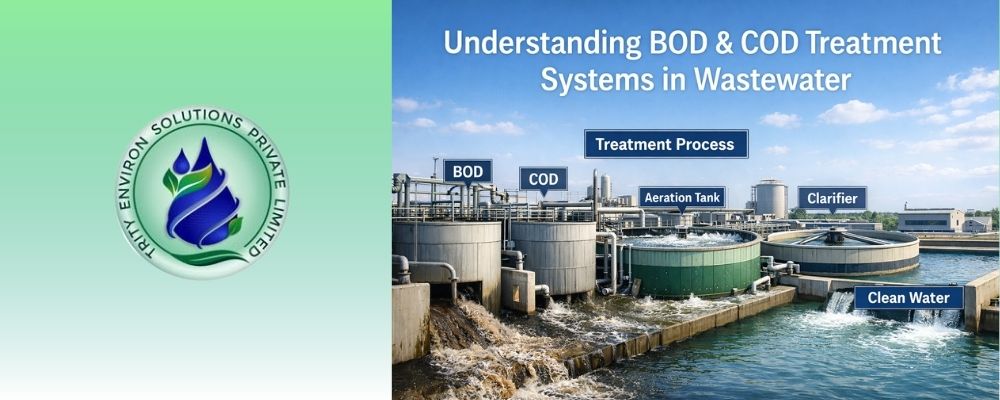
Understanding BOD & COD Treatment Systems in Wastewater Management
Learn how BOD and COD treatment systems work in wastewater treatment plants to reduce organic pollutants and improve treated water quality.

 ISO 9001:2015 & QCI Approved
What does a BOD of 30 mean, and why is COD always higher? Learn to read your effluent and sewage reports and spot problems early.
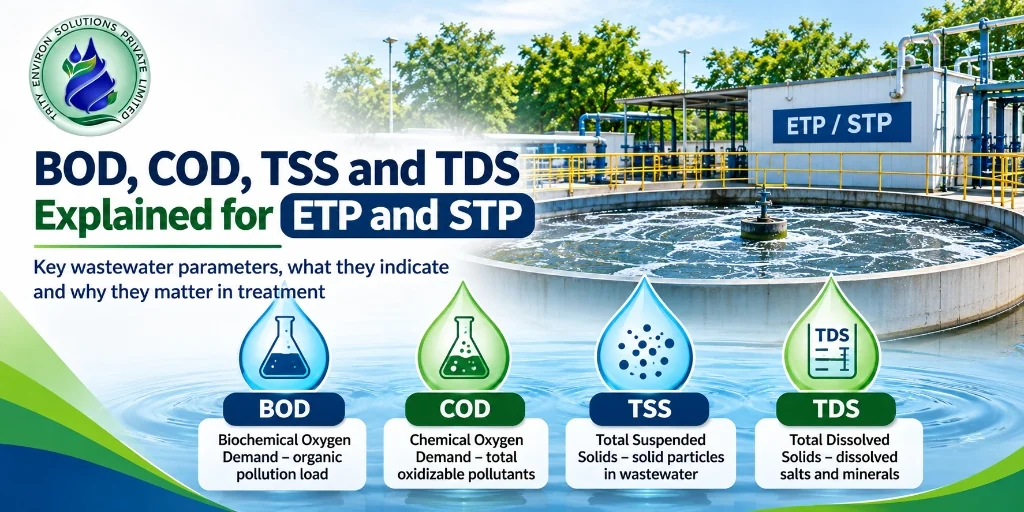
Every ETP and STP operator hears the same abbreviations: BOD, COD, TSS, TDS, pH. Consents list limits for them. Lab reports are full of them. Suppliers promise to meet them. But ask what each one really measures, why BOD is lower than COD, or why a plant can pass one test and fail another, and the answers often get fuzzy.
Understanding these parameters is not an academic exercise. It tells you which stage of your plant is working and which is failing. A high BOD with low TSS points to the biological stage. A high TSS with low BOD suggests a clarifier problem. A high TDS tells you biology and filtration will not fix it, and you need RO or evaporation. A low pH points to a dosing or inlet problem. Reading the report correctly saves days of guesswork.
This guide explains each key parameter in plain language: what it measures, how it is tested, what typical values look like, what limits the CPCB general standards set and what the numbers mean for plant design. It also shows how to read a typical report, with an example. It is written for plant operators, EHS officers, facility managers and anyone who receives a lab report from an ETP or STP. At Trity Enviro, we use these parameters daily in design and operation, and the guide reflects that practice.
BOD (biochemical oxygen demand) measures how much oxygen bacteria use to break down the biodegradable organic matter in water. It tells you how polluting a wastewater is to a river: the more oxygen the bacteria consume, the less is left for fish. It is reported in mg/L.
The test fills sealed bottles with a diluted sample, measures dissolved oxygen at the start, incubates the bottles in the dark and measures oxygen again after a fixed time. The difference is the BOD. The international standard is five days at 20 °C, called BOD₅. Indian effluent standards under the Environment (Protection) Rules usually specify BOD for three days at 27 °C, which is a different test with somewhat different results, so check which one your consent and your lab use.
BOD is slow, which is why plants do not use it for daily control. It is also sensitive to toxins: if the sample contains disinfectant or heavy metals, the bacteria in the bottle may be inhibited and BOD may read low.
COD (chemical oxygen demand) measures the oxygen needed to oxidise almost all organic matter, biodegradable or not, using a strong chemical oxidant, usually potassium dichromate under heat. It takes a few hours, not days, and gives a fast measure of total organic load.
COD is always equal to or higher than BOD, because the chemical oxidant attacks material that bacteria cannot break down in five days. The difference is the non-biodegradable part. COD also includes some inorganic matter that consumes oxidant, such as sulphides and ferrous iron, and chloride in salty samples can interfere.
The ratio of BOD to COD indicates how treatable the wastewater is by biology:
Typical raw domestic sewage has BOD of roughly 200 to 350 mg/L and COD of roughly 400 to 600 mg/L. Industrial effluent varies enormously, from a few hundred to tens of thousands of mg/L.
TSS (total suspended solids) is the weight of particles that can be filtered out, measured by filtering a sample through a fine filter and weighing what is retained after drying at about 105 °C. It includes silt, biological flocs, fibres and precipitates. High TSS in the outlet usually means solids are escaping the clarifier or filter, and it often carries BOD with it.
TDS (total dissolved solids) is the weight of everything that passes through the filter, such as salts, minerals and dissolved organics, measured after drying at about 180 °C or estimated from conductivity. It is not removed by settling, filtration or conventional biology. It needs RO, ion exchange or evaporation. TDS matters for reuse in cooling towers and boilers and for discharge to land or water bodies with salinity limits.
Turbidity is a measure of cloudiness, reported in NTU. It is a quick indicator of suspended matter and gives an immediate sense of clarifier and filter performance.
Knowing which type of solids you have decides the equipment. High TSS calls for screening, coagulation, settling, flotation or filtration. High TDS calls for membranes or thermal systems. A multi grade filter cannot reduce TDS, and an RO plant will foul quickly if TSS is high. Our guides on DM plant vs RO plant and UF plant selection before RO explain how to match treatment to solids.
Inside a biological plant, two readings guide the operator. MLSS (mixed liquor suspended solids) is the concentration of biomass in the aeration tank. SVI (sludge volume index) shows how well that sludge settles, calculated from a 30 minute settling test. These are plant control tools, not discharge parameters. Our guide to STP problems and solutions shows how to use them.
The CPCB general standards for discharge to inland surface water, from Schedule VI of the Environment (Protection) Rules, give these commonly quoted limits: pH 5.5 to 9.0, BOD (3 days, 27 °C) 30 mg/L, COD 250 mg/L, TSS 100 mg/L and oil and grease 10 mg/L. Other routes, such as discharge to sewers or on land, have different limits. STPs may fall under stricter NGT norms, with BOD of about 10 mg/L, TSS of about 20 mg/L and COD of 50 mg/L for the strictest category. Your consent sets the number that binds you.
Imagine an STP report: inlet BOD 280, COD 560, TSS 300, pH 7.4. Outlet BOD 22, COD 90, TSS 45, pH 7.2.
The pattern tells a story: the biology works, but solids carryover is the weak point. A tube settler, better sludge control or a tertiary filter would be the next step. Without reading the parameters together, you might simply add more air, which would not fix it.
Good data depends on good sampling. Take composite samples over the day for inlet and outlet where possible, because grab samples miss peaks. Use clean bottles, preserve and chill samples as the method requires and send them to an accredited laboratory promptly. Many tests, such as BOD, are time sensitive. Test pH, DO and turbidity on site daily, run TSS, MLSS and SVI weekly and send BOD, COD, TSS and any special parameters to the lab monthly, or as often as your consent requires. Keep every report. Our STP operation and maintenance checklist gives a schedule you can adapt.
Trity Enviro designs effluent treatment plants and sewage treatment plants against stated outlet parameters, and an annual maintenance contract includes regular testing and report review.
| Parameter / Stage | Target Optimal Range | Failure Impact / Risk | Corrective Engineering Action |
|---|---|---|---|
| BOD at outlet | At or below the consent limit, such as 30 mg/L for general standards or about 10 mg/L for strict STP norms | Failed sample, notice | Improve aeration, sludge control and load balancing |
| COD at outlet | At or below the consent limit, such as 250 mg/L general or 50 mg/L strict | High non-biodegradable load, failed sample | Add tertiary or oxidation stage, check industrial inputs |
| TSS at outlet | At or below limit, such as 100 mg/L general or about 20 mg/L strict | Solids carryover carrying BOD | Fix clarifier, add tube settlers or filters |
| TDS and pH | TDS suited to the reuse or discharge route, pH about 6.5 to 8.5 for treatment | Scaling in reuse, biological upset, corrosion | Add RO or evaporation for TDS, control pH with dosing |
Trity Environ Solutions is an ISO 9001:2015 certified and QCI-approved effluent treatment plant and sewage treatment plant manufacturer and supplier in India, delivering robust, high-efficiency systems engineered for CPCB and SPCB regulatory compliance.
Every installation is supported by pan-India Annual Maintenance Contract and Operation and Maintenance services.
Learn how BOD and COD treatment systems work in wastewater treatment plants to reduce organic pollutants and improve treated water quality.
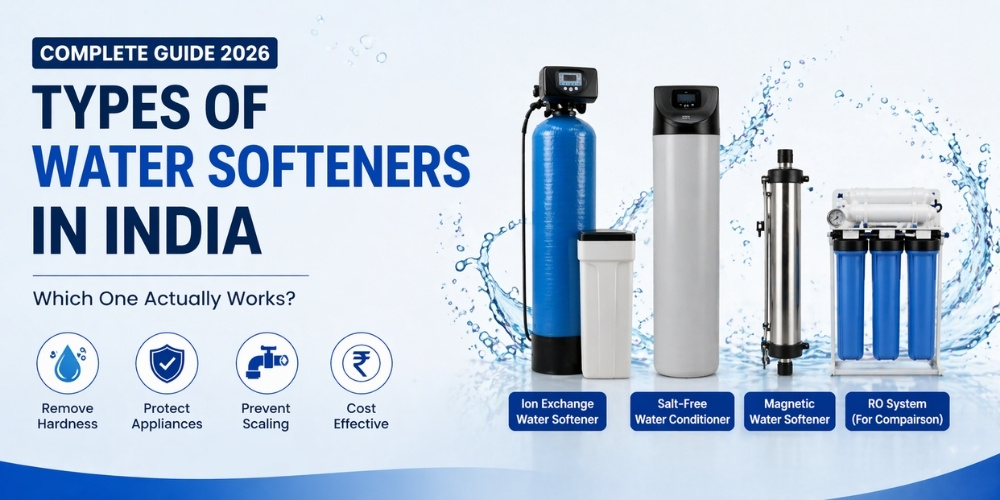
Explore all types of water softeners in India — ion exchange, salt-free, magnetic & more. Find the right hard water solution for your home or industry in 2026.
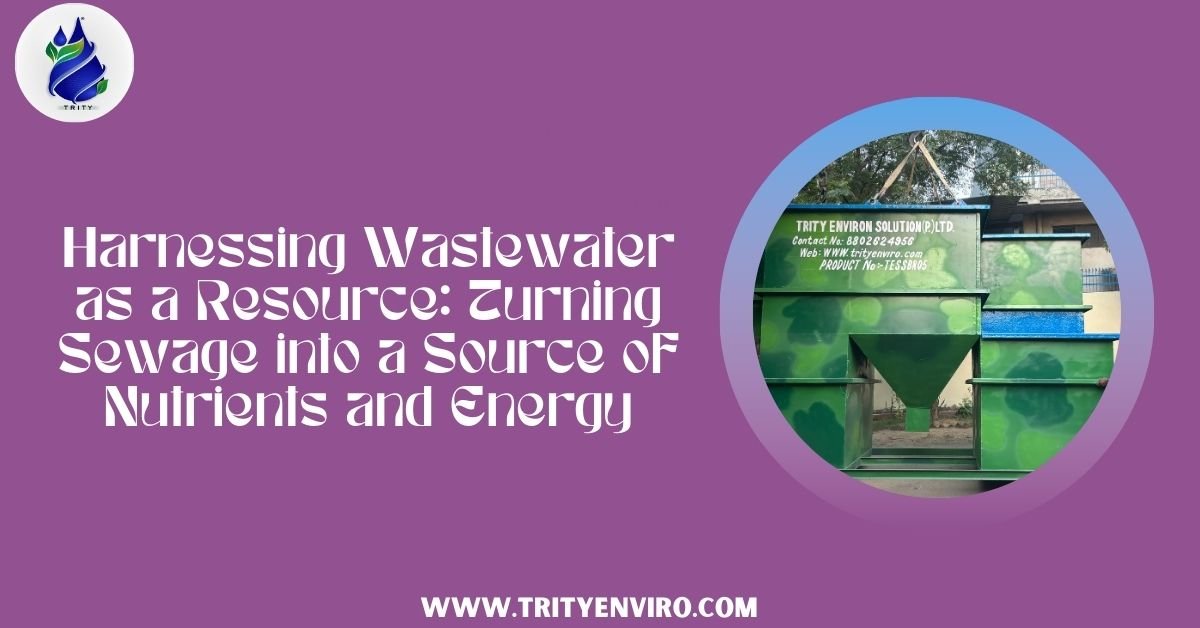
Explore how advanced wastewater treatment turns sewage into a resource, providing nutrients for agriculture and renewable energy while supporting a sustainable future.











Discuss your requirements with our engineering team and get practical guidance for your project.

