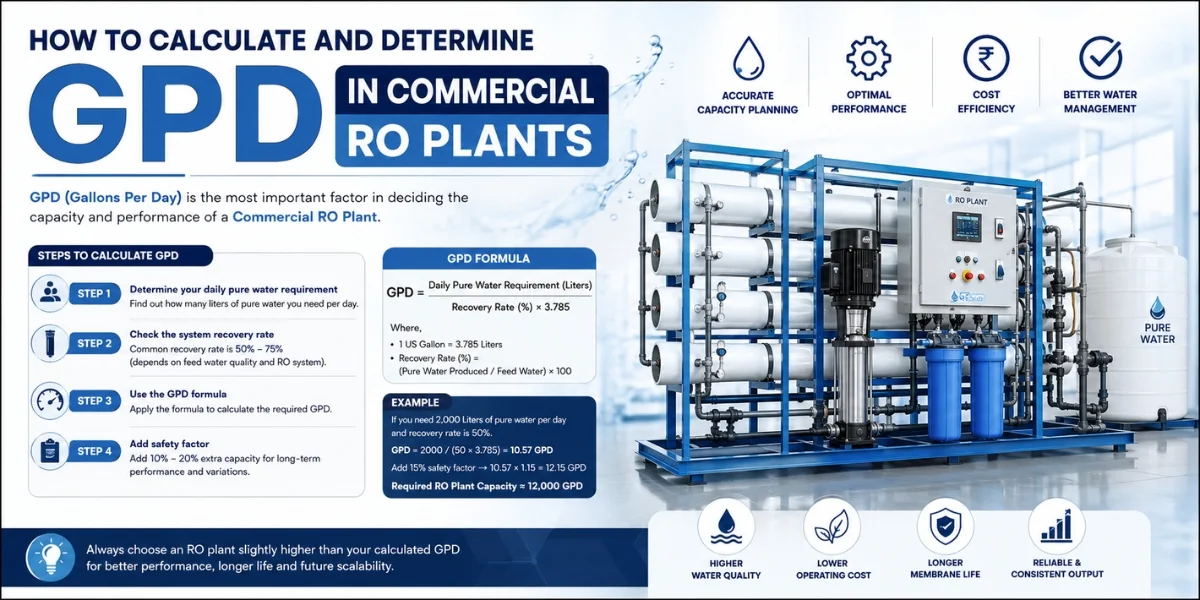
How to Calculate GPD in Commercial RO Plants: Formulas, Examples & Sizing Guide
Learn how to calculate GPD in commercial RO plants with step-by-step formulas, worked examples, and tips to size your RO system correctly.

 ISO 9001:2015 & QCI Approved
Electronics manufacturing is growing fast in India, and so is the need for water recycling and zero liquid discharge. Here is how to design the treatment train.
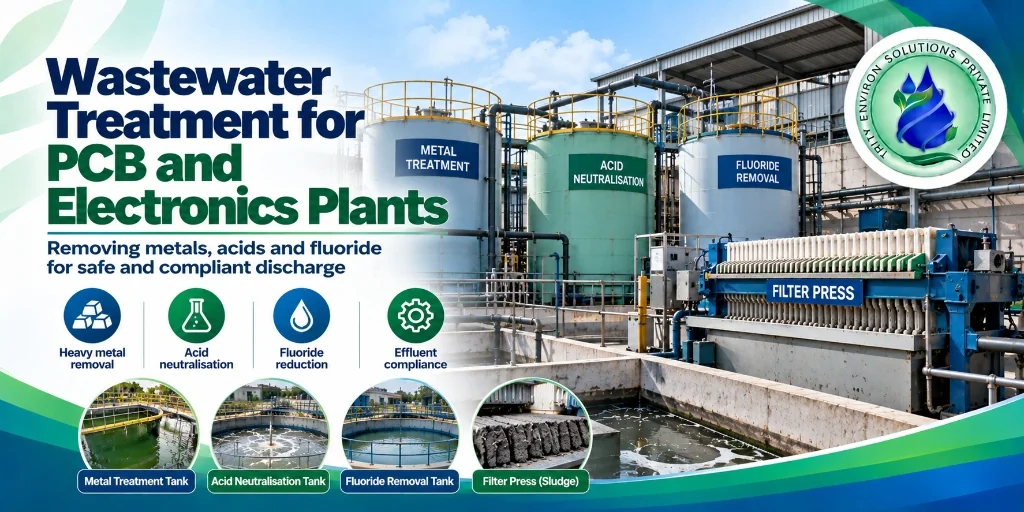
Chips, circuit boards and solar cells look dry and clean, but they are born in water. A PCB shop etches copper, plates metals and rinses boards through dozens of baths. A semiconductor fab needs vast volumes of ultrapure water. A solar cell line washes, etches and cleans wafers with acids and alkalis. After each step, the rinse water carries away traces of whatever the process used.
India is expanding all three industries quickly. The country's first semiconductor fab, in Gujarat, came online in March 2026 with an integrated system that produces ultrapure water and recycles wastewater to zero liquid discharge. In October 2026, a global water company announced five new design-build contracts in India across semiconductor, PCB and solar manufacturing, and its India head noted that water availability and ZLD compliance are becoming as strategic as power and land in deciding where new capacity gets built.
For an Indian manufacturer, the message is clear. Wastewater treatment is not an afterthought to be fitted after the production line. It influences site selection, consent, cost and reliability. A plant that cannot treat and recycle its water cannot run, and a plant that treats it badly faces closure directions.
This guide explains the main wastewater streams in PCB and electronics plants, how to segregate and treat them, how reuse and ZLD fit in and what to ask a supplier. At Trity Enviro, we design effluent treatment plants for such industries, and the guide draws on that experience. It is written for plant heads, EHS managers and project teams in PCB, electronics assembly, semiconductor and solar manufacturing.
A printed circuit board plant generates several different wastewaters, and mixing them is the commonest design mistake.
Semiconductor fabs and solar cell lines add other streams: fluoride from hydrofluoric acid etching and cleaning, silica and fine particles from chemical mechanical planarisation and wafer sawing, ammonia, peroxide and strong acids and alkalis, organic solvents and heavy metals in small quantities. Wastewater from a fab is variable and often silica rich, which complicates recycling. A reported fab project in Gujarat used selective contaminant extraction, ultrafiltration and semi-batch RO to recycle such water at high recovery.
Because every plant has a different process, start with a stream by stream survey: flow, pH, metals, fluoride, COD, TDS, ammonia and special pollutants, over several production cycles.
Segregation is the first rule. Keep concentrated spent baths away from rinse water, keep chelated streams away from simple metal streams and keep fluoride away from the rest. Segregation lets each treatment be simple and efficient.
For simple metal streams, the standard method is hydroxide precipitation with lime or caustic soda at the pH where each metal is least soluble, followed by coagulation, flocculation and settling or filtration. Copper and nickel have different optimum pH values, so multi-stage precipitation can improve removal. Sulphide precipitation reaches lower residual metal levels, though it needs careful handling.
For chelated copper, ordinary precipitation fails because the chelant keeps the metal dissolved. Options include breaking the complex with ferrous sulphate or a strong precipitant, advanced oxidation, or specialised chelate-breaking chemicals, followed by precipitation. Ion exchange resins can also capture metals and allow copper recovery. Where the value is high, electrowinning from concentrated baths recovers metal and cuts sludge.
Acidic and alkaline rinse water goes to a neutralisation system with pH control in two stages. Fluoride from etching and cleaning is usually removed by calcium precipitation, dosing lime or calcium chloride to form calcium fluoride, with coagulant and polymer to settle fine particles. Very low fluoride limits may need a second stage with aluminium salts or adsorption.
Ammonia needs its own approach, such as air stripping, ion exchange or biological nitrification where flows are large and nitrogen is a consent parameter. Solvent and organic streams may need oxidation, carbon adsorption or segregation for disposal.
After precipitation and settling, polishing filtration through sand and carbon removes fine solids, and ion exchange can act as a final metal polisher. For recycling, ultrafiltration and reverse osmosis produce permeate suitable for process rinses, cooling or ultrapure water make-up after further treatment. Our pages on ultrafiltration, industrial RO plants and DM plants describe these stages, and our guide on DM plant vs RO plant helps with polishing choices.
Metal bearing sludge from precipitation needs dewatering and correct disposal. A filter press for sludge dewatering reduces its volume, and the sludge is usually managed as hazardous waste, as discussed in our guide to ETP sludge disposal.
Whether you need ZLD depends on your location, consent and the available discharge route. The head of one water company active in India has said that ZLD rules leave no room for shortcuts, and fabs and solar plants in water stressed regions are often designed for zero discharge from the start. If your site has no sewer or surface water to discharge to, or if your consent requires ZLD, plan for it in the first design.
A ZLD train for electronics usually combines segregated pre-treatment, UF, multi-stage RO to maximise recovery, and evaporation or crystallisation for the final reject. The cost is high, and it rises with the amount of RO reject, so maximise recovery and reuse before evaporation. Our article on ZLD plant cost, technology and mandates explains the economics, and our zero liquid discharge page covers the systems.
Start with the water balance. Ultrapure water production creates its own reject, and the rinse steps use large volumes at low contamination. Opportunities include cascading rinses, recycling the last rinse to earlier stages, using RO permeate for cooling tower make-up, and returning treated reject to non-critical uses. A well-built balance often shows that fresh water demand can fall sharply with the right segregation. Our guides on water recycling for cooling towers and process water and industrial water audits show how.
Pre-treatment matters as much as the main plant. Equalization, neutralisation and cooling protect the downstream stages, as covered in our article on industrial wastewater pre-treatment before the ETP.
Cost depends on the number of streams, metal and fluoride loads, RO and ZLD scope, automation and materials. Acids and fluorides demand corrosion resistant materials such as FRP, HDPE, PVDF or lined steel in the right places. Instrumentation, including pH, ORP and conductivity control, matters because dosing errors waste chemicals and fail samples. Plan for sludge handling, laboratory support and operator training.
Think about modular growth. Electronics plants often expand in phases, so design the ETP and recycling plant to add capacity as production lines are added. Reserve space and utilities for later RO and evaporation stages. Check consent requirements, including online monitoring, before finalising the design, and see our guide on CTE and CTO for ETP and STP.
Trity Enviro's effluent treatment plant and physico-chemical ETP designs cover metal and acid bearing streams, with an annual maintenance contract for long-term performance.
Before the first line is installed, agree these points with your process team and your treatment partner. List every wet process step and its chemicals, with expected flows and concentrations. Decide which streams will be segregated at source and provide separate drains and tanks for them. Reserve space for neutralisation, precipitation, filtration, RO and sludge handling, with room to expand. Select materials of construction for acid and fluoride service. Plan chemical storage with secondary containment and safe delivery access. Specify instrumentation for pH, ORP, conductivity and flow, with data logging. Confirm the discharge or ZLD route in your consent, and define the water recycling target. Agree who operates the plant, how operators are trained and how spares and service are arranged. Trity Enviro engineers can review the layout with your team at the planning stage, which is far cheaper than changing tanks and drains after construction. A short design review of this kind often removes weeks from commissioning and prevents the most common mix-up, which is sending incompatible streams to the same tank.
| Parameter / Stage | Target Optimal Range | Failure Impact / Risk | Corrective Engineering Action |
|---|---|---|---|
| Stream segregation | Spent baths, chelated, fluoride and rinse streams kept separate | Failed precipitation, high sludge, higher chemical cost | Survey drains, add dedicated lines and tanks |
| Metal precipitation pH | Set per metal, controlled by feedback dosing | High residual copper or nickel, failed samples | Two-stage pH control, polishing filtration or ion exchange |
| Chelated copper treatment | Complex broken before precipitation | Copper passes through normal treatment | Dose chelate breaker or oxidation, then precipitate and filter |
| Fluoride removal | Within consent limit, with calcium dosing and settling | Fluoride exceedance, scaling, sludge carryover | Optimise dosing, add second stage, check settling |
Trity Environ Solutions is an ISO 9001:2015 certified and QCI-approved effluent treatment plant manufacturer and supplier in India, delivering robust, high-efficiency systems engineered for CPCB and SPCB regulatory compliance.
Every installation is supported by pan-India Annual Maintenance Contract and Operation and Maintenance services.
Learn how to calculate GPD in commercial RO plants with step-by-step formulas, worked examples, and tips to size your RO system correctly.
Learn about solid waste management types, segregation, hazardous waste disposal, CPCB compliance, and industrial waste treatment. Expert guide by Trity Enviro Solutions.
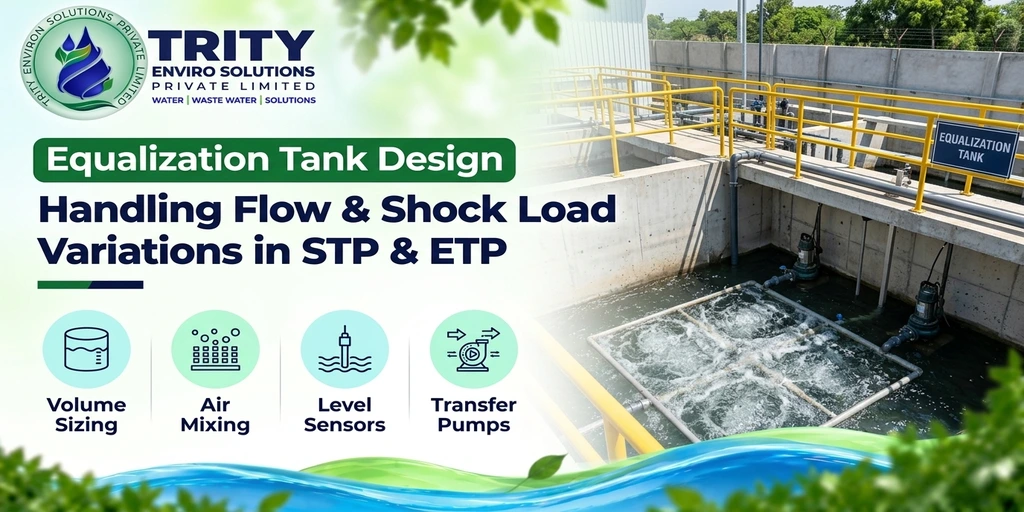
Design an equalization tank for your STP or ETP: size volume from flow variation, plan mixing and aeration, pH control and layout, with a worked example.











Discuss your requirements with our engineering team and get practical guidance for your project.

