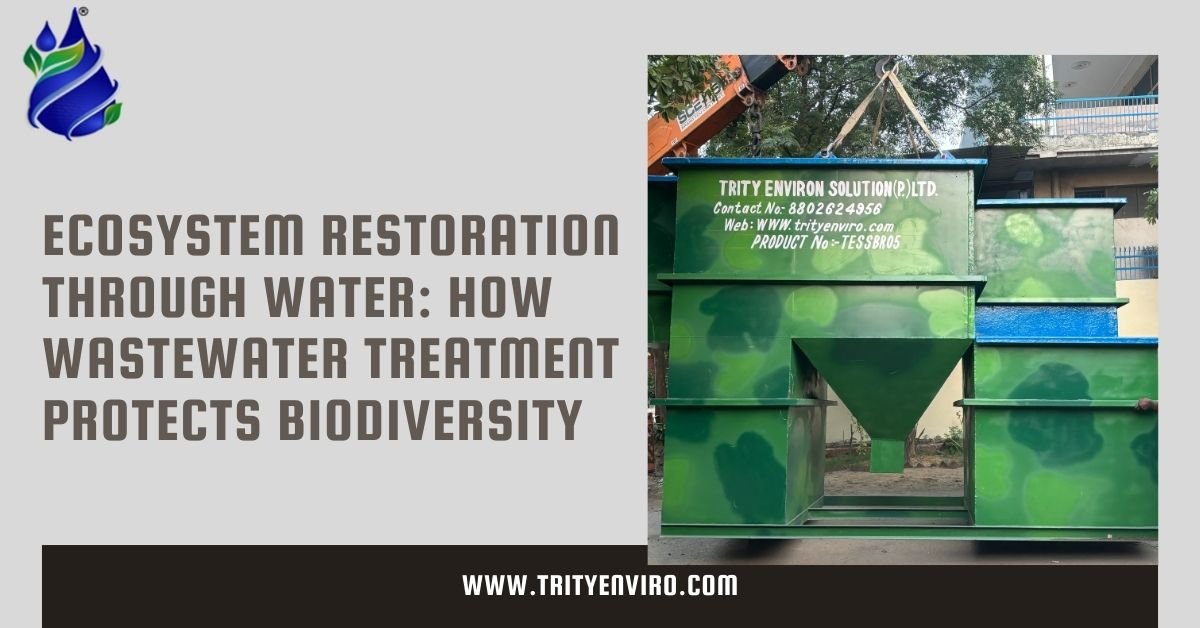
Ecosystem Restoration Through Water: How Wastewater Treatment Protects Biodiversity
Discover how wastewater treatment supports ecosystem restoration, protects biodiversity, and promotes sustainable practices for cleaner water and healthier habitats.

 ISO 9001:2015 & QCI Approved
Start with the water balance, then pick the treatment. These steps help you design a recycling system that saves water without upsetting your process.
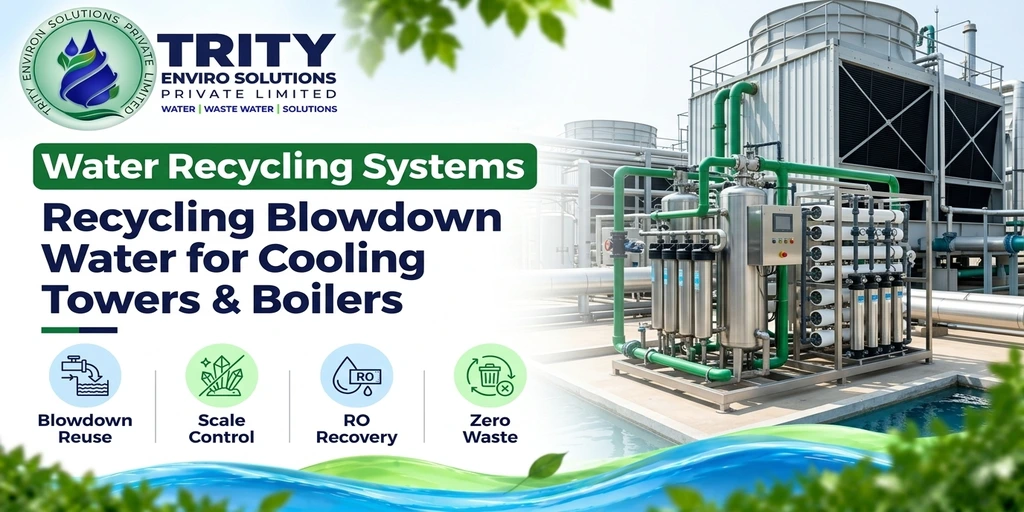
On many industrial sites, the cooling tower is the largest single user of fresh water. A tower serving a process plant, a power unit or a large air conditioning system loses water continuously by evaporation, by drift and by blowdown, and every litre lost has to be replaced by make-up water. In a water stressed area where borewell levels are falling or tanker water is costly, this is a serious expense and a risk to production.
Meanwhile, the same site generates wastewater streams that could often replace some of that make-up: treated sewage from the STP, treated effluent from the ETP, RO reject, condensate, rinse water and the blowdown itself. Putting these streams to work is the core idea of a water recycling system.
Design is not just about adding an RO plant. The right system depends on a water balance, on the quality each user needs, on the quality each source offers and on how far you can push the cooling tower's cycles of concentration. Get these right and the plant cuts freshwater use and effluent discharge together. Get them wrong, and you risk scaling, corrosion, biofouling and a system that is switched off after a few months.
This guide walks through the design in order: the water balance, the cooling tower arithmetic with a worked example, the treatment train, the process water loops, the economics and the questions to ask a supplier. It is written for plant heads, utility engineers and project teams in industry, hospitality and large buildings.
Draw a simple diagram of the whole site. On one side list every water source: municipal supply, borewell, tanker, rainwater. In the middle list every use: cooling towers, boilers, process, washing, gardening, flushing, canteen. On the other side list every outflow: evaporation, drift, blowdown, boiler blowdown, process effluent, sewage, product and sludge. Measure what you can with flow meters, and estimate the rest from equipment data.
The balance shows where water goes and where the largest savings lie. It also reveals streams that are suitable for reuse and uses that do not need fresh water. A balance that adds up within 10 percent is good enough to start design.
For each use, note the quality needed, and for each source, the quality available. Test TDS, hardness, alkalinity, silica, chloride, ammonia, COD, turbidity and bacteria. Then match: put the highest quality sources, such as RO permeate, on the most demanding uses, such as boilers, and put lower quality streams, such as filtered treated sewage, on tolerant uses, such as gardening, flushing and sometimes cooling make-up. Do not treat water to a higher standard than its use needs, because every extra stage adds cost without adding value.
Three losses define a cooling tower:
Cycles of concentration (COC) is the ratio of dissolved solids in the circulating water to that in the make-up. Without drift, blowdown is B = E (COC 1), and make-up is M = E + B + D. Raising COC reduces blowdown and make-up, but it also increases the concentration of everything in the tower, so it is limited by scaling and corrosion limits such as calcium hardness, silica and chloride. Silica often sets the limit.
A tower circulates 500 m/h with a 5 C temperature range, and drift of 0.02 percent.
At 2 cycles: blowdown is 4.5 1 = 4.5 m/h, minus drift, so about 4.4 m/h, and make-up is about 9.0 m/h.
At 4 cycles: blowdown is 4.5 3 = 1.5 m/h, minus drift, so about 1.4 m/h, and make-up is about 6.0 m/h.
Moving from 2 to 4 cycles cuts make-up by about 3 m/h, which is 33 percent, and cuts blowdown by about 70 percent. Over 8,000 operating hours, that is 24,000 m of water a year saved from one tower. The catch is that the make-up water must be good enough to run at 4 cycles without scaling. If your fresh water has 250 mg/L of calcium hardness as CaCO, four cycles pushes the tower to around 1,000 mg/L, which usually exceeds what scale inhibitors can handle. Softened or RO treated make-up, or side-stream treatment, allows higher cycles.
There are two places to treat water for a cooling tower: before it enters (make-up) and after it leaves (blowdown). Often both are used.
Make-up treatment improves the water going in. A water softener removes hardness, and RO reduces hardness, silica and TDS together. Treated sewage or ETP effluent used as make-up needs tertiary treatment first, including filtration, ultrafiltration and often RO, to remove ammonia, organics, silica and suspended solids. Published data warns that ammonia can attack copper alloys and feed bacteria, and that organic matter, phosphate and nitrate in reuse water raise biological and corrosion risks, so test for them. Our guide on tertiary water treatment for industrial reuse explains these stages.
Blowdown treatment recovers water from the stream that would otherwise go to drain. A typical train uses softening or antiscalant dosing, filtration or UF and then RO. The permeate returns to the tower as make-up, and the reject goes to disposal or to a zero liquid discharge system. Studies on cooling tower blowdown show that RO can remove most of the dissolved solids, and that higher cycles of concentration reduce the volume of RO reject. Silica commonly limits the cycles and the RO recovery, so manage it with care.
Side-stream filtration of 1 to 5 percent of the circulating flow keeps suspended solids low. Add a biocide programme, corrosion and scale inhibitors, a conductivity controller that triggers blowdown automatically and regular monitoring of pH, conductivity and microbial counts.
Process water reuse starts at the source. Segregate clean streams, such as final rinse water, condensate and RO reject, from dirty ones. Rinse water from multi-stage washing can be cascaded: the cleanest water from the last rinse goes to the earlier rinse, instead of fresh water for each stage. Condensate can return to the boiler. RO reject from a drinking water plant can serve flushing or cooling make-up if quality allows.
For treated sewage or effluent, send it through the appropriate tertiary stages for the use, as set out in the water balance. A wastewater recycling system or an RO water recycling plant polishes it to the standard. Where several sources and uses exist, provide separate storage tanks by quality grade, with clear pipe labelling and no cross connections to drinking water.
Remember the sequence: the STP or ETP must be stable first. Our articles on industrial wastewater pre-treatment before the ETP and ETP basics show how to get the front end right.
Estimate the value of the water saved by multiplying the volume by your true cost of water, which includes the supply charge, power for pumping, chemicals, tanker cost and the cost of treating and discharging the effluent you avoid. Then estimate the cost of the recycling system: capital cost, plus running cost of power, chemicals, membranes, cartridges, labour, reject handling and maintenance.
In the cooling tower example, 24,000 m a year saved at a cost of water of Rs 60 per m is worth Rs 14.4 lakh a year, while avoided effluent treatment adds to the saving. This is an illustration only: use your own water cost. Compare the annual saving with the annualised cost of the system. Payback can be short where fresh water is expensive or scarce and much longer where water is cheap, so calculate it for your own site.
Also consider risk. Reuse water that is poorly treated can cause scaling or corrosion that costs far more than the water saved. Include a margin of safety, a bypass to fresh water and monitoring of the cooling system after commissioning.
Our wastewater treatment plant range and project execution service cover design, supply and commissioning, and an annual maintenance contract keeps membranes, filters and controls performing.
| Parameter / Stage | Target Optimal Range | Failure Impact / Risk | Corrective Engineering Action |
|---|---|---|---|
| Cycles of concentration | As high as hardness, silica and chloride allow, often 3 to 6 with treated make-up | Scaling or corrosion if too high, water waste if too low | Treat make-up, control blowdown by conductivity, test regularly |
| Make-up water quality | Low hardness and silica, ammonia controlled when using reuse water | Scale, copper alloy attack, biofouling | Add softening, UF or RO, adjust chemical programme |
| Evaporation loss | About 1 percent of circulation per 5.5 C range | Wrong make-up estimate and poor water balance | Measure flow and range, correct design assumptions |
| RO recovery on blowdown | Set by silica and scaling limits | Membrane scaling, frequent cleaning, short life | Add antiscalant or softening, lower recovery, monitor silica |
Trity Environ Solutions is an ISO 9001:2015 certified and QCI-approved wastewater recycling system and water treatment plant manufacturer and supplier in India, delivering robust, high-efficiency systems engineered for CPCB and SPCB regulatory compliance.
Every installation is supported by pan-India Annual Maintenance Contract and Operation and Maintenance services.
Discover how wastewater treatment supports ecosystem restoration, protects biodiversity, and promotes sustainable practices for cleaner water and healthier habitats.
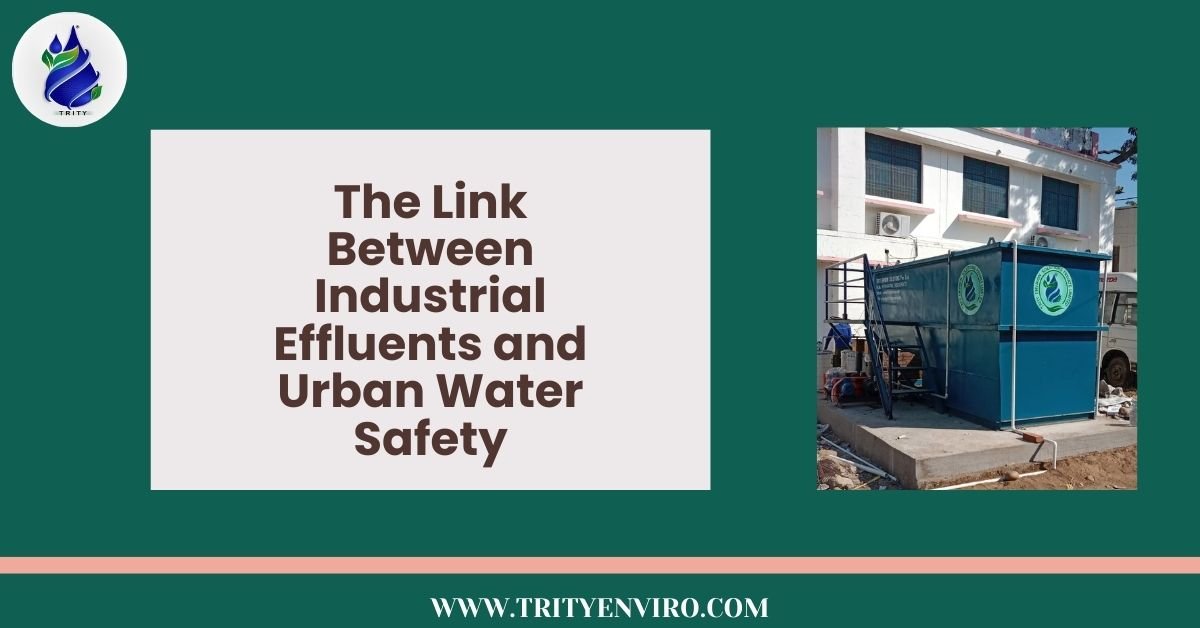
Industrial effluents harm urban water safety, with pollutants affecting health. Learn about wastewater treatment, regulations, and sustainable solutions for cleaner water.
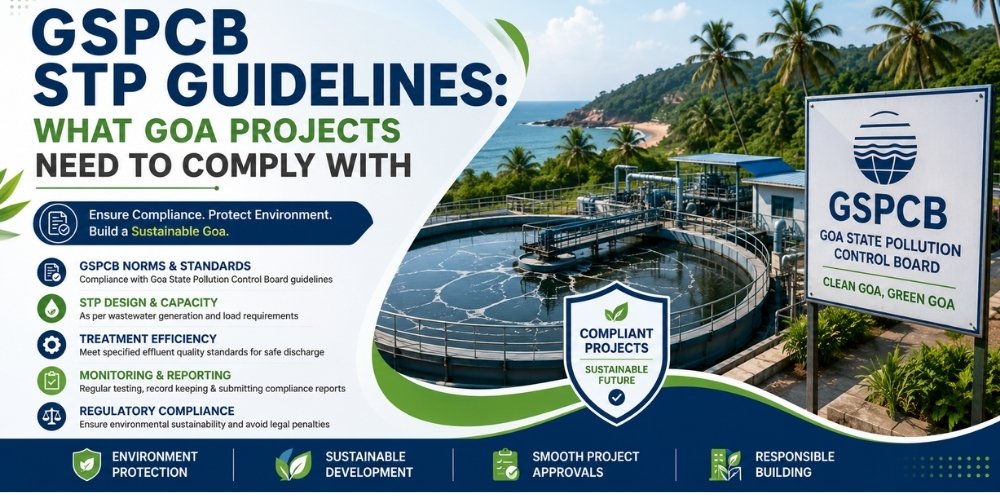
A guide to GSPCB's sewage treatment plant requirements in Goa, covering current discharge norms, CRZ considerations, and compliance steps for coastal projects.











Discuss your requirements with our engineering team and get practical guidance for your project.

