
How Do ETPs and STPs Help Prevent Waterborne Disease Outbreaks?
Real data on how ETPs and STPs prevent waterborne disease in India, including a study linking sewage treatment to lower infant mortality.

 ISO 9001:2015 & QCI Approved
Before you budget for ZLD, find out if you need it and what it really involves. A worked mass balance shows how much water and salt move through each stage.
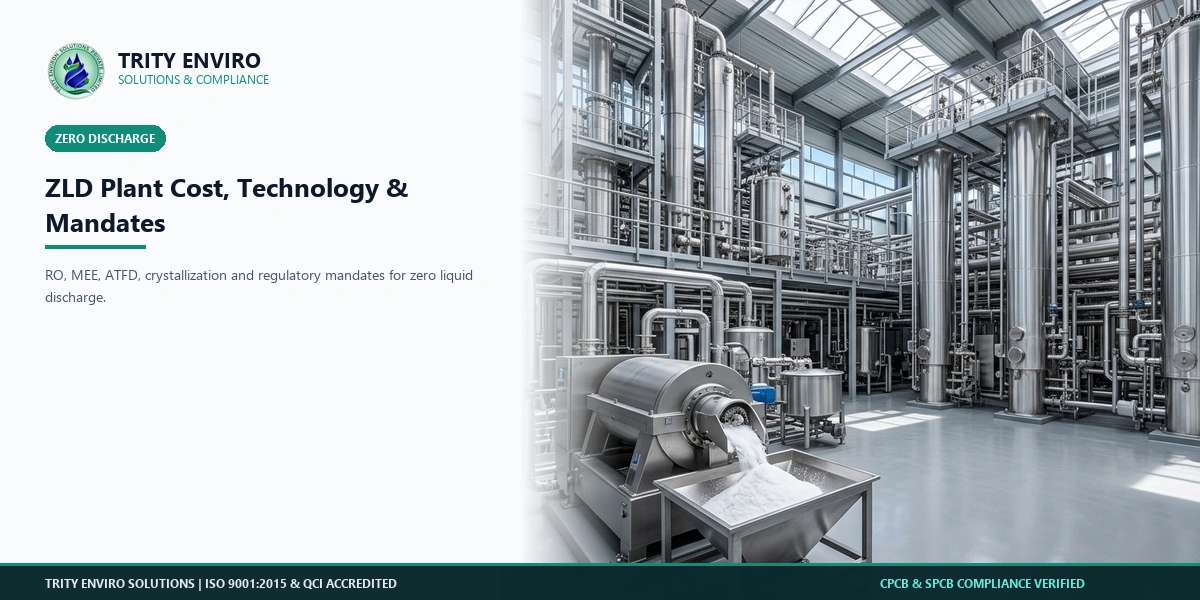
Most effluent treatment plants send treated water to a drain, a sewer, a river or the land. Zero liquid discharge (ZLD) takes a different view. It treats the wastewater so thoroughly that nothing liquid leaves the site. Water is recovered and reused, and what remains is a small quantity of solid salt and sludge that goes to authorised disposal.
The idea is simple, but the last stage is expensive. Removing the final fraction of water from a salty brine takes heat or electricity, special metals that resist corrosion and skilled operators. An academic review of ZLD in India's textile and tannery clusters notes that the evaporators and crystallisers needed to capture the last portion of the liquid are estimated to roughly double the cost of a system that stops at reverse osmosis. That is why ZLD should be chosen deliberately, not by default.
For some industries, ZLD is a legal condition. India's pollution control authorities introduced ZLD guidelines in 2015 for four sectors, textile processing, tanneries, distilleries and pulp and paper, and courts and boards have enforced ZLD in specific clusters such as the dyeing units of Tirupur in Tamil Nadu. For others, it is a voluntary choice driven by water scarcity or by a customer's sustainability demands. A CPCB status report to the National Green Tribunal also noted that national notified standards, in general, still allow discharge for most sectors, with ZLD applied where the consent or a regional direction requires it, for example for distilleries in the Ganga basin.
This guide explains where ZLD is required, how the technology works, what the numbers look like for a typical plant, what drives the cost and when you might avoid it. It is written for plant heads, EHS officers and project teams in textile, tannery, distillery, pharma, chemical, food, power and other industries. Always confirm your own obligation from your consent and from the direction that applies to your sector and region.
ZLD in India is driven by industrial pollution control, not by building bye-laws. It most often appears as a condition in the Consent to Operate, set by the state pollution control board following CPCB guidance, a court order or a regional direction. The sectors most associated with ZLD are:
Many units are also asked to meet ZLD by a regional direction, a river basin plan or a tribunal order. Others, such as power plants and some food and beverage units, adopt it voluntarily. Read your consent carefully. Look for wording such as "no discharge", "ZLD" or "zero effluent discharge", and note whether it applies to the whole plant or to specific streams. Our regional guides on Tamil Nadu ETP and STP upgrades and Andhra Pradesh pharma ETP compliance cover how this plays out in those states.
Where ZLD is not required, you can still choose it, usually for one of two reasons: water is scarce or expensive, or discharge is restricted. Often the best answer is something short of full ZLD. For example, you can recycle treated water for cooling or process, concentrate only the RO reject and send the concentrate to a common facility, or adopt ZLD for one high salinity stream and conventional treatment for the rest. Weigh these options against the cost of full ZLD before committing.
A typical ZLD plant for industrial wastewater has these stages:
1. Conventional treatment: Equalization, physico-chemical treatment and biological treatment to remove organics and solids. See our effluent treatment plant designs.
2. Tertiary and pre-treatment for membranes: Filtration, ultrafiltration, softening and antiscalant dosing, to protect the RO.
3. Reverse osmosis (RO): Separates most of the water, which returns to process, from a concentrated reject stream. Recovery is often in the range of 70 to 85 percent, limited by scaling. Some plants add a high recovery or brine concentrating stage.
4. Evaporation: A multiple effect evaporator (MEE) or a mechanical vapour recompression (MVR) unit boils off water from the reject, producing a clean condensate that is reused and a thick concentrate.
5. Drying or crystallisation: An agitated thin film dryer (ATFD), spray dryer or crystalliser dries the concentrate to a solid salt cake or powder.
6. Disposal: The solid is sent to an authorised secure landfill or recovered for sale if its quality allows.
Consider 100 KLD of treated effluent with TDS of 5,000 mg/L entering the RO stage.
Overall, about 97 to 100 percent of the water is recovered, and about 500 kg of salt per day must be handled. The evaporator is the biggest energy user. With a multi effect unit with a steam economy of about 3 to 4 kg of water evaporated per kg of steam, evaporating 22.5 tonnes a day needs roughly 6 to 7 tonnes of steam. MVR units trade steam for electricity, often tens of kWh per cubic metre evaporated. These numbers are illustrations: real figures depend on the salts, the scaling behaviour and the equipment.
Capital cost includes the pre-treatment and conventional ETP, the UF and RO units, the evaporator and dryer with their special metallurgy, the steam or power infrastructure, the salt handling and storage, controls and civil work. Cost depends on flow, TDS, the type of salts, organics that cause foaming or scaling and the metallurgy needed. Textile effluent with sodium chloride and sulphate behaves differently from pharma effluent with solvents or from tannery effluent with chromium and organics.
Operating cost includes steam or power for evaporation, chemicals for pre-treatment and scale control, membrane replacement, labour, maintenance and disposal of solid salt. Evaporator maintenance, scaling and fouling often cause downtime, which is why reliability matters.
A study of Tirupur's common ZLD plants found that the charge per kilolitre varied with how fully the plants were used rather than with their size, and that the least used plants were the most expensive. For a captive plant, the lesson is to size for realistic flow and not for a distant peak.
The solid residue is a real issue. Mixed salts often cannot be sold and must go to a secure landfill, which has its own cost and rules. Some plants separate salts, such as sodium sulphate and sodium chloride, to recover value, but this needs more equipment and clean feed. Plan for the salt from day one: where it will be stored, who will transport it and which landfill will take it.
Reliability is another cost driver. A ZLD plant has no safety valve. If the evaporator goes down for a week, effluent piles up. Good designs include spare capacity, storage tanks and a clear plan for upsets.
For the cost of the conventional plant that precedes ZLD, see our article on ETP plant cost in India, and for the membrane stage, our industrial RO plant cost guide.
Our zero liquid discharge systems page describes the options, and an annual maintenance contract is especially valuable for evaporators and membranes.
| Parameter / Stage | Target Optimal Range | Failure Impact / Risk | Corrective Engineering Action |
|---|---|---|---|
| RO recovery | Often about 70 to 85 percent, limited by scaling | Membrane scaling or too much reject if wrongly set | Softening, antiscalant, high recovery stage, monitor silica and hardness |
| Evaporator feed and scaling | Steady feed with controlled hardness and organics | Scale, foaming, low efficiency, frequent shutdowns | Pre-treat feed, control pH, schedule cleaning, keep spare capacity |
| Solid salt handling | Dry, stored safely and sent to an authorised facility | Storage violations, leachate, disposal cost | Plan storage, transport and landfill contract in advance |
| Overall water recovery | About 97 to 100 percent of inlet water | Liquid discharge violates ZLD consent | Check mass balance, fix leaks, add buffer storage |
Trity Environ Solutions is an ISO 9001:2015 certified and QCI-approved zero liquid discharge system manufacturer and supplier in India, delivering robust, high-efficiency systems engineered for CPCB and SPCB regulatory compliance.
Every installation is supported by pan-India Annual Maintenance Contract and Operation and Maintenance services.
Real data on how ETPs and STPs prevent waterborne disease in India, including a study linking sewage treatment to lower infant mortality.
Discover the steps water takes after treatment, from removal of impurities to disinfection, ensuring safe, clean water for homes, businesses, and the environment.
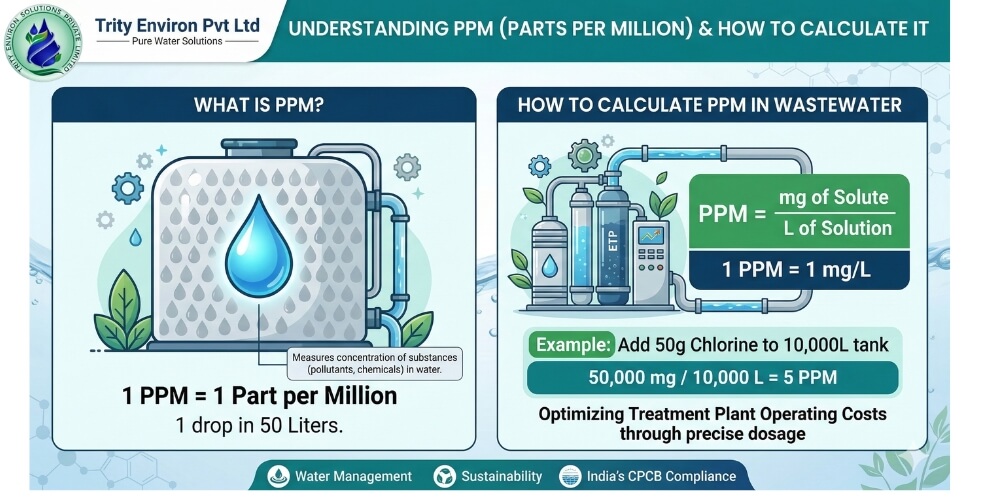
Learn how PPM (Parts Per Million) is used in wastewater management in India. This guide explains its meaning, calculation, importance in water quality monitoring, and role in industrial wastewater treatment.











Discuss your requirements with our engineering team and get practical guidance for your project.

