Zero Liquid Discharge (ZLD) Water Treatment: Process, Cost & CPCB Mandate Guide
A complete guide to Zero Liquid Discharge (ZLD) technology, who needs it under CPCB rules, how it works, real costs, and choosing a ZLD manufacturer.

 ISO 9001:2015 & QCI Approved
GPD, or Gallons Per Day, is the metric that tells you how much purified water a commercial RO plant can produce over a 24-hour cycle. Get this number wrong at the design stage and you either run short of water during peak demand or pay for capacity you never use. This guide covers the formula behind GPD, a worked calculation you can copy for your own site, and the real-world factors that cause actual output to differ from the number printed on the plant nameplate.
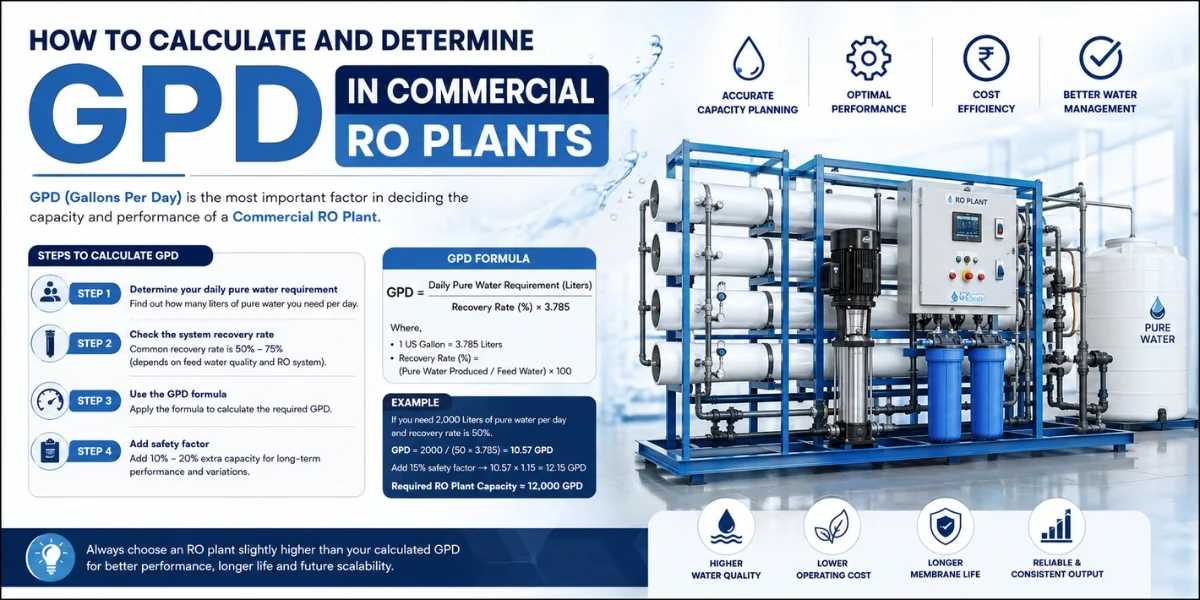
GPD stands for Gallons Per Day, and in the context of a commercial reverse osmosis system, it represents the volume of purified (permeate) water the plant can produce when running continuously for 24 hours under standard test conditions. A plant rated at 3,000 GPD is expected to deliver roughly 3,000 gallons, or close to 11,350 litres, of treated water per day at its designed feed pressure and temperature.
This number matters because it is the single specification that ties your water demand directly to plant size. Packaged drinking water units, beverage manufacturers, hotels, hospitals, and commercial kitchens all size their storage tanks, dosing systems, and downstream equipment around the GPD figure. If the GPD rating does not match actual daily consumption, the plant either runs constantly under strain, shortening membrane life, or sits idle for most of the day, which is a waste of capital that should have gone into a smaller, correctly sized commercial RO plant.
GPD ratings are usually quoted by manufacturers under standard test conditions, typically 77°F (25°C) feed water temperature and a fixed feed TDS level, often around 2,000 ppm. Real site conditions in India rarely match this exactly, which is why the calculation steps below matter more than the number on a brochure.
Before running any calculation, it helps to understand what actually drives GPD up or down on a real installation. Four variables do most of the work.
Calculating GPD for your commercial RO plant is a five-step process. You do not need lab equipment beyond a flow meter and a stopwatch, though for new plant sizing, this data typically comes from a feed water analysis report.
Gather the feed water flow rate, the recovery rate (or permeate flow rate if already known), and the number of hours the plant is expected to operate daily.
This is the rate at which raw water enters the RO system, measured in gallons per minute. If your flow meter reads in litres per minute, divide by 3.78541 to convert to GPM, since 1 gallon equals approximately 3.78541 litres. Feed flow rate should be checked against the membrane manufacturer's recommended range; a flow rate that is significantly outside this range usually points to a fouled prefilter, scaling on the membrane, or a pump issue that needs attention before you rely on the numbers.
Recovery rate is the percentage of feed water converted into pure permeate. Use this formula:
Recovery Rate (%) = (Permeate Flow Rate / Feed Water Flow Rate) x 100
For most commercial RO systems treating municipal or moderately hard groundwater, recovery rates of 50-75% are typical. Systems paired with a water softener plant or pretreatment stage can often push recovery higher without accelerating scaling, since hardness and silica are removed before the water reaches the membrane.
Note the actual number of hours per day the plant runs. A packaged drinking water unit running two production shifts might operate 16 hours a day, while a hotel's guest-water RO might run closer to continuous demand-based cycles.
With permeate flow rate, minutes per hour, and operating hours in hand, apply this formula:
GPD = Permeate Flow Rate (GPM) x 60 x Operating Hours per Day
Suppose your commercial RO plant has a permeate flow rate of 10 GPM and runs for 10 hours a day.
GPD = 10 x 60 x 10 = 6,000 GPD
That converts to roughly 22,700 litres per day, which is a realistic capacity for a mid-sized packaged drinking water unit or a large hotel's drinking and kitchen water supply.
| Permeate Flow Rate (GPM) | Operating Hours/Day | GPD Output | Approx. Litres/Day |
|---|---|---|---|
| 2 | 12 | 1,440 | 5,450 |
| 5 | 10 | 3,000 | 11,350 |
| 10 | 10 | 6,000 | 22,700 |
| 20 | 16 | 19,200 | 72,700 |
| 40 | 20 | 48,000 | 181,700 |
Use this table as a rough sizing reference only. Actual site design should always be based on your specific feed water report and peak demand pattern, not a generic table, which is where getting an engineering team involved early saves rework later.
A common mistake is treating the GPD number on a plant's nameplate as a guarantee rather than a lab-condition benchmark. Manufacturers test membranes at a fixed temperature (usually 25°C) and a standard feed TDS (often 2,000 ppm using a NaCl solution). Your actual site conditions rarely match this exactly, and the gap widens over the plant's operating life for a few reasons.
For all these reasons, most engineering teams size a commercial RO plant with 10-20% headroom above calculated daily demand, so that seasonal and end-of-membrane-life dips don't leave the facility short.
The GPD number you eventually achieve is only as good as the water reaching the membrane. Feed water quality has a direct, measurable effect on both output and membrane lifespan.
High turbidity and suspended solids foul the membrane surface quickly, which is why most commercial RO installations start with a multi grade filter to strip out particulates before water reaches finer stages. Chlorine and organic compounds, common in municipal supply, degrade thin-film composite membranes if not removed upstream, which is where activated carbon filters earn their place in the pretreatment train. Hardness (calcium and magnesium) drives scaling on the membrane surface, reducing both flux and recovery rate over time, and this is best addressed with a properly sized water softener ahead of the RO skid.
For facilities dealing with high-turbidity or bacterial-load feed water, adding an ultra filtration system ahead of the RO stage protects the membrane further and often allows the RO system to run at a higher, more stable recovery rate. Getting this pretreatment sequence right at the design stage is usually the difference between a plant that hits its rated GPD consistently for years and one that underperforms within the first six months.
GPD requirements vary enormously by industry, and sizing decisions should start from actual consumption data, not guesswork.
| Facility Type | Typical Daily RO Water Need | Approx. GPD Range |
|---|---|---|
| Small office / retail outlet | 200-500 litres | 50-130 GPD |
| Restaurant / café | 500-1,500 litres | 130-400 GPD |
| Mid-size hotel (50-100 rooms) | 5,000-15,000 litres | 1,300-4,000 GPD |
| Hospital / diagnostic centre | 10,000-30,000 litres | 2,600-8,000 GPD |
| Packaged drinking water unit | 20,000-100,000+ litres | 5,000-26,000+ GPD |
| Beverage / F&B processing plant | 50,000-200,000+ litres | 13,000-53,000+ GPD |
These are indicative ranges, and actual sizing needs to account for peak-hour demand, not just daily average, since most commercial facilities don't consume water evenly across 24 hours. A hotel's water use spikes sharply during morning check-out and evening hours, so storage tank sizing and RO capacity both need to account for that peak, not just the daily total. This is exactly the kind of site-specific assessment our engineering team runs before recommending a plant size, since a generic GPD figure pulled off a catalogue rarely matches real operating conditions.
If your facility's water demand is expected to grow, it is also worth discussing modular RO configurations or an industrial RO plant setup that allows capacity to be added in stages rather than replacing the entire system later.
A few recurring errors show up across commercial RO installations, and most of them trace back to skipping proper feed water analysis or ignoring operating hour assumptions.
Getting the GPD calculation right at the design stage is only half the job. Sustaining that output over years of operation depends on consistent monitoring and maintenance.
Routine cartridge and prefilter replacement prevents pressure drop from creeping up and starving the membrane of feed flow. Scheduled membrane cleaning-in-place, typically every 3-6 months depending on feed water quality, removes scale and organic fouling before it becomes irreversible. Continuous or periodic monitoring of permeate flow, conductivity, and pressure differential across the membrane array flags declining performance early enough to act on it, rather than discovering the shortfall only when storage tanks start running low.
For facilities that don't have in-house technical staff to manage this, an Annual Maintenance Contract covers scheduled servicing, chemical dosing checks, and membrane health monitoring, so GPD output stays close to its rated design figure across the plant's operating life rather than degrading unnoticed. Combined with proper operation and maintenance support, this is usually the more cost-effective path compared to reactive repairs after output has already dropped.
GPD stands for Gallons Per Day, the volume of purified water a reverse osmosis system produces over a 24-hour period under standard test conditions, typically used as the primary sizing metric for commercial RO plants.
Multiply the GPD figure by 3.78541, since 1 US gallon equals approximately 3.78541 litres. A 6,000 GPD plant produces roughly 22,700 litres per day.
Actual output is affected by feed water temperature, TDS levels, membrane age, and fouling. Nameplate GPD ratings are based on standard lab conditions (usually 25°C and fixed TDS) that rarely match real site conditions exactly, especially as membranes age.
Most commercial systems run recovery rates between 50% and 75%, depending on feed water hardness, TDS, and whether pretreatment like softening or ultrafiltration is in place. Higher recovery is achievable with proper pretreatment, but pushing recovery too high without it accelerates membrane scaling.
A hotel with 50-100 rooms typically needs an RO capacity in the range of 1,300 to 4,000 GPD, though actual sizing should be based on room occupancy, F&B operations, and peak-hour demand rather than a flat estimate.
Permeate flow, conductivity, and pressure differential should be monitored at least monthly, and ideally continuously via SCADA or flow meters, so any decline in output is caught early rather than discovered during a demand spike.
Getting GPD right, at the design stage and throughout years of operation, is what separates a commercial RO plant that reliably meets demand from one that leaves your facility short during peak hours. Trity Environ Solutions designs and manufactures commercial RO plants sized around your actual feed water report and peak demand pattern, not generic catalogue figures, backed by AMC and O&M support that keeps your plant's output close to its rated GPD for years, not just at commissioning.
Request a Free Site Assessment and GPD Sizing Consultation →
Call +91-9821030072 or email enquiry@trityenviro.com to talk to our engineering team about sizing the right RO plant for your facility.
A complete guide to Zero Liquid Discharge (ZLD) technology, who needs it under CPCB rules, how it works, real costs, and choosing a ZLD manufacturer.
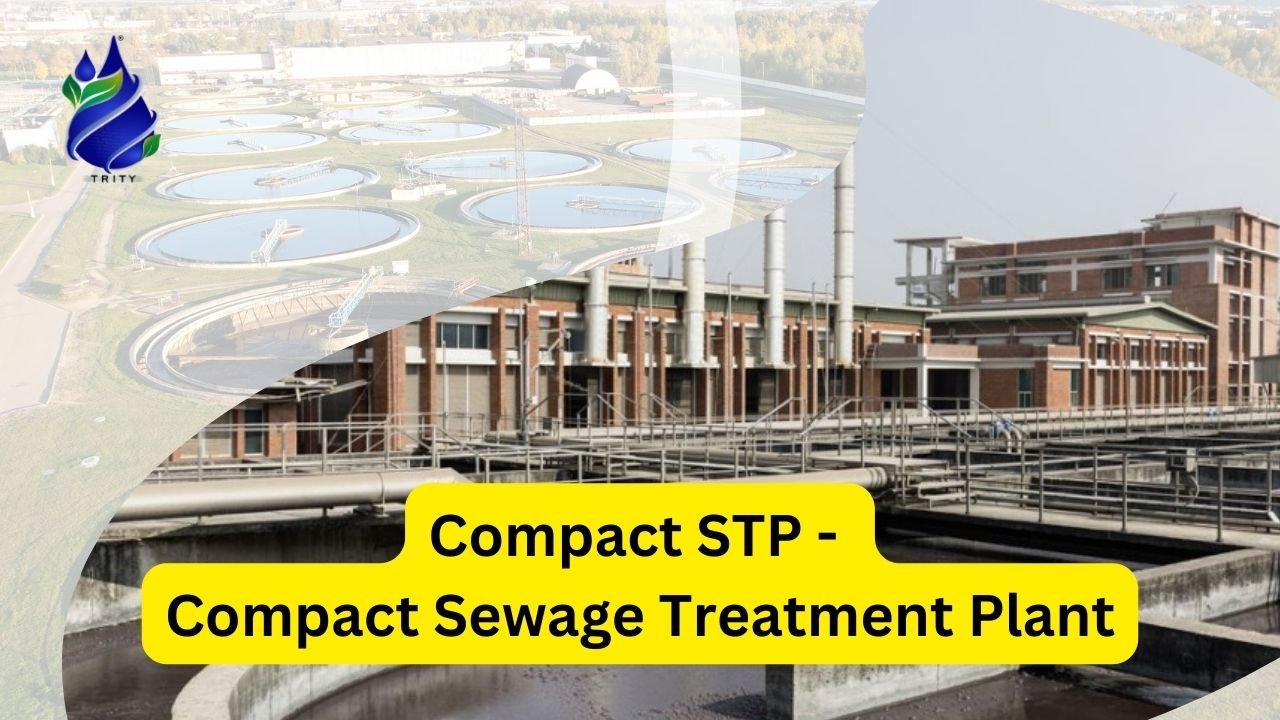
Compact STP – Compact Sewage Treatment Plant for efficient wastewater treatment in residential, commercial and industrial applications. Space-saving, cost-effective and easy to install solutions.

How ETP and STP plants are customized for textile, pharma, food, and oil & gas industries, with the specific technology each sector actually needs.




Discuss your requirements with our engineering team and get practical guidance for your project.