
Commercial RO Plant Benefits for the Environment — The Full Picture
Commercial RO (Reverse Osmosis) plants have become increasingly popular in recent years as a reliable solution to provide clean drinking water.

 ISO 9001:2015 & QCI Approved
A clear application gets consent faster. Learn the sequence, the documents and the mistakes that send applications back.
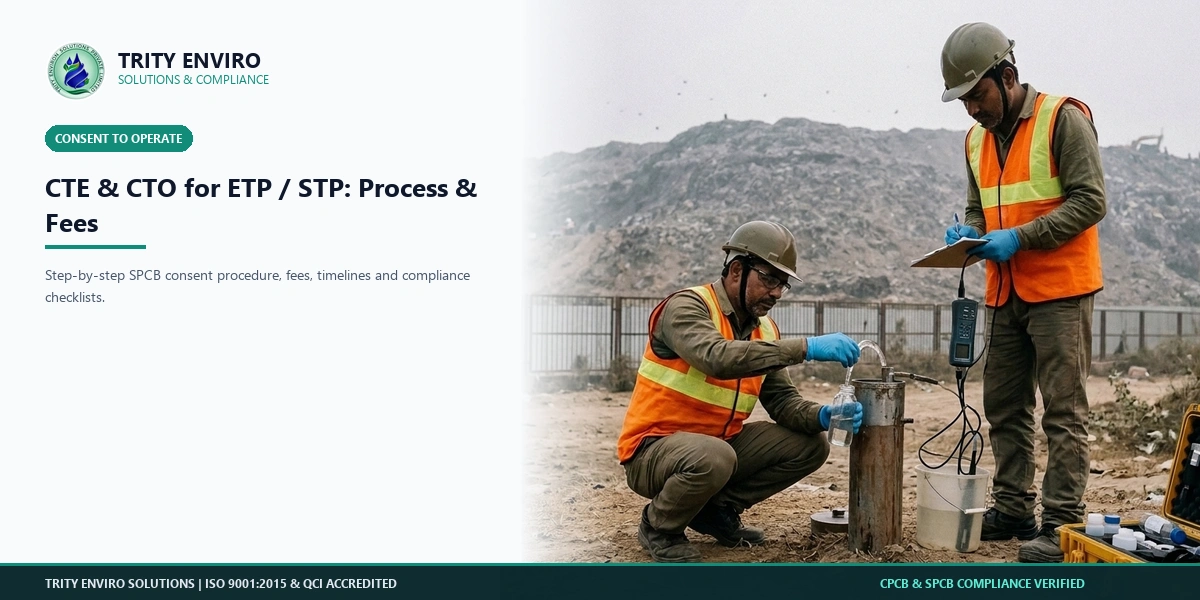
A treatment plant is a compliance tool, but it also needs compliance of its own. Before you build an industrial unit, a hotel, a hospital or a large residential project, and before you start running it, you usually need permissions from the State Pollution Control Board (SPCB) or Pollution Control Committee. These are the Consent to Establish (CTE) and the Consent to Operate (CTO). They come from the Water Act, 1974 and the Air Act, 1981, and in practice they are a single combined process on the state portal.
CTE is granted before construction or installation begins. It confirms that the site, the process and the proposed pollution control arrangements, such as the ETP, STP and air pollution control, are acceptable. CTO is granted before you start operating, after you have built and commissioned what the CTE required. It sets the conditions of day-to-day operation, including discharge limits, monitoring and reporting.
Many projects lose weeks or months because of avoidable mistakes: an ETP capacity that does not match the water balance, missing land documents, a drawing that does not match the site or a CTE condition that was ignored. This guide explains the process step by step, lists the documents, summarises fees and validity at a general level, explains renewal and shows the common reasons for rejection. Rules differ by state, so treat this as a map, and confirm the exact forms, fees and timelines on your own SPCB's portal. It is written for plant owners, project managers, EHS officers and consultants.
Industries, hospitals, hotels, large residential and commercial projects and many other establishments need consent, depending on their category and size. Pollution potential is classified by colour categories: red, orange, green and blue, with a white category for the least polluting. The category decides the validity of consent and how stringently the unit is examined. A recent central notification, referred to in a Bihar SPCB document as GSR 702(E) dated 12 November 2024, exempts white category industries from CTE. Check your category in the current list and your state's own rules.
Requirements vary, but most SPCBs ask for:
Our effluent treatment plant and sewage treatment plant teams help prepare design basis reports, process flow diagrams and drawings that match what the board expects.
A typical sequence is:
1. Create an account and submit the application on the SPCB's online consent system with documents and fee.
2. Scrutiny: the board checks completeness and may raise queries. Reply promptly and completely.
3. Site inspection for CTO and in some cases CTE, to verify that the site and installed equipment match the application.
4. Technical review of the ETP, STP and emission controls against the nature of your process.
5. Decision: grant with conditions, or rejection with reasons.
6. Compliance: meet the conditions, start monitoring and submit reports.
Some SPCBs have notified time limits for decisions, such as 30 days for CTE in one state's procedure. Overall, practitioners often describe a full cycle from CTE to CTO as taking a few months when documents are complete. Treat any timeline as an estimate, and check your own board's published limit.
Under the harmonised consent approach summarised by a law firm, CTO validity depends on the category: about five years for red, ten for orange, fifteen for green and seventeen for blue categories. Many states are moving toward these periods. Others still grant shorter terms. Confirm your own validity on the face of your consent.
Consent also lays down conditions that run through its life: discharge quality, monitoring frequency, reporting, online monitoring where applicable, solid and hazardous waste handling and the requirement to keep pollution control systems working.
Apply for renewal well before expiry. One summary of the harmonised approach mentions a fee rebate for applications made at least 120 days before expiry, and a delay beyond expiry can leave you operating without valid consent. Do not wait for the last month.
If you change capacity, process, fuel, products or the pollution control system, you generally need an amendment or fresh consent. Do not modify the plant first and inform the board afterward. Keep a record of every change and its approval.
Track your CTO conditions in a compliance calendar. Many violations are not about the plant but about missed reports, late tests or expired validity.
Boards look hard at the treatment plant, because it is where the promise of compliance becomes visible. A design that shows each unit, its size, its retention time and the expected outlet quality is more convincing than a block diagram. A match between the design basis and the lab data of similar plants helps. If your effluent contains difficult pollutants, such as solvents, heavy metals, high TDS or colour, say how the plant will deal with them. For high TDS or restricted discharge, you may need to propose reuse or zero liquid discharge, as explained in our article on ZLD plant cost, technology and mandates.
Pre-treatment, equalization and sludge handling are often missing from weak applications. Our guide on industrial wastewater pre-treatment before the ETP lists what a complete design includes, and the equalization tank design guide covers sizing.
Budget for the application fee, which varies by state and by project investment or capacity, the cost of the ETP, STP and pollution control equipment, laboratory tests, consultants, drawings, any required studies and the time of your own team. The biggest cost of delay is the plant that is built but cannot run. Start the application early, keep the construction schedule linked to the CTE conditions and plan commissioning so that CTO can be applied for immediately.
A single partner for design, supply, installation and compliance support reduces the risk of mismatched documents. Our project execution support, annual maintenance contract and operation and maintenance services keep you in step with your consent conditions after start up. If your unit must install online monitoring, read our OCEMS installation guide.
Once the consent arrives, convert every condition into a dated task: monitoring frequency, returns, renewal, equipment to install and records to keep. Assign an owner for each task, and review the list monthly. Most consent violations come from missed tasks, not from the plant itself.
| Parameter / Stage | Target Optimal Range | Failure Impact / Risk | Corrective Engineering Action |
|---|---|---|---|
| CTE before construction | Obtained before work begins on site | Illegal construction, notice, rejection of CTO | Apply early, link the project schedule to CTE conditions |
| ETP or STP design basis | Capacity, process and outlet quality consistent with water balance | Query, delay or rejection | Prepare water balance, flow diagram and drawings that agree |
| CTO before operation | Obtained before production, with conditions met | Closure direction, penalty | Commission, test, then apply with proof of compliance |
| Renewal timing | Applied well before expiry, for example 120 days where a rebate exists | Operating without valid consent, loss of rebate | Keep a compliance calendar, start renewal early |
Trity Environ Solutions is an ISO 9001:2015 certified and QCI-approved effluent treatment plant and sewage treatment plant manufacturer and supplier in India, delivering robust, high-efficiency systems engineered for CPCB and SPCB regulatory compliance.
Every installation is supported by pan-India Annual Maintenance Contract and Operation and Maintenance services.
Commercial RO (Reverse Osmosis) plants have become increasingly popular in recent years as a reliable solution to provide clean drinking water.
Learn how to size an industrial water softener: resin volume, service flow, salt dose and regeneration cycle, with a worked example for a factory.
Find the right solid waste management plant for your industry under the SWM Rules 2026. Learn waste audits, system options, compliance steps and cost drivers.











Discuss your requirements with our engineering team and get practical guidance for your project.

