Introduction: A New Kind of Responsibility for Large Water Users
India already has producer responsibility rules for plastics, batteries and electronic waste. The draft Liquid Waste Management Rules apply the same idea to water. Instead of Extended Producer Responsibility, they propose Extended User Responsibility, or EUR: the more water you use, the more responsibility you carry for treating and reusing the wastewater you generate.
The draft was notified by the Ministry of Environment, Forest and Climate Change on 7 October 2024, with public comments invited until 8 December 2024 and a proposed enforcement date of 1 October 2025. Several consultancy and competitor pages already describe the rules as being in force. Based on what we could find, the rules were still a draft, and we did not find a final notification. Please check the latest position with the Ministry, CPCB or your State Pollution Control Board before making investment decisions. At Trity Enviro, we recommend that bulk users prepare now, because the direction of policy is clear even if final numbers change.
For a plant manager, hotel owner, hospital administrator or society committee, the questions are practical. Are we a bulk user? What would we have to register, report and reuse? Can we buy certificates instead of building a plant? What systems will we need? And how do we avoid overspending?
This guide explains the draft in plain language, shows how to check your exposure, lists the systems that help and outlines a preparation plan. It is written for industries, hotels, hospitals, institutions, malls, IT parks and large housing societies.
What the Draft Rules Propose
Who Is a Bulk User
The draft defines a bulk user of water by consumption. Public summaries describe it as an entity using more than 5,000 litres of water per day, or, for industries, one with a pollution load above 10 kg per day. That would cover many factories, hotels, hospitals, schools, malls, offices and apartment complexes. Some stakeholder groups have recommended tiers, such as medium users from 5,000 to 10,000 litres a day and large users above 10,000 litres a day, so the final definition may differ from the draft.
If your daily water use is near 5,000 litres, measure it. Many sites do not know their real consumption, and a bill or a tanker count is not the same as a metered figure.
EUR, Reuse Targets and Certificates
Under EUR, a bulk user must ensure that the wastewater it generates is treated and that a minimum share is reused. Reported targets rise over time: summaries describe a start at about 20 percent in 2027-28 for new bulk users, increasing to 50 percent by 2030-31, with lower targets for existing users. The numbers come from the draft and from press summaries, so treat them as indicative.
The draft allows two routes. A bulk user can treat its wastewater on site and reuse it, or it can buy EUR certificates generated by registered wastewater treatment plants, much like EPR certificates. Duty is deemed met when the certificates match the minimum reuse requirement. There would be a central portal for registration and certificate trading, and wastewater treatment plants would need to register on it.
What Bulk Users Would Have to Do
Registration, Returns and Compliance
The draft proposes that bulk users register on the portal, submit an EUR plan and file returns. One summary lists an application form for bulk users, a form for the EUR plan and an annual return due by 30 June of the following financial year, with monthly or annual data on water consumed, wastewater generated and wastewater treated. Environmental compensation would apply for non-compliance, including false reporting and improper management, and operators of treatment plants would have to disclose performance data.
Note that the draft does not set new effluent standards. Discharge standards set by CPCB and your consent would continue to apply, as would CTE and CTO conditions. Our guide to CTE and CTO for ETP and STP explains how consents work.
Industries and Special Provisions
For industries, the draft is understood to include provisions on reuse within the process and a list of industries identified for reuse. Some summaries mention that certain industries must ensure no liquid effluent leaves the premises, which is zero liquid discharge. Check the schedules in the final text. If your sector is listed, you may need to evaluate recycling and ZLD sooner. Our article on ZLD plant cost, technology and mandates shows what that involves.
Preparing Your Wastewater System
The good news is that most steps that prepare you for the rules also save money on water.
Audit, Treatment and Reuse Options
- Measure water use. Install meters at the main intake and major users. A structured exercise, as described in our guide to the industrial water audit, gives you a water balance.
- Characterise wastewater. Separate blackwater, greywater, process effluent and cooling blowdown. Each has different treatment and reuse potential.
- Fix the base treatment. A stable sewage treatment plant or effluent treatment plant is the foundation of any reuse system. Reuse water can only be as good as the plant feeding it.
- Add tertiary treatment. Filtration, carbon, UF, RO and disinfection polish water for reuse, as explained in our guide to tertiary water treatment for industrial reuse.
- Pick the right reuse. Flushing, gardening, cooling tower make-up, washing and process use all have different quality needs. See our article on water recycling for cooling towers and process water.
- Consider greywater separately. Water from baths and basins is easier to treat and reuse, as our grey water treatment plant page describes.
A Worked Example for a 100 KLD Facility
A hotel uses 100 KLD of fresh water and produces about 80 KLD of wastewater. Suppose the final rules require a minimum reuse of 20 percent of wastewater, which is 16 KLD. The hotel needs uses for that 16 KLD. Flushing in guest toilets and common areas, plus gardening and cooling tower make-up, can easily absorb that much. The hotel's STP already treats 80 KLD. By adding filtration, carbon and disinfection, it can supply reuse water for flushing and gardening. If the target rises to 50 percent, 40 KLD of reuse is needed, and the hotel would add UF and RO for cooling and laundry use. The step-by-step approach spreads cost and fits the rule's rising targets.
Compare that with buying EUR certificates for the same volume. The price of a certificate is not yet known, and it may fall or rise. A plant on your own site gives certainty and lowers your water bill, while certificates give flexibility. Many large sites will use both.
Cost, Planning and Choosing a Partner
Budgeting the Compliance Route
Budget for metering and the water audit, upgrades to the base STP or ETP, tertiary stages, storage and dual plumbing for reuse, monitoring and reporting systems and operation and maintenance. Offset them against savings in fresh water, tanker water, effluent discharge and, where applicable, certificate purchases. Water saved is money saved every year, and the saving grows as water prices rise.
Plan for uncertainty. Since final targets, definitions and timelines may change, design in modules. Build the base plant and filtration first, leave space and utilities for UF and RO and install meters now. This approach avoids both over-investment and a rush later.
Questions to Ask Before You Order
- Which version of the rules and which targets are you designing for, and how flexible is the design if they change?
- What treatment train do you propose for my reuse applications, and what quality do you guarantee?
- How will reject, sludge and backwash be handled?
- How will the system be metered and reported for the portal and annual returns?
- What are the power, chemical and membrane costs per cubic metre?
- How do you handle operation, maintenance and training?
- Can you show similar installations?
Trity Enviro designs and supplies the whole chain, from base plants to recycling. Our wastewater recycling system, RO water recycling plant and wastewater treatment plant pages describe the options, and data centre owners can read how reuse applies in our guide on data centre water treatment in India.
A Simple Preparation Timeline
Treat preparation as a four step plan. In the first month, install meters on the main intake, the STP inlet and outlet and the largest users, and start logging daily. In months two and three, complete a water audit and a wastewater survey, then decide which streams can be reused and for what. Over the next six months, fix any weak points in the existing STP or ETP and add tertiary treatment, storage and reuse piping in phases. Throughout, keep a file of drawings, bills, lab reports and consents, so that registration and returns take days, not weeks. Trity Enviro engineers can help you build this plan around your own site, whether you need a small greywater loop or a full recycling and ZLD system. Review the plan whenever the Ministry releases a final notification, and adjust targets and timelines if they change.
Industry Comparison / Operational Parameter Table
| Parameter / Stage | Target Optimal Range | Failure Impact / Risk | Corrective Engineering Action |
| Bulk user threshold | Draft: above 5,000 L/day water use, or 10 kg/day pollution load for industries | Missed obligations if consumption is unmeasured | Meter intake, confirm status against the final text |
| Reuse share of wastewater | Rising draft targets, from about 20 percent in 2027-28 to 50 percent by 2030-31 for new users | Penalty or certificate cost if targets are missed | Build reuse in phases, track reuse volume monthly |
| Treated water quality for reuse | Suited to each use, such as flushing, cooling or process | Scaling, odour, health risk, process failure | Add tertiary treatment, UF and RO where needed |
| Reporting and records | Monthly or annual data on water use, wastewater and reuse, with annual return | Compensation for false or missing reports | Install meters, keep digital logs, assign an owner |
Why Choose Trity Enviro
Trity Environ Solutions is an ISO 9001:2015 certified and QCI-approved wastewater recycling system and sewage and effluent treatment plant manufacturer and supplier in India, delivering robust, high-efficiency systems engineered for CPCB and SPCB regulatory compliance.
Every installation is supported by pan-India Annual Maintenance Contract and Operation and Maintenance services.
Free Engineering Consultation
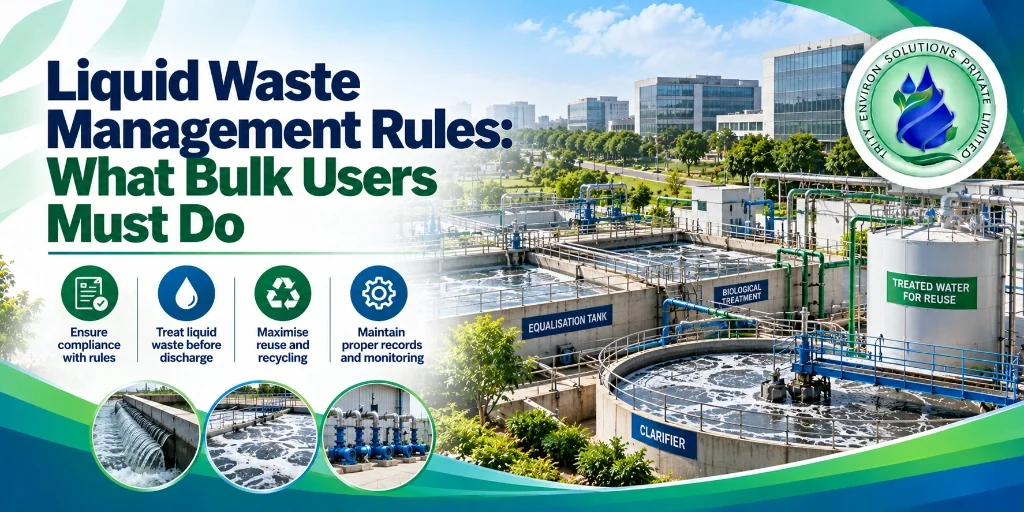
Liquid Waste Management Rules: What Bulk Users Must Do
Looking to upgrade, size, or install a high-performance system? Speak directly with our senior environmental engineers today for expert sizing calculations, CPCB/SPCB compliance support, and turnkey execution. Call +91-9821030072 or email enquiry@trityenviro.com.
Request a Free Site Assessment