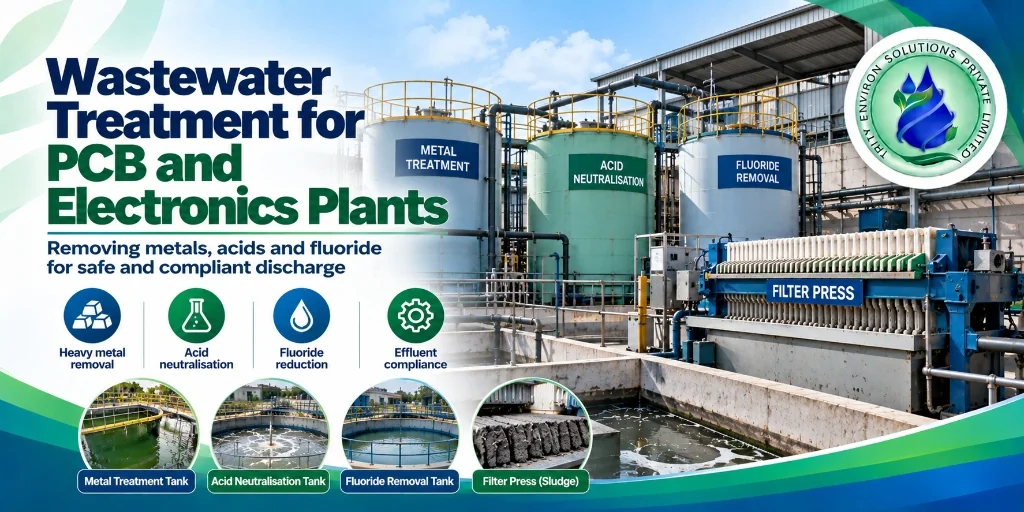
Wastewater Treatment for PCB and Electronics Plants
Trity Enviro explains PCB and electronics wastewater treatment: metals, chelated copper, fluoride, acid streams, reuse and ZLD for India's growing plants.

 ISO 9001:2015 & QCI Approved
A practical engineering guide to distillery spent wash treatment, evaporation, condensate polishing and ZLD design for molasses and grain based plants in India.
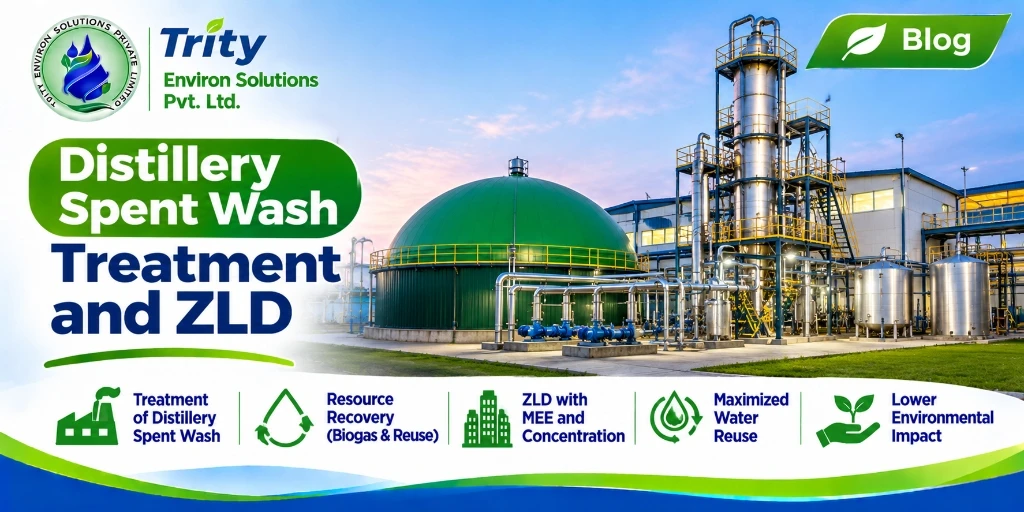
A distillery can run its fermentation and distillation perfectly and still be shut down by its effluent. Spent wash, the liquid left in the still after alcohol is recovered, is dark, hot, acidic and loaded with organic matter. CPCB documents describe COD for molasses based spent wash as starting at roughly 80,000 mg/L, so verify the figure for your own feedstock by lab test.
For that reason, regulators and the National Green Tribunal have repeatedly pushed distilleries towards zero liquid discharge. This guide covers distillery spent wash treatment from a plant engineer's side: what the stream contains, the usual treatment route, a mass balance you can adapt, the operating problems that cost money, and how to compare supplier proposals. Always confirm your exact obligation in your consent to operate and state directions.
Before choosing equipment, know what you are treating and what the regulator expects you to achieve.
Molasses spent wash carries high COD and BOD, a large amount of dissolved potassium, sulphate and chloride, melanoidin pigments that give the dark brown colour, and a low pH. It leaves the still at high temperature. Grain based spent wash differs: it is often richer in suspended solids and protein, and it is commonly separated into thin and thick fractions using a decanter before evaporation.
Volume depends on feedstock, fermentation strength and how much spent wash is recycled back into fermentation. CPCB guidance encourages lower specific generation, so a plant that cuts litres per litre of alcohol also shrinks every downstream unit. Treat your plant's actual metered figure as the design basis.
In practical terms, zero liquid discharge means no process effluent leaves the site as liquid. Water is recovered and reused, and the remaining solids go to a boiler, a dryer, compost or approved disposal. CPCB documents describe ZLD as the target for distilleries, and joint committee reports submitted to the NGT discuss it case by case. Because the details sit in each consent, check yours for permitted spent wash quantity, storage limits and the approved final disposal route.
Most Indian molasses distilleries follow a similar chain: anaerobic digestion, then evaporation, then disposal of the concentrate, with condensate polished for reuse.
Anaerobic digestion, often called biomethanation, removes a large share of COD and produces biogas that can fire the boiler. A reactor design reference is our article on UASB reactor design for high COD wastewater, and the anaerobic digester page lists the equipment scope.
The digested liquid then goes to a multiple effect evaporator, where water is boiled off to give a concentrated syrup and a condensate stream. The concentrate is typically burnt in an incineration boiler, mixed with press mud for composting, or dried, depending on the consent. Our guide on MEE vs MVR evaporators compares the evaporation options, and the ZLD technology and cost article explains how the stages fit together. Grain plants often place a decanter centrifuge ahead of the evaporator to remove solids.
Every number here is an assumption for illustration only. Use your measured data.
Now evaporation. Assume the evaporator feed is 12 percent solids and the concentrate leaves at 40 percent solids (density effects ignored).
If the consent calls for incineration, concentrate may need 55 percent solids or higher. Then concentrate is 960 x 12 / 55 = 209 KLD, condensate is about 751 KLD, and steam is about 751 / 3.5 = 215 tonnes per day. The extra solids concentration costs steam but reduces fuel for the incineration boiler, so test both cases. A pilot or vendor trial on your own spent wash is the only way to fix the true solids limit.
Biogas deserves its own plan. In the example above, about 33,600 m3 per day of biogas could displace a meaningful share of boiler fuel, but only if gas cleaning, a flare for surplus gas and safe storage are included. H2S in raw biogas corrodes burners and boiler tubes, so ask who supplies the scrubber and what the sulphur target is. Treat the biogas yield as a result to confirm in commissioning, not a promise to bank in the business case.
Also decide early what happens to old lagoons. Many sites hold stored spent wash or concentrate from earlier years, and inspection reports in tribunal cases have flagged lagoon storage. A ZLD scheme should say how stored volume will be cleared, and the lagoon lining and freeboard should be inspected before the monsoon.
The evaporator solves the volume problem but creates a new one: hundreds of kilolitres of warm condensate that must be reused.
Evaporator condensate carries volatile organics, ammonia and some carryover. It is usually polished in a condensate polishing unit with biological treatment, filtration and sometimes ultrafiltration and an RO water recycling plant. Polished water goes to cooling tower make-up, process water and boiler feed after demineralisation. Cooling tower blowdown, boiler blowdown and plant washings should be routed to the same polishing train.
Water balance matters. When all streams are returned, the plant can end up with more water than it can use, especially in monsoon. Draw a monthly balance with fermentation dilution, cooling tower make-up and boiler feed on one side and all recovered streams on the other. If the balance is positive, say so before ordering, since a ZLD scheme with no sink for the excess is not zero discharge. RO concentrate from the polishing train needs its own plan, which our article on RO reject water reuse discusses.
Three problems account for most downtime. First, evaporator scaling from calcium, silica and sulphate, which cuts heat transfer and forces frequent boil-outs. Plan a cleaning cycle, antiscalant dosing where suitable and tube material suited to chlorides. Second, foaming in digesters and evaporators, which often follows a feed change or antifoam shortage. Third, concentrate handling: syrup at high solids is viscous, so line heating, steam tracing and slope matter.
Online metering helps both operation and compliance. Install flow meters on spent wash generation, evaporator feed, concentrate and condensate, and keep the log book up to date, because inspectors compare these figures against the consented quantity. Ask whether your state requires real time data transfer, and see our OCEMS installation guide for how monitoring is set up.
Keep a daily log of feed flow, feed solids, concentrate solids, condensate COD and pH, steam consumption and biogas yield. Sudden drift in any of these tells you early that a stage is losing performance.
ZLD projects are large, and early errors are expensive. Frame the decision around the whole chain, not one machine.
Capital cost is driven by spent wash quantity, digester volume, evaporator effects and materials of construction, the condensate polishing train, concentrate handling and the incineration or drying arrangement. Operating cost is mainly steam, power, chemicals for pH and cleaning, manpower, membrane and media replacement, and fuel or compost handling for the concentrate. Never accept a price per KLD without a defined scope, and ask for steam per tonne of spent wash in writing.
Many distilleries are also adding ethanol capacity, often from grain or cane juice as well as molasses, so ask whether the evaporator and polishing train can be extended modularly when output rises.
For the effluent and reuse side of the scope, review our zero liquid discharge and effluent treatment plant pages, and see the annual maintenance contract options. Trity Enviro engineers can review a design basis, effluent and reuse scope, or a competing proposal. Please confirm evaporator and incineration boiler scope with the team directly, since these depend on the project.
| Parameter / Stage | Target Optimal Range | Failure Impact / Risk | Corrective Engineering Action |
|---|---|---|---|
| Digester operation | Stable pH near neutral, steady feed and temperature, VFA to alkalinity ratio monitored | Souring, foaming, poor COD removal and low biogas | Slow feed changes, add alkalinity, check mixing and temperature control |
| Evaporator concentrate | Solids set by trial, for example 40 to 55 percent depending on disposal | Too thin wastes fuel, too thick chokes lines and scales tubes | Control feed density, steam trace lines, schedule boil-outs |
| Condensate quality | Low COD and ammonia suited to cooling tower or RO feed | Biofouling, corrosion and RO membrane damage | Polish with biology, filtration and UF, monitor daily |
| Plant water balance | Reused volume at least equal to recovered volume | Excess water, forced discharge, consent breach | Draw monthly balance, add reuse sinks or storage before commissioning |
Always check limits and obligations against your own consent to operate. Treat the example figures as a template for your own balance, and replace each one with a lab result or a meter reading as soon as you have it.
Trity Environ Solutions is an ISO 9001:2015 certified and QCI-approved ETP manufacturer and supplier in India, delivering robust, high-efficiency systems engineered for CPCB and SPCB regulatory compliance.
Every installation is supported by pan-India Annual Maintenance Contract and Operation and Maintenance services.
Speak directly with our senior environmental engineers for technical guidance, sizing calculations, or a tailored project proposal.
Call +91-9821030072 or email enquiry@trityenviro.com
Trity Enviro explains PCB and electronics wastewater treatment: metals, chelated copper, fluoride, acid streams, reuse and ZLD for India's growing plants.

Broken TDS meters can lead to high bills, health risks, and damaged equipment. Learn how to spot issues and maintain your meter for accurate water quality readings.
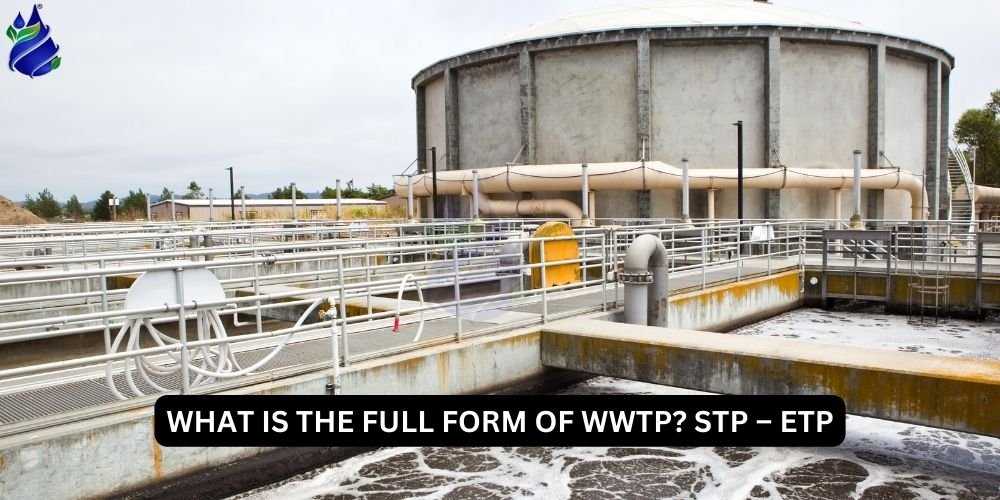
WWTP, STP, and ETP full forms explained with real CPCB data on how many exist in India, and which term actually applies to your project.











Discuss your requirements with our engineering team and get practical guidance for your project.

