Delhi-NCR 50 mg/Nm³ PM Emission Standard: What Industries Must Do by 1 October 2026
CAQM Direction 98 sets a 50 mg/Nm3 particulate limit for covered Delhi NCR industries from 1 October 2026. See who is covered and how to close the gap.

 ISO 9001:2015 & QCI Approved
A practical engineering guide to cutting and reusing RO reject water in industrial and commercial plants, with mass balance maths, scaling limits and supplier questions.
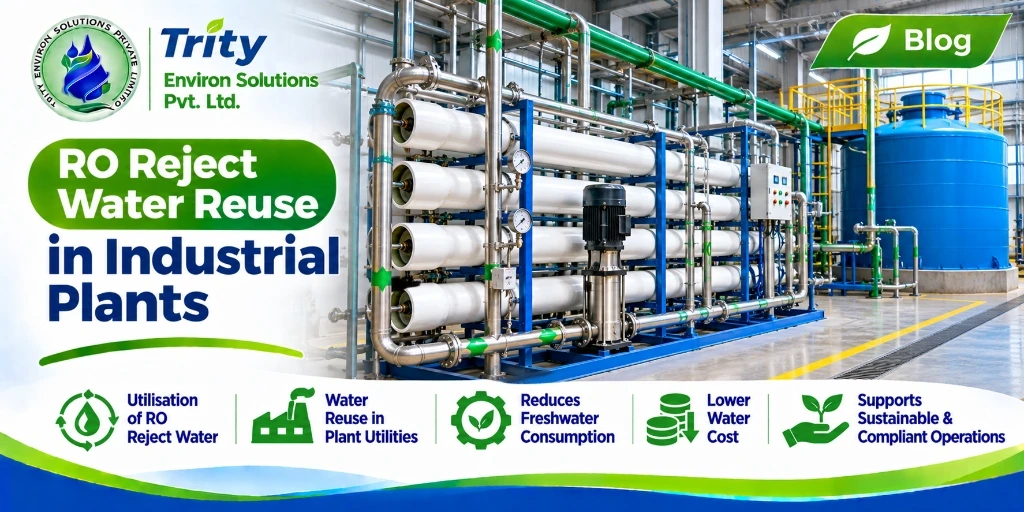
An RO plant produces clean permeate and a stream of concentrated reject. You paid once to draw and pretreat that water, and you pay again to dispose of it. At 75 percent recovery, a quarter of everything you treat leaves as reject. Small domestic RO purifiers are reported to reject far more, with press reports citing 70 to 80 percent of intake going to drain.
This guide looks at RO reject water reuse for industrial and commercial plants: what the reject contains, how recovery changes it, which reuses are realistic, how a reject stage RO can cut the volume, and what to ask a supplier. Test your own water before copying any figure here, because reject quality follows your feed water.
RO reject is the feed water with most of its dissolved salts and organics left in it, at a higher concentration. Nothing new is added by the membrane. That is the key to understanding both its risks and its uses.
Recovery is the share of feed that becomes permeate. Higher recovery means less reject by volume but a more concentrated reject. The concentration factor is feed flow divided by reject flow. At 75 percent recovery it is 4, at 90 percent it is 10. Every dissolved ion that membranes reject, including hardness, silica, sulphate and chloride, is multiplied by roughly that factor.
So the quality of the reject depends on three things: feed water quality, recovery and the membrane's salt rejection. Reject also carries antiscalant and any chemicals dosed upstream, such as chlorine reducing agents. Biological or organic loads, if present in feed, are concentrated as well.
All values are assumptions for illustration. Replace them with your own analysis.
Now add a second stage that treats the 25 m3 per hour of reject at 60 percent recovery.
The plant now sends 10 m3 per hour to disposal instead of 25. That saves 15 m3 per hour, or 360 m3 per day on a 24 hour plant. Multiply by your own water, treatment and disposal cost to see the saving.
Check silica next. If feed silica is an assumed 20 mg/L, the final reject carries about 20 x 10 = 200 mg/L. Silica scaling limits are often quoted at roughly 100 to 120 mg/L without special measures, so the second stage as drawn is at risk. It would need a silica-specific antiscalant, pH control, softening or a lower recovery, and the supplier should show the calculation. Hardness works the same way: 300 mg/L as CaCO3 in feed would be 3,000 mg/L in the final reject, which also demands proper scale control.
Reject is not clean water, and it should not be treated as such. The aim is to use it where salt does no harm.
Common uses include dust suppression on roads and stockpiles, ash conditioning in boiler houses, floor washing in non-food areas, filter and softener backwash, and toilet flushing where plumbing is corrosion resistant. Some plants send reject to landscape irrigation, but salinity can damage soil and plants, so this depends on TDS, sodium and the plants chosen. Do not use reject for food contact, washing sensitive materials or anywhere people may drink or cook.
Match each use with a quality limit and a volume, and write both into the reuse plan. A reject stream of 25 m3 per hour is a lot of water. A few hosepipes will not consume it, so estimate demand by use, season and shift before promising a reuse figure. Read the commercial side of this question in our commercial RO plant selection guide and on the commercial RO plant page.
Cooling towers look like the ideal sink, but salt content gets in the way. A tower concentrates make-up water by its cycles of concentration, so cycles equal the allowed circulating TDS divided by make-up TDS. If the allowed circulating TDS is an assumed 3,000 mg/L, raw water at 1,200 mg/L allows 2.5 cycles. Reject at 4,728 mg/L gives 3,000 / 4,728 = 0.63, which is less than one and therefore not workable on its own.
Blending reject into make-up only lowers the cycles you can run, so it usually costs more in blowdown than it saves. Reject can work in a tower with a high allowable TDS, special metallurgy and a good scale and corrosion program, but test this rather than assume it. Our article on recycling water for cooling towers and process use covers the better source options.
The cheapest reject is the one you do not make. Look at recovery before reuse, and look at reuse before disposal.
A reject stage RO, sometimes called a brine recovery RO, takes the first stage reject as feed and pulls more permeate out of it, as in the example above. It requires clean, well controlled feed, so good pretreatment is essential. The usual train has a multi-grade filter, carbon where chlorine or organics are present, softening or antiscalant and often an ultra filtration system. Our guide to UF selection before RO explains when UF pays off.
Recovered permeate can return to the RO feed tank or serve a lower grade use. Many plants find that a modest increase in recovery, for example from 75 to 85 percent, is easy, while going to 90 percent or more takes scale control that must be designed in.
Scaling decides the real recovery limit, not the membrane's pressure rating. Calcium carbonate and sulphate, barium, strontium and silica all become less soluble as they concentrate. Methods include sodium cycle softening, as sized in our water softener sizing calculation, antiscalant dosing based on projection software, acid dosing for carbonate control and, where silica is high, a silica specific program. A water softener ahead of RO is often the simplest option.
Monitor normalised permeate flow, differential pressure across each stage and salt passage every day. A 10 to 15 percent drop in normalised flow is a common trigger for cleaning in place, but follow the membrane maker's guidance for your system.
After recovery is maximised, a small and very salty stream remains. Options include discharge to a sewer or CETP if the consent and the receiving body allow it, evaporation, or a full zero liquid discharge system. Do not assume any option is allowed without checking your consent, since many states are strict about salinity. Our guide on MEE vs MVR evaporators compares the main evaporation choices.
Where reject is the only liquid leaving the site, the question becomes economic: how much can you spend on concentrating it before disposal costs fall? A mass balance across all plant streams, not only the RO, gives the answer.
Ask about reject at the start of an RO purchase, not after commissioning. It shapes both the design and the operating bill.
Cost depends on feed quality, target recovery, number of stages, pretreatment train, membrane area, materials for high salinity, antiscalant and cleaning chemicals, and the disposal route. Operating cost has energy, chemicals, membrane replacement, manpower and the cost of dealing with reject. Our industrial RO plant cost guide sets out the structure, and the industrial RO plant page describes the scope.
Higher recovery is not automatically better. Each additional point of recovery raises pressure, scaling risk and cleaning frequency, so test the economics at two or three recovery levels.
Share your water analysis for a reject plan along with the equipment quote, and read about the annual maintenance contract so cleaning and monitoring are covered. Trity Enviro engineers can compare recovery cases and review a competing RO proposal against your water data.
| Parameter / Stage | Target Optimal Range | Failure Impact / Risk | Corrective Engineering Action |
|---|---|---|---|
| RO recovery | Set by scaling projection, for example 75 to 85 percent for a single stage | Too high causes scaling and frequent cleaning, too low wastes water | Run projection at several recoveries, add antiscalant or softening before raising recovery |
| Silica in reject | Below the quoted limit, about 100 to 120 mg/L without special measures | Hard silica scale that is difficult to clean | Use silica specific antiscalant, adjust pH, add softening or lower recovery |
| Reject reuse | Matched to a use with a known TDS and volume | Salt damage to soil or equipment, unused reject overflows | Limit to dust control, ash conditioning and similar uses, store and meter flow |
| Normalised permeate flow | Within 10 percent of start-up values | Fouling, scaling or membrane damage goes unnoticed | Trend data daily, clean when guidance trigger is reached, check pretreatment |
Always check discharge and reuse conditions against your own consent to operate.
Trity Environ Solutions is an ISO 9001:2015 certified and QCI-approved RO plant manufacturer and supplier in India, delivering robust, high-efficiency systems engineered for CPCB and SPCB regulatory compliance.
Every installation is supported by pan-India Annual Maintenance Contract and Operation and Maintenance services.
Speak directly with our senior environmental engineers for technical guidance, sizing calculations, or a tailored project proposal.
Call +91-9821030072 or email enquiry@trityenviro.com
CAQM Direction 98 sets a 50 mg/Nm3 particulate limit for covered Delhi NCR industries from 1 October 2026. See who is covered and how to close the gap.
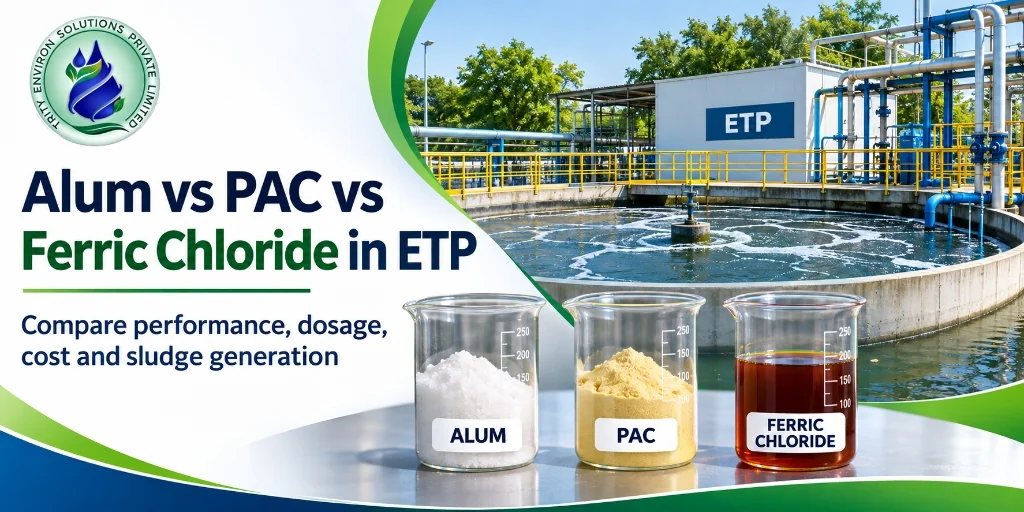
Trity Enviro compares alum, PAC and ferric chloride for ETP and STP: pH range, alkalinity use, sludge, cost, polymer choice and how to run a jar test.

Are ETPs and STPs suitable for small-scale industries? Yes, with compact tech, CETP options, and MSME subsidies. Here's how to choose.











Discuss your requirements with our engineering team and get practical guidance for your project.

