
Why Is pH Control Crucial in ETP and STP Systems?
How pH balance affects biological treatment, coagulation, and equipment life in STP and ETP systems, with real control methods and dosing chemicals.

 ISO 9001:2015 & QCI Approved
A practical engineering guide to planning, sizing and running decentralised sewage treatment for villages, schools, hostels and institutional campuses in India.
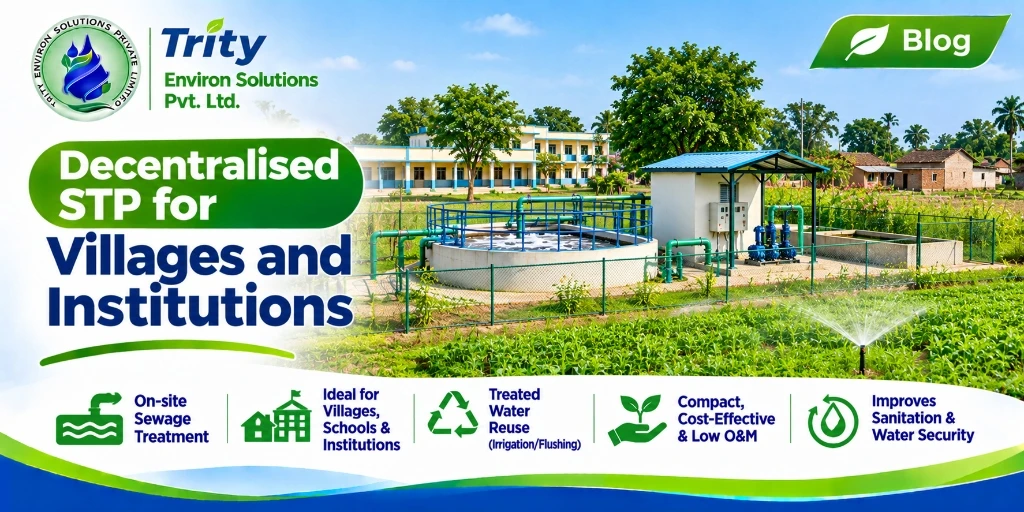
Many villages and institutions have no sewer network, and laying kilometres of pipe to a distant plant is often slow and costly. A decentralised plant treats sewage close to where it is produced and returns the water to nearby fields, gardens or toilets. The idea is sound. The record is mixed, though: a European research project that reviewed more than 1,500 decentralised plants in India reported that not all were working well.
Most failures trace back to the same few causes: wrong design flow, no operator, no power plan and no owner for sludge. This guide shows how to plan a decentralised STP so it keeps working after the inauguration photograph, with a worked example, a technology comparison and a supplier checklist. Always align the final design with your state pollution control board and local body requirements.
Decentralised treatment is a planning choice, not a technology. The same plant can be right in one place and wrong in another.
A centralised system collects sewage from a whole town through sewers and pumping stations to one large plant. It works well where density is high and the network already exists. In scattered settlements, the pipe and pumping cost can exceed the cost of treatment itself, and sewers laid on flat ground may need deep excavation.
A decentralised plant serves one cluster, one institution or one ward. It needs a short collection network, usually gravity, and gives treated water right where it can be used. The trade-off is that you now run many small plants instead of one large one, so operation and monitoring must be simple and clearly owned.
Typical users include village clusters, residential schools, hostels, ashrams, military and police colonies, resorts, highway facilities and hospital campuses. Their flow patterns differ. Schools and offices load heavily by day and are quiet on holidays. Hostels peak in the morning and evening. Villages show morning and evening peaks with festival surges. Hospitals need a separate design, covered in our hospital sewage treatment plant page.
Where only washing and bathing water needs treatment, a grey water treatment plant can be simpler and cheaper. Research at a rural school in Karnataka by IISc reported that decentralised greywater recycling can be put into practice economically in a village setting.
Size the plant on real water use, add a sensible margin, then pick the process that your operator can run.
All values are assumptions for illustration. Replace them with surveyed data.
Power gives a running cost view. At an assumed 0.6 kWh per m3, 132 m3 uses 79 kWh a day. At an assumed Rs 8 per kWh that is about Rs 19,000 a month (assumption, for illustration only).
The treated water has a use. If one hectare needs an assumed 40 m3 a day in the dry season (4 mm), 132 m3 a day covers about 3.3 hectares. In the monsoon that demand falls, so plan a storage tank or a disposal option.
An MBBR sewage treatment plant is compact, copes with load swings and restarts easily after a holiday. It needs a blower and regular power, which must be planned for in villages with unreliable supply.
Constructed wetlands and soil based systems need little power and no complex equipment, but they need much more land and a design that matches soil and climate. They suit places where land is cheap and operators are scarce. The Centre for Science and Environment has published case studies of decentralised systems of both kinds across India.
A packaged or containerised STP shortens site work and can be moved if needs change, while an RCC plant suits long, stable use. Our article comparing package STP vs RCC civil STP sets out the trade-offs. If treated water must meet a stricter limit, add a tertiary treatment plant with filtration and disinfection.
Site selection matters as much as process selection. Place the plant downwind of homes where possible, keep it above flood level and away from drinking water sources and borewells, and leave room for a second module. Fence it, light it and give it a safe approach road. Many small plants fail because the site floods in the first monsoon or because the only access is across a field.
Think about the sewer too. A leaking or choked village sewer sends less flow, and more stormwater, to the plant than the design assumed. Add manholes at regular spacing, screen at the inlet and keep a clear rule that rainwater drains must not connect to the sewer. A small flow meter at the inlet turns these problems into numbers the operator can see.
The design is only half the project. A plant with no daily care will slowly stop working, whatever its technology.
Reuse is the main benefit of decentralised treatment, so decide the end use before you finalise the process. Landscape, tree plantation and non-food crops are the easiest uses. For food crops, rules and local practice vary, and the quality demanded is much stricter, particularly for pathogens. Check the guidance of your state and the local health department before promising farmers any use.
Some states are working on reuse of treated wastewater, and our article on treated wastewater reuse in Telangana looks at one example. Whatever the state, the treated water should be tested for BOD, TSS, pH and faecal coliform before it leaves the plant, and the results should be logged.
Sludge is the quiet failure point. Without a plan, drying beds overflow, sludge goes into the nearest drain and the consent is at risk. Use the numbers from your example to size drying beds, cover them against rain and agree where dried sludge goes. Many sites use it as soil conditioner after drying and testing, but confirm local rules first.
Daily care should be short and written. A trained local operator can do this in about an hour: check the screen and clear rags, confirm the blower runs, look at the colour and smell of the aeration tank, note the power meter reading and record flow. Weekly, clean diffusers or media screens and check sludge levels. Monthly, send a treated water sample to a laboratory. A one page checklist like the one in our STP operation and maintenance checklist can be adapted for a village panchayat or school.
A decentralised plant needs an owner as much as an engineer. Decide who runs it, who pays for power and who handles repairs before the contract is signed.
Cost drivers are the design flow, the process and whether the tanks are RCC, fabricated or containerised. The collection network, pumping stations, power connection, a standby blower and a treated water tank often add more than the buyer expects. Look at running cost too: power, a part time operator, spare parts, laboratory tests and sludge handling.
Reliability depends on supplier support. A plant installed in a remote village is only as good as the service response. Ask for an AMC that names a visit schedule, spare parts list and response time. Where the owner is a school or panchayat with little technical staff, an operation and maintenance contract is often more practical than self operation.
If the same organisation also runs offices or a campus, our guide on STP for IT parks and commercial buildings covers larger central plants.
Start with the sewage treatment plant options, then request an AMC and O&M proposal alongside the equipment price. Trity Enviro engineers can help turn a village survey into a design basis and compare quotes on a like for like scope.
| Parameter / Stage | Target Optimal Range | Failure Impact / Risk | Corrective Engineering Action |
|---|---|---|---|
| Design flow | Based on survey plus margin, for example 20 percent | Undersized plant overflows, oversized plant starves biology | Re-survey, add equalisation, phase capacity in modules |
| Aeration | DO about 2 mg/L, steady blower run | Odour, poor BOD removal, floating sludge | Clean diffusers, add standby blower, fit a timer or DO control |
| Treated water for irrigation | Low BOD and TSS, low faecal coliform, no odour | Health risk, clogged drip lines, poor acceptance by farmers | Add filtration and disinfection, test monthly, restrict to suitable crops |
| Sludge handling | Drying bed area matched to yearly sludge, covered | Sludge in drains, odour, consent action | Size beds from the sludge balance, schedule lifting, keep records |
Check all limits against your state pollution control board conditions and local body rules.
Trity Environ Solutions is an ISO 9001:2015 certified and QCI-approved STP manufacturer and supplier in India, delivering robust, high-efficiency systems engineered for CPCB and SPCB regulatory compliance.
Every installation is supported by pan-India Annual Maintenance Contract and Operation and Maintenance services.
Speak directly with our senior environmental engineers for technical guidance, sizing calculations, or a tailored project proposal.
Call +91-9821030072 or email enquiry@trityenviro.com
How pH balance affects biological treatment, coagulation, and equipment life in STP and ETP systems, with real control methods and dosing chemicals.

Wastewater is no longer waste—it’s a valuable resource for global water sustainability. Advanced treatment technologies are reshaping water reuse, tackling scarcity.
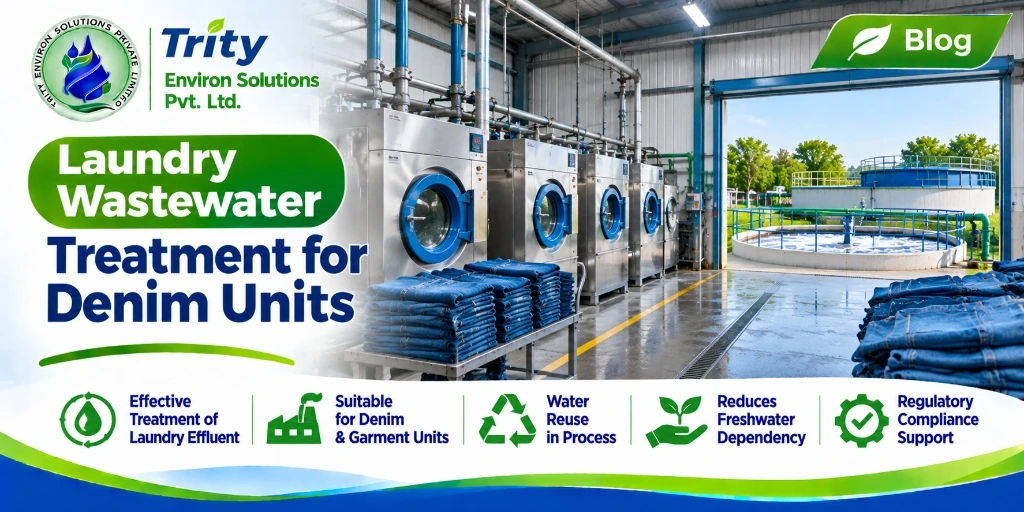
Laundry wastewater treatment for denim and garment washing by Trity Enviro: effluent profile, a 5,250 kg per day sizing example, ETP stages and reuse.











Discuss your requirements with our engineering team and get practical guidance for your project.

