Phosphate Removal in STP and ETP
Trity Enviro explains phosphate removal in STP and ETP: sources, norms, alum and ferric dosing, biological removal and a worked dosing example.

 ISO 9001:2015 & QCI Approved
Cheap steam or cheap power? That one question often decides between MEE and MVR. Here is how to run the numbers for your site.
When a factory is told to achieve zero liquid discharge, the first part of the plan is usually easy to picture. Treat the effluent, filter it, pass it through RO and recover as much water as possible. The hard part is what is left: a small volume of dark, salty reject that RO cannot concentrate any further, because the osmotic pressure is too high and the membranes would scale. That reject has to go to a thermal evaporator, which boils off the water and leaves a concentrated brine, which then goes to a dryer or crystalliser.
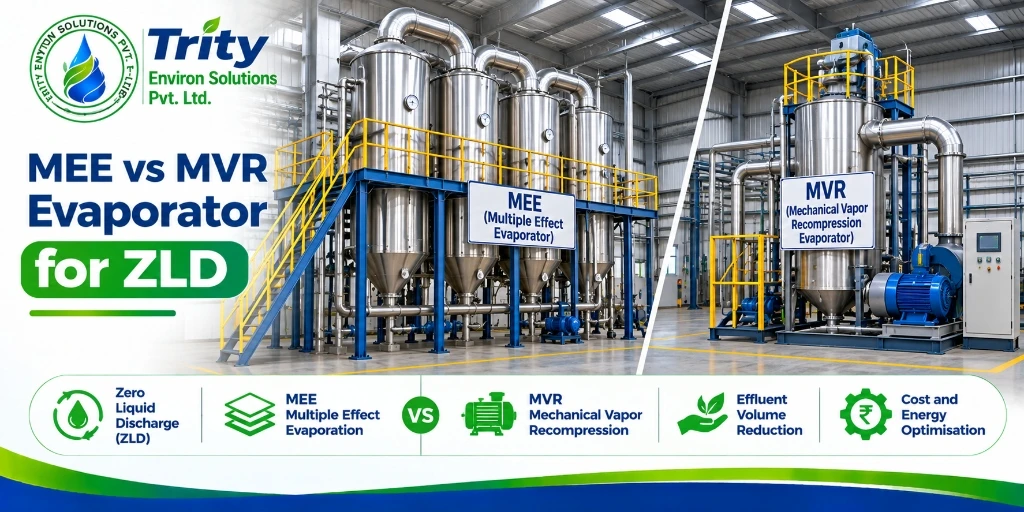
Evaporators are where ZLD plants spend most of their energy, and so they decide much of the running cost. The two main choices in India are the multiple effect evaporator (MEE), which reuses steam several times, and the mechanical vapour recompression (MVR) evaporator, which squeezes its own vapour with a compressor and reuses its heat. Both are proven. Which is better depends on what energy you have, what your wastewater does and how much you want to spend upfront.
Suppliers tend to push whichever system they sell. MVR vendors say it saves energy, and MEE vendors say it costs less and is simpler. Both statements are true in the right circumstances, which is why a plant owner needs to run the numbers.
This guide explains how each works, compares them on energy, fouling, capital cost and operation, shows a worked energy comparison for a 100 KLD evaporation duty and gives a decision guide. It is written for plant heads, EHS and utilities managers and project teams working on ZLD in chemical, pharma, textile, distillery and other industries. Trity Enviro designs ZLD systems, and the comparison reflects what we see in projects.
An MEE is a series of evaporator bodies, called effects, operating at progressively lower pressure and temperature. Fresh steam heats the first effect and boils off some water. The vapour from that effect, still hot, becomes the heating steam for the second, which boils at a lower pressure, and so on down the line. Because the same energy is used again in each effect, the steam consumption falls as effects are added. A common rule is that the steam economy, the kilograms of water evaporated per kilogram of fresh steam, is roughly 0.8 times the number of effects, so a three effect plant evaporates about 2.4 kg of water per kg of steam, and a five effect plant about 4 kg.
Many MEE plants add a thermal vapour recompressor (TVR), a steam jet that recycles some vapour and lifts efficiency further. Published vendor figures put a four effect MEE with TVR at about 0.28 kg of steam per kg of water evaporated, plus electricity of about 0.03 kWh per kg for pumps and the condenser. MEE needs a steam supply from a boiler, cooling water for the condenser and often a cooling tower.
In an MVR evaporator, the vapour boiled off from the liquid is drawn into a compressor, which raises its pressure and temperature by a few degrees. That hotter vapour is then used to heat the same evaporator, where it condenses and gives its latent heat back. Almost no fresh steam is needed once the system is running, apart from start-up. The main energy input is electricity to drive the compressor.
Vendor and academic sources quote electricity use for MVR in a wide range, from about 10 to 15 kWh per cubic metre in some descriptions to around 60 kWh per cubic metre of water evaporated for a double stage compressor in others. The range reflects different designs, salinity, boiling point elevation and compressor type. For very salty brines, the boiling point rises, so the compressor must lift the vapour further and uses more power.
MVR uses less primary energy, because it recycles latent heat directly. One vendor analysis, using coal as the basis for both steam and power, suggested about 41 percent less primary energy for MVR than for a MEE with TVR. But primary energy is not the same as the rupees on your bill. MVR uses electricity, which in India is usually costlier per unit of heat than steam from your own boiler. MEE uses steam, which can be cheap if you have waste heat, biomass, bagasse or a boiler with spare capacity. So the answer depends on the relative price of electricity and steam at your site.
Both types foul. Vendors report that evaporators concentrating difficult effluent such as dye wastes can lose a large share of their capacity within a few hundred hours without cleaning. Scale from calcium sulphate, silica and carbonates, organic fouling and foaming are the usual problems. The remedies are good pre-treatment, such as softening and antiscalant dosing, forced circulation designs, regular cleaning in place, seeding with crystals to encourage scale formation on the crystals instead of on tubes and, in some designs, self-cleaning or multiple parallel units.
Wastewater with a very high boiling point elevation, such as concentrated sodium sulphate or chloride, is harder for MVR, because the compressor must work harder. MEE copes with it by using higher pressure steam in the first effect. Foaming wastewaters, such as those from distilleries and dairies, need antifoam and careful design for either system.
MVR plants often cost more to build. One published comparison of a single stage MVR and a single effect evaporator for wastewater reported an MVR capital cost of about 113 percent of the MEE, though numbers vary a lot by project. The MVR is compact, needs no steam network and no big cooling water system, and it can run on electricity alone, which suits sites with no boiler. MEE needs more floor space, a steam line, a condenser and cooling water. MVR has a high-speed compressor, a critical rotating machine that needs skilled maintenance and spares, while MEE has simpler equipment but more of it.
| Factor | MEE | MVR |
|---|---|---|
| Main energy | Steam, plus some power | Electricity |
| Steam from boiler needed | Yes | Only at start-up |
| Capital cost | Often lower | Often higher |
| Footprint | Larger | Compact |
| Water for condenser | Needed | Little |
| Handles high boiling point elevation | Well | Harder, higher power use |
| Key maintenance item | Fouling, tubes, steam system | Compressor, fouling |
Consider a ZLD plant that must evaporate 100 m3/day of RO reject, or about 4.2 m3/h, which is 4,170 kg/h of water. Assume continuous operation, a four effect MEE with TVR using 0.28 kg of steam per kg evaporated and 0.03 kWh/kg of electricity, and a double stage MVR using 0.06 kWh/kg, using the vendor figures quoted above.
MEE: * Steam: 4,170 × 0.28 = about 1,170 kg/h * Electricity: 4,170 × 0.03 = about 125 kW * If steam costs about Rs 1.3 per kg (for instance from coal at Rs 8/kg with boiler efficiency about 75 percent) and power Rs 9 per kWh, steam costs about Rs 1,520/h and power about Rs 1,125/h. The total is about Rs 2,650/h, or about Rs 635 per m3 evaporated
MVR: * Electricity: 4,170 × 0.06 = about 250 kW * At Rs 9 per kWh, that is about Rs 2,250/h, or about Rs 540 per m3 evaporated
These prices are assumptions, and you should replace them with your own. On these numbers, MVR is cheaper by roughly 15 percent. If your steam costs half as much, because you have cheap biomass or waste heat, the MEE total falls to about Rs 450 per m3 and comes out ahead of the MVR. If your power is cheaper, or your steam dearer, MVR pulls further ahead. The lesson is that the choice should be made on your own energy prices. Add maintenance, cooling water, chemicals and labour, and compare capital cost, then check the annual saving against any extra capital for MVR.
For the larger economics of ZLD, including RO and the final dryer, see our article on ZLD plant cost, technology and mandates and our zero liquid discharge page.
Before choosing, minimise the load. Better pre-treatment, higher RO recovery and effective reuse reduce what the evaporator must handle. Our guides on tertiary water treatment, water recycling for cooling towers and industrial RO plant cost show how to cut the volume.
Trity Enviro designs ZLD systems with RO, evaporators and dryers, and an annual maintenance contract keeps them clean and efficient.
| Parameter / Stage | Target Optimal Range | Failure Impact / Risk | Corrective Engineering Action |
|---|---|---|---|
| Steam economy (MEE) | About 0.8 kg evaporation per kg steam per effect, higher with TVR | High steam bill if effects are too few | Add effects or TVR, insulate, recover condensate heat |
| Compressor power (MVR) | Roughly 15 to 60 kWh per m3 depending on design and boiling point elevation | High power bill, compressor overload | Optimise stage design, reduce salinity and fouling, service compressor |
| Fouling and scaling | Scale controlled by softening, antiscalant and cleaning schedule | Capacity falls sharply, frequent shutdowns | Pre-treat, use forced circulation, seed crystals, clean on schedule |
| Distillate quality | Low in COD and conductivity, fit for reuse or polishing | Odour, carryover, unusable water | Add vapour scrubber, polishing RO or carbon filter |
Trity Environ Solutions is an ISO 9001:2015 certified and QCI-approved zero liquid discharge system and effluent treatment plant manufacturer and supplier in India, delivering robust, high-efficiency systems engineered for CPCB and SPCB regulatory compliance.
Every installation is supported by pan-India Annual Maintenance Contract and Operation and Maintenance services.
Speak directly with our senior environmental engineers for technical guidance, sizing calculations, or a tailored project proposal.
Call +91-9821030072 or email enquiry@trityenviro.com
Trity Enviro explains phosphate removal in STP and ETP: sources, norms, alum and ferric dosing, biological removal and a worked dosing example.

Is RO water good for cooking and nutrition? An honest, evidence-based look at mineral loss, real health impact, and when remineralization matters.
Learn how to size an industrial water softener: resin volume, service flow, salt dose and regeneration cycle, with a worked example for a factory.



Discuss your requirements with our engineering team and get practical guidance for your project.