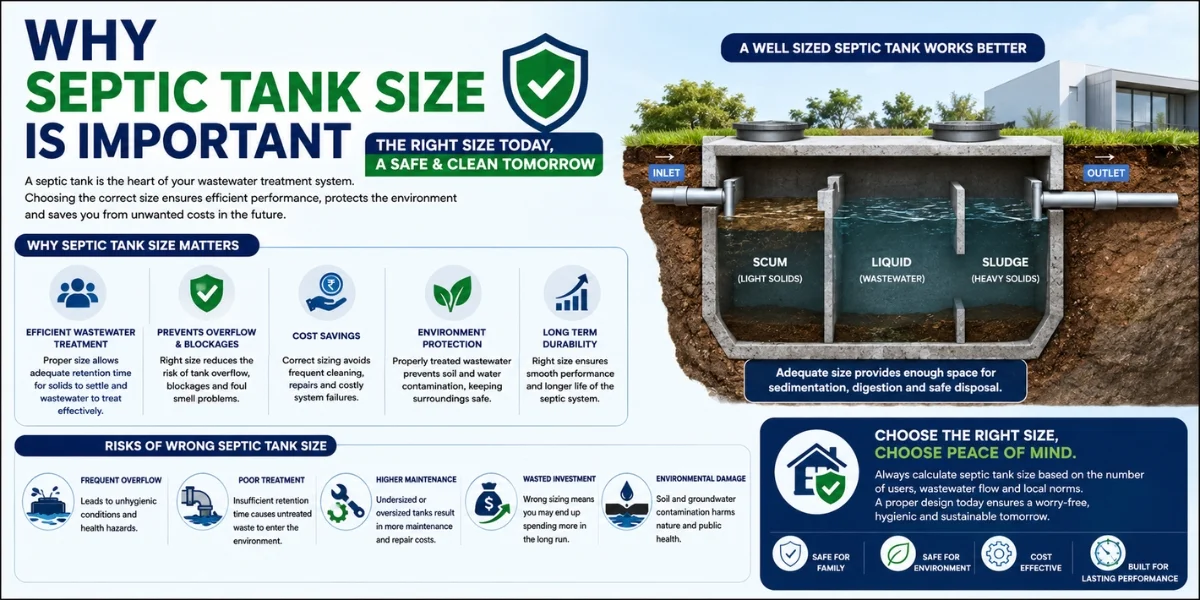
Why Septic Tank Size Matters: Standard Sizes, Formula & Sizing Guide for India
Learn the correct septic tank size for your property, IS 2470 based sizing formula, standard capacities per person, and when to upgrade to an STP.

 ISO 9001:2015 & QCI Approved
UF can double the life of an RO plant on difficult water and add cost on easy water. Here is how to tell which case is yours.
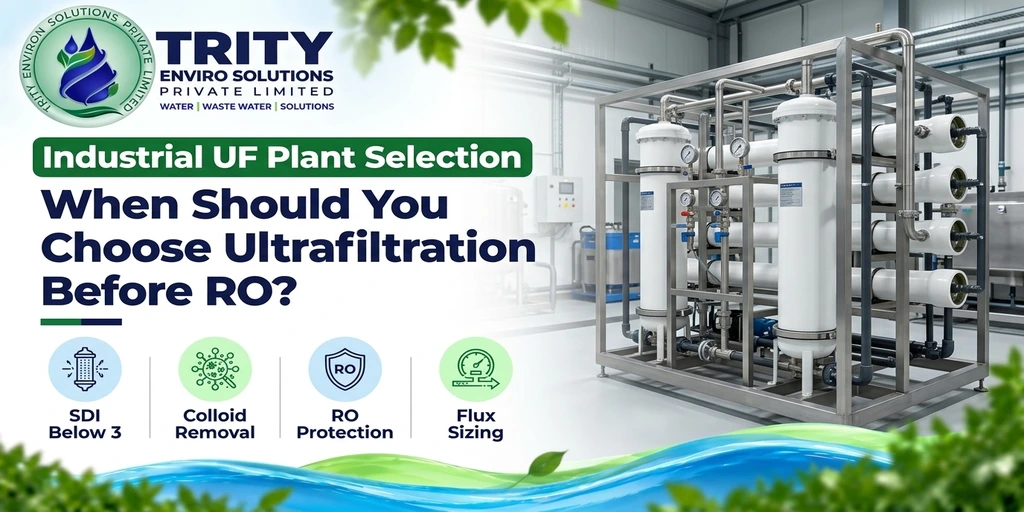
Ask any RO service engineer why membranes were replaced after eighteen months instead of five years, and the answer is rarely the membrane itself. It is the water that reached it. Colloids, fine silt, bacteria and organic matter pass through ordinary media filters, settle on the membrane surface and form a fouling layer that raises pressure, cuts flow and demands ever more frequent cleaning.
Ultrafiltration (UF) was built to stop that. A hollow fibre UF membrane acts as an absolute barrier for suspended solids and most bacteria, and it delivers a steady quality of water to the RO plant even when the raw water changes from day to day. Many plants that struggle with fouling have fixed the problem by adding UF ahead of the RO.
But UF is not free. It adds capital cost, a backwash system, cleaning chemicals and another set of instruments to maintain. On clean, steady borewell water, a good multi grade filter and cartridge filter may protect the RO perfectly well. The skill lies in knowing which situation you are in.
This guide explains how to decide, how to size an industrial UF plant, what it costs to run and what to ask a supplier. It is written for plant heads, utility engineers and project teams who already run or plan an RO, and who want to protect that investment without overspending.
A UF module is a bundle of thin hollow fibres with microscopic pores in the wall. Water is pushed from the outside to the inside of the fibres, or the reverse, and the pore size holds back suspended particles, colloids, bacteria and most viruses while allowing water and dissolved salts to pass. Solids collect on the membrane, so the plant runs in cycles: a filtration period of perhaps half an hour to an hour, followed by a short backwash and, at intervals, a chemically enhanced backwash to remove stubborn fouling.
UF delivers consistent water regardless of feed solids. Suppliers and published work report that it reduces organic matter by a large share and produces feed water with a Silt Density Index (SDI) below 3, a common target for RO feed. It also needs no coagulant in many cases, which removes a chemical dosing step.
Media filters such as multigrade or pressure sand filters work by depth filtration. They are cheap and robust, handle high turbidity well and have a long life. Their limit is the particle size they hold back and their sensitivity to changes in feed. A sand filter that gives an SDI of 3 on a calm day may give 5 or more after a rain, a pump change or a backwash. Fine colloids and bacteria pass through. Cartridge filters downstream catch some of this, but they clog and need frequent replacement.
UF does not remove dissolved salts, hardness, silica or dissolved organics in any large amount. It is a pre-treatment, not a replacement for RO, a softener or an activated carbon filter. Chlorine and organics still need their own treatment.
Consider UF when one or more of these apply:
If your water is a clean, stable borewell source with low turbidity, SDI consistently below 3 after a multigrade filter and cartridge filter, and no biological issues, UF may not pay for itself. A well maintained media filter bank is simpler, cheaper to run and easier for plant operators to understand. The same applies to small plants with a steady municipal supply.
A practical test is to measure SDI at the RO inlet daily for two weeks, including after backwash and after rain. If readings stay below the membrane maker's limit with margin, stay with media filtration. If they spike, or if membranes foul faster than expected, add UF.
UF design is based on flux, the flow per square metre of membrane area, expressed in litres per square metre per hour (LMH). Design flux depends strongly on the feed: clean groundwater allows higher values, while turbid surface water and treated effluent need lower ones. Many designs fall in a broad range of about 40 to 100 LMH, with the cleanest feeds at the top and effluent applications at the bottom. Confirm values with the module supplier for your own water.
Net production equals gross filtration minus the water used for backwash, which is usually small. Recovery in many UF plants is about 90 to 95 percent, and the backwash water can be recycled to the head of the plant or sent to treatment. Chemically enhanced backwash uses dilute acid, alkali or chlorine at set intervals, depending on the foulants.
The membrane area then follows from the net flow divided by design flux. For example, a plant that must deliver 20 m/h of net filtrate at a design flux of 60 LMH needs roughly 333 m of membrane area, before allowing for backwash losses and standby capacity. Add a margin so that the plant can meet demand while a rack is being cleaned.
UF still needs protection. A self cleaning strainer of about 100 to 200 microns ahead of the modules removes sand, fibres and debris that can puncture the fibres. High iron or manganese water needs oxidation and removal, and heavy turbidity may need an inline coagulant or a clarifier. Check the chlorine tolerance of the membrane and the allowed pH range, since both affect cleaning options.
Materials matter. Look for membranes made from PVDF or PES, with a stated chemical tolerance, in modules that can be replaced individually. Frames, piping and valves should suit the cleaning chemicals. An automated plant with a PLC, transmembrane pressure sensors and flow meters will protect itself by alarming when fouling rises.
Before the plant goes into service, flush the modules to remove preservative, check that the strainer and all valves operate in the right sequence and confirm that the backwash and chemical cleaning pumps deliver their design flow. Many suppliers run an integrity test, such as a pressure decay test, to prove that no fibre is broken. Repeat it at intervals, because a single broken fibre lets bacteria and solids through to the RO. Record the baseline permeability and transmembrane pressure when the plant is new, so that you can judge fouling later against a real reference. Train operators to read the trend, not just the instantaneous value, and to log every chemical cleaning with the date, the chemical and the permeability recovered.
The running cost of a UF plant includes power for the feed and backwash pumps, chemicals for cleaning, compressed air for valves, membrane replacement every several years and operator time. Power use is modest compared with RO. The savings appear on the RO side: lower cleaning frequency, longer membrane life, more stable output and lower cartridge filter consumption. Many users find that these savings offset much of the UF cost, especially on variable water.
Operators should watch transmembrane pressure and permeability. A steady upward drift means fouling is outpacing cleaning. Adjust the backwash interval, the chemical dose or the pre-treatment, and clean before the plant reaches its limit. Keep records of each cleaning and the recovery it achieved.
You can read about our ultra filtration system and see how it pairs with our industrial RO plant. For a broader view of choosing a treatment train, our article on water treatment plant selection for industries is a useful companion, and an annual maintenance contract keeps cleaning and checks on a schedule.
| Parameter / Stage | Target Optimal Range | Failure Impact / Risk | Corrective Engineering Action |
|---|---|---|---|
| SDI at RO inlet | Below 3 for best protection, within the RO membrane maker's limit | Fast RO fouling, frequent cleaning, short membrane life | Add or repair UF, improve pre-treatment, check cartridge filters |
| UF design flux | Commonly 40 to 100 LMH, lower for turbid or effluent feed | Rapid fouling and high transmembrane pressure if too high | Increase membrane area, lower flux, improve strainer and coagulation |
| Strainer ahead of UF | Typically 100 to 200 micron, self cleaning | Broken fibres, loss of integrity, bacteria passing | Install or service strainer, add integrity testing |
| Transmembrane pressure trend | Stable after each backwash, with slow rise between cleans | Fouling, reduced output, plant shutdown | Adjust backwash and chemical cleaning interval, check feed quality |
Trity Environ Solutions is an ISO 9001:2015 certified and QCI-approved ultrafiltration system manufacturer and supplier in India, delivering robust, high-efficiency systems engineered for CPCB and SPCB regulatory compliance.
Every installation is supported by pan-India Annual Maintenance Contract and Operation and Maintenance services.
Learn the correct septic tank size for your property, IS 2470 based sizing formula, standard capacities per person, and when to upgrade to an STP.

A guide to DPCC's sewage treatment plant requirements in Delhi, covering current discharge norms, mandatory installation rules, and compliance steps.

Discover why the size of your water softener is crucial. Learn how to choose the right size for optimal performance, efficiency, and cost savings for your home.











Discuss your requirements with our engineering team and get practical guidance for your project.

