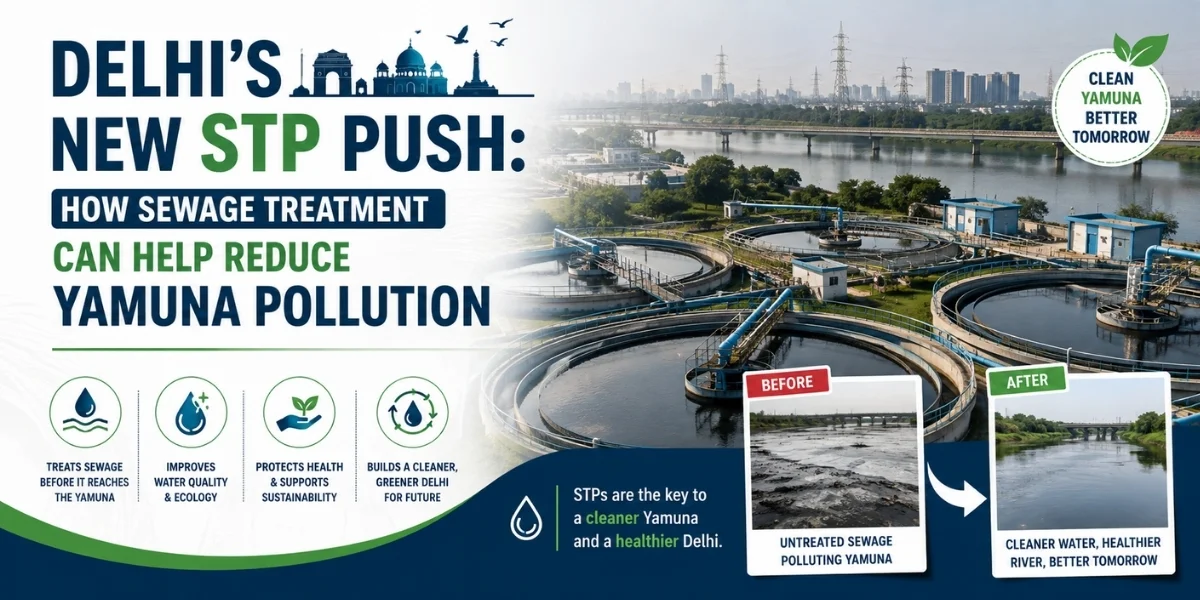
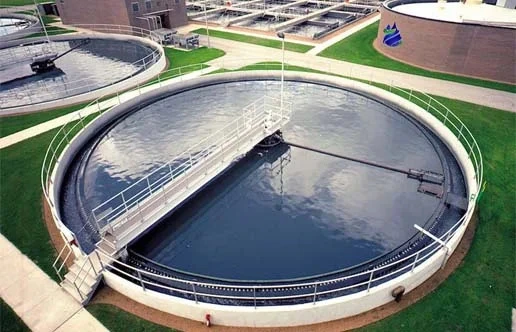
The Delhi Jal Board has approved a nearly Rs 4,500 crore package to expand the city's sewage treatment and sewer network. The plan, cleared at DJB's 179th meeting in late July 2026, adds 15 new decentralised sewage treatment plants and nearly 989 km of new sewer lines.
Officials say the goal is to ensure treated capacity finally catches up with the sewage Delhi generates every day. The announcement builds on earlier 2025 and 2026 projects, including the Okhla wastewater treatment plant and STP expansions at Nilothi and Pappankalan.
Delhi's Latest STP Development at a Glance
| Detail | Information |
|---|---|
| Location | Underserved colonies and villages across Delhi, including the Najafgarh drainage zone |
| Project/Facility | 15 new Decentralised Sewage Treatment Plants (DSTPs), part of a wider Rs 4,500 crore package |
| Capacity | 103.5 MGD combined additional capacity from the 15 new DSTPs (28 DSTPs now under implementation in total) |
| Authority | Delhi Jal Board (DJB) |
| Current Status | Approved and awarded at DJB's 179th meeting, late July 2026, with a 21-month completion deadline |
| Purpose | Reduce untreated sewage reaching the Yamuna from areas that currently lack sewer connections |
What Is Driving Delhi's New STP Push?
Delhi generates close to 1,000 MGD of sewage every day, but its installed treatment capacity stood at only 749 MGD when the current government took charge. That gap meant a large volume of sewage was reaching the Yamuna without full treatment.
Over the past year, DJB has raised installed capacity to 814 MGD by upgrading existing plants. The latest package is meant to close the remaining gap through new decentralised plants and better sewer connectivity.
Central government attention has added pressure too. In July 2025, Union Home Minister Amit Shah chaired a review meeting on Yamuna rejuvenation and directed that Delhi's STP capacity be increased to 1,500 MGD by 2028, with third-party testing of treated water quality.
What Is the Current Sewage Treatment Situation in Delhi?
Delhi currently operates 37 sewage treatment plants, most of them run by private contractors under DJB oversight. In 2025, the Water Minister ordered a third-party audit of all 37 plants to assess their actual performance against design capacity.
Combined installed capacity across these plants is 814 MGD, against estimated daily sewage generation of close to 1,000 MGD. This shortfall is the core reason large volumes of sewage still reach the Yamuna without complete treatment, particularly from colonies and villages that are not yet connected to the sewer network.
How Sewage Treatment Plants Help Reduce Yamuna Pollution
An STP removes organic matter, suspended solids, and pathogens from sewage before it is discharged. This lowers the pollution load entering the river compared to raw, untreated sewage.
Properly functioning STPs reduce oxygen-depleting organic waste, cut down foul odour, and bring down harmful bacteria levels in the water that finally reaches the Yamuna. The benefit depends heavily on how much sewage is actually intercepted and routed to a plant, not just on how many plants exist.
How an STP Works
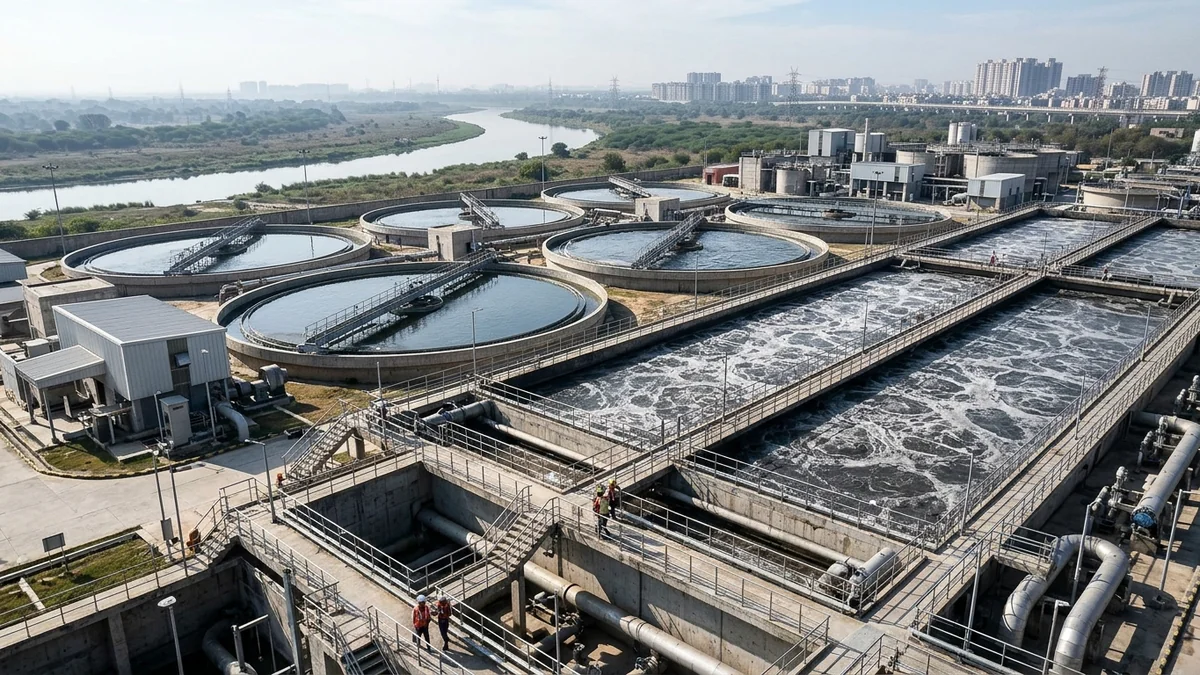
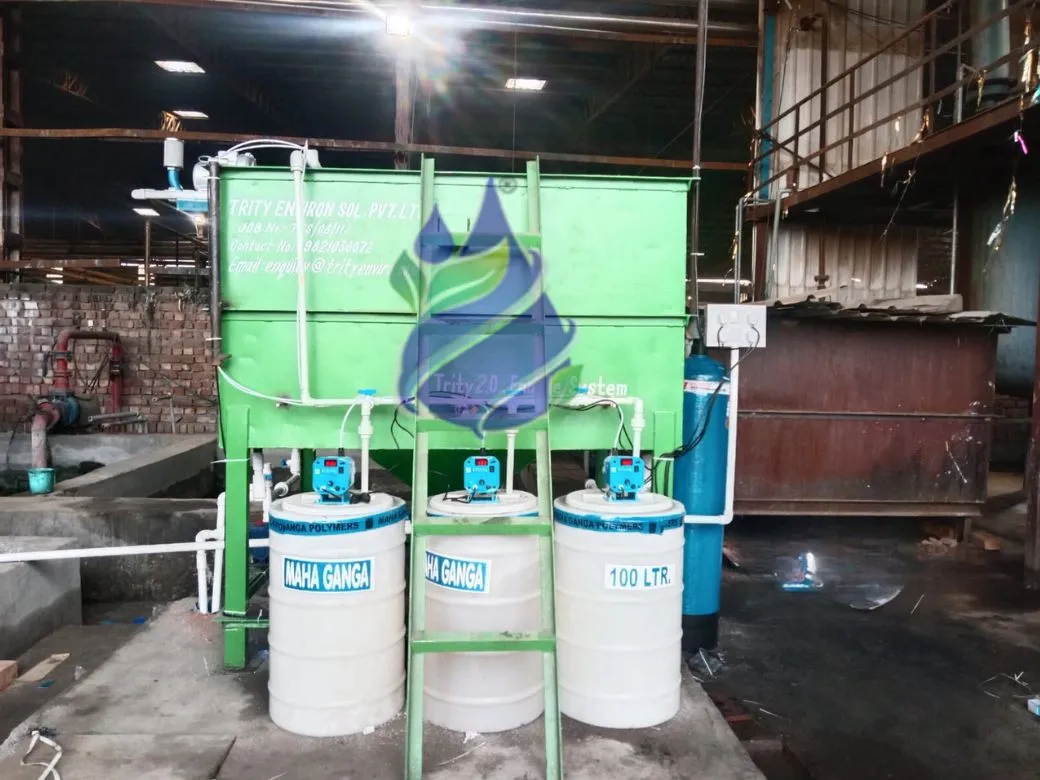
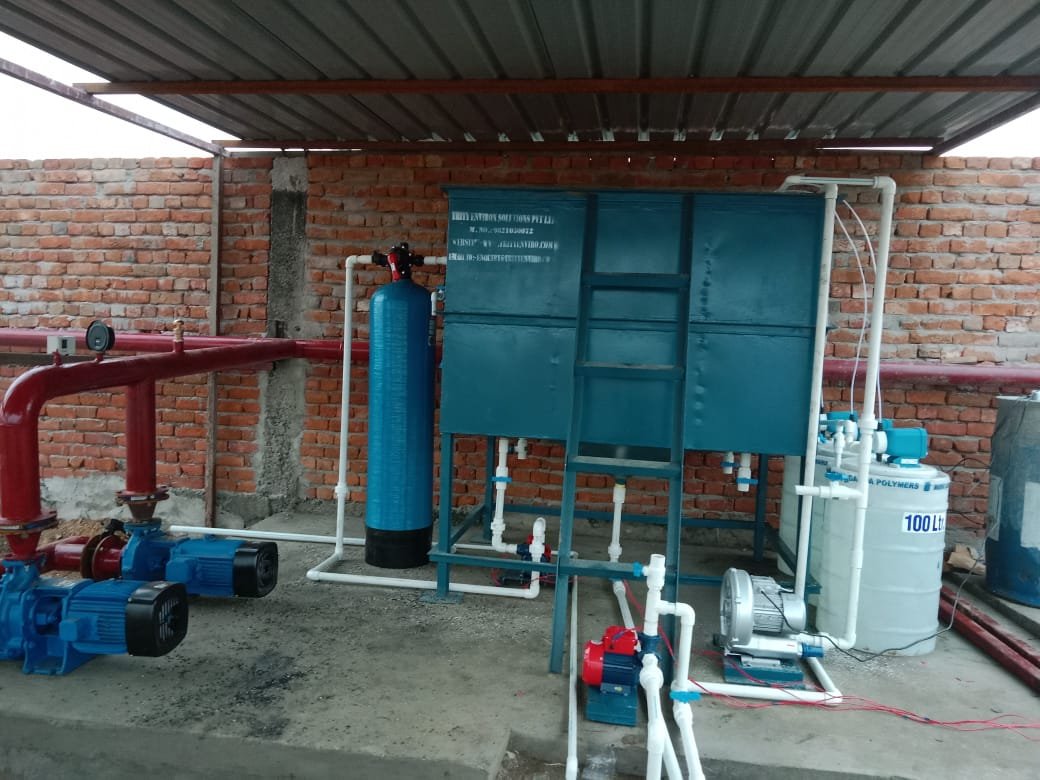
Different STPs in Delhi use different technologies, from conventional Activated Sludge Process (ASP) systems to newer decentralised units. Many of the city's smaller and newer plants also rely on MBBR-based secondary treatment, which uses moving biofilm media to break down organic pollutants in a compact footprint. The stages below describe a typical sewage treatment plant, similar in principle to the Okhla facility, and not every Delhi STP will include every stage described.
Preliminary Treatment
Incoming sewage first passes through screens and grit chambers. This removes large debris, plastic, rags, and sand that could damage downstream equipment.
Primary Treatment
The sewage then moves into primary settling tanks. Heavier solids settle out as primary sludge, while oil and grease are skimmed from the surface.
Biological Treatment
In this stage, microorganisms break down dissolved and suspended organic matter. Plants like Okhla use the Activated Sludge Process, where aeration tanks keep bacteria active and oxygenated to consume organic pollutants.
Secondary Clarification
After biological treatment, the water moves to secondary clarifiers, where treated water separates from the biological sludge. Some of this sludge is recycled back into the aeration tanks to maintain the microbial population.
Tertiary Treatment and Disinfection
Advanced plants add a further polishing stage. At Okhla, this includes tertiary disc filters and UV disinfection, which help the plant achieve BOD and TSS levels below 10 mg/L in the final treated water.
What Happens to Treated Wastewater?
Treated wastewater from Delhi's STPs is used in several ways, depending on the plant and location. Verified uses include:
- Horticulture, such as watering parks and green spaces
- Discharge back into the Yamuna to supplement river flow with treated rather than raw sewage
- Non-potable applications like flushing and construction use in some projects
At Okhla specifically, around 40 MLD of treated water has been used for horticulture across Delhi since June 2024, based on official government statements. Not every wastewater treatment plant in the city currently has a dedicated large-scale reuse arrangement, and this varies by plant.
What Happens to Sludge Generated at an STP?
Biological and primary treatment stages generate sludge, which needs separate handling. At Okhla, sludge is processed to generate biogas that powers part of the plant itself, supplying around 4.8 MW of green energy and meeting roughly half the facility's own energy needs.
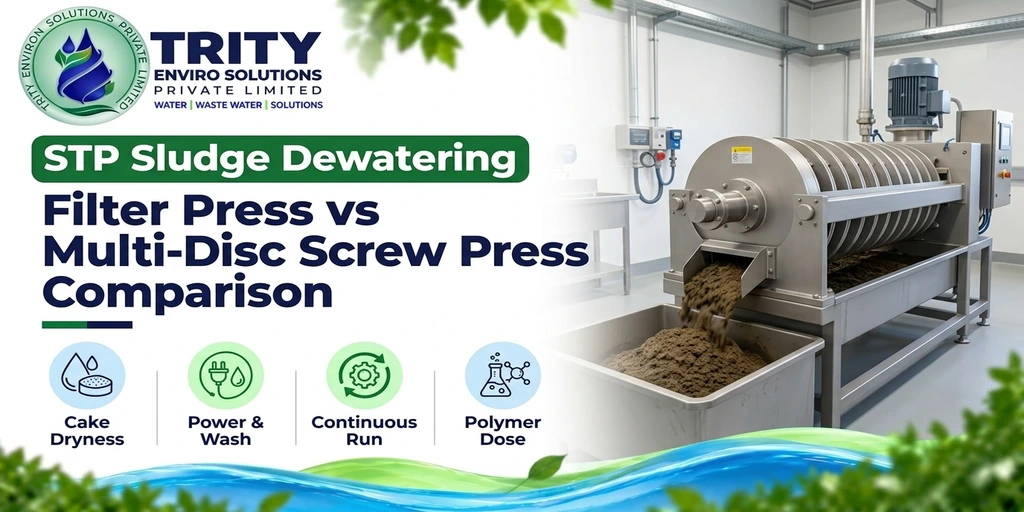
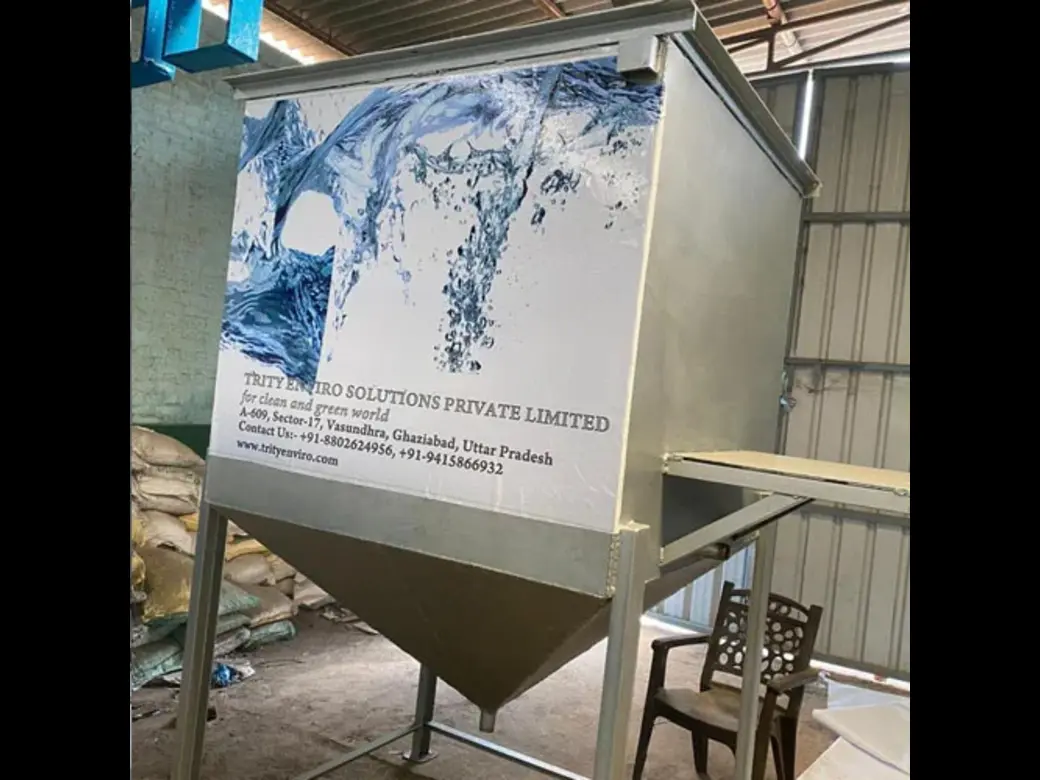
The residual sludge from Okhla is treated to Class-A quality, described by officials as odourless, pathogen-free, and safe for use as organic fertiliser or soil conditioner, reportedly the first plant in India to achieve this standard. Under the newly approved Rs 4,500 crore package, DJB has also approved a citywide sludge management initiative to convert sludge from other plants into biogas and construction materials such as bricks, rather than treating it purely as waste. Getting sludge to that usable, dry state typically requires dedicated equipment such as a sludge dewatering filter press, which separates solids from liquid before further processing.
How Untreated Sewage Affects the Yamuna
Untreated sewage carries high levels of organic matter, measured through Biochemical Oxygen Demand (BOD) and Chemical Oxygen Demand (COD). As bacteria break down this organic matter in the river, they consume dissolved oxygen (DO), leaving less available for fish and other aquatic life.
For water to be considered safe for bathing, BOD should stay below 3 mg/L, according to CPCB standards. A CPCB report submitted to the National Green Tribunal showed BOD levels at Delhi's Palla monitoring station reaching 6 mg/L in late October 2024 and spiking to 13 mg/L in mid-December 2024, well above the bathing standard.
The same report found faecal coliform levels at Palla far exceeding the permissible limit of 2,500 MPN per 100 ml on certain dates, pointing to heavy sewage contamination. Beyond oxygen depletion and bacterial contamination, untreated sewage also causes visible foam, odour, and long-term ecological damage to the river stretch that flows through Delhi.
Delhi's Existing STP Network and Major Projects
| STP/Project | Location | Capacity | Status | Purpose |
|---|---|---|---|---|
| Okhla WWTP | Okhla, South Delhi | 564 MLD | Fully operational since April 2025 | Treats sewage from Old Delhi, Central Delhi, NDMC and South Delhi areas |
| Nilothi-1 STP expansion | Nilothi, West Delhi | Expanded from 40 MGD to 60 MGD | Inaugurated March 2026 | Increases treatment capacity in west Delhi |
| Pappankalan Phase-1 STP expansion | Pappankalan, West Delhi | Expanded from 20 MGD to 30 MGD | Inaugurated March 2026 | Increases treatment capacity in west Delhi |
| Najafgarh zone DSTPs (earlier batch) | Najafgarh drainage zone, including Kair, Kanganheri, Kakrola, Dichaon Kalan | Combined capacity not stated | Awarded, May 2026 | Targets the Najafgarh drain, reported to carry 60 to 70 percent of Yamuna's total pollution load |
| 15 new DSTPs (2026 batch) | Underserved colonies and villages across Delhi | 103.5 MGD combined | Awarded, late July 2026, 21-month deadline | Decentralised treatment in areas lacking sewer infrastructure |
Why STP Capacity Alone Is Not Enough
Adding treatment capacity does not automatically mean less pollution reaches the Yamuna. Several other factors determine whether that capacity actually gets used.
Sewer connectivity matters as much as plant capacity. DJB's own data shows around 8 lakh households across 244 colonies and 57 villages still lack sewer connections, meaning their sewage currently bypasses treatment plants entirely and flows directly into drains.
Sewage interception at drain points is another gap. Even where sewer lines exist, some sewage escapes into open drains before reaching an STP, particularly in older or informal settlements.
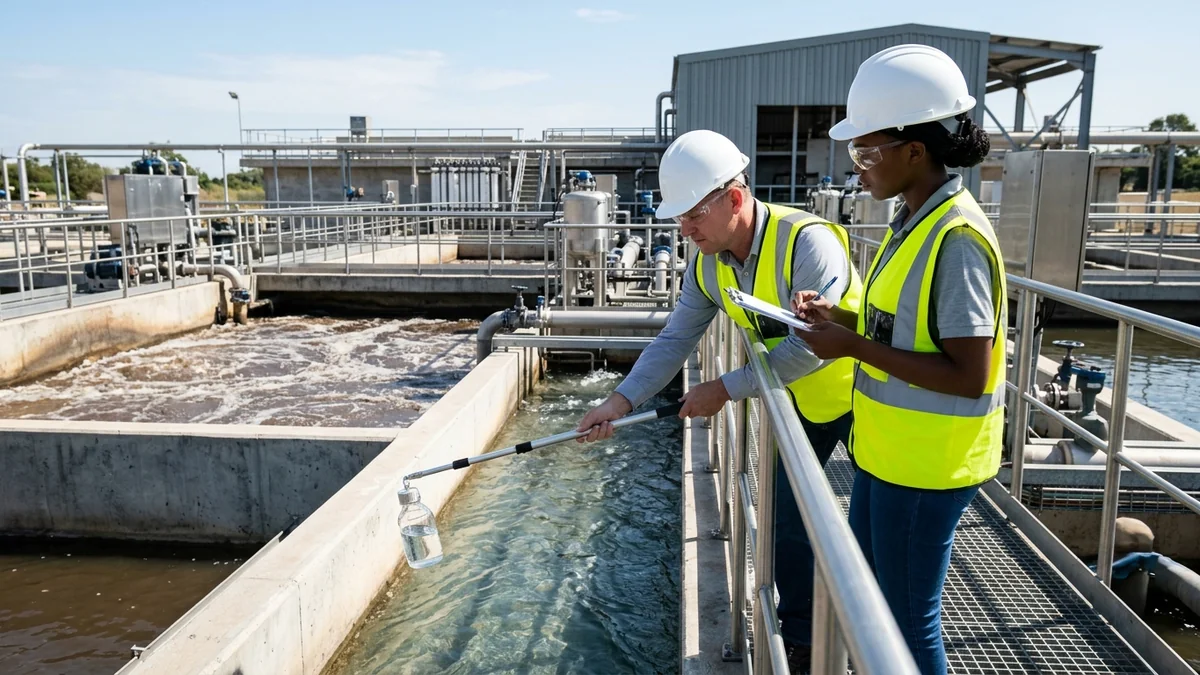
Operation and maintenance quality affects real-world performance. This is why DJB ordered a third-party audit of all 37 existing STPs and introduced a performance-linked payment system tying contractor payments to actual treated water quality, not just plant uptime.
Power reliability, correct loading of plants, and consistent monitoring of BOD and other parameters at plant inlets and outlets all influence whether an STP meets its design standards day to day. Tertiary treatment, where required, and proper sludge management add further layers of cost and complexity that some older plants were not originally built to handle, which is why many operators work with a dedicated STP and ETP plant manufacturer in Delhi NCR for upgrades rather than retrofitting equipment in-house.
What This Means for Yamuna Pollution
Better sewage treatment is one part of a larger pollution picture, not a complete solution by itself. Sewage treatment addresses domestic wastewater, but Yamuna pollution also comes from industrial effluent, which requires separate treatment through an effluent treatment plant rather than a standard STP, along with solid waste dumped into drains, stormwater runoff, and encroachment along the riverbed and floodplain.
Expanding STP and DSTP capacity, combined with sewer network expansion and drain interception, directly targets the sewage component of this problem. It does not by itself resolve industrial discharge, unauthorised dumping, or the broader ecological and hydrological issues affecting the river, including low flow during dry months.
Challenges Delhi Still Needs to Address
Several structural issues remain even after this latest package. Connecting the remaining unconnected colonies and villages to the sewer network is a multi-year task, and delays in laying pipelines can offset gains from new treatment capacity.
Consistent operation and maintenance of decentralised plants spread across many small sites is harder to monitor than a handful of large centralised STPs. Sustained third-party quality checks, as directed by both the Union Home Minister and Delhi's Water Minister, will need to continue well beyond the initial audit.
Sludge management at scale, beyond flagship plants like Okhla, is still being rolled out citywide. Coordination with neighbouring states, since the Yamuna also picks up pollution before and after it passes through Delhi, remains a separate and largely unresolved challenge.
What Could Improve Delhi's Wastewater Management?
Practical steps that follow from the current gaps include faster household sewer connections in the newly targeted colonies and villages, so new treatment capacity is not left underused. Continued third-party auditing and performance-linked payments can help ensure that treated water quality matches design standards, not just installed capacity.
Expanding proven reuse models, such as Okhla's horticulture use of treated water, to other plants could reduce reliance on fresh water for non-potable needs. Scaling up sludge-to-biogas and sludge-to-brick initiatives across more STPs, not only Okhla, would also cut down on sludge disposal as a pollution source in its own right.
Frequently Asked Questions
Q1. Why does Delhi need more sewage treatment plants?
Delhi generates close to 1,000 MGD of sewage daily, but installed treatment capacity was only 749 MGD before recent upgrades, now raised to 814 MGD. This gap means a significant volume of sewage has been reaching the Yamuna without complete treatment.
Q2. How does an STP help reduce Yamuna pollution?
An STP removes organic matter, suspended solids, and pathogens from sewage before discharge. This lowers the oxygen-depleting load and bacterial contamination that would otherwise enter the river directly from untreated sewage.
Q3. How does a sewage treatment plant work?
Sewage typically passes through preliminary screening, primary settling, biological treatment using microorganisms, secondary clarification, and in advanced plants, tertiary filtration and disinfection, before the treated water is discharged or reused.
Q4. What happens to sewage after it reaches an STP?
It moves through progressive treatment stages that remove solids, break down organic pollutants biologically, and in advanced plants, apply filtration and disinfection, before the treated water is released or reused and the residual sludge is processed separately.
Q5. What is treated wastewater?
Treated wastewater is sewage that has passed through an STP's treatment stages and meets defined quality parameters such as reduced BOD and suspended solids, making it suitable for discharge into a water body or reuse in non-potable applications.
Q6. Can treated wastewater be reused?
Yes. At Delhi's Okhla plant, around 40 MLD of treated water has been used for horticulture since June 2024. Reuse potential also extends to non-potable applications like flushing and construction, though this varies by plant.
Q7. What are the main challenges in Delhi's sewage treatment system?
Key challenges include unconnected households bypassing the sewer network, sewage escaping into open drains before reaching STPs, inconsistent plant operation and maintenance, and scaling up sludge management beyond a few flagship facilities.
Q8. Can STPs alone clean the Yamuna?
No. Sewage treatment addresses domestic wastewater pollution, but Yamuna pollution also comes from industrial effluent, solid waste, stormwater, and encroachment. STP expansion is one necessary part of a larger, multi-source cleanup effort.