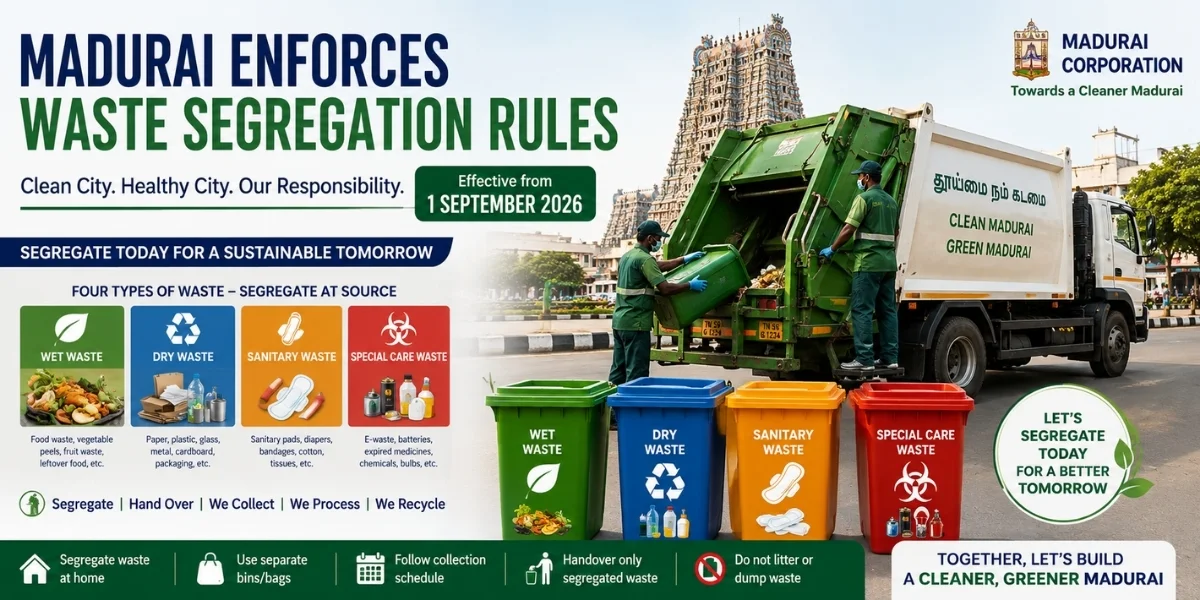
Madurai Corporation is enforcing source segregation of household and commercial waste from September 1, 2026. Residents and businesses are now required to separate waste at the point of generation before handing it over to collection staff, rather than mixing it together.
This is a local enforcement push by Madurai Corporation, distinct from the national Solid Waste Management (SWM) Rules, 2026, which were notified by the Ministry of Environment, Forest and Climate Change and came into effect across India on April 1, 2026. Madurai's move is about strengthening compliance with that national framework at the city level.
Madurai Waste Segregation Rules at a Glance
| Detail | Information |
|---|---|
| City | Madurai |
| Implementing Authority | Madurai Corporation |
| Enforcement Date | September 1, 2026 |
| Coverage | Citywide, across Madurai Corporation limits |
| Segregation System | Four-stream segregation as per national SWM Rules, 2026: wet, dry, sanitary, and special care waste |
| Mixed Waste | Households and businesses are required to hand over pre-segregated waste to collection staff |
| Penalties | Governed by the Polluter Pays principle under SWM Rules, 2026; specific local fine amounts have not been independently verified at the time of writing |
| Collection System | Door-to-door collection by Madurai Corporation sanitation staff |
What Has Changed in Madurai From September 1?
Madurai Corporation has begun requiring residents and commercial establishments to segregate waste into separate streams before it is collected. This shifts responsibility for sorting waste from the point of collection back to the point of generation.
The city has historically struggled with full source segregation. Madurai Corporation's own published data has previously acknowledged that segregation and house-to-house collection covered only a fraction of the city, so this enforcement push is meant to close that gap.
Why Is Source Segregation Important?
When waste is mixed at the household level, it becomes far harder and costlier to sort later. Wet waste contaminates dry recyclables, sanitary items pose handling risks to workers, and everything ends up heading toward a landfill instead of a recycling or composting facility.
Segregating at source keeps materials clean enough to actually be composted, recycled, or safely disposed of. It also directly protects the sanitation workers who handle the waste, since mixed loads carry a higher risk of injury from sharp or hazardous items.
What Are the Four Waste Categories?
The national SWM Rules, 2026 mandate a four-stream segregation system. This replaces the earlier three-category approach used under the 2016 rules.
Wet Waste
Wet waste covers kitchen scraps, food leftovers, vegetable and fruit peels, and similar organic matter. Under the SWM Rules, 2026, this stream is meant to be composted or processed through biomethanation at the nearest facility.
Dry Waste
Dry waste includes recyclable materials such as plastic, paper, metal, glass, wood, and rubber. It is meant to be routed to Material Recovery Facilities (MRFs), where it is sorted and sent on to recyclers.
Sanitary Waste
Sanitary waste includes items such as diapers, sanitary napkins, tampons, and similar hygiene products. The rules require this waste to be securely wrapped and stored separately, rather than mixed with other streams.
Special Care Waste
Special care waste covers items like paint cans, bulbs, batteries, and expired medicines. These are meant to be handed over only to authorised agencies or designated collection centres, not the regular waste stream.
What Happens if Waste Is Not Segregated?
Under the national SWM Rules, 2026, non-compliance can attract environmental compensation based on the Polluter Pays principle, with State Pollution Control Boards and Pollution Control Committees empowered to levy this compensation. Specific fine amounts applicable within Madurai have not been independently verified as of this writing.
Sanitation workers are generally expected to encourage residents to segregate waste before collection, in line with the broader intent of the rules. Readers should confirm exact local penalty amounts and any grace period directly with Madurai Corporation, since this level of detail can change and was not confirmed in verifiable sources at the time of publishing.
How Will Door-to-Door Waste Collection Work?
Madurai Corporation carries out door-to-door waste collection through its sanitation staff across the city. The enforcement change from September 1 asks residents to hand over waste already separated into the relevant streams, rather than as a single mixed load.
Specific details such as the exact colour-coding scheme used on collection vehicles, the weekly collection frequency for each waste stream, and ward-by-ward rollout timelines have not been independently verified for this article and are not included here. Residents should refer to official communication from Madurai Corporation for these operational specifics.
What Happens to the Segregated Waste?
Once collected, each waste stream is meant to follow a different treatment path rather than ending up together.
Wet or biodegradable waste is collected and processed through composting or biological treatment, producing compost or biogas as a useful output. Dry waste is collected, sorted at a Material Recovery Facility, and channelled into recycling. Sanitary and special care waste follow a separate handling path, going to authorised treatment or disposal rather than a standard landfill or composting stream.
What Changes for Households and Businesses?
For Households
Households are expected to keep wet, dry, sanitary, and special care waste in separate containers at home and hand each stream over separately to collection staff, rather than combining them into one bag or bin.
For Shops and Commercial Establishments
Shops and other commercial establishments generating waste are expected to follow the same four-stream segregation before handover, since mixed commercial waste creates the same downstream sorting problems as mixed household waste.
For Bulk Waste Generators
Under the national SWM Rules, 2026, large waste generators, defined by thresholds such as floor area, water consumption, or daily waste volume, carry additional responsibility for managing their own waste, including onsite processing arrangements in some cases. Establishments in Madurai that meet these thresholds should check their specific obligations directly, since bulk generator status depends on verified size and consumption data not available for individual establishments here.
How Source Segregation Can Reduce Landfill Waste
Segregating waste at source directly improves how much can be recovered instead of landfilled. Clean wet waste can go to composting or biomethanation, clean dry waste can be recycled at a Material Recovery Facility, and hazardous items can be kept out of the general waste stream entirely.
This does not mean landfill use disappears. Only the genuinely non-recyclable, non-compostable residue is meant to reach a landfill under this model, but achieving that in practice still depends on how consistently segregation is followed across the city.
Challenges in Implementing Waste Segregation
Enforcement pushes like this one face a familiar set of challenges in cities across India, and Madurai is unlikely to be an exception.
Household participation is often the hardest part to sustain, since segregation requires a daily habit change rather than a one-time action. Even partial compliance can lead to contamination, where a small amount of wet waste mixed into a dry waste bag makes the whole load harder to recycle.
Collection logistics also matter. Vehicles and staff need to be organised to keep segregated streams separate all the way to processing, not just at the doorstep. Sanitation worker training, consistent monitoring, and sufficient processing capacity at composting and recycling facilities all need to keep pace with how much segregated waste is actually being collected.
What Madurai's Move Means for Waste Management
Madurai's enforcement push reflects a broader pattern seen in other Tamil Nadu and Indian cities working to align local practice with the national SWM Rules, 2026. The shift from a collect-and-dump approach to a segregation-first system is central to that framework's goal of reducing landfill dependence and improving resource recovery.
Whether this translates into real change on the ground will depend on how consistently the rules are enforced, how much residents and businesses adapt their daily habits, and whether the city's collection and processing infrastructure can keep up with cleanly segregated waste at scale.
Frequently Asked Questions
Q1. What are the new waste segregation rules in Madurai?
From September 1, 2026, Madurai Corporation is enforcing source segregation, requiring households and businesses to separate waste into wet, dry, sanitary, and special care categories before handing it over for collection.
Q2. When did Madurai begin enforcing source segregation?
Madurai Corporation's local enforcement of source segregation began on September 1, 2026, building on the national Solid Waste Management Rules, 2026, which came into effect on April 1, 2026.
Q3. What are the four categories of waste under the SWM Rules, 2026?
The four categories are wet waste (kitchen and organic waste), dry waste (recyclables like plastic, paper, metal, and glass), sanitary waste (diapers and hygiene products), and special care waste (items like batteries, bulbs, and expired medicines).
Q4. What should households put in the wet waste bin?
Wet waste includes kitchen scraps, food leftovers, and fruit or vegetable peels. This waste is meant to be composted or processed through biomethanation rather than sent to a landfill.
Q5. What happens if mixed waste is handed over for collection?
Under the national SWM Rules, 2026, non-compliance can attract environmental compensation under the Polluter Pays principle. Specific fine amounts applicable in Madurai have not been independently verified at the time of writing.
Q6. How is dry waste processed after collection?
Dry waste such as plastic, paper, metal, and glass is sent to a Material Recovery Facility, where it is sorted before being channelled to recyclers.
Q7. What is special care waste?
Special care waste refers to items such as paint cans, bulbs, batteries, and expired medicines. These must be handed over to authorised agencies or designated collection centres rather than mixed with regular household waste.
Q8. Why is source segregation important for waste management?
Segregating waste at the household or business level keeps materials clean enough to be composted or recycled, reduces landfill dependence, and protects sanitation workers from the risks of handling mixed or hazardous waste.