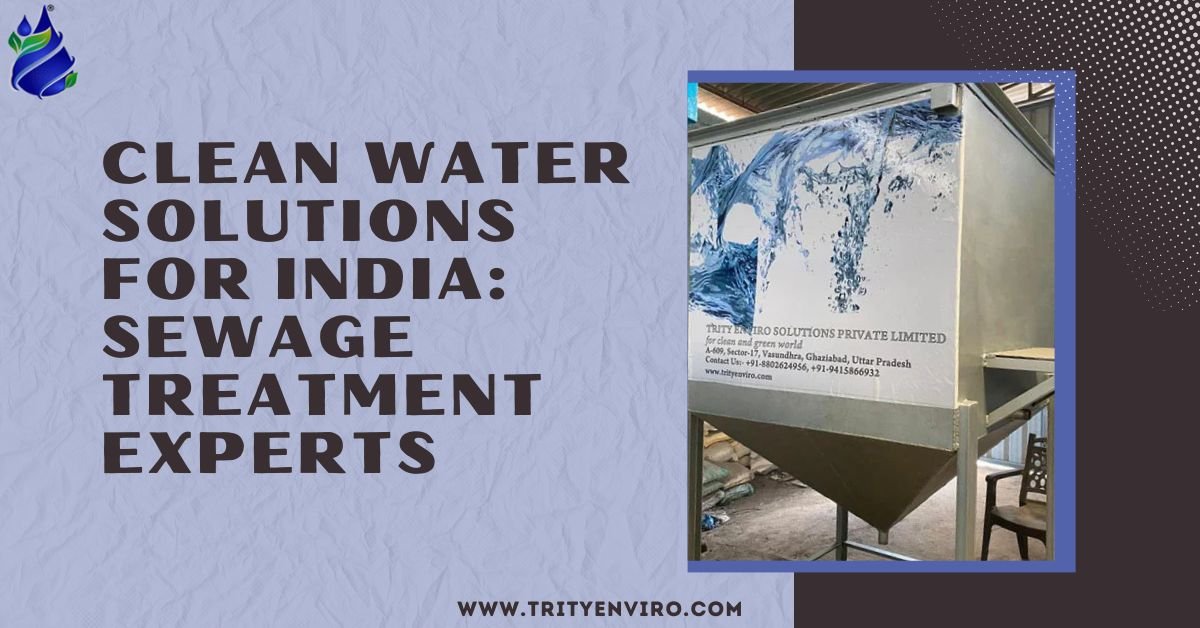
Clean Water Solutions for India: Sewage Treatment Experts
Trity Enviro Solutions offers advanced, affordable sewage treatment systems for residential, industrial, and environmental needs to solve India's water crisis.

 ISO 9001:2015 & QCI Approved
The revised particulate limit now applies to covered Delhi-NCR industries from 1 October 2026. This guide shows how to test your stack, pick the right control system and stay inspection ready.
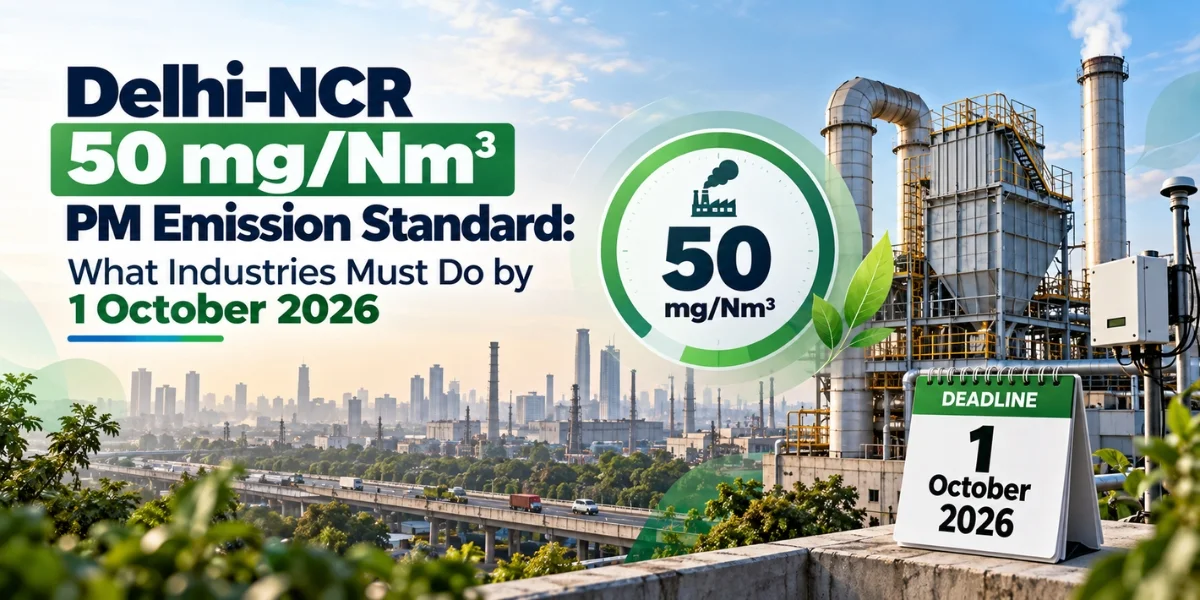
Most plant managers in Delhi-NCR have spent the last few winters answering the same question from their management: are we part of the smog problem? For industrial stacks, the regulator has now answered it with a number.
The Commission for Air Quality Management (CAQM) issued Direction No. 98 in February 2026, setting a particulate matter limit of 50 mg/Nm³ for identified industries in the region. The original schedule was phased, with large and medium units first and the rest later. After representations from industry, CAQM amended the direction so that the 50 mg/Nm³ PM emission standard applies to all covered industries uniformly from 1 October 2026, while leaving the limit itself unchanged.
The Commission based the standard on CPCB recommendations, IIT Kanpur studies and a technical committee report, and it concluded that the limit is achievable with proper control equipment. It also says the new direction overrides the earlier PM standards in its 2022 directions. For a plant running an old cyclone on a coal or biomass boiler, this is a real engineering task and it needs planning, not last minute purchase orders.
The direction is short, but each phrase in it decides whether your unit is inside or outside its scope.
The maximum permissible limit of particulate matter is 50 mg/Nm³, measured at the stack and expressed at normal conditions of temperature and pressure. The direction applies to 17 categories of highly polluting industries identified by CPCB, to medium and large red category air polluting industries, and to food and food processing units, textile units that have boilers or thermic fluid heaters, and metal units that have furnaces, operating in Delhi-NCR.
Delhi-NCR here means the National Capital Territory and the NCR districts of Haryana, Uttar Pradesh and Rajasthan. The respective state governments and pollution control boards, including DPCC, are tasked with enforcement.
Units that already carry a PM limit below 50 mg/Nm³ under a consent, direction or statutory provision keep that stricter limit. The 50 mg/Nm³ figure is a ceiling, not a target you can sit at comfortably. If your consent says 30, then 30 is your number.
On timing, the direction first ran in two phases, 1 August 2026 for large and medium industries and 1 October 2026 for the rest. The amendment brought everyone to 1 October 2026. If your unit was counting on the later date as a small unit, nothing has changed for you. If you are large or medium, you gained two months, and those months are almost gone.
You cannot design an upgrade around a guess. The starting point is a set of measured numbers from your own stack.
Ask an accredited environmental laboratory to carry out isokinetic stack sampling on each boiler, thermic fluid heater or furnace stack. Isokinetic means the sampling nozzle draws gas at the same velocity as the flue gas, which gives a representative particulate concentration. Ask for the report to include flue gas temperature, velocity, oxygen level and moisture, since the correction to normal conditions depends on them.
Run the test at your normal operating load. A test done at half load flatters the result and will not survive an inspection sampling at full load.
Reading the Result
If your reading is comfortably under 40 mg/Nm³, you have some margin. Between 40 and 50 mg/Nm³, one bad fuel batch can push you over. Above 50 mg/Nm³, you need a control device or a serious improvement to your existing one. Repeat the test after any change in fuel.
Fuel quality is the first culprit. Biomass with high ash and moisture, or coal with variable ash, produces more fly ash than a device sized for cleaner fuel can handle. Second is an old cyclone doing a job it was never meant to do: cyclones capture coarse particles well but let fine dust through. Third is poor combustion control, where excess air is too high or too low and unburnt carbon leaves as soot. Fourth is neglected maintenance, such as torn bags, corroded scrubber internals or an ESP with dead fields.
There is no single right answer. The choice depends on dust load, particle size, gas temperature, moisture and the gases that come with the dust.
A bag filter (fabric filter) is the usual answer when the target is a low outlet number. Pulse jet units typically operate at an air to cloth ratio of roughly 1 to 1.5 metres per minute, and they can reach outlet levels well under 50 mg/Nm³ when the bags match the gas temperature and chemistry. Their weak point is moisture and acid dew point: if the gas cools below dew point, bags blind and corrode.
An electrostatic precipitator handles large gas volumes with low pressure drop and suits high temperature service, but its performance depends on dust resistivity and it needs disciplined electrical maintenance.
A wet scrubber is useful where the gas contains acid components, sticky dust or a fire risk, and where water handling is already in place. It also produces wastewater, which must be treated, so plan the effluent side of the project early.
A cyclone separator is best used as a pre-cleaner ahead of a bag filter, removing the coarse fraction and reducing load on the fabric.
Matching Equipment to Fuel and Process
Coal and biomass boilers usually pair a cyclone with a bag filter. High temperature furnaces may need gas cooling before the filter. Units with acid gases or sticky dust often choose a scrubber. Your supplier should ask for gas flow, temperature, dust loading and fuel data before recommending anything.
Buying the equipment is half the job. Monitor differential pressure across the bag filter, since a steady rise means bags are blinding, and a sudden drop means a tear. Log fan current, scrubber water flow and ESP field voltages. Replace bags on schedule rather than on failure. Where continuous monitoring is required or planned, gas and particulate analysers make records automatic. We supply a SOx-NOx gas analyzer built for continuous emission monitoring.
Project cost follows gas volume more than anything else. A bag filter for a small boiler is a very different purchase from an ESP for a large furnace, and ducting, fans, stack modifications and civil work add to it. Supplier quotes that compare only the price of the filter body hide most of the real cost.
The main drivers are flue gas flow in cubic metres per hour, inlet dust load, gas temperature, choice of bag material, need for gas conditioning, fan power and site constraints such as space for ducting. Fuel change, for example moving from biomass briquettes to a cleaner fuel, can reduce the size of the equipment needed, so ask your supplier to price both routes.
If your existing bag house is sound but under-sized, adding compartments or upgrading bag material may be cheaper than replacing it. If the structure is corroded or the dust load has doubled, replacement is often the honest answer. A good supplier will tell you which one applies after a site visit and a sampling report.
When you shortlist vendors, ask them to show installations at plants similar to yours, to state guaranteed outlet emissions in mg/Nm³, and to explain what happens if the guarantee is missed. Many NCR units also run an effluent treatment plant or sewage treatment plant on the same site, so using one accountable partner across air and water compliance saves coordination. Our regional pages for Delhi/NCR, Ghaziabad, Noida and Faridabad describe how we support units in each belt.
Plan the work backward from the day your unit must comply. A typical sequence is a stack test and site survey in the first two weeks, design, quotation and order finalisation over the next three to four weeks, fabrication and delivery over two to three months, then installation during a planned shutdown and a week or two of commissioning and re-testing. As a rough guide, a bag filter retrofit on a mid-size boiler often runs three to five months end to end, and longer where stack modification or civil work is needed.
If your unit has not yet tested its stack and you are reading this close to 1 October 2026, test first, record the result and agree a dated action plan with your supplier. A documented plan backed by measured data is a much stronger position than having nothing on file. Ask your consultant or your state pollution control board how enforcement is being approached for your category, since practice can differ across Delhi, Haryana, Uttar Pradesh and Rajasthan.
Also budget for the period after commissioning. New bags need a conditioning period, fans need balancing and operators need training on cleaning cycles and alarms. Include these in the purchase order so that you are not negotiating them after the equipment is on site.
| Parameter / Stage | Target Optimal Range | Failure Impact / Risk | Corrective Engineering Action |
|---|---|---|---|
| Stack PM at normal conditions | At or below 50 mg/Nm³, or your stricter consent value | Notice, penalty or closure direction under CAQM enforcement | Isokinetic test, then add or upgrade bag filter or ESP |
| Bag filter differential pressure | Steady, typically 100 to 200 mm water column (check vendor data) | Blinded bags, fan overload, high PM if bags tear | Tune pulse cleaning, replace bags, control gas temperature above dew point |
| Flue gas temperature at filter | Within the bag material rating and above acid dew point | Bag burn, condensation, corrosion | Add gas cooler or insulation; select suitable bag fabric |
| Combustion excess oxygen | Set for the fuel and boiler by the boiler supplier | Soot, unburnt carbon, higher dust load | Tune air to fuel ratio, service burners, keep fuel quality consistent |
Trity Environ Solutions is an ISO 9001:2015 certified and QCI-approved air pollution control and wastewater treatment equipment manufacturer and supplier in India, delivering robust, high-efficiency systems engineered for CPCB and SPCB regulatory compliance.
Every installation is supported by pan-India Annual Maintenance Contract and Operation and Maintenance services.
Looking to upgrade or install a high-performance ETP, STP or emission control system? Call +91-9821030072 or email enquiry@trityenviro.com, or request a free engineering consultation from our technical team.
Trity Enviro Solutions offers advanced, affordable sewage treatment systems for residential, industrial, and environmental needs to solve India's water crisis.
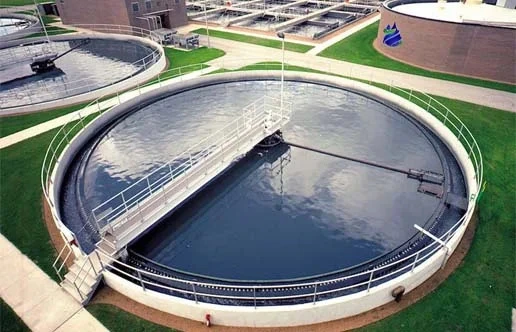
Discover the essential role of sewage treatment plant suppliers in India in maintaining public health and environmental integrity. This blog delves into the stages of sewage treatment, the impact of these plants on the environment, and the regulations ensuring their safe operation. Learn about the common challenges faced by these plants and how expert suppliers provide cutting-edge solutions to address them.

How ETPs and STPs conserve water, energy, and nutrients in India, with real recovery data, and the large untapped potential still being missed.

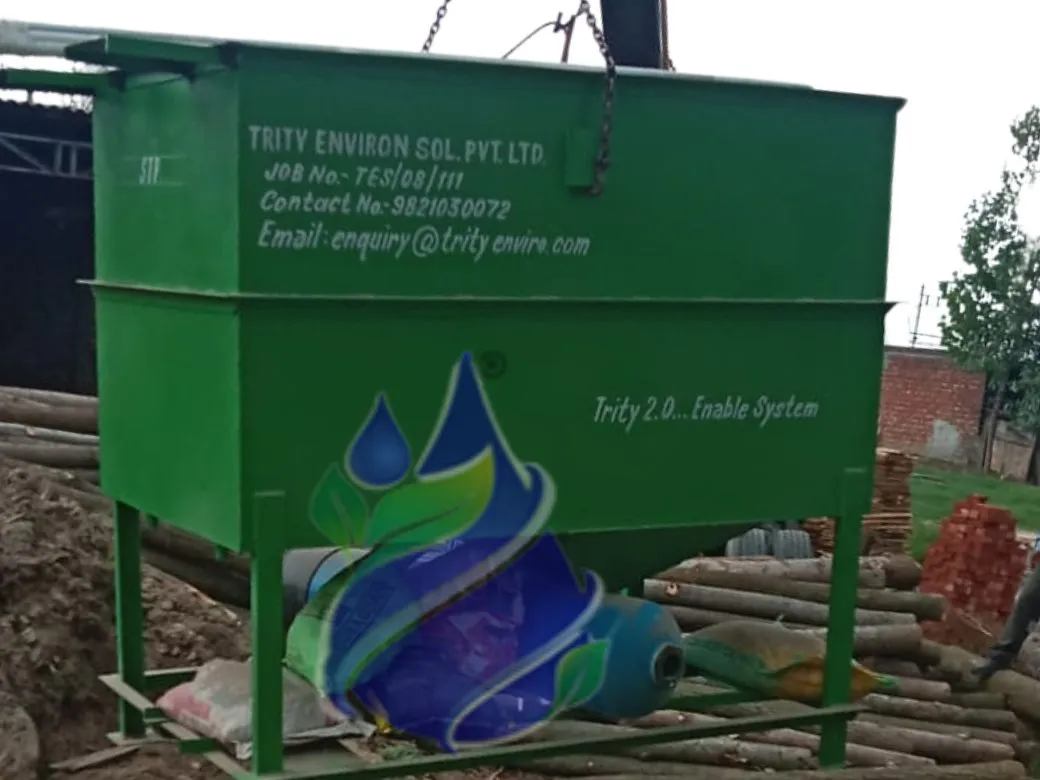



Discuss your requirements with our engineering team and get practical guidance for your project.