
Vertical Farming and Wastewater Reuse: A Hidden Partnership
Discover how vertical farming and wastewater reuse unite to boost food security, conserve water, and enable sustainable agriculture in urban areas.

 ISO 9001:2015 & QCI Approved
A practical engineering guide to laundry wastewater treatment for denim wash units, garment processors and industrial laundries in India, from lint screens to UF and RO reuse.
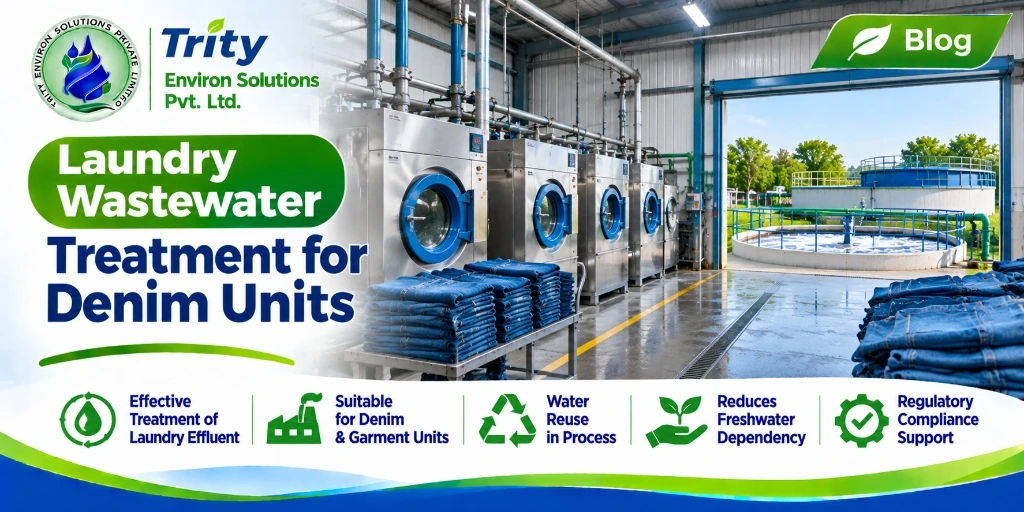
A denim washing unit looks like a simple operation: load jeans, add chemicals, rinse, repeat. The effluent is not simple. It carries lint, enzymes, bleach, dyes, softeners and detergents in rapid batches, and the flow, colour and pH change every few minutes. An ETP designed for steady flow gets overwhelmed within weeks.
This guide sets out how to approach laundry wastewater treatment for denim and garment units, and for industrial laundries that serve hotels and hospitals. It covers the effluent profile, a worked sizing example, the treatment train, colour and reuse, common faults and how to compare supplier proposals. Check discharge and reuse limits in your own consent, since these differ by state and by whether you discharge to a CETP, sewer or land.
Good design starts with a plain description of what comes out of each machine and how it changes through the day.
Denim wash lines use desizing enzymes and detergents, stone or enzyme wash, bleaching with hypochlorite or potassium permanganate, neutralising chemicals, fabric softeners and sometimes resin or pigment finishes. Each step adds a different load. Alkaline steps raise pH, bleach steps add oxidants that can harm biology, and rinse steps carry colour and fibres.
Salt and dissolved solids rise with every chemical, which matters if you plan to reuse water. Sulphur dyes can create sulphide, and indigo carries colour that survives ordinary biological treatment. Reported COD for textile and wash effluent usually falls in the hundreds to a few thousand mg/L depending on process, so analyse composite and peak samples from your own plant before sizing anything.
An industrial laundry serving hotels, hospitals and uniform contracts has a different profile. Detergent, surfactant and phosphate dominate, along with oil, grease and soil from linen, and the colour is less severe. Foaming is the usual problem, and hospital linen may call for disinfection and separate handling. Denim wash adds colour, abrasive fibres and chemical oxidants.
Many projects handle both: a garment factory with a wash house and an in-house laundry. Keep streams separate at source where you can. Strong bleach and dye streams can then be pretreated without overloading the whole plant, and low strength rinse water can be diverted for reuse. Our broader guide on ETP for the textile industry covers dyeing and processing units.
Start with a flow estimate from production, then size each stage. Batch discharge makes equalisation the most important tank on the site.
All inputs are assumptions for illustration. Replace them with your recipe data and meter readings.
Now reuse. Assume UF recovery of 90 percent and RO recovery of 75 percent on the polished effluent.
The 154 KLD of reject still needs a destination. That is where reuse plans often fail, and our article on RO reject water reuse explains the options.
First comes a fine screen or lint trap, preferably a rotating or step screen, with a basket per machine outlet to catch fibres and pumice. Without it, lint wraps around pumps and mixers. Next is the equalization tank with air mixing, which damps flow, pH and colour swings and lets you neutralise with acid or CO2 before the next step.
Then a physico-chemical treatment stage with coagulation, flocculation and settling or dissolved air flotation. The right coagulant depends on dye and pH, so run jar tests, and see our comparison of alum, PAC and ferric chloride. After that comes biological treatment, usually activated sludge or MBBR, as described on our biological effluent treatment plant page. Sludge goes to a filter press.
Cut the load at source before you buy more treatment. Counter-current rinsing, fewer rinse cycles, recipe changes that use enzymes in place of some chemicals, and ozone or laser finishing in place of part of the bleaching can reduce water use and colour. Every litre saved at the machine is a litre the ETP never has to treat, and it lowers the size of the RO and the reject stream. Ask your wash technologist to list water use per recipe, then rank recipes by litres per kg so the heaviest users are fixed first.
Keep chemical records, too. Treatment staff should receive the weekly list of chemicals used on the wash floor, because a new bleach, softener or dye can change how the ETP behaves within a day. A simple rule that no new chemical enters the line without telling the ETP team prevents many unexplained upsets.
Passing the BOD test is easy compared with removing colour and salt. These two decide whether reuse is practical.
Indigo and other dyes pass through biology unchanged, so colour removal needs a dedicated step. Options are chemical oxidation such as ozone or Fenton type processes, adsorption on activated carbon, or coagulation tuned to the dye. Each has trade-offs: oxidation adds operating cost and may need a quench, carbon needs regeneration or disposal, and heavy coagulant dosing adds sludge.
For reuse, follow the biology with filtration and ultrafiltration, then an RO water recycling plant. The final design depends on salt level. If you intend to move towards zero liquid discharge, the reject stream needs evaporation or another approved disposal route, which sets total cost. Treated water for rinse and wash steps needs low hardness and low iron so it does not stain cloth, so run a trial wash on reuse water before switching over.
Foaming in the aeration tank usually points to surfactants or a shock load, so reduce the load at source and check antifoam practice. Pale yellow or brown water leaving the clarifier points to colour carryover or low sludge age. Poor settling suggests filaments, low dissolved oxygen or high fibre carryover. Sudden pH or oxidant spikes from bleach rinses can kill the biology, so give the equalisation tank enough time and add a quench step for oxidants, such as a reducing agent, where required.
Keep a short daily log: flow, equalisation tank pH, aeration DO and MLSS, clarifier colour and sludge level, and filter press cake. Match each reading to the production shift, so that a bad day can be traced to a specific recipe or machine.
Plan for production growth. Denim and laundry units tend to add machines faster than they expand the ETP, so leave space, tank volume and electrical capacity for a second train.
The main drivers are design flow, how the plant handles peaks, the number of treatment stages, colour removal method, tertiary and RO scope, automation and the sludge system. Operating cost is made up of chemicals, power for aeration and pumping, manpower, membrane and carbon replacement, sludge disposal and the cost of dealing with reject. Compare proposals using total cost per cubic metre over several years, not only the capital figure, and ask each bidder to state its assumptions for dose, power and sludge.
Some supplier quotes include only a physico-chemical plant, while others include biology, tertiary and RO. Ask for a scope table in which every stage is listed, so quotes can be put side by side.
Review the scope and the AMC terms in writing before ordering. Trity Enviro engineers can work from your recipe sheets and wash machine list to build a design basis, and can compare competing proposals with you.
| Parameter / Stage | Target Optimal Range | Failure Impact / Risk | Corrective Engineering Action |
|---|---|---|---|
| Equalisation | About 6 hours of average flow, mixed, pH near neutral after dosing | Batch peaks upset coagulation and biology, colour surges reach the clarifier | Enlarge the tank, add mixing, install pH control and a level controlled feed |
| Coagulation | Dose set by jar test, pH set for the chosen coagulant | Weak floc, colour carryover, excess sludge | Repeat jar tests with each recipe change, adjust pH and polymer dose |
| Aeration | DO near 2 mg/L, MLSS held steady | Foaming, bulking, poor COD removal | Clean diffusers, control sludge age, reduce surfactant load at source |
| Reuse water | Low colour, hardness and iron, RO permeate TDS suited to rinse | Stained garments, rejected lots, membrane fouling | Add UF and carbon, trial wash before full use, monitor SDI and conductivity |
Always check discharge and reuse limits against your own consent to operate. Treat the sizing example as a template and replace each assumed value with your own recipe data and meter readings.
Trity Environ Solutions is an ISO 9001:2015 certified and QCI-approved ETP manufacturer and supplier in India, delivering robust, high-efficiency systems engineered for CPCB and SPCB regulatory compliance.
Every installation is supported by pan-India Annual Maintenance Contract and Operation and Maintenance services.
Speak directly with our senior environmental engineers for technical guidance, sizing calculations, or a tailored project proposal.
Call +91-9821030072 or email enquiry@trityenviro.com
Discover how vertical farming and wastewater reuse unite to boost food security, conserve water, and enable sustainable agriculture in urban areas.
Learn what retention time in wastewater treatment means, how HRT and SRT are calculated, ideal values for STP and ETP, and how wrong retention time affects plant performance.

Empower communities with sustainable wastewater solutions. Learn how local participation boosts efficiency, education, and environmental care











Discuss your requirements with our engineering team and get practical guidance for your project.

