ISO 9001:2015 & QCI Approved
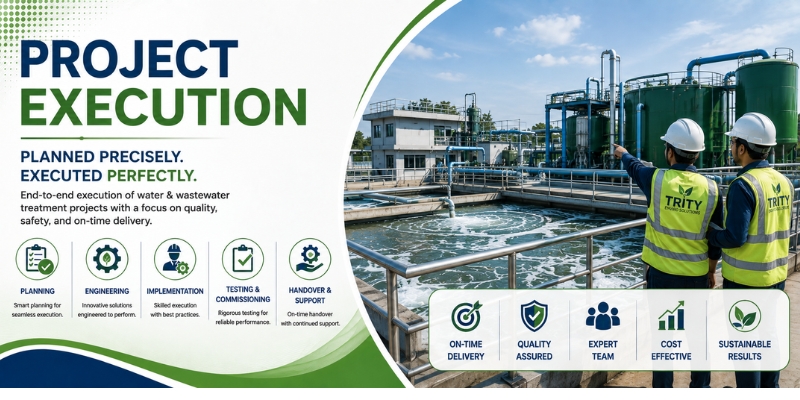
Project Execution
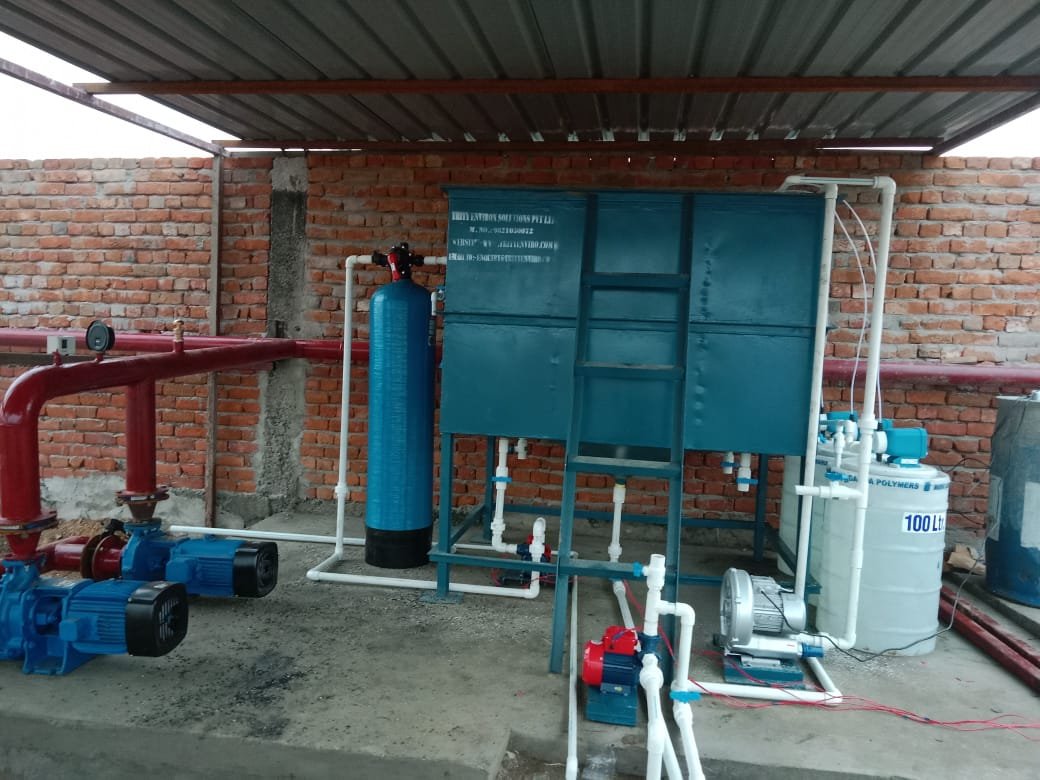
Trity Enviro handles turnkey wastewater treatment projects end-to-end, from site assessment and process design through fabrication, installation, and commissioning.
Why Coordination Gaps Are the Real Project Risk
Most delays and cost overruns on a wastewater treatment project don't come from a single bad decision, they come from the handoffs between separate vendors: the design consultant who specified a chamber volume the civil contractor built differently, the equipment supplier who delivered a blower sized for a different assumption than what the installer expected, the electrical contractor who wired a control panel before final process parameters were confirmed. Each handoff is a place where information gets lost or reinterpreted. Trity Environ Solution's project execution approach exists specifically to remove those gaps, by keeping design, fabrication, installation, and commissioning inside one accountable team rather than stitched together across vendors who never talk to each other directly.
What Our Project Execution Covers
- Site assessment and requirement study: understanding actual flow rates, effluent or sewage characteristics, available footprint, and site-specific constraints before any design work starts, rather than designing to a generic template and adjusting later
- Process design and engineering: selecting the treatment technology and sizing the system to the site's real conditions, with margins that account for future capacity growth rather than just current load
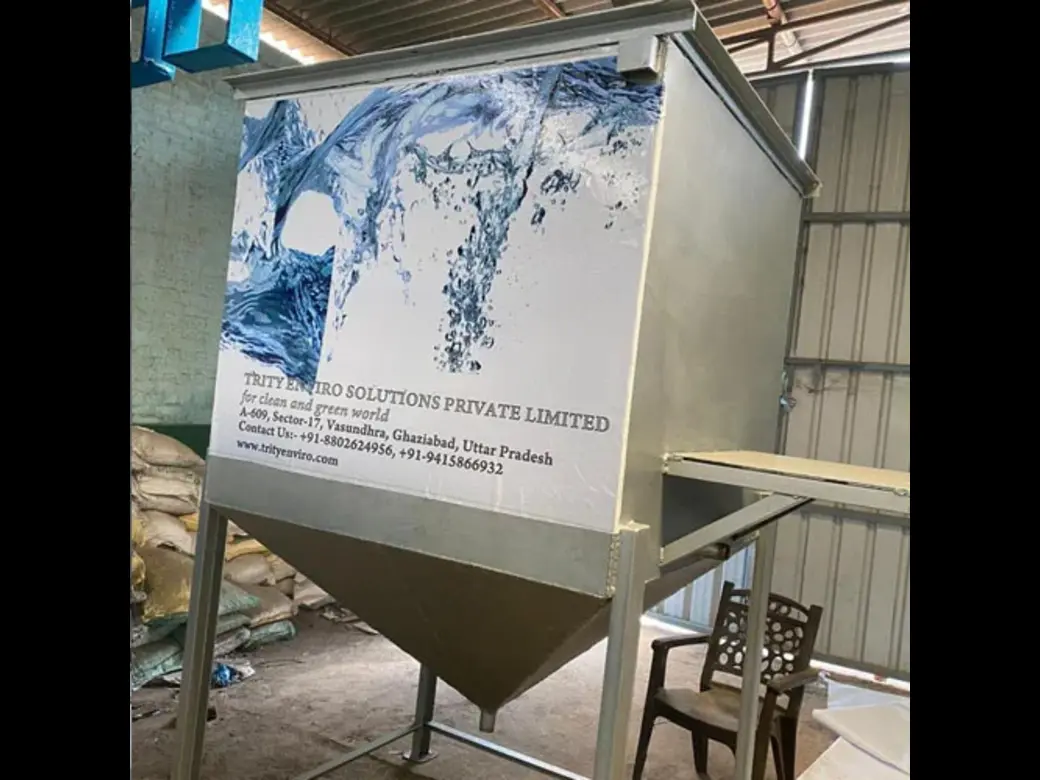
- Fabrication: manufacturing FRP vessels, tanks, and mechanical components under our own quality control, so what gets delivered to site matches what was engineered, not a field-adjusted approximation of it
- Civil coordination: working directly with civil contractors using our own drawings, so foundation and chamber work matches the equipment that will actually go into it
- Installation and electrical work: mechanical assembly, piping, and control panel installation, handled by teams who understand the process design, not subcontracted out to whoever was available
- Commissioning and performance verification: startup, biological seeding where applicable, and performance testing against the design parameters before handover
- Documentation and handover: operation manuals, as-built drawings, and warranty documentation delivered as one complete package, not scattered across multiple vendor invoices
Where Turnkey Execution Actually Saves Time and Cost
The value of single-vendor execution shows up most clearly at the points where multi-vendor projects typically lose time: when a design change is needed mid-project, one team can adjust across engineering, fabrication, and installation without a change order bouncing between three separate companies. When something doesn't perform as expected at commissioning, there's no ambiguity about which vendor is responsible for the fix, because the same team designed, built, and installed it. This doesn't just save time, it removes the finger-pointing that often stalls a project in its final weeks, right when a client is under the most pressure to get the plant operational.
What a Fragmented Project Usually Looks Like
It's worth being specific about the failure pattern this is designed to avoid, since it's common enough to be predictable. A design consultant specifies a treatment configuration, an equipment supplier quotes and delivers components sized to their own reading of the spec, a civil contractor builds chambers based on drawings that may have been revised since the equipment order was placed, and an installer arrives to find the civil work doesn't quite match the equipment footprint. Each party did their piece correctly by their own brief, but nobody owned the whole picture, and the client ends up absorbing the cost and delay of reconciling it on-site. Turnkey execution removes this failure mode structurally, not by hoping the vendors coordinate better, but by making coordination unnecessary in the first place.
Why Trity Environ Solution for Project Execution
We execute projects this way because we manufacture the STP and ETP systems at the center of them, so design, fabrication, and installation are naturally under one roof rather than assembled from subcontractors for each project. Once a plant is commissioned, our Annual Maintenance Contract and Operation and Maintenance services continue with the same team's institutional knowledge of how that specific plant was built, rather than handing the client off to a separate service provider who's seeing the plant for the first time.
Frequently Asked Questions
What's the actual difference between hiring Trity for turnkey execution versus separate vendors?
With separate vendors, you're managing the coordination between design, fabrication, civil work, and installation yourself, or paying a project management consultant to do it. With turnkey execution, one team is accountable for the whole sequence, which removes the handoff points where miscommunication typically causes delays or rework.
Can you take over a project partway through if it was started with another vendor?
Often yes, though it depends on how the project was structured up to that point. We'd need to assess what's already been built or specified before confirming we can integrate it into a coherent execution plan rather than starting over.
How do you handle design changes once fabrication has started?
Because engineering, fabrication, and installation sit within the same team, a design change can be evaluated and adjusted for across all three stages directly, rather than routed through separate change-order processes with multiple vendors.
Does turnkey execution cost more than sourcing design, equipment, and installation separately?
Not typically on a total project basis. Coordination failures between separate vendors are a common source of rework and delay costs that don't show up on the initial quote but do show up in the final project timeline and budget.
Scope Highlights
Why Choose Trity Enviro Solutions?
Industry-certified environmental engineers delivering compliant, high-efficiency turnkey systems across India.
100% SPCB/CPCB Compliance
Complete regulatory clearance & legal liaison support.
Certified Engineers
Over a decade of industrial wastewater expertise.
Turnkey Execution
End-to-end design, fabrication, setup & commissioning.
Pan-India AMC & Service
24/7 technical hotline, scheduled visits & spare parts.
Frequently Asked Questions
Q1. What is a MBBR Media?
Moving bed biofilm reactor (MBBR) is a type of wastewater treatment process that was first invented by Prof. Hallvard Ødegaard at Norwegian University of Science and Technology in the late 1980s. For more detail call us on 8802624956
Q2. What is a digester tank?
The wet anaerobic digestion process is applied to liquid waste streams that are conveyable by liquid pumping. Sometimes wet systems are called Low Solids AD (LSAD). The Wet AD process can be done in reactors of two main configurations, continuously stirred tank reactors (CSTR) and plug flow reactors.
Q3. Which air pollutant is produced in anaerobic decomposition of organic matter?
Methane is the largest natural source of hydrocarbons. It's produced by the anaerobic decomposition of organic matter in bodies of water. -Trees and plants produce most of the remaining natural VOC's called terpenes. Volatile Organic Compounds - VOCs -Petroleum is the key source of man-made VOC pollution.
Q4. What is a sewage treatment plant?
The Sewage Treatment Plant process is similar to the way that a Septic Tank works but mechanical components provide a process to help break down solids to produce a cleaner, more environmentally friendly effluent.
Q5. What is the tertiary treatment of sewage?
Tertiary treatment is the final cleaning process that improves wastewater quality before it is reused, recycled or discharged to the environment. The treatment removes remaining inorganic compounds, and substances, such as the nitrogen and phosphorus.
Related Service Solutions
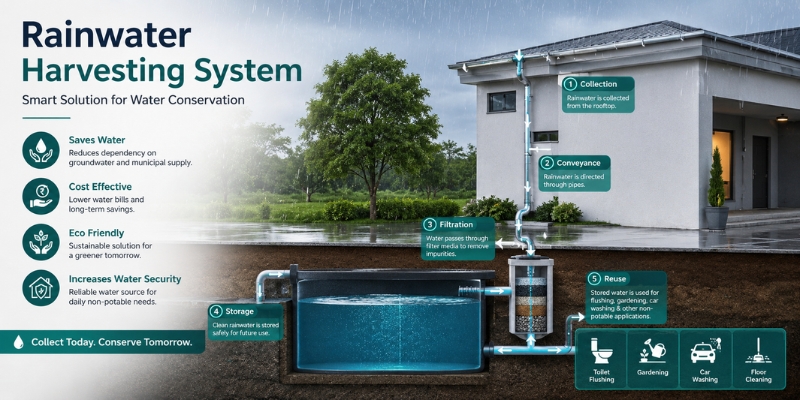
Rainwater Harvesting System

Technical Assistance on Web
Consent to Establishment
Related Industry Insights
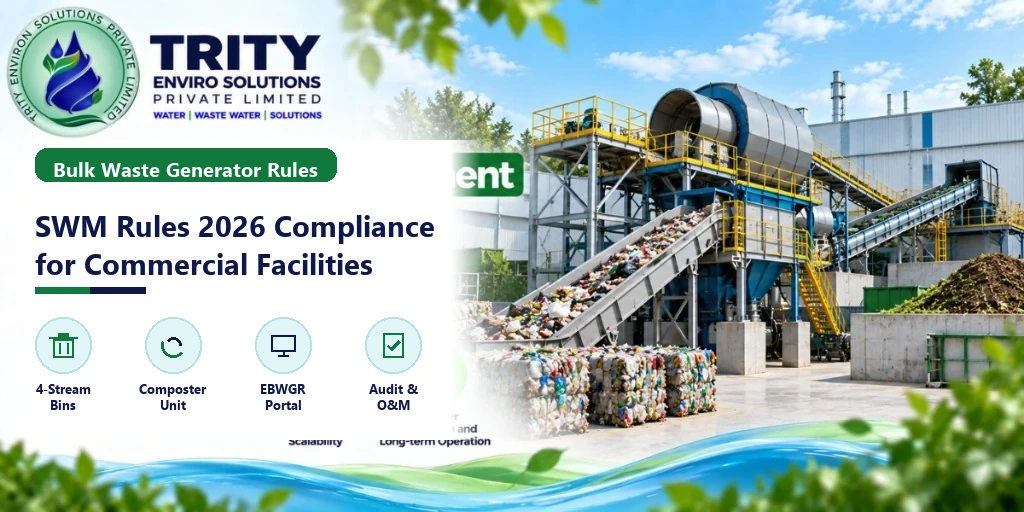
Bulk Waste Generator Compliance Under India's SWM Rules 2026: What Businesses Need to Set Up
A practical checklist for bulk waste generators under SWM Rules 2026: registration, four-stream segregation, on-site processing, EBWGR certificates and records.
Read Article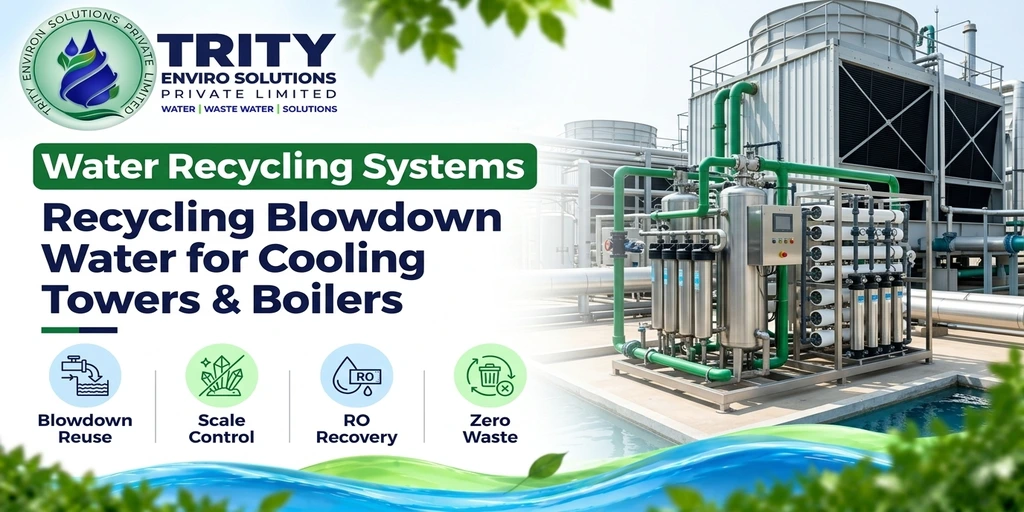
How to Design a Water Recycling System for Cooling Towers and Industrial Process Water
Design a water recycling system for cooling towers and process water: water balance, cycles of concentration, treatment train and payback, with an example.
Read Article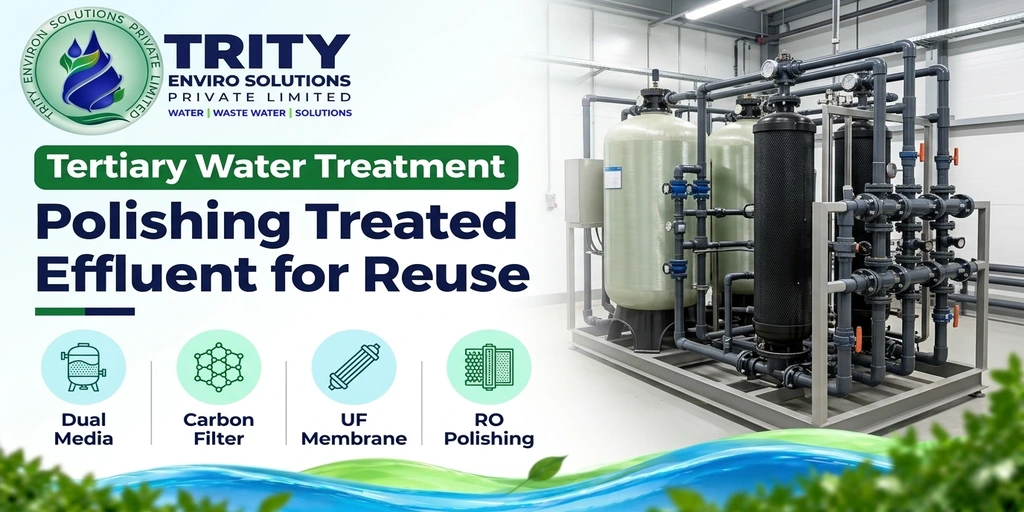
Tertiary Water Treatment for Industrial Reuse: When Filtration Alone Is Not Enough
Is filtration enough to reuse treated wastewater? Learn when you need UF, RO, softening or disinfection, and how to match tertiary treatment to each reuse.
Read ArticleFeatured Turnkey Installations

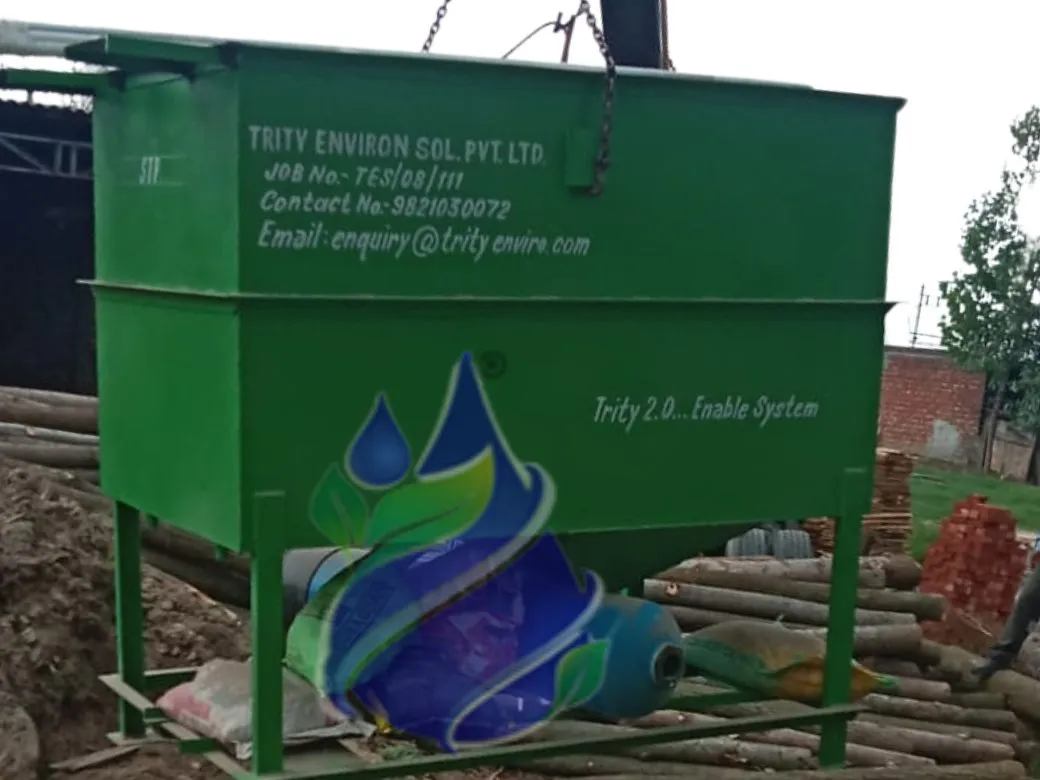
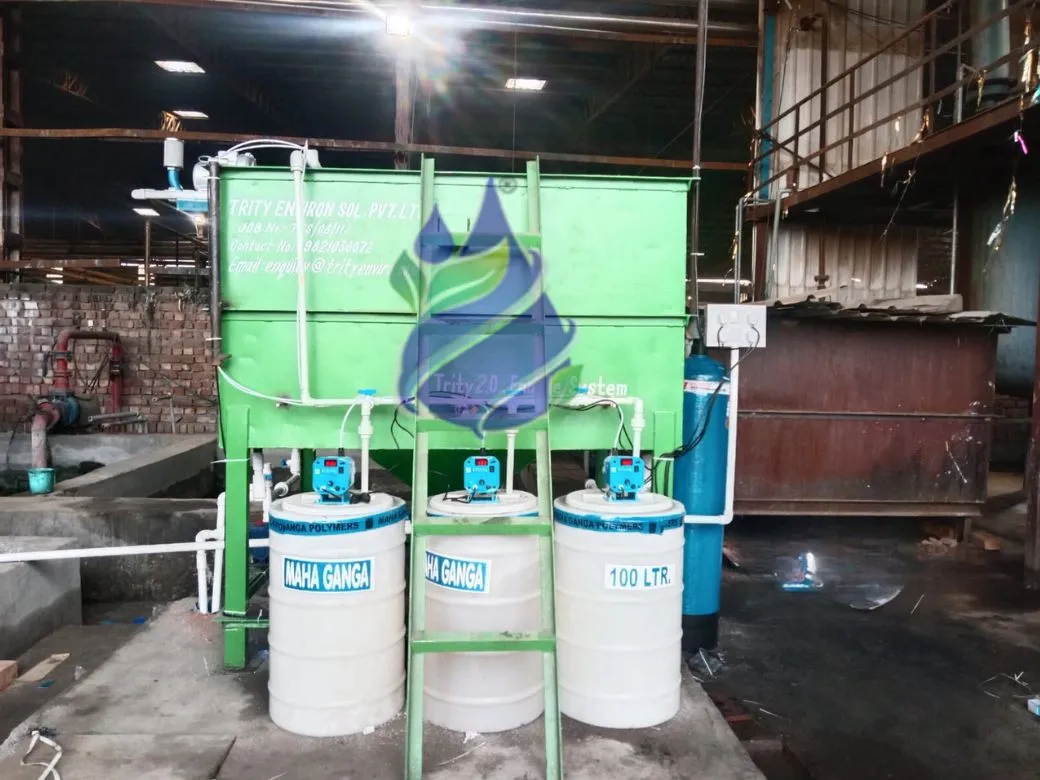



Need Expert Support for Your Water Treatment Project?
From regulatory compliance to turnkey engineering and O&M, our certified environmental engineers are ready to assist.